Our Top Picks
A wedding moves fast. The ceremony lasts twenty minutes, the light changes every few seconds, and the couple walks down the aisle exactly once. A tripod would steady every frame, but most venues ban tripods outright, and even where they are allowed, three legs take up too much floor space in a crowded room. A monopod solves that problem. One leg gives your arms a rest, steadies a long lens, and folds small enough to carry all day, yet it stays out of the way.
This guide compares five monopods that suit wedding work.
As an Amazon Associate, we earn from qualifying purchases.
Why a Monopod Belongs at a Wedding
Wedding photography is a long day of standing, walking, and waiting. A ceremony runs in dim light, a reception runs in mixed light, and a dance floor runs in near darkness. A monopod takes the weight off your arms and turns a shaky handheld frame into a steady one, without the footprint of a tripod.
Venues are the other reason. Churches, chapels, barns, and hotel ballrooms often ban tripods because three legs block aisles and trip guests. A monopod stands in a small circle of floor. It also helps you move: lift it, walk ten steps, and plant it again in seconds.
Be honest about what a monopod cannot do. It steadies handheld shots, but it cannot replace a tripod for long exposures. A monopod still leans on your hands, so a thirty-second exposure of a sparkler exit will blur. For those rare shots, use a tripod, a wall, or a ledge.
What to Look for in a Wedding Monopod
Weight comes first. You will carry the monopod for ten hours or more, often with a camera already in your hands. A carbon fiber pole under 1.5 pounds disappears on your shoulder. An aluminum pole weighs a little more, but it costs less and survives knocks better.
Folded length comes second. A monopod that folds to 15 inches slips into a camera bag. One that folds to 27 inches needs its own strap or a long bag.
Load capacity comes third, and it needs care. Listings quote a maximum load, but that number is not always the safe working load. One monopod in this guide lists 22 pounds on its Amazon page while the maker datasheet lists 5 kilograms as the safe working load. We use the datasheet number.
Grip and locks come fourth. Flip locks open and close fast, which helps when the couple moves and you need to change height in a second. Twist locks are slimmer and quieter, which helps during vows. Height comes fifth: a monopod should reach your eye level without forcing you to bend. A folding base is a bonus, not a requirement, and you should never walk away from a camera balanced on one.
SIRUI P-326 Carbon Fiber Monopod
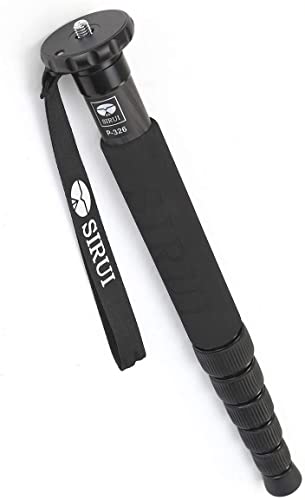
The SIRUI P-326 is the lightest monopod in this guide, and the easiest to carry all day. Six carbon fiber sections fold down to just 15 inches, so it slips into a camera bag beside a spare lens. At 400 grams, it weighs less than a small prime lens.
The P-326 extends to 60.6 inches, which suits most shooters at eye level. Its reversible mounting screw fits both 1/4 inch and 3/8 inch threads, so it takes a camera directly or a small ball head. Twist locks adjust quietly during a ceremony. The trade-off is height and speed: at 60.6 inches, very tall photographers may bend slightly, twist locks are slower than flip locks, and the head is sold separately.
Specs
- Material: carbon fiber; Sections: 6; Max height: 60.6 in; Folded length: 15 in; Weight: 400 g (0.88 lb); Load: 22 lb; Mount: reversible 1/4 in and 3/8 in screw; Wrist strap included; Head sold separately.
Manfrotto XPRO Carbon Fiber Monopod

The Manfrotto XPRO Carbon Fiber Monopod is the professional pick in this guide. Its model number is MPMXPROC4US, and it is the carbon version of the XPRO line, not the aluminum version. Four carbon fiber sections reach 64.76 inches, which gives tall photographers a comfortable eye-level height, and the Quick Power Lock system lets you change height in a second with one hand.
The XPRO weighs 1.3 pounds and folds to 20.47 inches. Its D-shaped tube stops the sections from rotating as you adjust height, so the monopod feels solid. A rubber leg warmer gives your hand a warm grip in a cold church, and the pole is rated to carry 20 kilograms, which covers any wedding camera and lens combination with room to spare. The trade-off is bulk: at 20.47 inches folded, it needs a longer bag or a shoulder strap, and it ships without a head.
Specs
- Model: MPMXPROC4US; Material: carbon fiber; Sections: 4; Max height: 64.76 in; Folded length: 20.47 in; Weight: 1.3 lb; Load: 20 kg; Lock: Quick Power Lock; Rubber leg warmer; FLUIDTECH base compatible (sold separately); Head sold separately.
iFootage Cobra 3 C180F Monopod
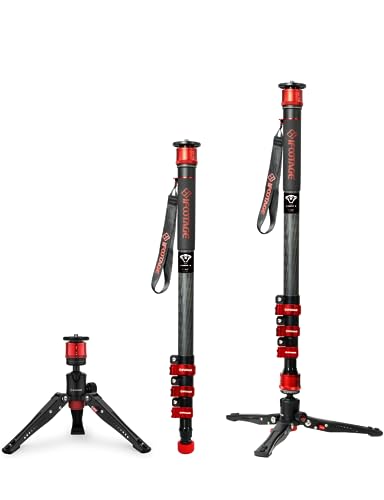
The iFootage Cobra 3 C180F is the tallest monopod in this guide, reaching 71 inches. That height suits tall photographers and lets you shoot over a crowd during a ceremony or a first dance. Four carbon fiber sections fold to 27 inches, and the pole weighs 1.13 kilograms. Flip locks make height changes fast, which helps when the couple moves from the aisle to the garden in a single minute.
The Cobra 3 stands out because of its folding tripod base. The base splays out into three small feet, so the monopod can stand on its own for a moment while you change a lens or check a setting. Be clear about this: the base is a convenience, not a tripod. The trade-off is size and weight: at 27 inches folded, it needs its own carry strap.
Specs
- Model: CB3 C180F; Material: carbon fiber; Sections: 4; Max height: 71 in (180 cm); Folded length: 27 in; Weight: 1.13 kg; Load: 10 kg; Folding tripod base included; Flip locks.
Manfrotto 290 Carbon Fiber Monopod

The Manfrotto 290 Carbon Fiber Monopod is the classic workhorse of this guide. Its model number is MM290C4US. Four carbon fiber sections reach 59.4 inches and fold to 19.29 inches, and the pole weighs just 1.1 pounds. Rubber leg warmers and a wrist strap make it comfortable to hold for hours, and the D-shaped tube keeps the sections from twisting as you adjust height.
Load capacity needs an honest note here. The Amazon listing quotes 22 pounds, but the Manfrotto datasheet lists 5 kilograms as the safe working load. This guide uses 5 kilograms, because the datasheet is the maker own figure for safe daily use, and a wedding is the wrong day to trust an optimistic listing. The trade-off is height: at 59.4 inches, it is the shortest monopod here, so very tall photographers will bend slightly, and it ships without a head or a folding base.
Specs
- Model: MM290C4US; Material: carbon fiber; Sections: 4; Max height: 59.4 in; Folded length: 19.29 in; Weight: 1.1 lb; Safe working load: 5 kg per Manfrotto datasheet (Amazon listing quotes 22 lb); Flip locks; Rubber leg warmers; Wrist strap; Head sold separately.
NEEWER T222 Monopod
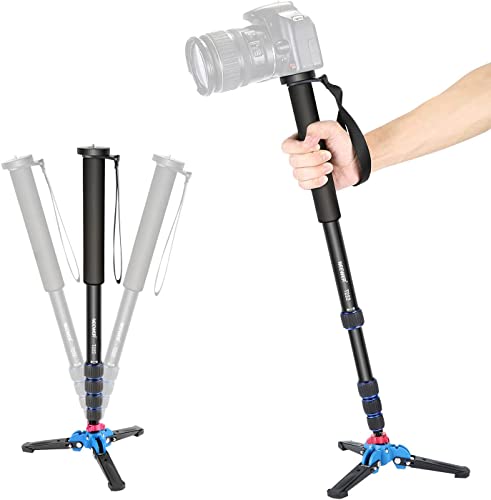
The NEEWER T222 is the value pick in this guide, and the only aluminum monopod here. Five sections reach 66 inches and fold to 20.5 inches, and the pole weighs 1.3 pounds. A detachable folding base comes in the box, so the monopod can stand on its own for a moment while you change a lens, and the base removes when you want a lighter pole. The mounting screw reverses between 1/4 inch and 3/8 inch threads.
Aluminum has honest trade-offs against carbon fiber. It costs less, and it survives knocks and drops better, which matters in crowded rooms and tight church aisles. But aluminum feels cold in winter, and it transmits more vibration than carbon fiber, so you need a steadier hand at slow shutter speeds. The T222 is rated to carry 5 kilograms, which covers a full-frame camera with a 70-200mm lens.
Specs
- Model: T222; Material: aluminum alloy; Sections: 5; Max height: 66 in; Folded length: 20.5 in; Weight: 1.3 lb; Load: 5 kg; Detachable folding tripod base included; Mounting screw reversible 1/4 in to 3/8 in.
How the Five Monopods Compare
The lightest pick is the SIRUI P-326 at 400 grams, and the tallest is the iFootage Cobra 3 C180F at 71 inches. The Manfrotto XPRO sits in the middle on weight and near the top on height, with the fastest locks in the guide. The Manfrotto 290 is the lightest Manfrotto here and the shortest, while the NEEWER T222 offers the tallest reach per dollar with a folding base in the box.
Load capacity is honest across the guide. The XPRO carries 20 kilograms, the Cobra 3 carries 10 kilograms, and the 290 and the T222 each carry 5 kilograms as a safe working load. The P-326 lists 22 pounds. Every pick here holds a full-frame camera with a 70-200mm lens, which is the heaviest kit most wedding photographers use.
Wedding Shooting Tips
Arrive early and walk the venue before the guests do. Find where the light falls during the ceremony, where the couple will stand, and where you can plant a monopod without blocking an aisle.
Set the height before the moment begins. A monopod set too low forces you to bend, and one set too high forces you to reach. Both make your arms tired and your frames crooked. Set it once, lock it, and leave it alone until the scene changes.
Lean into the pole. A monopod works best when you press it gently into the floor and lean your body into it, forming a triangle with your two feet and the single leg.
Check the venue rules before the day, and keep spare batteries warm in an inside pocket. Practice opening and closing the locks at home until the motion is smooth and silent.
Which One to Choose
Pick the SIRUI P-326 if you want the lightest kit possible and you travel with a small bag. It folds to 15 inches, weighs 400 grams, and carries a full-frame camera with a 70-200mm lens.
Pick the Manfrotto XPRO Carbon Fiber if you want the most professional tool in this guide. It reaches 64.76 inches, locks in a second with Quick Power Lock, and carries 20 kilograms.
Pick the iFootage Cobra 3 C180F if you want the tallest reach and a folding base. At 71 inches, it shoots over a crowd, and the base lets it stand for a moment while you change a lens.
Pick the Manfrotto 290 Carbon Fiber if you want a light, rigid, no-fuss monopod with a long track record. It weighs 1.1 pounds, folds to 19.29 inches, and carries 5 kilograms as a safe working load.
Pick the NEEWER T222 if you want the best value. It reaches 66 inches, includes a detachable folding base, and carries 5 kilograms.
Is a monopod allowed at most weddings?
It depends on the venue, not on the couple. Many churches and hotels ban tripods but allow a monopod, because one leg takes up far less floor space. Always ask the venue coordinator before the day, and bring a plan for shooting handheld if the answer is no.
Can a monopod replace a tripod for wedding photos?
No, not for everything. A monopod steadies handheld shots and takes the weight off your arms, which covers most of a wedding day. But it cannot hold a long exposure steady the way three legs can. For sparkler exits and other long exposures, use a tripod, a wall, or a ledge.
What load capacity do I need for a wedding monopod?
Match the monopod to your heaviest camera and lens, then leave some margin. A full-frame camera with a 70-200mm lens weighs around 2.5 kilograms, so a monopod rated for 5 kilograms as a safe working load covers it comfortably.
Should I use a ball head with a wedding monopod?
Yes, a small ball head makes framing much easier. It lets you tilt the camera for vertical portraits and level the horizon without moving the pole. The three monopods in this guide that ship without a head all accept a standard ball head.
More from Amazon
Programs that pair well with the guide above. Offers and eligibility are set by Amazon and may change.
Free shipping on eligible items, Prime Video and more. Eligible new members can start with a free trial.
Start a Prime free trialAudiobooks and podcasts to listen to on the go. Eligible new members can start with a free trial.
Try Audible freeAd-free music streaming. Eligible new subscribers can start with a free trial.
Try Music Unlimited freeA free business account with business pricing and bulk-buying tools for work, shop or home office.
Create a business accountAs an Amazon Associate we earn from qualifying purchases.