Our Top Picks
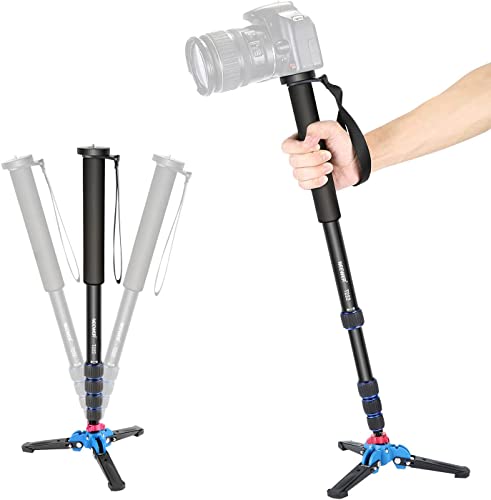
Skiing photography is fast and cold. Racers pass in seconds and light shifts by the minute. A tripod is too slow beside a race course and too bulky in a lift queue, while handheld shooting tires arms and drifts frames. A monopod sits in the middle: one leg, one quick plant in the snow, and a camera that stays level while you track a skier through a turn.
A good monopod for skiing must fold short enough to strap to a pack, extend tall enough for eye-level shooting in deep snow, and keep working when locks freeze. It must hold a full-frame body with a telephoto lens without flexing, and plant firmly on snow, ice, and slush.
As an Amazon Associate, we earn from qualifying purchases.
Why a Monopod Works for Skiing Photography
A monopod gives you a pivot point. Plant the foot, lean the pole slightly toward you, and pan with your hips while the camera stays at a fixed height. The result is smoother tracking and sharper frames at slower shutter speeds than handheld, especially with a long lens.
It is also fast. A monopod deploys in a couple of seconds: pull it from a pack strap, flick the locks open, and plant it. When the light changes, you can shift position without breaking down a tripod, and when the session ends the pole folds down and rides home on the pack.
Cold is the hidden test. Metal locks get stiff and twist locks slip with gloved hands, while carbon fiber stays warmer to the touch. That is why four of the five monopods here use carbon fiber.
What to Look for in a Skiing Monopod
Portability comes first. A monopod that folds to 15 inches slips into a pack side pocket, while one that folds to 27 inches rides on the outside of a pack and can catch on lift gates.
Stability on snow comes second. A monopod is only as steady as its foot: a spiked foot bites into packed snow and ice, a rubber foot grips wet floors and rock, and a small folding base adds a third point of contact on flat ground. On soft powder, plant the pole deep and lean it slightly toward you.
Load capacity comes third, and here you must read carefully: listings sometimes quote a higher number than the maker sheet. The Manfrotto 290 is the clear example, with the Amazon listing quoting 22 lb while the Manfrotto datasheet gives 5 kg. We use 5 kg as the safe working load. A full-frame body with a 70-200mm lens weighs around 2 kg, so 5 kg leaves a comfortable margin, but a 400mm lens with a gripped body needs a pole rated higher.
Cold-weather handling comes fourth. Flip locks open with a flick of a gloved thumb, while twist locks need a firm grip that thick gloves make awkward. A wrist strap helps too, because dropping a pole in deep snow can end a shoot.
1. Sirui P-326 Carbon Fiber Monopod
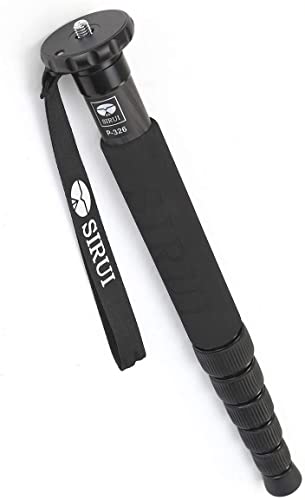
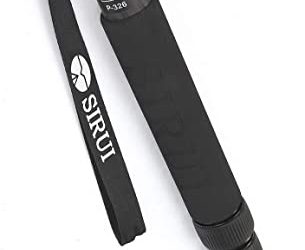
The Sirui P-326 is the lightest pole in this guide and the easiest to forget you are carrying. Six carbon fiber sections fold down to 15 inches and weigh about 400 g, yet the pole extends to 60.6 inches and carries up to 22 lb. That makes it the natural pick for photographers who hike to a viewpoint and shoot all day.
Carbon fiber is the right material for cold work: it stays warmer than aluminum, does not flex in the cold, and shrugs off snow and slush. The twist locks are silicone coated, which helps with gloved hands, and a wrist strap keeps the pole attached to your hand on a lift.
The head is sold separately, so you will need a small ball head or a tilt head to aim the camera. That simplicity is the point: fewer parts to freeze, fewer parts to fail.
Specs
- Carbon fiber, 6 sections, 60.6 in maximum height, 15 in folded length, 400 g weight, 22 lb load capacity, reversible 1/4 in and 3/8 in mounting screw, wrist strap included, head sold separately
2. Manfrotto XPRO Carbon Fiber Monopod

The Manfrotto XPRO carbon fiber monopod is the tallest pole in this guide, reaching 64.76 inches, which matters when you shoot from deep snow or looking up at a jump. Four carbon fiber sections fold to 20.47 inches and weigh just 1.3 lb, so the pole still packs easily on a ski pack.
The D-shaped tubes resist twisting, which keeps the camera from rotating when you pan, and the flip locks open fast with gloved hands. The pole is compatible with the Manfrotto full fluid base, so you can turn it into a fluid video support later.
Note that the listing for this ASIN shows the carbon fiber XPRO model MPMXPROC4US, not the aluminum video version with the built-in fluid head. For maximum height and a pole that will last for years, the XPRO is a strong choice.
Specs
- Carbon fiber, 4 sections, 64.76 in maximum height, 20.47 in folded length, 1.3 lb weight, model MPMXPROC4US, D-shaped anti-twist tubes, flip locks, compatible with Manfrotto full fluid base, 1/4 in and 3/8 in mount
3. iFootage Cobra 3 C180F Monopod
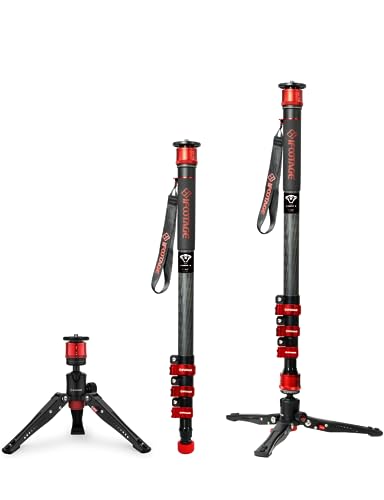
The iFootage Cobra 3 C180F is the most versatile monopod in this guide, and the only one that arrives with a tripod base in the box. The base folds out to give the pole a third point of contact on flat ground, which helps when you set up beside a race course and want to let go of the pole between runs. Four carbon fiber sections extend to 71 inches, the tallest reach here, and fold to 27 inches.
At 1.13 kg the Cobra 3 is heavier than the two poles above it, but the weight buys capability: the rated load is 10 kg, enough for a full-frame body with a long telephoto lens and a head. Flip locks make height changes fast, even with gloves, and the base detaches for hiking or swaps for a spike foot on snow and ice.
For a photographer who shoots both stills and video on the mountain, the Cobra 3 is the most complete package: the base lets you frame a shot and step back, and the tall reach keeps the camera at eye level in deep snow.
Specs
- Carbon fiber, 4 sections, 71 in (180 cm) maximum height, 27 in folded length, 1.13 kg weight, 10 kg (22.05 lb) load capacity, tripod base included, flip locks, model CB3 C180F
4. Manfrotto 290 Carbon Fiber Monopod

The Manfrotto 290 is the classic lightweight carbon monopod: simple, tough, and easy to carry. Four carbon fiber sections extend to 59.4 inches and fold to 19.29 inches, and the whole pole weighs just 1.1 lb. Rubber leg warmers give a warm grip in the cold, and a wrist strap keeps the pole secure on a lift.
Here is the honest load note. The Amazon listing quotes a 22 lb load, while the Manfrotto datasheet gives 5 kg, and we use 5 kg as the safe working load. A full-frame body with a 70-200mm lens weighs around 2 kg, so 5 kg still leaves a wide margin. If you plan to mount a 400mm lens with a gripped body, choose a higher-rated pole from this guide instead.
The 290 has no head included, so pair it with a small ball head or a tilt head. Its D-shaped tubes resist twisting, and the flip locks work well with gloves.
Specs
- Carbon fiber, 4 sections, 59.4 in maximum height, 19.29 in folded length, 1.1 lb weight, model MM290C4US, rubber leg warmers, wrist strap included, safe working load 5 kg per maker datasheet (listing quotes 22 lb), head sold separately
5. NEEWER T222 Monopod
The NEEWER T222 is the budget pick in this guide, and it earns its place with a feature the others lack at this level: a detachable folding stand base that turns the monopod into a small tripod on flat ground. The aluminum alloy pole extends from 20.5 inches to 66 inches in five sections, weighs 1.3 lb, and carries up to 5 kg. The base pans 360 degrees and tilts 15 degrees, which is handy for tracking a skier across a slope.
Aluminum is colder to hold than carbon fiber, so wear gloves and use the foam grip. The flip locks are glove friendly, and the mounting screw reverses between 1/4 inch and 3/8 inch. The base detaches for hiking, and a spike foot can take its place on snow and ice.
For a photographer who wants a base-equipped monopod without a premium outlay, the T222 is a sensible choice. It is heavier and colder than the carbon poles here, but the stand base and long reach make it genuinely useful slope-side.
Specs
- Aluminum alloy, 5 sections, 66 in (168 cm) maximum height, 20.5 in folded length, 1.3 lb weight, 5 kg (11 lb) load capacity, detachable folding stand base with 360-degree pan and 15-degree tilt, model T222, reversible 1/4 in and 3/8 in mounting screw
Which Monopod Fits Your Skiing Photography
If you hike to viewpoints and want the lightest pole that still holds a long lens, take the Sirui P-326. Its 15-inch folded length and 400 g weight disappear in a pack, and the 22 lb load handles a full-frame body with a telephoto lens.
If you want maximum height for shooting from deep snow, take the Manfrotto XPRO. Its 64.76-inch reach gives a tall, twist-free support, and it pairs with a fluid base if you add video later.
If you want one pole that does everything, take the iFootage Cobra 3 C180F. The tripod base, the 71-inch reach, and the 10 kg load make it the most complete package here.
If you want a light, proven carbon pole for a mid-range zoom, take the Manfrotto 290, and respect the 5 kg safe working load from the maker datasheet.
If you want a base-equipped monopod on a modest budget, take the NEEWER T222. The folding stand base and the 66-inch reach make it a practical slope-side tool.
Slope-Side Shooting Tips
Plant the foot before the skier arrives. Pick a spot with a clear view of the turn or the jump, plant the monopod foot in packed snow, and lean the pole slightly toward you.
Use a fast shutter for racing and a slower shutter with a smooth pan for a sense of speed. A monopod lets you drop to 1/250s or slower while tracking, blurring the background and keeping the skier sharp.
Keep spare batteries warm. Cold drains batteries fast, so carry spares in an inside pocket and swap them often. Wipe snow off the camera before you change a lens.
Pack the monopod the same way every time. Strap it to the outside of your pack with the foot down, so it does not catch on a lift gate. On a lift, hold the pole across your lap or clip it to your pack.
Final Verdict
A monopod matches the pace of the mountain: quick to deploy, easy to carry, and steady enough for long lenses. The Sirui P-326 is the lightest, the Manfrotto XPRO is the tallest, the iFootage Cobra 3 is the most versatile, the Manfrotto 290 is the proven classic, and the NEEWER T222 is the best value with a stand base. Choose by weight, height, and load, then get out and shoot.
One honest note before you head out: monopods are for slope-side and lodge-area use, not for carrying while skiing down. Strap the pole to your pack on the way down, keep your hands free for your ski poles, and set up again at the next viewpoint.
Can I use a monopod while skiing downhill?
No. A monopod is a slope-side support, not something to carry in your hands while you ski down. Strap it to the outside of your pack with the foot down, keep your hands free for your ski poles, and set up again at the next viewpoint.
Which monopod is best for a heavy telephoto lens?
The iFootage Cobra 3 C180F carries the highest rated load here at 10 kg, which handles a full-frame body with a long telephoto lens and a head. The Sirui P-326 is next at 22 lb. For the Manfrotto 290, use 5 kg as the safe working load from the maker datasheet, not the higher number on the listing.
Do monopods work on snow and ice?
Yes, with the right foot. A spiked foot bites into packed snow and ice, a rubber foot grips wet floors and rock, and a folding base adds stability on flat ground. On soft powder, plant the pole deep and lean it slightly toward you.
Are carbon fiber monopods better than aluminum in the cold?
Carbon fiber is the better cold-weather choice. It feels warmer to hold than bare aluminum, it does not flex in the cold, and it keeps its strength in freezing temperatures. Aluminum works fine too, especially with a foam grip and gloves.
More from Amazon
Programs that pair well with the guide above. Offers and eligibility are set by Amazon and may change.
Free shipping on eligible items, Prime Video and more. Eligible new members can start with a free trial.
Start a Prime free trialAudiobooks and podcasts to listen to on the go. Eligible new members can start with a free trial.
Try Audible freeAd-free music streaming. Eligible new subscribers can start with a free trial.
Try Music Unlimited freeA free business account with business pricing and bulk-buying tools for work, shop or home office.
Create a business accountAs an Amazon Associate we earn from qualifying purchases.