Key takeaways
- Hemlock is poisonous, so shoot it only from the path. These five monopods steady a long lens at the bank edge without blocking the way for others.
Hemlock grows tall along riverbanks and hedgerows, a pale green tower topped with flat clusters of tiny white flowers. Seen from the path on a still summer morning, it is one of the most photogenic plants in the British countryside. It is also one of the most dangerous. Every part of the plant is poisonous, and the only safe way to photograph it is from a path, with your feet on firm ground and your hands nowhere near the stems.
As an Amazon Associate, we earn from qualifying purchases.
That warning shapes everything in this guide. A monopod is a weak tool for hemlock photography, and this article says so plainly. The plant does not move, the light changes slowly, and the best pictures come from standing still at the edge of a stand and framing carefully. A monopod can steady a long lens while you wait for the wind to drop, and it can take the weight of a heavy camera and lens off your arms during a long session. If you do not already own a monopod, do not buy one only for hemlock. If you already own one, the five below are the ones worth carrying to the riverbank.
Hemlock on the Riverbank
Hemlock, Conium maculatum, belongs to the carrot family, Apiaceae. It grows in damp ground beside rivers, ditches, and field edges, and along the base of hedgerows where the soil stays moist through summer. A mature plant reaches two metres or more, with a smooth hollow stem marked by purple spots and blotches, finely divided fern-like leaves, and broad flat-topped clusters of small white flowers that open from June into August.
The plant favours the same ground that photographers love: open banks with a view across water, field margins with a hedge behind, and quiet lanes where the verge stays damp.
Photograph hemlock in the morning, when the air is still and the flower heads are lit from the side. Never step into a stand to find a better angle, and never push stems aside with your hands or with a lens hood.
A Poisonous Plant: Read This First
Hemlock is deadly poisonous. The whole plant contains coniine and related alkaloids, and the roots, stems, leaves, and seeds are all toxic. The danger is real, and it is not limited to eating the plant. Sap on broken skin can cause irritation, and the plant should never be handled, picked, or cut. Children and dogs should be kept on the path and away from the stems.
Photograph hemlock only from a path, a bridge, or a bank where you can stand without touching the plant. If a lens cap or a piece of kit falls into a stand, leave it there or retrieve it with a long stick from the path; never reach in with a bare hand.
Hemlock Is Not Chervil
Hemlock is often confused with chervil, and the confusion matters. Chervil, Anthriscus, is a smaller plant in the same family, Apiaceae, with delicate fern-like leaves and small white flowers. Chervil generic has been covered on this site in cameras form, and rough chervil has been covered in cameras form too, in different batches. Both are harmless plants of hedgerows and woodland edges. Hemlock is not.
The two plants differ in size and in detail. Hemlock is tall, often over two metres, with a thick smooth stem marked by purple spots. Chervil is much smaller, usually under a metre, with a slender stem that carries no purple spots and leaves that are finer and softer in outline. Hemlock flowers form broad flat-topped clusters, while chervil flowers form looser, smaller clusters on thin stalks.
What a Monopod Can and Cannot Do Here
A monopod is a single leg that steadies a camera and takes its weight. It is not a tripod, and it does not hold a camera on its own. For hemlock, that limitation matters more than usual. The plant grows in damp ground where a monopod foot can sink, and the best viewpoints are often on narrow paths where a tripod would block the way. A monopod fits that space: one leg, a small footprint, and a camera that can be lifted and moved in seconds.
What a monopod does well at the riverbank is hold a long lens steady while you wait. Hemlock flower heads move in the breeze, and a sharp picture needs a fast shutter or a moment of calm. A monopod takes the weight of a heavy lens off your arms, so you can hold a composition for minutes while the wind drops.
What a monopod cannot do is hold a camera still for a long exposure, support a camera while you step away, or give you a stable base on soft ground. On a muddy bank, a monopod foot sinks and the camera drifts. For hemlock, that means the monopod is a support for handheld work, not a substitute for a tripod. If your picture needs a long exposure or a precise composition held for minutes, use a tripod from the path instead.
Sirui P-326
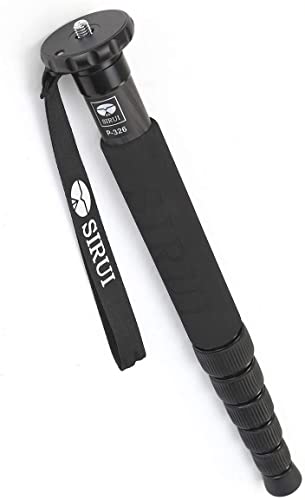
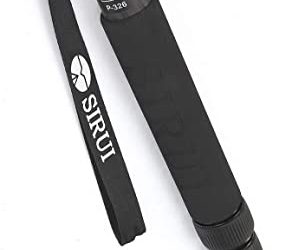
The Sirui P-326 is the lightest monopod in this guide, and the easiest to carry to a riverbank. It is a six-section carbon fibre pole that folds to 15 inches and extends to 60.6 inches, weighing 400 grams. The listed load is 22 lb. Twist locks hold each section, and the mounting plate reverses between a 1/4 inch and a 3/8 inch screw. A head is sold separately, and a wrist strap is included.
For hemlock, the P-326 suits a light mirrorless camera with a modest telephoto lens. Its low weight means it can be carried in a side pocket or strapped to a bag on a long walk along a river, and its six sections collapse small enough to stow when the path narrows. The trade-off is stability: six thin sections flex more than four thick ones, and a heavy lens will show that flex in the viewfinder. With a heavy full-frame camera and a long telephoto lens, it asks too much of its slim tubes.
Specs
- 6 sections, carbon fibre, 400 g, 60.6 in max, 15 in folded, 22 lb listed load, twist locks, reversible 1/4 in and 3/8 in screw, head sold separately
Manfrotto XPRO Carbon Monopod

The Manfrotto XPRO Carbon Monopod, model MPMXPROC4US, is the professional choice in this guide. It is a four-section carbon fibre monopod that extends to 64.76 inches and folds to 20.47 inches, weighing 1.3 lb. The listed load is 20 kg. Flip locks hold the four sections, the tubes are D-shaped to stop twisting, and a head is sold separately.
For hemlock, the XPRO Carbon suits a heavy camera and a long lens. Its four thick sections are stiffer than the six thin sections of the P-326, and its height reaches above a tall stand of hemlock when you need to shoot down onto flower heads from the path. The D-shaped tubes keep the camera from rotating as you pan, which matters when you are tracking a flower cluster in a breeze. The trade-off is bulk: at 1.3 lb and over 20 inches folded, it is a larger thing to carry on a long walk.
Specs
- 4 sections, carbon fibre, 1.3 lb, 64.76 in max, 20.47 in folded, 20 kg listed load, flip locks, D-shaped tubes, head sold separately
JOBY GorillaPod 3K PRO Stand

The JOBY GorillaPod 3K PRO Stand is the odd one in this guide, and it is here for a reason. It is not a pole at all. It is a flexible stand with anodised aluminium legs that bend and grip, standing 9.25 inches tall and weighing 9.6 ounces, holding up to 3 kg of camera and lens. A ball head is sold separately.
For hemlock, the GorillaPod suits low work from the path edge. Set it on a flat stone, a fence post, or a low wall beside a stand, and it holds a small camera steady at the level of the lower flower heads. Its flexible legs wrap around a fence rail or grip a rough surface, which a straight pole cannot do. The trade-off is obvious: at 9.25 inches tall, it cannot lift a camera to eye level, and it cannot support a heavy lens. It is a specialist tool for low angles and awkward perches, and it works best with a light mirrorless camera and a short lens.
Specs
- Flexible legs, anodised aluminium, 9.25 in tall, 9.6 oz, holds up to 3 kg, ball head sold separately
Manfrotto 290 Carbon Monopod

The Manfrotto 290 Carbon Monopod, model MM290C4US, is the balanced choice in this guide. It is a four-section carbon fibre monopod that extends to 59.4 inches and folds to 19.29 inches, weighing 1.1 lb. The datasheet gives a safe working load of 5 kg, which is lower than the 22 lb figure on some listings, and this guide uses the 5 kg figure. Flip locks hold the sections, rubber leg warmers give a secure grip, and a head is sold separately.
For hemlock, the 290 Carbon suits a mid-weight camera and lens, the kind of kit most photographers carry to a riverbank. Its four sections are stiff enough for a telephoto lens, its height reaches eye level for most users, and its weight is low enough to carry all morning. The rubber leg warmers matter on a damp bank, where cold carbon fibre can be hard to hold. The trade-off is reach: at 59.4 inches it is shorter than the XPRO Carbon, and a tall photographer shooting over a high stand may want the extra height.
Specs
- 4 sections, carbon fibre, 1.1 lb, 59.4 in max, 19.29 in folded, 5 kg safe working load from the datasheet, flip locks, rubber leg warmers, head sold separately
NEEWER T222
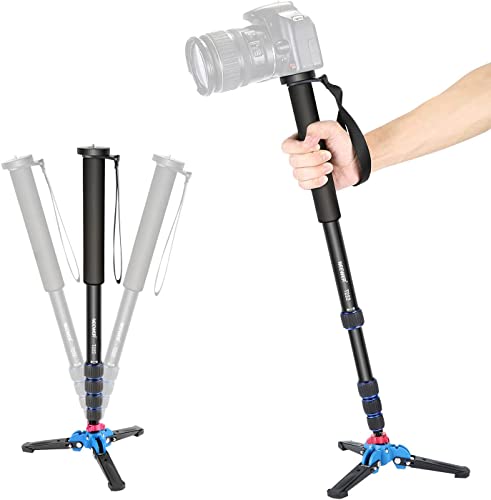
The NEEWER T222 is the most versatile monopod in this guide, and the most forgiving on soft ground. It is a five-section aluminium alloy monopod that extends to 66 inches and folds to 20.5 inches, weighing 1.3 lb, with a maximum load of 5 kg. It comes with a detachable foldable tripod base and a spike foot.
For hemlock, the T222 suits a photographer who works on muddy banks. Its 66 inch maximum height is the tallest in this guide, useful when a stand of hemlock rises above the path and the flower heads need a high viewpoint. The detachable tripod base gives a wider footprint on soft ground than a single point, and the spike foot bites into turf where a rubber foot would slip. The trade-off is weight and bulk: aluminium is heavier than carbon fibre for the same stiffness, and five sections take longer to extend and lock than four.
Specs
- 5 sections, aluminium alloy, 1.3 lb, 66 in max, 20.5 in folded, 5 kg max load, detachable foldable tripod base, spike foot included
Frequently Asked Questions
Is hemlock safe to photograph?
Yes, if you photograph it only from a path and never touch it. Hemlock is deadly poisonous, and every part of the plant is toxic. Stay on firm ground, keep your hands away from the stems, wash your hands after the session, and keep children and dogs on the path. A long lens and a steady support let you take good pictures from a safe distance.
How can I tell hemlock from chervil?
Hemlock is tall, often over two metres, with a thick smooth stem marked by purple spots and broad flat-topped flower clusters. Chervil is much smaller, usually under a metre, with a slender unspotted stem and looser, smaller flower clusters. If you are unsure, treat the plant as hemlock and do not touch it.
Do I need a monopod for hemlock photography?
No. A monopod is a weak tool for hemlock. The plant does not move, the best viewpoints are fixed, and a tripod from the path suits long exposures better. A monopod only helps if you already own one and want to steady a long lens while waiting for the wind to drop.
Which monopod suits a long lens at the riverbank?
The Manfrotto XPRO Carbon suits a heavy camera and a long lens, with stiff four-section carbon fibre tubes and a 64.76 inch reach. The Manfrotto 290 Carbon suits most users. The NEEWER T222 suits muddy banks, with the tallest reach and a tripod base. The Sirui P-326 suits a light camera, and the JOBY GorillaPod 3K PRO Stand suits low work from a wall or a fence rail.
More from Amazon
Programs that pair well with the guide above. Offers and eligibility are set by Amazon and may change.
Free shipping on eligible items, Prime Video and more. Eligible new members can start with a free trial.
Start a Prime free trialAudiobooks and podcasts to listen to on the go. Eligible new members can start with a free trial.
Try Audible freeAd-free music streaming. Eligible new subscribers can start with a free trial.
Try Music Unlimited freeA free business account with business pricing and bulk-buying tools for work, shop or home office.
Create a business accountAs an Amazon Associate we earn from qualifying purchases.