Our Top Picks

A seal colony at dawn is one of the great sights in coastal wildlife photography. The animals haul out on rocks in grey light, slip into the water without warning, and pop up fifty metres away. The light is low, the air is full of salt spray, and the distance is usually larger than you hoped. Every camera below was picked for the same job: locking focus on a dark, wet, fast-moving seal at a distance and delivering a sharp file in cold, damp, windy conditions.
As an Amazon Associate, we earn from qualifying purchases.
Why Seal Photography Is Hard on a Camera
Seals do not pose. A grey seal may lie still for an hour, then slide into the surf in two seconds. A harbour seal will surface, look at you, and vanish before you have lifted the camera to your eye. The moments that matter are short.
Distance is the first problem. Seals are protected in many places, and colonies are often roped off. You will usually be shooting from a cliff path, a hide, or a boat, and the seals will be far off. That means a long telephoto lens, which needs strong autofocus and strong stabilisation to keep a small, dark subject sharp at full reach.
Light is the second problem. The best seal behaviour happens at dawn and dusk, when the light is soft and low. A seal coat is dark and wet, so it swallows light, and the water around it is often brighter than the animal itself. A camera that cannot focus in dim light will waste the best hour of the day. Weather is the third problem: salt spray, wind, rain, and cold are normal on a seal shore, and a battery that fades in the cold will die just as the light turns good.
What to Look for in a Seal Camera
Autofocus comes first. Look for animal eye detection and a system that tracks a moving subject across the frame rather than locking onto the brightest thing in the scene. A seal head breaking the surface is a small, low-contrast target, so the camera needs to find it fast and hold it.
Burst speed comes second. Seals move in bursts: a head appears, a body arches, and the animal is gone. A camera that shoots ten frames a second will catch one good frame from a dive; a camera that shoots twenty or thirty will catch three or four.
Low-light performance comes third. A large sensor gathers more light, and good high ISO behaviour keeps detail in a dark coat. Resolution matters too, because you will crop: a seal that fills a tenth of the frame needs enough pixels to survive a heavy crop. Portability comes last, but a seal shoot often means a long walk along a cliff path or a boat trip, and a heavy body plus a long lens gets tiring fast.
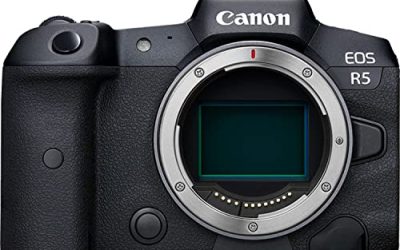
1. Canon EOS R5
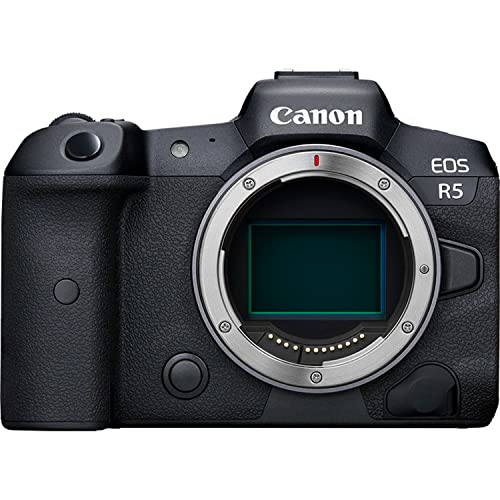
The Canon EOS R5 is the best all-round pick in this guide. Its 45 megapixel full-frame sensor gives you room to crop a distant seal, and its Dual Pixel CMOS AF II system, with 1,053 autofocus points and animal eye detection, is one of the most reliable in this group at finding a seal head against moving water. It shoots at 12 frames per second with the mechanical shutter and 20 frames per second with the electronic shutter.
Specs
- 45MP full-frame CMOS sensor; DIGIC X processor; Dual Pixel CMOS AF II with 1,053 points and animal eye detection; 12 fps mechanical / 20 fps electronic; 8-stop in-body stabilisation; 8K30 video; dual card slots (CFexpress Type B and SD UHS-II); weather sealed; body about 738 g; model 4147C002.
Eight stops of in-body stabilisation help with a long lens handheld from a cliff path, and the body is sealed against dust and moisture. The R5 is not the fastest camera here, and it is not the lightest, but it is the most balanced. If you want one camera that handles a hauled-out seal at dawn and a pup on the sand in the evening, this is the one to take.
2. Sony A1 II

The Sony A1 II is the most powerful camera in this guide. Its 50.1 megapixel full-frame stacked sensor pairs huge resolution with a 30 frames per second burst at full autofocus and auto exposure tracking, the fastest continuous shooting here. When a seal dives, the A1 II gives you more frames of the dive than any other camera here.
The dedicated AI processing unit drives animal eye detection that is remarkably steady on a small, dark subject against a bright sea, holding focus on its eye even when the head dips below a wave and comes back up. That steadiness is worth a great deal on a seal shore.
Specs
- 50.1MP full-frame stacked Exmor RS sensor; BIONZ XR processor with dedicated AI processing unit; animal eye autofocus; 30 fps continuous shooting with full AF/AE tracking; 8.5-stop in-body stabilisation; 8K30 video; dual card slots (CFexpress Type A and SD UHS-II); weather sealed; body about 743 g; model ILCE-1M2.
The A1 II is a heavy investment, and its 50 megapixel files demand fast cards and plenty of storage. But if your priority is catching the sharpest frame of a fast seal, no other camera here gives you as many chances per second.
3. Nikon Z8
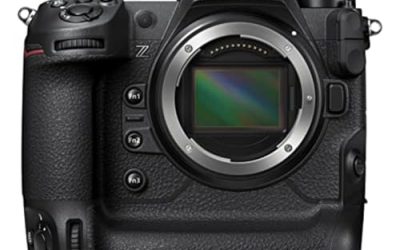
The Nikon Z8 brings most of the flagship Z9 into a smaller, lighter body, and it is the quietest camera in this guide. It has no mechanical shutter at all, so it shoots in complete silence, which matters close to a hauled-out colony. Its 45.7 megapixel stacked sensor and EXPEED 7 processor deliver 20 frames per second in RAW and up to 120 frames per second in JPEG.
The autofocus system tracks animals well, and the blackout-free viewfinder means you never lose sight of a seal while the camera is firing. The Z8 also records 8K video at 60 frames per second, useful if you want footage of a colony as well as stills.
Specs
- 45.7MP full-frame stacked CMOS sensor; EXPEED 7 processor; animal subject detection autofocus; 20 fps RAW / 120 fps JPEG; fully electronic shutter, completely silent; 8K60 video; dual card slots (CFexpress Type B and SD UHS-II); weather sealed; body about 910 g.
The honest trade-off is battery life. The Z8 is rated at roughly 330 shots per charge under standard test conditions, the shortest battery life in this guide, and cold weather will shorten it further. Carry at least two spare batteries and keep them warm in an inside pocket. With that handled, the Z8 is a superb seal camera: silent, fast, and sharp.
4. OM System OM-1 Mark II

The OM System OM-1 Mark II is the odd one out in this guide. Its Micro Four Thirds sensor is smaller than the full-frame sensors above, but the 2x crop factor turns every lens into a much longer one: a 300mm lens behaves like a 600mm lens on a full-frame body, a real advantage when the seals are far away.
The camera shoots at 50 frames per second with autofocus, faster than the R5 and the Z8 in RAW, and its Pro Capture mode records frames before you fully press the shutter, so a seal that surfaces without warning can still be caught. The body is sealed to the IP53 standard, the strongest weather protection in this group.
Specs
- 20.4MP Micro Four Thirds stacked Live MOS sensor; TruePic X processor; 50 fps continuous shooting with autofocus; Pro Capture mode; 8.5-stop in-body stabilisation; IP53 weather sealing; 2x crop factor; dual UHS-II SD card slots; body about 599 g; model V210041BU000.
Be clear about what you are buying: this listing is the kit, which pairs the body with the M.Zuiko 12-40mm f/2.8 PRO II lens. That lens is a fine general zoom, but at 24-80mm equivalent it is far too short for seals on its own, so you will need a long telephoto lens to go with it.
5. Fujifilm X-H2S
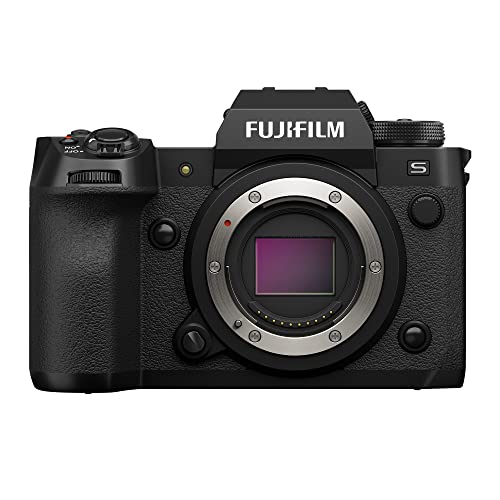
The Fujifilm X-H2S is the fastest APS-C camera in this guide. Its 26.1 megapixel stacked X-Trans 5 sensor and X-Processor 5 deliver 40 frames per second with the electronic shutter and 15 frames per second with the mechanical shutter, with AI animal subject detection.
At about 660 g, the X-H2S is lighter than the full-frame bodies here, and the APS-C format gives you a 1.5x crop, so a 300mm lens reaches like a 450mm lens. That combination of speed, reach, and light weight makes it a good choice for a photographer who walks a long way to a colony and shoots handheld all morning.
Specs
- 26.1MP APS-C stacked X-Trans CMOS 5 HS sensor; X-Processor 5; AI animal subject detection; 40 fps electronic / 15 fps mechanical; 7-stop in-body stabilisation; 6.2K open-gate video; dual card slots (CFexpress Type B and SD UHS-II); weather sealed; body about 660 g; model 16756924.
The trade-off is resolution. At 26.1 megapixels, the X-H2S gives you less cropping room than the 45 and 50 megapixel full-frame bodies, so you need to get closer or use a longer lens. But if you want a fast, light, well-sealed camera that you can carry all day, the X-H2S earns its place.
How the Five Cameras Compare
The Sony A1 II leads on speed and resolution, with 30 frames per second at 50.1 megapixels and the most confident animal eye tracking in the group. The Canon R5 and the Nikon Z8 sit just behind it, both above 45 megapixels, with the R5 offering the best balance and the Z8 offering silence and a blackout-free viewfinder. The OM-1 Mark II leads on reach per gram and weather protection, with its 2x crop factor, 50 frames per second burst, and IP53 sealing. The Fujifilm X-H2S leads on portable speed, with 40 frames per second in a body that weighs about 660 g. A long telephoto lens matters more than the body in many seal situations, so weigh the lens as carefully as the camera itself.
Seal Shooting Tips
Arrive early. Seals haul out in the first light, and the best behaviour often happens in the first hour after sunrise, before walkers and dogs arrive. Set up quietly. Use a fast shutter speed: a seal head breaking the surface needs at least 1/500 of a second, and a diving seal needs 1/1000 or faster. If the light is low, open the aperture and raise the ISO rather than dropping the shutter speed.
Shoot in RAW. A dark, wet seal coat against a bright sea is a hard exposure, and RAW files give you room to lift the shadows and hold the highlights afterwards. Lock the exposure on the seal, not on the water. Keep your distance and respect the colony: seals are easily disturbed, and a disturbed colony will stampede into the water. Use a long lens, stay behind fences and ropes, and follow warden guidance. Never use flash near seals. Keep spare batteries warm in an inside pocket.
Which One to Choose
For most seal photographers, the Canon EOS R5 is the best single pick, pairing 45 megapixels of cropping room with reliable animal eye autofocus and a fast burst. If speed is your top priority, the Sony A1 II is the best tool here, with 30 frames per second at 50.1 megapixels. If silence matters most, the Nikon Z8 is the pick, with its completely silent shutter. If reach and weather protection matter most, the OM System OM-1 Mark II is the smartest choice, as long as you pair it with a long telephoto lens, because the kit zoom is too short for seals. And if you want a fast, light, well-sealed camera for all-day carrying, the Fujifilm X-H2S is the one to take.
Which camera is best for seal photography?
The Canon EOS R5 is the best all-round choice for most people, with 45 megapixels, reliable animal eye autofocus, and strong sealing. The Sony A1 II is faster, the Nikon Z8 is silent, and the OM-1 Mark II reaches further for its weight.
Do I need a long lens for seal photography?
Yes, in almost every case. Seals are usually far away, and colonies are often protected by distance rules, so a lens of 300mm or longer is the norm. A high-resolution body helps because you can crop, but a long lens is still the most useful piece of kit.
Can I photograph seals in the rain?
Yes, with care. All five cameras in this guide are weather sealed, and the OM-1 Mark II carries the strongest sealing here. Wipe spray from the front element often, and dry the body and lens at the end of the day to stop salt building up.
Is it safe to get close to seals?
Keep your distance. Seals can bite, and a disturbed colony will stampede into the water, which can injure pups. Stay behind fences and ropes, follow warden guidance, use a long lens, and never use flash near seals.
More from Amazon
Programs that pair well with the guide above. Offers and eligibility are set by Amazon and may change.
Free shipping on eligible items, Prime Video and more. Eligible new members can start with a free trial.
Start a Prime free trialAudiobooks and podcasts to listen to on the go. Eligible new members can start with a free trial.
Try Audible freeAd-free music streaming. Eligible new subscribers can start with a free trial.
Try Music Unlimited freeA free business account with business pricing and bulk-buying tools for work, shop or home office.
Create a business accountAs an Amazon Associate we earn from qualifying purchases.