Our Top Picks


Hedgehogs are one of the most rewarding garden animals to photograph, and one of the hardest to get right. They appear at dusk, move quietly through grass and fallen leaves, and vanish into a hedge at the first loud sound. They are small, low to the ground, and active in light so dim that most cameras struggle to focus. A good hedgehog camera finds a small dark shape in poor light, locks focus fast, and shoots without a sound.
As an Amazon Associate, we earn from qualifying purchases.
This guide covers five cameras: two full-frame flagships, two fast mid-range bodies, and one light APS-C camera. Every camera here is a body-only listing unless noted, so you will need a lens to match.
Why Hedgehog Photography Is Hard
A hedgehog is about the size of a small melon, and it spends most of its active hours in near darkness, foraging along lawn edges and under shrubs, where the light is uneven and the background is busy. Your camera has to separate a brown and cream spiny shape from leaves and shadows, with little contrast to grab onto, while the animal keeps moving.
Sound is the second problem. A hedgehog freezes at a sharp noise, and may roll into a ball or shuffle away, so a silent electronic shutter matters a great deal here. Dew is a constant companion at those hours, so some protection against moisture helps. And remember the animal itself: never use a bright flash aimed at a hedgehog, never pick one up, and never block its path to food or shelter.
What to Look for in a Hedgehog Camera
Low-light autofocus comes first. Look for a camera that can focus in very dim light and track a small moving subject without jumping to the background. Animal eye detection helps, but a hedgehog eye is tiny and dark, so the camera also needs strong general subject tracking for when the eyes are hidden behind spines or grass. A silent shutter comes second: a fully electronic shutter that makes no sound at all is the ideal.
Close focus and reach come third. You need a lens that can focus close, or a body with enough resolution to crop into the frame. A high-resolution sensor gives room to crop, while a crop sensor gives extra reach from the same lens. Body size, battery life and sealing come last. Cold damp air drains batteries faster than warm daylight, so a large battery or a spare is good insurance, and a little sealing against dew is useful.
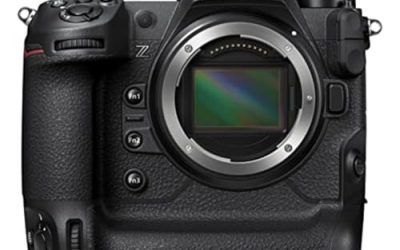
Nikon Z9

The Nikon Z9 is the most capable camera in this guide, and the heaviest. Its stacked 45.7-megapixel sensor gives a fully silent electronic shutter with no blackout, so you can follow a hedgehog without a sound. The autofocus finds and tracks small subjects in very low light. The 20 frames per second burst gives you plenty of chances to catch a hedgehog lifting its nose. Dual card slots back up every frame.
Specs
- 45.7MP full-frame stacked CMOS; EXPEED 7; 20 fps RAW, 120 fps JPEG at 11MP; silent shutter; 8K/30p; 4-axis tilting screen; EN-EL18d, about 740 shots; dual CFexpress Type B slots; about 1,340 g; Z mount; model 1669.
The trade-off is weight. At about 1,340 g, the Z9 is the heaviest camera here by a wide margin, and holding it low for an hour will tire your arms. If you already shoot Nikon Z lenses, or you want the best low-light autofocus and silent shooting available, the Z9 is hard to fault.
Sony A7R V

The Sony A7R V brings the highest resolution in this guide: a 61-megapixel full-frame sensor that lets you crop deeply into a distant hedgehog and still keep a detailed file. That matters because you often cannot get close, and a heavy crop can turn a small animal in a wide frame into a strong portrait. The AI processing unit drives Real-time Recognition autofocus, and the 8-stop stabilization helps when you shoot handheld at slow shutter speeds. The A7R V is far lighter than the Z9, at about 723 g, and the vari-angle screen flips out to the side, which is handy when you kneel low.
Specs
- 61.0MP full-frame Exmor R CMOS; BIONZ XR with AI unit; Real-time Recognition autofocus; 10 fps; 5-axis stabilization up to 8 stops; 8K/24p and 4K/60p; vari-angle touchscreen; NP-FZ100 battery; dual SD and CFexpress Type A slots; about 723 g; E mount; model ILCE7RM5/B.
The honest trade-offs are burst speed and file size. At 10 frames per second, the A7R V will not match the Z9 or the Canon bodies for a fast-moving animal, though hedgehogs rarely move that fast. The 61-megapixel files are large, so you will fill cards faster. If cropping power is your top need, the A7R V is the strongest choice here.
Canon EOS R7
The Canon EOS R7 is the best value for reach in this guide. Its 32.5-megapixel APS-C sensor gives a 1.6x crop factor, so a 200mm lens frames like a 320mm lens on a full-frame body, which is a real help when a hedgehog keeps its distance. The Dual Pixel CMOS AF II system works across up to 651 zones, and the 15 frames per second mechanical burst, or 30 frames per second with the electronic shutter, gives you plenty of chances to catch a quick movement. In-body stabilization helps when you shoot handheld at slow shutter speeds. The R7 is compact, balances well with a telephoto lens, and is light enough to hold at ground level for a long session. Dual card slots back up your files.
Specs
- 32.5MP APS-C CMOS; DIGIC X; Dual Pixel CMOS AF II, up to 651 zones; 15 fps mechanical, 30 fps electronic; 5-axis stabilization; 4K/60p; vari-angle touchscreen; LP-E6NH battery; dual SD UHS-II slots; about 612 g; RF mount; model 5137C002.
The trade-off is the smaller sensor, which shows more grain than the full-frame bodies here when you push the ISO high on a dark night. If you want the most reach for the least money, the R7 is a strong and sensible pick.
Canon EOS R6 Mark II
The Canon EOS R6 Mark II is the best all-round low-light camera in this guide for many garden photographers. Its 24.2-megapixel full-frame sensor gathers light cleanly at high ISO values, and its files stay manageable in size. The Dual Pixel CMOS AF II system is fast and reliable in dim light, and the 12 frames per second mechanical burst, or 40 frames per second with the electronic shutter, is more than enough for a hedgehog. The 8-stop in-body stabilization is a genuine help when you shoot handheld at slow shutter speeds in the dark. At about 670 g, it is comfortable for long sessions. The LP-E6NH battery is shared with the R7, so spares are simple to carry.
Specs
- 24.2MP full-frame CMOS; DIGIC X; Dual Pixel CMOS AF II; 12 fps mechanical, 40 fps electronic; 5-axis stabilization up to 8 stops; 6K oversampled 4K/60p; vari-angle touchscreen; LP-E6NH battery; dual SD UHS-II slots; about 670 g; RF mount; model 5666C002.
The honest trade-off is resolution. At 24.2 megapixels, the R6 Mark II gives you the least room to crop in this guide, so you will need to get closer or use a longer lens than you would with the A7R V or the Z9. If you want a camera that does everything well and handles low light with confidence, the R6 Mark II is the most balanced choice here.
Fujifilm X-S20

The Fujifilm X-S20 is the lightest and most portable camera in this guide, at just 491 g with battery and card. That matters when you crouch beside a garden path, hold the camera low, and wait for a hedgehog to appear. The 26.1-megapixel APS-C X-Trans sensor delivers lovely colour straight from the camera, and the X-Processor 5 engine drives fast autofocus with subject detection. The 20 frames per second electronic burst gives you plenty of chances to catch a fleeting moment, and the 7-stop in-body stabilization helps when you shoot handheld at slow shutter speeds. The NP-W235 battery is rated to about 750 frames in normal mode, so you can cover a long evening without swapping batteries.
Specs
- 26.1MP APS-C X-Trans CMOS 4; X-Processor 5; subject detection autofocus; 20 fps electronic; 5-axis stabilization up to 7 stops; 6.2K/30p and 4K/60p; vari-angle touchscreen; NP-W235 battery, about 750 frames; single SD slot; about 491 g; X mount; model 16781852.
The honest trade-offs are the single card slot and the lack of weather sealing. The X-S20 is not weather sealed, so you need to be careful with dew and damp grass. If you want the lightest kit in this guide, the X-S20 is a charming and capable companion for a night in the garden.
Comparing the Five Cameras
The Z9 and the A7R V are high-resolution full-frame bodies that give you the most detail and the most room to crop. The Z9 is faster and tougher, while the A7R V is lighter and offers even more resolution. The R7, the R6 Mark II, and the X-S20 are the lighter, more practical choices. The R7 gives you the most reach from a given lens, and it is the best value for getting close to a distant hedgehog. The R6 Mark II gives you the cleanest high-ISO files and the most balanced handling. The X-S20 is the lightest of all.
Hedgehog Photography Tips
Work at dusk and just after dark, when hedgehogs are most active and the light is soft. Arrive before the animal appears, set up low beside a path or a feeding area, and wait quietly. Move slowly, keep your voice down, and wear dark clothing. Avoid shining a bright light at the animal.
Use a long lens and keep your distance. A 200mm lens on a full-frame body, or a 100mm lens on a crop body, is a good place to begin. Set your camera to silent or quiet shutter mode, and use continuous autofocus with animal subject detection if your camera offers it. Shoot at a shutter speed of at least 1/250s if the hedgehog is moving, and drop to 1/125s or slower when it pauses. Open your aperture wide to gather light, and let the ISO rise as high as it needs to go for a sharp shot, because a sharp noisy frame is better than a clean blurry one.
Focus on the eye when you can see it, and on the nose when the eye is hidden. Get low, at the level of the animal, rather than shooting down from standing height. A low angle makes the hedgehog look larger, and it puts the background into a soft blur. Take a lot of frames, and be patient.
Which One to Choose
Pick the Nikon Z9 if you want the best low-light autofocus, the fastest silent shooting, and the toughest body. Pick the Sony A7R V if cropping power and detail matter most to you. Pick the Canon EOS R7 if you want the most reach for your money. Pick the Canon EOS R6 Mark II if you want the most balanced camera in this guide. It is our pick for most garden photographers. Pick the Fujifilm X-S20 if you want the lightest kit.
What is the best camera for hedgehog photography?
The Canon EOS R6 Mark II is the most balanced choice for most garden photographers, with clean high-ISO files and fast low-light autofocus. If you want the most cropping power, the Sony A7R V gives you 61 megapixels to work with. If you want the fastest silent shooting, the Nikon Z9 leads the group.
Do I need a flash for hedgehog photography?
No, and you should avoid using a bright flash aimed at a hedgehog. A sudden burst of light can frighten the animal and send it into a ball or away into cover. The cameras in this guide can work in low light without extra light, using high ISO values, wide apertures, and stabilization. If you need to see where you are walking, use a dim red light.
What lens should I use for hedgehog photography?
A telephoto lens is the best choice, because it lets you keep a respectful distance while still filling the frame. A 200mm lens on a full-frame body, or a 100mm lens on a crop-sensor body, is a good place to begin. A lens that can focus close is useful for tight portraits. A wide maximum aperture, such as f/2.8 or f/4, helps gather light after dark.
When is the best time to photograph hedgehogs?
Hedgehogs are most active in the hour after sunset and in the hour before dawn, when the light is dim and the garden is quiet. Dusk is the easier time to work, because you can set up while there is still some light. Warm, damp evenings after rain are often good. Avoid cold, dry nights in midwinter, when hedgehogs are often asleep in hibernation and will not appear at all.
More from Amazon
Programs that pair well with the guide above. Offers and eligibility are set by Amazon and may change.
Free shipping on eligible items, Prime Video and more. Eligible new members can start with a free trial.
Start a Prime free trialAudiobooks and podcasts to listen to on the go. Eligible new members can start with a free trial.
Try Audible freeAd-free music streaming. Eligible new subscribers can start with a free trial.
Try Music Unlimited freeA free business account with business pricing and bulk-buying tools for work, shop or home office.
Create a business accountAs an Amazon Associate we earn from qualifying purchases.