Our Top Picks
Macro photography asks more of a camera support than almost any other kind of close-range shooting. The subject is small, the working distance is short, and the depth of field at life-size magnification can be thinner than a single antenna. A tiny shift moves the plane of focus off the eye of a bee, and the whole frame falls apart. Handheld shooting can work in bright light, but it leaves nothing in reserve for focus bracketing.
A monopod fills the gap between handheld freedom and tripod rigidity. It takes the weight of the camera off your arms, it steadies the vertical axis, and it still lets you pivot, lean, and track a subject that will not sit still. As an Amazon Associate, we earn from qualifying purchases.
Why Macro Photography Needs a Monopod
Macro work is slow work. You find a subject, set the magnification, move the camera a millimetre at a time until the focus lands, and then hold still while the shutter fires. A tripod can do that job on flat ground, but it is a poor companion in a flower bed or on a slope.
The second reason is weight. A macro rig is heavier than it looks: a full-frame body, a 100 mm macro lens, a flash, and a focusing rail add up quickly, and holding that rig at arm’s length for an hour is tiring. A monopod carries the weight down to the ground, so your hands are free to work the focus ring.
One honest limit: a monopod is not a tripod, and it will not hold a long exposure on its own. For macro, it steadies the camera for focus bracketing and handheld stacks, but it does not replace a tripod for long exposures. Treat it as a third point of contact, not as a hands-free stand.
What to Look for in a Macro Monopod
Weight comes first, because a monopod that stays in the bag helps nobody. Carbon fibre poles weigh less than aluminium poles of the same height, and the difference matters on a long walk through a garden or a nature reserve. The five monopods here range from 0.88 lb to about 2.5 lb, and every one is light enough to carry all day.
Collapsed length comes second. Macro subjects live close to the ground, and a monopod that folds short can be carried inside a camera bag or strapped to the side of one. A folded length of 15 inches fits almost anywhere, while a folded length near 28 inches needs a dedicated strap or a larger bag.
Load capacity comes third. Check the listed load against your heaviest combination of body, macro lens, flash, and focusing rail, and leave a margin. A monopod loaded near its limit flexes, and flex at macro magnification ruins focus. The Manfrotto datasheet for the 290 carbon model lists 5 kg as the safe working load, even though the Amazon listing quotes a higher figure, and this guide uses the lower datasheet number as the safe working load. Grip and locks come fourth: twist locks are compact and quiet, which helps near a living subject, while flip locks are faster with one hand and easier with cold or wet fingers.
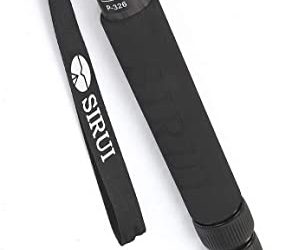
1. SIRUI P-326 Carbon Fiber Monopod
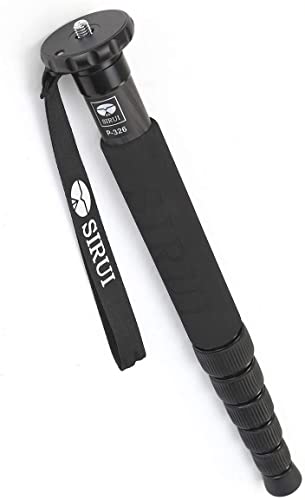
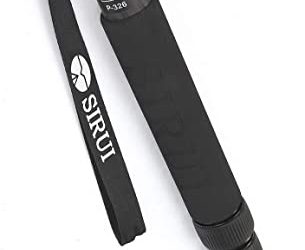
The SIRUI P-326 is the lightest monopod in this guide, and it is the one to choose when portability matters most. Six carbon fibre sections fold down to just 15 inches, and the whole pole weighs 0.88 lb, which is less than most macro lenses. It extends to 60.6 inches, and it carries a listed load of 22 lb, which covers any normal macro rig with room to spare.
It suits travel, because it slips into a camera bag and adds almost no weight, and low-angle work, because the six sections set the height in small steps. It has no head and no folding base, so the camera mounts directly on the reversible screw, and six locks take longer to open than four.
Specs
- Material: carbon fiber; Sections: 6; Maximum height: 60.6 in; Folded length: 15 in; Weight: 0.88 lb; Listed load: 22 lb; Mount: reversible 1/4-inch and 3/8-inch screw; Grip: foam with wrist strap
2. Manfrotto XPRO Carbon Fiber Monopod

The Manfrotto XPRO Carbon Fiber Monopod is the professional pole in this guide, and it is the one to choose when height and rigidity matter most. It is a four-section carbon fibre monopod, model MPMXPROC4US, that reaches 64.76 inches and folds to 20.47 inches. It weighs 1.3 lb, and the Amazon listing quotes a listed load of 20 kg, which is far more than any macro rig will ever need.
The XPRO is built for photographers who work at full height and need a pole that does not flex. The four sections use flip locks, which open and close quickly with one hand, and the D-shaped carbon tubes resist twisting, so the camera stays pointed where you put it. That matters for macro work, because a twisting pole shifts the focus plane sideways. Buy the right version: this is the carbon fibre photo monopod, model MPMXPROC4US, not the aluminium video monopod sold under the same XPRO name.
Specs
- Material: carbon fiber; Sections: 4; Maximum height: 64.76 in; Folded length: 20.47 in; Weight: 1.3 lb; Listed load: 20 kg; Model: MPMXPROC4US; Locks: flip locks; Mount: 1/4-inch and 3/8-inch
3. iFootage Cobra 3 C180F Carbon Fiber Monopod
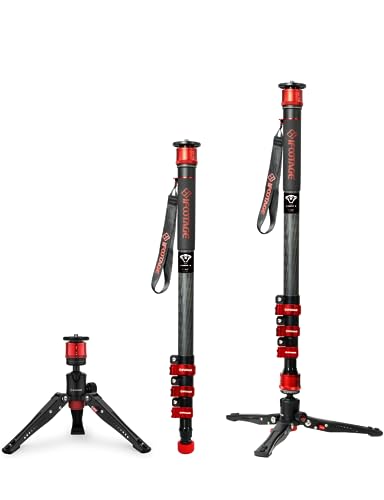
The iFootage Cobra 3 C180F is the most versatile monopod in this guide, and it is the one to choose when you want a folding base and a fluid feel. It is a carbon fibre monopod, model CB3 C180F, that reaches 71 inches, the tallest in this guide, and it folds to 27 inches. It weighs 1.13 kg, and the Amazon listing quotes a listed load of 10 kg. It ships with a tripod base that folds out under the pole.
That base is the reason to buy this monopod. With the base open, the pole stands on its own for a moment while you adjust the camera. For macro work, the base is useful when you are focus bracketing, because you can set the pole down, check the frames on the camera screen, and pick the pole up again without losing your position. The top plate fits both 1/4-inch and 3/8-inch threads, so it takes a camera, a small ball head, or a focusing rail without an adapter. The trade-off is size: at 27 inches folded, it needs a strap or a larger bag.
Specs
- Material: carbon fiber; Sections: 4; Maximum height: 71 in; Folded length: 27 in; Weight: 1.13 kg; Listed load: 10 kg; Model: CB3 C180F; Base: folding tripod base included; Mount: 1/4-inch and 3/8-inch
4. Manfrotto 290 Carbon Fiber Monopod

The Manfrotto 290 Carbon Fiber Monopod is the safe, dependable choice in this guide, and it is the one to choose when you want a proven pole for a heavy macro rig. It is a four-section carbon fibre monopod, model MM290C4US, that reaches 59.4 inches and folds to 19.29 inches. It weighs 1.1 lb, and it has a rubber grip and a wrist strap.
The load figure for this monopod deserves an honest note, because two sources disagree. The Amazon listing quotes 22 lb, but the Manfrotto datasheet for the 290 series lists 5 kg as the safe working load for the carbon monopod, and this guide uses the lower datasheet figure as the safe working load. Even at 5 kg, the 290 carries any normal macro rig with a comfortable margin. The carbon sections are rigid, the flip locks are positive and easy to use with cold hands, and the D-shaped tube profile resists twisting.
Specs
- Material: carbon fiber; Sections: 4; Maximum height: 59.4 in; Folded length: 19.29 in; Weight: 1.1 lb; Safe working load: 5 kg per Manfrotto datasheet (Amazon listing quotes 22 lb); Model: MM290C4US; Grip: rubber leg warmer with wrist strap
5. NEEWER T222 Monopod
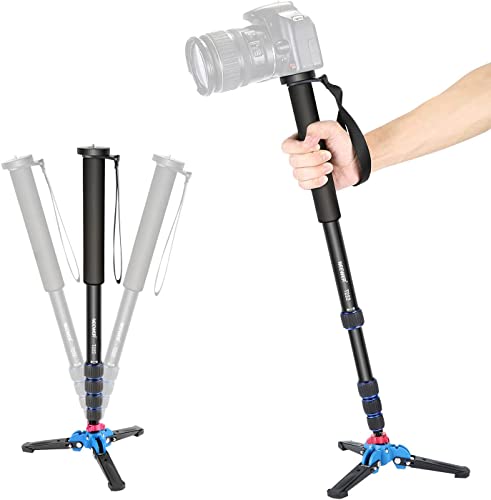
The NEEWER T222 is the most affordable all-rounder in this guide, and it is the one to choose when you want a folding base without paying for a premium carbon pole. It is an aluminium alloy monopod, model T222, with five sections, 66 inches tall and 20.5 inches folded. It weighs 1.3 lb, and the Amazon listing quotes a listed load of 5 kg. It ships with a detachable folding base.
The base is the T222’s best feature. It folds out into three small feet, and the pole can stand on its own for a moment while you adjust a setting or check a frame. The base also lets the pole pan a full 360 degrees. For macro work, that combination of a detachable base and a pan facility makes the T222 a practical choice for focus bracketing, because you can set the pole down, check the stack, and resume without losing your place. Aluminium is tougher than carbon fibre when the pole gets knocked against rocks or a fence. Note the height: the T222 reaches 66 inches, not 62 inches, as the listing and the NEEWER manual confirm.
Specs
- Material: aluminium alloy; Sections: 5; Maximum height: 66 in; Folded length: 20.5 in; Weight: 1.3 lb; Listed load: 5 kg; Model: T222; Base: detachable folding tripod base included; Mount: 1/4-inch screw, reversible to 3/8-inch
How the Five Monopods Compare
The SIRUI P-326 is the lightest and most compact, at 0.88 lb and 15 inches folded, and the best choice for travel and a light macro kit. The Manfrotto XPRO is the tallest carbon pole, at 64.76 inches, with the highest listed load, and the best choice for a heavy rig. The iFootage Cobra 3 is the tallest of all, at 71 inches, and it adds a folding base, which makes it the best choice when you want the pole to stand on its own for a moment. The Manfrotto 290 is the most dependable all-rounder. The NEEWER T222 is the most affordable option with a folding base.
Macro Shooting Tips With a Monopod
Work with the monopod, not against it. Plant the foot on firm ground, lean the pole slightly toward you, and let your body form the second and third points of contact. Keep your elbows tucked in, breathe out slowly, and fire the shutter at the end of the breath.
For focus bracketing, set the pole height first, then move the camera along the pole axis. A focusing rail makes this easier, moving the camera in precise increments. Take more frames than you think you need, and overlap the focus planes generously. For living subjects, move slowly and keep the monopod still: insects notice movement, and a pole that waves in the air will send them away before you focus.
Which One to Choose
If you travel light, buy the SIRUI P-326. It weighs less than a pound, it folds to 15 inches, and it carries any normal macro rig. If you shoot with a heavy rig, buy the Manfrotto XPRO, which reaches 64.76 inches and carries the heaviest load in this guide. If you want a folding base and the tallest reach, buy the iFootage Cobra 3 C180F. If you want the most dependable all-rounder, buy the Manfrotto 290. If you want a folding base on a modest budget, buy the NEEWER T222.
Is a monopod good enough for macro photography?
Yes, for most macro work a monopod is good enough, and it is often better than a tripod in the field. It steadies the vertical axis, carries the weight of the rig, and lets you move quickly between subjects. It does not replace a tripod for long exposures, but for focus bracketing and handheld stacks it is a practical support.
Can a monopod replace a tripod for macro focus stacking?
No, a monopod cannot fully replace a tripod for focus stacking, but it can get close when the stack is short and the light is good. A tripod holds the camera fixed while the focus moves. A monopod steadies the camera while you move it along one axis, which works for a short stack with a steady hand and a focusing rail.
How much load capacity do I need for a macro monopod?
Add up the weight of your body, macro lens, flash, and focusing rail, then choose a monopod with a listed load at least double that total. A pole loaded near its limit flexes, and flex at macro magnification moves the focus plane. For a light mirrorless rig, 5 kg is plenty, and for a heavy full-frame rig, a higher listed load gives you room to work.
What is the best monopod for low-angle macro work?
The best monopod for low-angle macro work is one that folds short, stays rigid at low heights, and lets you set the height in small steps. The SIRUI P-326 folds to 15 inches and weighs 0.88 lb, and the Manfrotto 290 folds to 19.29 inches and stays rigid at low heights. Either one works well for flowers, fungi, and insects at ground level.
More from Amazon
Programs that pair well with the guide above. Offers and eligibility are set by Amazon and may change.
Free shipping on eligible items, Prime Video and more. Eligible new members can start with a free trial.
Start a Prime free trialAudiobooks and podcasts to listen to on the go. Eligible new members can start with a free trial.
Try Audible freeAd-free music streaming. Eligible new subscribers can start with a free trial.
Try Music Unlimited freeA free business account with business pricing and bulk-buying tools for work, shop or home office.
Create a business accountAs an Amazon Associate we earn from qualifying purchases.