Our Top Picks


Glaciers are some of the most dramatic subjects a camera can frame. Blue ice, deep crevasses, and meltwater rivers stretch for miles, and only an aerial view shows their true scale. A drone turns a flat white expanse into a living map of cracks, seracs, and blue pools.
But glacier country is also one of the harshest places to fly. Cold air drains batteries fast, valley winds gust without warning, and bright ice can fool a camera sensor into dull gray images. This guide covers five drones that handle all of that.
As an Amazon Associate, we earn from qualifying purchases.
Why Glacier Photography Is Hard on a Drone
Cold is the first challenge. Lithium batteries lose capacity as temperatures drop, and a flight time measured on a warm day can shrink by a quarter or more on an ice field. Carry spare batteries in an inside pocket and land with plenty of charge left.
Wind is the second challenge. Cold air sinks off the ice and rushes down the valley, and gusts can double in strength in seconds. Strong motors, a high wind resistance level, and reliable satellite positioning all matter here.
The third challenge is the light itself. Ice is bright, and a camera that meters for the average scene will turn white snow into gray mush. You need real dynamic range and a flat color profile to pull detail back out of the highlights. A larger sensor and exposure bracketing both help.
Finally, there is altitude. Many glaciers sit well above sea level, and thin air makes propellers work harder. A drone rated for high-altitude takeoff gives confidence at 4,000 meters, while one with a low ceiling may refuse to launch.
What to Look for in a Glacier Drone
Flight time comes first. On a glacier you cannot land just anywhere to swap a battery, so look for at least 30 minutes of rated flight time and plan to land with a third left. Cold weather eats into that number, so a 45-minute drone beats a 30-minute one below freezing.
Obstacle avoidance comes second. Glacier terrain is full of ice towers, rock walls, and ridges that appear from nowhere in flat light. Omnidirectional sensing watches in every direction, while forward-only sensing leaves the sides and rear blind. Since you often fly backward to keep the ice face in frame, all-direction sensing is a genuine safety feature.
Camera quality comes third. A 48MP sensor captures the fine detail of crevasse patterns, while a larger one-inch or Four Thirds sensor handles the extreme contrast between sunlit ice and deep shadow. Look for 4K video at 60 frames per second and 10-bit color, plus a flat color profile. A telephoto lens is a bonus because it lets you photograph a distant icefall without crossing a crevasse field.
Wind resistance and cold tolerance come fourth. A drone built for strong gusts will hold its line when the valley wind picks up, and a drone with a low temperature limit will keep flying when the air turns bitter. Treat the wind resistance level as a hard limit, not a suggestion.
Ease of carrying comes last but still matters. You will hike for hours to reach the ice, often with a camera bag, food, and layers on your back. A drone under 249 grams folds into a jacket pocket, while a heavier flagship needs its own case.
1. DJI Mini 4 Pro

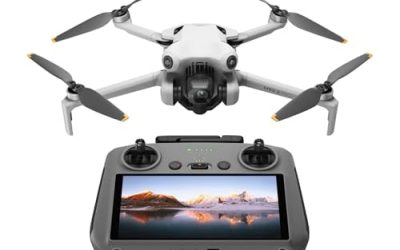
The Mini 4 Pro is the lightest drone in this guide and the easiest to carry onto a glacier. At under 249 grams it folds to pocket size, yet it carries a 48MP camera, omnidirectional obstacle sensing, and a 34-minute flight time. Six fisheye sensors and a 3D depth sensor watch in every direction, which matters when you fly backward along a crevasse line.
The 4K/60fps HDR video captures the blue tones of the ice well, and the 48MP stills hold up to heavy cropping when you isolate a single serac. ActiveTrack can follow a skier crossing the ice while you concentrate on framing. The trade-off is wind handling: its light weight means it works harder than a heavier drone in a valley wind, so fly it in the calm morning hours and keep the battery warm before launch.
Specs
- 48MP camera, 4K/60fps HDR video, 34-minute max flight time, omnidirectional obstacle sensing, under 249 g, 20 km max video transmission range, RC 2 controller with built-in screen.
2. DJI Air 3S
The Air 3S may be the best all-round glacier drone for most photographers. It pairs a one-inch wide-angle camera with a 3x medium telephoto, so you can shoot a broad panorama, then zoom in on a distant icefall without moving the aircraft. That matters on a glacier, where flying closer often means crossing dangerous terrain.
Flight time is a generous 45 minutes, the longest of the standard drones here, giving you a real buffer against cold-weather battery drain. The 724-gram airframe handles wind better than any sub-249-gram drone, and 4K/60fps HDR video with 14 stops of dynamic range holds bright ice and dark rock together. The telephoto camera is the quiet hero: a 70mm equivalent focal length compresses the layers of an icefall and makes distant peaks look closer.
Specs
- Dual camera (1-inch CMOS wide-angle and 3x medium telephoto), 48MP stills, 4K/60fps HDR video, 45-minute max flight time, omnidirectional obstacle sensing, 724 g, 20 km max video transmission range, RC-N3 controller.
3. DJI Mavic 3 Pro

The Mavic 3 Pro is the flagship of this guide and the pick when image quality matters more than pack weight. Its triple-camera system pairs a Four Thirds Hasselblad wide camera with a 3x medium telephoto and a 7x telephoto, giving you three focal lengths in a single flight. On a glacier, that range means you can photograph a crevasse at your feet, an icefall a kilometer away, and a summit ridge without landing.
The 20MP Hasselblad sensor has an adjustable aperture from f/2.8 to f/11, which tames glare off the ice, and it records 5.1K video at 50 frames per second. Flight time is 43 minutes, and the 958-gram airframe is the most wind-capable camera drone here. The Mavic 3 Pro suits trips with a short walk to the launch point rather than a long alpine approach. It ships with one battery, the RC controller with a built-in screen, and a 65W portable charger for topping up from a power bank at base camp.
Specs
- Triple camera (Four Thirds Hasselblad 20MP wide, 3x medium telephoto, 7x telephoto), 5.1K/50fps video, 43-minute max flight time, omnidirectional obstacle sensing, 958 g, 15 km max video transmission range, RC controller with built-in screen.
4. DJI Mini 3
The Mini 3 is the budget-friendly entry in this guide and a smart pick for a first glacier drone. At 248 grams it folds into a small bag, its 48MP camera shoots 4K HDR video, and the 38-minute flight time stretches to 51 minutes with the extended battery, sold separately. The 4K HDR video holds the blue ice tones well, and true vertical shooting captures tall seracs.
What it gives up is obstacle sensing: it has no forward, backward, or sideways sensors, so you must fly it with care and keep it in sight at all times. On a glacier that means flying higher and wider, avoiding low passes along ice walls, and never flying backward into unknown terrain. Its Level 5 wind resistance handles gusts up to 38 kph, enough for calm mornings but not for a windy afternoon on an exposed ice cap.
Specs
- 48MP camera, 4K HDR video, 38-minute max flight time (51 minutes with extended battery, sold separately), Level 5 wind resistance, under 249 g, 10 km max video transmission range, RC-N1 controller.
5. DJI Avata 2 Fly More Combo
The Avata 2 Fly More Combo is the wild card here. It is a first-person-view drone with a built-in propeller guard, a 155-degree field of view, and a 4K camera stabilized by RockSteady and HorizonSteady. Instead of calm, gliding shots, it dives and skims across the ice for a sense of speed no standard drone can match.
The combo includes three batteries, Goggles 3, the RC Motion 3 controller, a charging hub, and a sling bag. Each battery gives up to 23 minutes of flight, so three batteries add up to more than an hour of flying time across a session. The built-in propeller guard is a genuine safety feature on a glacier, where a brush against an ice wall can end a flight.
The Avata 2 is not a stills drone. Its 12MP sensor cannot match the 48MP stills of the camera drones here, and the wide-angle view distorts straight lines at the edges. Use it for video and scouting, and bring a camera drone when still images are the goal. Fly it with care near ice walls, and keep the goggles dry, since cold fog can mist the lenses.
Specs
- 4K/60fps video, 12MP stills, 155-degree field of view, built-in propeller guard, 23-minute max flight time per battery, 3 batteries included, Goggles 3 and RC Motion 3 included, 377 g, 13 km max video transmission range.
Which Drone Fits Your Glacier Trip
Choose the Mini 4 Pro if you hike long distances and want the lightest kit with full obstacle sensing.
Choose the Air 3S if you want the longest flight time and a telephoto lens without carrying a flagship. Its dual cameras and 45-minute endurance make it the most versatile glacier drone.
Choose the Mavic 3 Pro if image quality is the priority and the approach is short. Its three focal lengths and Four Thirds sensor make it the strongest camera system here.
Choose the Mini 3 if you are new to glacier flying or working with a smaller budget. It is light and capable in calm conditions, but it needs a careful pilot because it has no obstacle sensing.
Choose the Avata 2 Fly More Combo if you want immersive, fast-moving glacier video. It is a specialist tool for dynamic footage, not a stills camera.
Glacier Drone Tips
Warm your batteries before you fly. Keep them in an inside pocket until launch, and never leave them in a cold pack overnight. A warm battery holds its charge far better than a cold one.
Fly in the morning when the glacier air is calm, and watch for fog. Valley winds build through the day as the sun heats the rock, so the first two hours after sunrise give you the smoothest air and the softest light. Low sun also brings out the texture of the ice.
Set your return-to-home altitude high. Glacier terrain rises steeply, and a drone returning low can meet an ice wall or a moraine ridge. Set it well above the highest ground between you and the drone before you launch.
Shoot in a flat color profile and bracket your exposures. Bright ice and dark rock sit at opposite ends of the dynamic range, and a flat profile preserves detail in both. Bracketing gives you extra frames to blend later.
Keep the drone in sight and respect local rules. Many glaciers lie inside national parks or near borders where flights need permission. Check the rules before you travel, and never fly over other people on the ice.
Final Verdict
Glacier photography rewards a drone that can fly long, hold steady in wind, and capture the extreme contrast of ice and rock. The Air 3S is the best all-round pick, with its 45-minute flight time, dual cameras, and strong wind handling. The Mini 4 Pro is best for long hikes, the Mavic 3 Pro is best for image quality, the Mini 3 is best for a first glacier drone, and the Avata 2 Fly More Combo is best for immersive video. Keep the batteries warm, fly in the calm morning air, and give the ice the respect it deserves.
Can I fly a drone over a glacier in cold weather?
Yes, but cold air reduces battery capacity, so expect shorter flights than the rated time. Keep batteries warm until launch, hover briefly after takeoff so the battery warms up, and land with at least a third of the charge remaining.
Which drone is best for glacier photography?
The Air 3S is the best all-round pick, with a 45-minute flight time, dual cameras, and strong wind handling. The Mini 4 Pro is best for long hikes, the Mavic 3 Pro is best for image quality, and the Mini 3 is best for a first glacier drone.
Do I need obstacle avoidance on a glacier?
It helps a great deal. Glaciers are full of ice towers, rock walls, and ridges that appear suddenly. The Mini 4 Pro, Air 3S, and Mavic 3 Pro all have omnidirectional sensing, while the Mini 3 has none.
Is any drone in this guide waterproof?
No. None of the five drones in this guide is waterproof, and none should be flown in rain or landed on wet ice. Meltwater, spray, and fog can all damage a drone, so keep it dry.
More from Amazon
Programs that pair well with the guide above. Offers and eligibility are set by Amazon and may change.
Free shipping on eligible items, Prime Video and more. Eligible new members can start with a free trial.
Start a Prime free trialAudiobooks and podcasts to listen to on the go. Eligible new members can start with a free trial.
Try Audible freeAd-free music streaming. Eligible new subscribers can start with a free trial.
Try Music Unlimited freeA free business account with business pricing and bulk-buying tools for work, shop or home office.
Create a business accountAs an Amazon Associate we earn from qualifying purchases.