Key takeaways
- Carry your camera safely across ice and snow. Compare five glacier-ready camera bags for weather protection, capacity, comfort, and fast access.
Glaciers are among the most demanding places to carry a camera. The air is cold, the wind drives snow sideways, meltwater runs underfoot, and the light shifts from blinding glare to flat grey in minutes. A bag that works well on a city walk can fail badly here: zips freeze, fabric soaks through, straps dig in under a heavy load, and a camera buried at the bottom of a pack is useless when the light lasts ten seconds and then goes dark. The right bag keeps moisture out, spreads weight across your hips and shoulders, and lets you reach your camera with gloves on. This guide compares five bags that handle those demands.
As an Amazon Associate, we earn from qualifying purchases.
Why Glacier Photography Is Hard on a Bag
A glacier is not just cold. It is wet, windy, and abrasive all at once. Snow blows into every opening, and fine grains work their way into zips and seams. When the sun comes out, snow melts on a dark bag and soaks into fabric that looked dry an hour earlier. Crampons, ice axes, and tripod legs bang against the pack, and weak zips jam when ice forms in the teeth.
Cold also changes how you use a bag. Thick gloves make small zip pulls hard to grip, stiff fabric folds instead of flexing, and foam dividers harden and stop cushioning the camera inside. Batteries drain faster in the cold, so you need room for spares kept close to your body. A good glacier bag uses large zip pulls, oversized buckles, and fabric that stays flexible well below freezing. Weight matters too: hours on uneven ice with a body, lenses, a tripod, food, and layers demand a padded hip belt and a stiff back panel.
What to Look for in a Glacier Camera Bag
Weather protection comes first. No bag in this guide is fully waterproof, and you should treat that claim with care. What matters is a weather-resistant shell, covered zips, and a rain cover that actually fits the loaded pack. A rain cover is essential: check that the bag includes one or that a cover fits easily.
Capacity is next. A glacier kit usually means one body, a wide lens, a mid telephoto, spare batteries, filters, and a tripod, and the bag must hold it all without inviting overpacking.
Comfort decides whether you enjoy the day: a padded hip belt takes weight off your shoulders, the back panel breathes, and a sternum strap holds the straps in place on slopes.
Access is the last big factor. Side access lets you pull the camera out without setting the bag down on wet ice. Top access works well for a camera with a lens attached. Large openings and simple layouts beat fiddly designs with cold hands.
1. Lowepro ProTactic BP 450 AW II
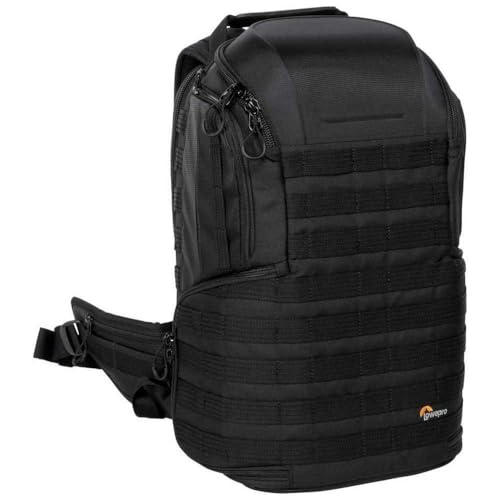
The Lowepro ProTactic BP 450 AW II is the workhorse of this group: a professional backpack built around a rigid shell, four-side access, and a modular exterior for attaching pouches and straps. On a glacier, the built-in All Weather cover earns its place. It pulls out of a pocket at the base of the bag and shields the whole pack from blowing snow and meltwater when the weather turns during a long traverse.
The bag is not light. At around 2.84 kg empty, it adds real weight before you load it, but the FormShell outer is stiff enough to shield gear from knocks against ice and rock, and it holds its shape on uneven ground. Four-side access means you can reach the camera from the top, either side, or the back, so you never have to lay the bag down in slush to change a lens.
Specs
- Capacity 25 L; fits 1-2 pro bodies with a 70-200mm f/2.8 lens attached; laptop sleeve up to 15 in; built-in All Weather cover; external dimensions 36 x 22 x 52 cm; weight 2.84 kg; model LP37177-GRL.
2. Shimoda Explore V2 35 Backpack

The Shimoda Explore V2 35 is the largest landscape pack in this guide, built for long days in rough country. Its 35 L volume holds a full glacier kit plus layers, food, and water. The pack uses a Core Unit system, a padded insert for the camera gear, so the upper part of the bag stays free for personal items.
The harness is one of the best here: an adjustable torso system sets the fit to your back length, and the padded hip belt carries much of the load. The back panel breathes better than most camera packs, helping on hard uphill work.
Access comes from the top and the sides. The pack is water resistant, not waterproof, and ships with a rain fly: use it whenever snow falls. At 4.5 lb on the Amazon listing, and near 2.6 kg elsewhere for the full kit, this is a heavy pack, and weight is the trade-off for capacity.
Specs
- Capacity 35 L; fits gripped mirrorless and DSLR bodies; Medium Core Unit included; laptop sleeve up to 16 in; rain fly included; hydration pocket for 3 L; weight 4.5 lb per Amazon listing; model 520-159.
3. WANDRD PRVKE 31L V3

The WANDRD PRVKE 31L V3 is the most versatile bag in this guide. It is a roll-top backpack that expands from 31 L to 36 L, swallowing a glacier kit and compressing down when you carry less. The roll top is a real advantage in snow: it closes with a simple fold and a magnetic buckle, and there is no zip at the top for ice to jam. Waterproof tarpaulin on the front and tough 1680D ballistic nylon elsewhere, with weather-resistant zips, shed meltwater better than most fabric packs.
Side access is quick: a zip lets you pull the camera out without opening the whole pack, keeping snow out. Inside, a camera cube holds a body and three lenses.
The PRVKE carries well, with a back panel and shoulder straps redesigned for the V3 model. One note: the Amazon listing shows several colours and sizes, so confirm the 31 L V3 model before you order.
Specs
- Capacity 31 L, expands to 36 L with roll top; camera cube fits a body and 3 lenses; laptop sleeve up to 16 in; waterproof tarpaulin front and 1680D ballistic nylon; weight 3.4 lb; model D201001.
4. K&F Concept Sling Bag

The K&F Concept sling bag is the outlier in this group, and it earns its place by being honest about what it is. This is a small 5 L crossbody bag for a compact kit: one mirrorless body, one lens, and a few accessories. It is not a bag for a full glacier expedition. It suits a short walk to a viewpoint, or a second body beside a larger pack.
Its strength is speed. The sling design swings the bag from back to chest so you can pull the camera out in seconds, which is what you want when the light breaks over a glacier. The strap adjusts from 29.5 in to 52.7 in, fitting over a bulky winter jacket.
The fabric is water resistant, not waterproof, and at this size there is no rain cover. In falling snow, keep the bag under your jacket. That limits it to a light companion, not your only bag on a glacier.
Specs
- Capacity 5 L; external size 9.1 x 7.3 x 5.1 in; internal size 8.3 x 6.8 x 4.3 in; weight 0.61 lb; one removable padded divider; adjustable shoulder strap 29.5 to 52.7 in; model KF13.179.
5. Peak Design Everyday Backpack 30L

The Peak Design Everyday Backpack 30L is the most polished bag in this guide. Its MagLatch top opens with one hand and expands the pack from 22 L to 30 L, growing with extra layers and shrinking when you travel light. Dual side access reaches the camera from either side without taking the pack off fully.
Inside, three FlexFold dividers fold into shelves, walls, or a flat floor, so the interior switches between camera space and luggage space. The dividers hold gear in place on uneven ground, each one locking into a shape.
The shell is a 400D double poly-coated nylon canvas with a DWR treatment, and the zips are weatherproof UltraZips. That sheds snow and light rain well, but the bag has no stowed rain cover, so add your own cover in heavy snowfall. The drawback is weight: 3.88 lb without dividers and 4.65 lb with them.
Specs
- Capacity 22 L minimum, 30 L maximum; MagLatch top closure; dual side access; 3 FlexFold dividers included; laptop sleeve up to 16 in; tablet sleeve up to 12.9 in; weight 3.88 lb without dividers, 4.65 lb with dividers; model BEDB30CH2.
How the Five Bags Compare
The Lowepro ProTactic suits bad weather best: built-in rain cover, four-side access, and room for a full pro kit, at the cost of weight.
The Shimoda Explore V2 35 suits big kits and long days: 35 L, the best harness here, and a Core Unit that separates camera gear from layers and food, but it is the heaviest pack.
The WANDRD PRVKE 31L V3 is the most adaptable: an expanding roll top and a weather-resistant shell, a middle ground between expedition packs and everyday bags.
The K&F Concept sling is the lightest and fastest option, but only for a compact kit, as a second bag or a short-walk bag.
The Peak Design Everyday Backpack 30L is the most refined, with the best dividers and smartest access, and a strong pick for a day trip from a lodge.
Glacier Shooting Tips
Pack the bag the night before, loaded the way you will use it: the camera with your first lens at the top or in the side-access pocket. Keep spare batteries close to your body, since cold drains them fast.
Use the rain cover early: pull it on when snow begins to fall, and keep it on until you are under shelter. A cover also keeps fine snow out of the zips.
Wipe the bag down at the end of the day: snow melting inside a warm lodge soaks into fabric and zips, and the moisture can freeze again overnight. Open every pocket, shake out the snow, and leave the bag open overnight so it dries fully.
Carry a tripod on the outside of the bag. Strapped to the side, it keeps the main compartment free and deploys faster when the light changes. Keep the straps tight, since a loose tripod throws your balance off on uneven ice.
Which Bag to Choose
For a full pro kit in bad weather, choose the Lowepro ProTactic BP 450 AW II. Its built-in rain cover, rigid shell, and four-side access give the most protection and fastest access.
For long walks with a large kit, choose the Shimoda Explore V2 35. Its harness and 35 L volume carry heavy loads most comfortably.
For one bag that adapts to different trips, choose the WANDRD PRVKE 31L V3. The expanding roll top and weather-resistant shell handle most conditions.
For light travel with a compact camera, choose the K&F Concept sling bag. It is the fastest way to carry a small kit, ideal for short walks and viewpoint stops.
For the best dividers and smartest access on a day trip, choose the Peak Design Everyday Backpack 30L. Its FlexFold system and dual side access are a pleasure to use, if you accept the weight and bring a rain cover.
Frequently Asked Questions
Do I need a rain cover on a glacier?
Yes. Snow blows sideways and meltwater runs over every surface. No bag here is fully waterproof, so a rain cover keeps your gear dry during the worst hours. Use it early.
Can I use a normal camera backpack on a glacier?
You can, but a bag built for rough weather serves you better. A normal backpack may lack a rain cover, large glove-friendly zips, and a good hip belt.
How much gear should I carry on a glacier?
Carry the kit you will actually use and leave the rest behind. One body, a wide lens, and a mid telephoto cover most glacier scenes. Add a tripod, spare batteries, and filters, then stop. Every extra kilo makes the walk harder.
What is the best way to keep batteries warm on a glacier?
Keep spare batteries in an inside pocket close to your body. Swap a cold battery for a warm one when the camera slows down, and warm the cold one in your pocket again. A battery that feels dead in the cold often works again once warm.
Final Word
A glacier rewards photographers who are ready for it. The right bag will not take the photograph for you, but it will keep your camera dry, your back comfortable, and your gear within reach when the moment arrives. Choose the bag that matches your kit, pack it the night before, and use the rain cover early. The ice will do the rest.
More from Amazon
Programs that pair well with the guide above. Offers and eligibility are set by Amazon and may change.
Free shipping on eligible items, Prime Video and more. Eligible new members can start with a free trial.
Start a Prime free trialAudiobooks and podcasts to listen to on the go. Eligible new members can start with a free trial.
Try Audible freeAd-free music streaming. Eligible new subscribers can start with a free trial.
Try Music Unlimited freeA free business account with business pricing and bulk-buying tools for work, shop or home office.
Create a business accountAs an Amazon Associate we earn from qualifying purchases.