Our Top Picks
A tripod is a wonderful tool at home, yet it turns into dead weight on a long walk through a new city, on a mountain trail, or in a crowded market. A monopod gives you most of the steadiness with a fraction of the bulk, and it sets up in seconds. This guide compares five monopods that are light enough to pack, strong enough for a real camera and lens, and easy to carry all day. Every model below has a verified Amazon listing, and we list the exact model numbers so you can check each listing yourself before you buy.
As an Amazon Associate, we earn from qualifying purchases.
Why a Monopod Works So Well for Travel
A monopod removes one axis of shake — the vertical bounce that blurs a slow shutter shot — and lets you shoot two or three stops slower than handheld, while taking the weight of a long lens off your arms. After hours of walking with a telephoto lens, your arms tire and your framing drifts. A monopod carries the load while you keep moving.
A monopod also packs where a tripod cannot: the shortest model here folds to 15 inches and fits inside a daypack or straps to a carry-on bag. At airports and in museums, a single pole draws far less attention than a tripod, and many places that ban tripods allow a monopod. You can lean it against a wall or brace it on a railing for a low angle.
There are limits. A monopod cannot hold your camera still for a long exposure on its own, and it will not stand by itself unless it has a folding base. What it does is turn a shaky handheld shot into a steady one, and turn a heavy lens into a comfortable one — exactly the help most travel work needs.
How to Choose a Travel Monopod
Collapsed length decides whether the monopod travels with you or stays in the hotel, so measure your bag first. A pole that folds to 15 or 19 inches fits a daypack, while one that folds to 27 inches needs a full backpack or an outside strap. Carbon fiber poles here weigh between 0.9 and 2.5 pounds, and the difference shows up after a full day on foot.
Load capacity is the number most buyers get wrong. Match the monopod to your heaviest camera and lens combination, then leave a margin, and check the limit in the same units everywhere, because some listings quote pounds, others kilograms, and a few disagree with the maker’s own datasheet. We flag one such case below.
Flip locks open with one hand, even with gloves. Twist locks are slimmer and less likely to snag on a bag, but they take a moment longer. A folding tripod base adds stability and lets the pole stand on its own when you need both hands free.
1. Sirui P-326 Carbon Fiber Monopod
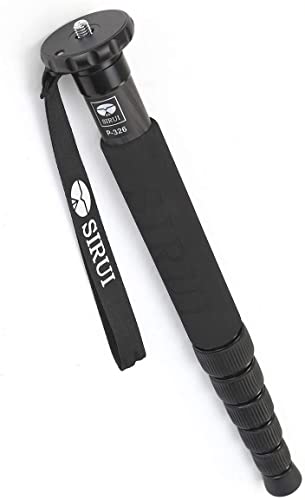
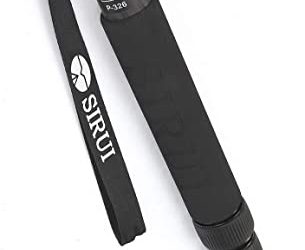
The Sirui P-326 is the lightest monopod in this guide and the easiest to pack. Six carbon fiber sections fold down to 15 inches, so the pole slips into a daypack beside a water bottle. It weighs 0.9 pounds yet carries up to 22 pounds, a ratio no aluminum pole here matches.
On the trail, the P-326 feels almost invisible until you need it. The silicon twist locks open with a quarter turn, the pole extends to 60.6 inches for eye-level use, and a wrist strap keeps it secure while you change lenses. The rubber foot grips wet stone and tile, with a retractable spike underneath for soft ground.
The P-326 ships without a head, so you mount your camera directly or add your own ball head, and its 60.6-inch height is shorter than the tallest poles here. Even so, if your priority is the lightest possible pole that still holds a real camera, this is the one to carry.
Specs
- Material: carbon fiber; Sections: 6; Max height: 60.6 inches; Folded length: 15 inches; Weight: 0.9 lb (400 g); Load capacity: 22 lb; Mount: reversible 1/4-inch and 3/8-inch screw; Locks: silicon twist locks; Foot: rubber with retractable spike; Head: not included.
2. Manfrotto XPRO Carbon Fiber Monopod MPMXPROC4US

The Manfrotto XPRO MPMXPROC4US is the tallest carbon fiber pole in this guide, built for photographers who shoot over crowds and fences. It extends to 64.76 inches, folds to 20.47 inches, and weighs 1.3 pounds. Four rigid carbon fiber sections carry a listed load of 20 kilograms, the highest in this guide.
The flip locks open with one hand, even with gloves, and the D-shaped tube profile stops the sections from twisting as you extend them. The dual 1/4-inch and 3/8-inch coaxial screw accepts a camera or a head without an adapter, and the rubber leg warmer gives you a secure grip in cold weather.
At 20.47 inches folded, it fits a full backpack rather than a small daypack. It also ships without a head, and the 20-kilogram load figure is the listing value, so treat it as a ceiling rather than a daily working load. For travelers who need height and rigidity above all else, the XPRO is the most capable carbon fiber monopod here.
Specs
- Material: carbon fiber; Sections: 4; Max height: 64.76 inches; Folded length: 20.47 inches; Weight: 1.3 lb; Load capacity: 20 kg; Mount: dual 1/4-inch and 3/8-inch coaxial screw; Locks: flip locks; Tube: D-shaped, anti-rotation; Grip: rubber leg warmer; UPC: 719821412380; Head: not included.
3. iFootage Cobra 3 C180F Monopod
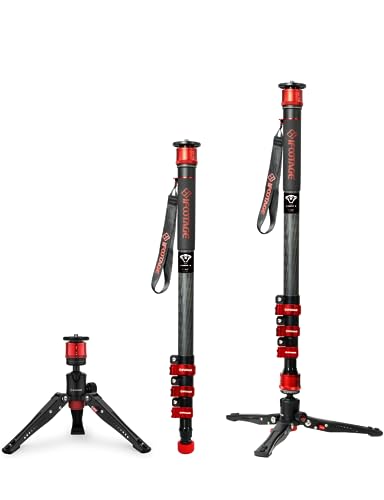
The iFootage Cobra 3 C180F is the most versatile monopod in this guide, and the only one with a folding tripod base that lets it stand on its own. It reaches 71 inches, the tallest height here, and folds to 27 inches. The carbon fiber body weighs 1.13 kilograms with a listed load capacity of 10 kilograms, and the base folds out so the pole can stand alone.
The base detaches, so you can use the pole as a simple monopod when you want to travel light, or add the base when you need hands-free stability. The flip locks are quick, the top plate uses an auto-convertible screw for 1/4-inch and 3/8-inch threads, and the pole doubles as a walking stick.
At 27 inches folded, the longest here, it needs a full backpack or an outside strap, and at 1.13 kilograms it is the heaviest carbon fiber model in this guide. Check availability before you order, because stock of this model has varied.
Specs
- Material: carbon fiber; Model: CB3 C180F; Max height: 71 inches (180 cm); Folded length: 27 inches; Weight: 1.13 kg; Load capacity: 10 kg; Base: detachable folding tripod base; Locks: flip locks; Mount: auto-convertible 1/4-inch and 3/8-inch screw; Minimum height: 28 inches; Use: travel, video, and outdoor shooting.
4. Manfrotto 290 Carbon Fiber Monopod MM290C4US

The Manfrotto 290 MM290C4US is the classic travel monopod. Four carbon fiber sections extend to 59.45 inches and fold to 19.29 inches, and the pole weighs 1.1 pounds. Flip locks adjust the height in seconds, the D-shaped tubes resist twisting, and a rubber grip keeps it comfortable all day.
One detail deserves an honest note. The Amazon listing quotes a load capacity of 22 pounds (10 kilograms), while Manfrotto’s own datasheet for the MM290C4 lists 5 kilograms (11 pounds). Treat 5 kilograms as the safe working load. Even so, the 290 handles a mirrorless body with a standard zoom or a short telephoto, which covers most travel kits.
The 290 ships without a head and has no folding base, so it will not stand on its own. What it offers is a proven, simple design from a maker with a long record in camera support. If your kit stays within the 5-kilogram working load, the 290 is a safe and satisfying choice.
Specs
- Material: carbon fiber; Model: MM290C4US; Sections: 4; Max height: 59.45 inches; Folded length: 19.29 inches; Weight: 1.1 lb; Load capacity: 10 kg (22 lb) as listed on Amazon, 5 kg (11 lb) per Manfrotto’s own datasheet — treat 5 kg as the safe working load; Locks: flip locks; Tube: D-shaped, anti-rotation; Grip: rubber leg warmer with angled wrist strap; Mount: 1/4-inch and 3/8-inch attachments; Head: not included.
5. NEEWER T222 Monopod
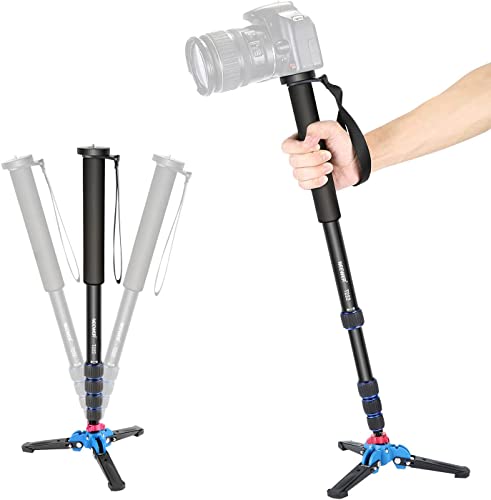
The NEEWER T222 is the budget-friendly pick in this guide, and it proves that a travel monopod does not need carbon fiber to be useful. The aluminum alloy body extends from 52 to 168 centimeters (20.5 to 66 inches), folds to 20.5 inches, weighs 1.3 pounds, and carries up to 5 kilograms. The detachable folding base gives it the same stand-alone ability as the iFootage at a much lower cost.
Five sections adjust quickly, the mounting screw reverses between 1/4-inch and 3/8-inch, and the base lets you set the camera down without laying the rig on the ground. The spike foot and rubber foot both come in the box, so you can swap them for pavement or soft earth, and a wrist strap and hex key are included.
Aluminum is heavier than carbon fiber for the same strength, and the T222 shows it: at 1.3 pounds it weighs more than the Sirui while carrying less, and the 5-kilogram load limit rules out the heaviest telephoto lenses. Even so, for a mirrorless kit or a DSLR with a standard zoom, the T222 is a capable travel companion, and the folding base makes it the most flexible low-cost option here.
Specs
- Material: aluminum alloy; Model: T222; Height range: 52–168 cm (20.5–66 inches); Folded length: 20.5 inches (52 cm); Sections: 5; Weight: 1.3 lb; Load capacity: 5 kg (11 lb); Base: detachable folding tripod base, 360-degree pan, 15-degree tilt; Mount: 1/4-inch screw, reversible to 3/8-inch; Foot: rubber and spike, both included; Included: wrist strap, hex key.
Which One to Choose
If you walk all day with a light mirrorless kit, the Sirui P-326 is the obvious carry: 15 inches folded, 0.9 pounds, and a 22-pound load limit. If you shoot over crowds, the Manfrotto XPRO at 64.76 inches is the strongest tall pole here. If you want a pole that stands on its own and reaches 71 inches, the iFootage Cobra 3 C180F is the most versatile, if your bag fits a 27-inch pole. The Manfrotto 290 suits kits within 5 kilograms, and the NEEWER T222 covers the basics well at the lowest cost.
The Benro SupaDupa MSD46C, Gitzo GM2542, and Manfrotto Element MII monopods are real products, but none has a verifiable Amazon listing with a confirmed ASIN, so they are not in this guide.
Travel Tips for Shooting with a Monopod
Pack the monopod where you can reach it. Strap it to the side of your daypack or keep it in a side pocket, and practice extending it until it takes seconds. Set the height before you raise the camera to your eye, and brace the foot against a railing, a rock, or a bench whenever you can.
Use the monopod with a slow shutter speed to blur water or crowds, and let the pole carry the lens while your hands stay relaxed. When you walk, collapse the pole and carry it by the grip, not by the camera. Check local rules before you shoot in museums, temples, and historic sites: many places that ban tripods allow a monopod, but a few ban all supports.
What is the best monopod for travel photography?
The Sirui P-326: it folds to 15 inches, weighs 0.9 pounds, and carries 22 pounds. For more height, the Manfrotto XPRO reaches 64.76 inches; for a pole that stands alone, the iFootage Cobra 3 C180F has a folding tripod base.
Can a monopod replace a tripod when traveling?
For most handheld travel work, yes: it removes vertical shake and carries a long lens. It cannot replace a tripod for very long exposures, night skies, or shots where the camera must stay perfectly still without your hands on it.
How much weight should a travel monopod carry?
Pick a load limit above your heaviest camera, lens, and head combination, with room to spare. A 22-pound limit covers most travel kits; 5 kilograms suits a mirrorless body with a standard zoom. Check that the listing and the maker’s datasheet agree — they do not for the Manfrotto 290 here.
Are carbon fiber monopods worth it for travel?
Yes, when you walk long distances: carbon fiber gives the same strength as aluminum at roughly half the weight. The Sirui and both Manfrotto carbon fiber models here weigh 0.9 to 1.3 pounds. Near your car or hotel, the aluminum NEEWER T222 saves money and still does the job well.
More from Amazon
Programs that pair well with the guide above. Offers and eligibility are set by Amazon and may change.
Free shipping on eligible items, Prime Video and more. Eligible new members can start with a free trial.
Start a Prime free trialAudiobooks and podcasts to listen to on the go. Eligible new members can start with a free trial.
Try Audible freeAd-free music streaming. Eligible new subscribers can start with a free trial.
Try Music Unlimited freeA free business account with business pricing and bulk-buying tools for work, shop or home office.
Create a business accountAs an Amazon Associate we earn from qualifying purchases.