
Our Top Picks
Two compact cinema cameras, two very different ideas about filmmaking. The Panasonic GH7 is a Micro Four Thirds hybrid that leans into high resolution video, open gate capture and internal RAW recording. The Sony FX30 is a Super 35 cinema camera built around the Cinema Line workflow, with a larger sensor, dual base ISO and the colour science of its bigger siblings. Both shoot beautiful 4K footage and fit in a small bag. The right choice depends on how you shoot and which lenses you own.


As an Amazon Associate, we earn from qualifying purchases.
At a Glance
The GH7 pairs a 25.2 megapixel Micro Four Thirds sensor with 5.7K open gate recording, internal Apple ProRes RAW, 32-bit float audio and strong stabilisation. It is a capable stills camera that happens to be a formidable video tool, with a fully articulating screen and a bright electronic viewfinder. The FX30 pairs a 26.1 megapixel APS-C sensor in Super 35 format with 6K oversampling for 4K, S-Cinetone and S-Log3, dual base ISO and a body designed from the ground up for video. It has no electronic viewfinder, because it is not trying to be a hybrid. Choose the GH7 for resolution, open gate, internal RAW and handheld work. Choose the FX30 for cleaner low light footage and a Sony cinema workflow.
Sensor and Image Quality
Sensor size is the first fork in the road. The GH7 uses a Micro Four Thirds sensor, roughly half the area of the APS-C sensor in the FX30. That smaller sensor gives a deeper depth of field at the same aperture, which helps documentary work and interviews. It also makes the camera and its lenses smaller and lighter, and it gives every lens a two times crop factor.
The FX30 uses a larger Super 35 sensor, and the difference shows in low light and in background separation. At the same aperture, the FX30 renders a softer background and holds cleaner shadows. Its dual base ISO design, with a second native sensitivity near ISO 2500 in S-Log3, keeps dim scenes cleaner. For night interiors, concerts and moody narrative work, that headroom is a genuine advantage.
Resolution favours the GH7. It records 5.7K open gate video, so you can crop a vertical version from the same take, plus 5.7K at up to 60 frames per second in ProRes RAW and 4K at up to 120 frames per second. The FX30 oversamples 6K down to 4K and records 4K at up to 120 frames per second, but it tops out at 4K and does not offer open gate capture.
Video Codecs and Recording
This is where the GH7 pulls ahead on paper. Internal Apple ProRes RAW at 5.7K, ProRes 422 HQ, and 32-bit float audio recording set it apart from almost every camera near its size. ProRes RAW gives you enormous latitude in post, letting you change white balance and exposure far more freely than a compressed codec allows. The 32-bit float audio, when used with a compatible adapter, means a sudden loud sound will not clip and ruin a take.
The GH7 also records open gate and anamorphic modes. Its dual slots take one CFexpress Type B card and one SD card for ProRes RAW and a backup. The FX30 records 4K in XAVC HS, XAVC S and XAVC S-I, including 10-bit 4:2:2 All-Intra, and it can output 16-bit RAW over HDMI to an external recorder. Its files are smaller and easier to edit, and its timecode sync, LUT import and Cine EI modes mirror the larger Cinema Line bodies.
Autofocus
Autofocus has long been a weak point for Panasonic, and the GH7 is the camera that finally closes the gap. Phase detection autofocus, with real-time recognition for humans, animals and vehicles, tracks subjects with confidence that earlier GH cameras could not match. Eye and face detection hold focus during interviews. It is not quite as sticky as the best Sony tracking in very fast scenes, but for most video work it is reliable.
The FX30 uses Sony Fast Hybrid autofocus with 759 phase detection points, plus real-time eye autofocus and tracking that locks onto a subject and follows it through the scene. In side-by-side use, the FX30 is a little quicker to acquire focus and a little more tenacious when a subject turns away and comes back. If you rely on autofocus, the FX30 holds a narrow lead, while the GH7 is now close enough that autofocus alone should not decide the purchase.
Stabilisation
Handheld shooting is a clear win for the GH7. Its 5-axis in-body stabilisation is rated to 7.5 stops, and when paired with a stabilised lens it smooths walking shots and handheld pans in a way that looks gimbal-like at wide angles. Active stabilisation adds an extra electronic layer for video, with a small crop.
The FX30 has no in-body stabilisation at all. It relies on lens stabilisation and on Active Mode, an electronic mode that crops the image to smooth movement. Active Mode works well, especially with a wide lens, but it cannot match the GH7 for walking shots or for handheld work with a non-stabilised prime. A GH7 rig can be small, light and fast to set up. An FX30 rig tends to grow, with a gimbal, cage and monitor adding weight and setup time.
Audio
Audio is another area where the GH7 aims high. Its 32-bit float recording, through the optional DMW-XLR2 adapter, captures a huge dynamic range without the need to set levels carefully. A whisper and a shout can live in the same take without clipping. The camera also offers a 3.5 mm microphone input and headphone output.
The FX30, in its base body-only form, offers a 3.5 mm microphone input, a headphone output and a multi-interface shoe. With the XLR handle unit, it gains two full-size XLR inputs with phantom power and physical dials. That handle is a separate purchase and adds height and weight, but it turns the FX30 into a proper two-channel field recorder. For solo creators using a single microphone or a wireless system, both cameras will do the job. For crews recording two microphones at once, the FX30 with its XLR handle is the more complete tool.
Handling, Ports and Battery
The GH7 feels like a stills camera that learned video. It has an electronic viewfinder, a fully articulating touch screen, a joystick and dual control dials. The body is weather sealed and the grip is deep and comfortable. The battery is the DMW-BLK22, shared with the S5 II and GH6, and USB-C power delivery lets you run the camera from a power bank.
The FX30 feels like a cinema camera in a small body. There is no viewfinder, so you compose on the touch screen or on an external monitor. The top carries multiple threaded mounting points, and the controls are laid out for video. The battery is the NP-FZ100, shared with many Sony cameras. Both cameras offer full-size HDMI, USB-C, microphone and headphone sockets, timecode sync, Wi-Fi, Bluetooth and USB streaming.
Lenses and Ecosystem
Lens choice may matter more than the body itself. The GH7 uses the Micro Four Thirds mount, with a huge range of lenses from Panasonic, OM System, Sigma, Olympus and many others. Lenses are small, light and often very affordable, and the two times crop factor turns a modest telephoto into a long lens. The trade-off is that fast wide angle lenses are less common and depth of field is deeper at the same aperture.
The FX30 uses the Sony E mount, one of the largest lens ecosystems in the world. Native Sony lenses, plus third party options from Sigma, Tamron and Samyang, cover every focal length and budget. The larger sensor means a 35 mm lens behaves like a true wide normal lens, and fast primes give you the shallow depth of field that many filmmakers want. If you already own E mount lenses, the FX30 is the natural choice. If you already own Micro Four Thirds lenses, the GH7 is the natural choice.
Who Should Choose Which Camera
Choose the Panasonic GH7 if you shoot handheld, travel light, want open gate and internal ProRes RAW, need strong stabilisation, or work alone and want the most forgiving camera in the pair. It is the better all-rounder and the better hybrid for stills and video.
Choose the Sony FX30 if you shoot in low light, want the shallowest depth of field, already own E mount lenses, work with a crew, or plan to move up to an FX3 or FX6 later. It is the better cinema-first tool and the better match for a Sony workflow. Both cameras will serve a working filmmaker well. Pick the one that matches the way you actually shoot, not the one with the longer spec sheet.
Our Picks for a GH7 and FX30 Kit
The two bodies below are the heart of this comparison. The three accessories that follow work with either camera.
1. Panasonic LUMIX GH7 Mirrorless Camera Body
The GH7 is the most capable Micro Four Thirds video camera Panasonic has made, with a 25.2 megapixel sensor, 5.7K open gate recording, internal ProRes RAW and 32-bit float audio.
Specs
- 25.2 megapixel Micro Four Thirds BSI CMOS sensor; 5.7K 60p open gate and 4K 120p video; internal Apple ProRes RAW; 32-bit float audio with optional adapter; 5-axis stabilisation rated to 7.5 stops; phase detection autofocus; CFexpress Type B and SD UHS-II slots.
2. Sony FX30 Cinema Line Camera Body
The FX30 brings Cinema Line colour, dual base ISO and fast hybrid autofocus to a compact Super 35 body. Its 26.1 megapixel sensor oversamples 6K to 4K, and S-Cinetone delivers pleasing skin tones with little grading.
Specs
- 26.1 megapixel APS-C Super 35 BSI CMOS sensor; 4K 120p video from 6K oversampling; 10-bit 4:2:2 recording; S-Cinetone and S-Log3; dual base ISO; Fast Hybrid autofocus; dual CFexpress Type A and SD slots; NP-FZ100 battery.
3. SmallRig VB99 Pro Mini V-Mount Battery
Long video days drain small camera batteries. A compact V-mount battery powers the camera through USB-C, plus a monitor, a light and a wireless microphone receiver from the same pack.
Specs
- 99Wh capacity, 6800mAh; 100W USB-C power delivery; D-TAP, USB-A and dual DC outputs; OLED status screen; compact mini V-mount form.
4. Sony MDR-7506 Professional Headphones
Good audio monitoring matters for video work. The MDR-7506 is a long running studio standard: closed earcups cut out background noise, the sound is clear and honest, and the folding design packs down small in a camera bag. Plug them into either camera and you will hear handling noise, wind and clipping before it ruins a take.
Specs
- 40 mm neodymium drivers; closed-back dynamic design; frequency response 10 Hz to 20 kHz; 63 ohm impedance; 9.8 foot coiled cable; 1/4 inch adapter included; folding design with soft case; weight 227 g.
5. Hollyland Lark M2 Wireless Lavalier Microphone Combo
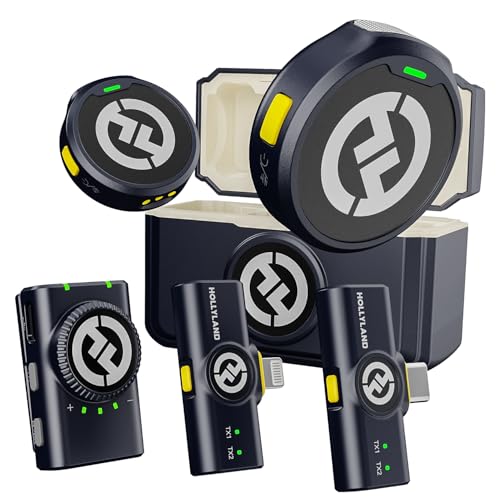
A wireless lavalier system lets you capture clean dialogue at a distance. The Lark M2 Combo includes two transmitters and receivers for camera, phone and computer, plus a charging case, so you can mic two people at once.
Specs
- Two transmitters and camera, USB-C and Lightning receivers; 48 kHz 24-bit audio; range up to 1000 feet in open space; noise cancellation; up to 40 hours total use with charging case; 3.5 mm camera output.
Verdict
The GH7 and the FX30 are both excellent cinema cameras, and neither is a clear winner for every shooter. The GH7 wins on resolution, open gate, internal RAW and stabilisation. The FX30 wins on low light, depth of field, autofocus and a cinema-first workflow. If you want one camera that does almost everything, pick the GH7. If you want a dedicated video camera that fits a Sony cinema kit, pick the FX30.
FAQ
Which camera is better for low light work, the GH7 or the FX30?
The FX30 is better in low light. Its larger Super 35 sensor and dual base ISO keep shadows cleaner at high sensitivity, while the GH7 needs more light or a faster lens to match it.
Can the GH7 and the FX30 both record 4K at 120 frames per second?
Yes, both cameras record 4K at up to 120 frames per second. The GH7 adds 5.7K open gate recording, while the FX30 oversamples 6K down to 4K.
Does the FX30 have in-body stabilisation like the GH7?
No, the FX30 has no in-body stabilisation. It relies on lens stabilisation and electronic Active Mode, while the GH7 offers 5-axis in-body stabilisation rated to 7.5 stops.
Which camera should a solo creator choose for documentary work?
A solo creator will often find the GH7 easier to live with. Its stabilisation, internal ProRes RAW and open gate framing give one person more room to capture a moment cleanly without extra crew.
More from Amazon
Programs that pair well with the guide above. Offers and eligibility are set by Amazon and may change.
Free shipping on eligible items, Prime Video and more. Eligible new members can start with a free trial.
Start a Prime free trialAudiobooks and podcasts to listen to on the go. Eligible new members can start with a free trial.
Try Audible freeAd-free music streaming. Eligible new subscribers can start with a free trial.
Try Music Unlimited freeA free business account with business pricing and bulk-buying tools for work, shop or home office.
Create a business accountAs an Amazon Associate we earn from qualifying purchases.









