
Our Short List of 3
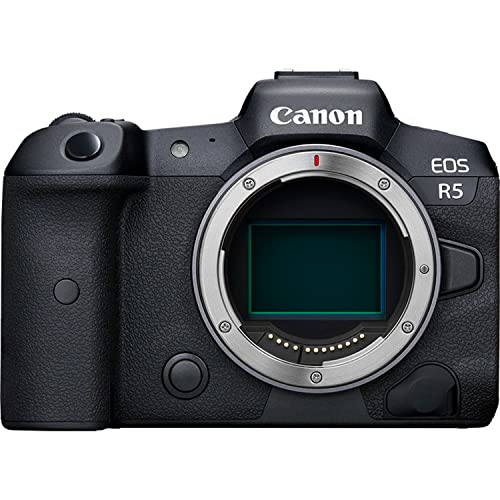
- 45MP full-frame CMOS sensor; DIGIC X processor; 8K DCI RAW up to 30p; 4K up to 120p; Dual Pixel CMOS AF II; 12 fps mechanical, 20 fps electronic; IBIS up to 8 stops; CFexpress Type B plus SD UHS-II slots.

- 61MP full-frame Exmor R CMOS sensor; BIONZ XR plus AI processing unit; 8K up to 24p; 4K up to 60p oversampled from 8.6K; Real-time Recognition AF; 10 fps with AF and AE tracking; IBIS up to 8 stops; dual CFexpress Type A and SD UHS-II slots.

- 128GB capacity; SDXC UHS-II; V60 video speed class; up to 280MB/s read, up to 200MB/s write; built for 6K and 4K UHD video; fits the SD slot of both cameras.
All 5 Picks at a Glance
| Product | Specs | Action |
|---|---|---|
| 1. Canon EOS R5 Body |
| Check price on Amazon |
| 2. Sony A7R V Body |
| Check price on Amazon |
| 3. SanDisk Extreme PRO SDXC UHS-II V60 128GB Memory Card |
| Check price on Amazon |
 4. SanDisk Extreme Portable SSD 1TB |
| Check price on Amazon |
 5. Peak Design Everyday Backpack 20L |
| Check price on Amazon |
Our Top Picks
Two of the most capable high-resolution mirrorless cameras sit on opposite sides of a familiar divide. The Canon EOS R5 pairs a 45MP sensor with 8K RAW video and the deep RF lens lineup, while the Sony A7R V counters with a 61MP sensor, a dedicated AI processing unit and a flexible 4-axis screen. Both aim at the same photographer: someone who wants enormous files for landscape, studio and commercial work, plus serious video.
There is no runaway winner. Each camera leads in different areas, and the right choice depends on how you shoot, which lenses you own and whether video or stills matter more. This guide compares resolution, autofocus, video, stabilization, battery life and handling, then looks at five products that fit either body.
As an Amazon Associate, we earn from qualifying purchases.
The Quick Verdict
If you want the highest resolution available in a full-frame mirrorless body and the smartest subject detection on the market, the Sony A7R V takes the lead. Its 61MP sensor delivers visibly more detail than the R5, and its AI unit recognizes people, animals, birds, insects, cars, trains and planes with confidence.
If you want the faster all-rounder, the Canon EOS R5 is the better pick. It shoots at up to 20 frames per second with the electronic shutter, records 8K RAW internally, and handles long sessions with a grip and control layout many photographers find more natural. Its 45MP files are also smaller and easier to work with.
In short: choose the A7R V for maximum detail and autofocus intelligence, and the R5 for speed, video flexibility and handling.
Resolution: 45MP vs 61MP
Resolution is the headline difference. The A7R V records 9504 x 6336 pixel files, while the R5 records 8192 x 5464, giving the Sony roughly 35 percent more pixels, which means more room to crop, larger prints and finer detail.
The A7R V also offers pixel shift multi shooting, combining 16 frames into one image of around 240MP for tripod-based studio work.
The R5 answers with a 400MP high-resolution mode of its own, and its 45MP sensor is no slouch. For prints up to A2 size and most commercial delivery, 45MP is more than enough, and the smaller files keep storage and editing lighter. A full day on the R5 can save tens of gigabytes over the same day on the A7R V.
Both sensors are back-illuminated full-frame designs. The Sony edges ahead in fine detail and cropping latitude, while the Canon edges ahead in file management and burst depth. If your work lives or dies by the crop, take the Sony. If you shoot volume, take the Canon.
Autofocus: Deep Learning vs Dedicated AI
Autofocus is where the gap is most interesting. The R5 uses Dual Pixel CMOS AF II with deep learning subject tracking for people, animals and vehicles. It locks onto eyes quickly, holds focus through erratic movement and rarely loses a subject once found, and for weddings, events and wildlife it remains one of the most dependable systems available.
The A7R V goes further. Its dedicated AI processing unit powers Real-time Recognition AF, which identifies a wider set of subjects and understands body posture as well as faces and eyes, so it can keep tracking a person who turns away, pick out a bird among branches, and hold focus on a small subject in a busy scene.
Both cameras cover nearly the whole frame with focus points and offer eye detection for humans and animals. The Canon feels slightly quicker to snap onto a subject at first, while the Sony feels stickier once it has a lock, and the difference shows mainly in demanding situations such as birds in flight.
Video: 8K RAW vs 8K With Smarter Tools
Video is the R5’s strongest argument. It records 8K DCI RAW internally at up to 30 frames per second, 4K at up to 120 frames per second, and oversampled 4K from the full sensor width, making it a genuine hybrid for filmmakers who also shoot stills.
The A7R V records 8K at 24 or 25 frames per second and 4K at up to 60 frames per second, oversampled from 8.6K capture, with 10-bit 4:2:2 recording and S-Log3, S-Cinetone and HLG profiles. What it lacks is the R5’s 8K RAW option and its 4K 120p mode.
Both cameras can run hot during long 8K takes, and neither suits uninterrupted hour-long recording, but for short clips, interviews and B-roll both perform well, with clean HDMI output and reliable video autofocus.
Where the Sony pulls ahead is in assist tools. Its 4-axis multi-angle screen tilts and flips in ways the R5 screen cannot, which helps at low angles or on a gimbal, and its active stabilization mode makes it a calmer handheld video camera. Where the Canon pulls ahead is raw capability: 8K RAW and 4K 120p give editors more to work with. If video is half your work, the R5 wins; if stills lead, the A7R V is capable.
Image Stabilization
Both cameras claim up to 8 stops of in-body stabilization, and both deliver genuinely useful handheld performance at slow shutter speeds, so you can shoot a 45MP or 61MP file at speeds that would have been unthinkable a few years ago and come away with sharp results.
The R5 coordinates IBIS with lens stabilization, while the A7R V uses a 5-axis system tuned for single-pixel sharpness.
In practice the two are close, and lens choice matters more than the body. The A7R V edges ahead in handheld video, the R5 in stills with its longest stabilized lenses. Call this round a draw.
Battery Life
Battery life favors the Sony. The A7R V uses the NP-FZ100 battery, rated for around 440 shots per charge with the viewfinder, and its USB-C port supports charging and power delivery while shooting.
The R5 uses the LP-E6NH battery, rated for around 320 shots per charge. The gap is real, though Canon shooters are used to carrying spares, and on a full wedding day the A7R V will usually need one fewer battery swap than the R5.
Handling and Ergonomics
Handling is the most personal part of this comparison. The R5 feels like a traditional DSLR that happens to be mirrorless: a deep grip, a familiar button layout, a top LCD panel, and a joystick plus a rear control dial under the thumb. Photographers coming from Canon DSLRs feel at home within minutes.
The A7R V feels more modern and compact. Its grip is improved over earlier Sony bodies and comfortable for long sessions, but it remains slimmer than the R5 grip, and photographers with large hands may prefer adding a grip. Its menu system is far better organized than older Sony menus.
The R5 uses a 3.2-inch vari-angle touchscreen with 2.1 million dots, which flips out for video. The A7R V uses a 3.2-inch 4-axis multi-angle touchscreen with 2.1 million dots, which tilts like a traditional screen and also swings out to the side, making it the more versatile tool for stills shooters who work at waist level.
Viewfinders are close: the R5 offers a 5.76 million dot OLED finder, the A7R V a 9.44 million dot finder with higher magnification. Build quality is a tie: both bodies are magnesium alloy, weather sealed, and built for professional use. The R5 weighs around 738 grams with battery and card, the A7R V around 723 grams.
The Cameras and the Kit That Fits Both
1. Canon EOS R5 Body
- 45MP full-frame CMOS sensor; DIGIC X processor; 8K DCI RAW up to 30p; 4K up to 120p; Dual Pixel CMOS AF II; 12 fps mechanical, 20 fps electronic; IBIS up to 8 stops; CFexpress Type B plus SD UHS-II slots.
The R5 is the speed and video champion of this pair. Its 45MP sensor, 20 frames per second electronic shutter and 8K RAW recording make it the more versatile hybrid. Choose it if you shoot action, weddings or video alongside stills, and if you value handling and burst speed over ultimate resolution.
2. Sony A7R V Body
- 61MP full-frame Exmor R CMOS sensor; BIONZ XR plus AI processing unit; 8K up to 24p; 4K up to 60p oversampled from 8.6K; Real-time Recognition AF; 10 fps with AF and AE tracking; IBIS up to 8 stops; dual CFexpress Type A and SD UHS-II slots.
The A7R V is the resolution and autofocus champion of this pair. Its 61MP sensor captures more detail than any other full-frame camera in this class, and its AI processing unit delivers subject recognition no rival currently matches. Choose it for landscape, studio, architecture or commercial work, where cropping latitude and autofocus intelligence matter more than burst speed.
3. SanDisk Extreme PRO SDXC UHS-II V60 128GB Memory Card
- 128GB capacity; SDXC UHS-II; V60 video speed class; up to 280MB/s read, up to 200MB/s write; built for 6K and 4K UHD video; fits the SD slot of both cameras.
This memory card fits both cameras at full speed, since each body has an SD UHS-II slot. With read speeds up to 280MB/s and write speeds up to 200MB/s, it handles high-resolution bursts and 4K video without slowing the buffer. Use it in either body while you decide which system to commit to.
4. SanDisk Extreme Portable SSD 1TB
- 1TB capacity; NVMe solid state drive; up to 1050MB/s read, up to 1000MB/s write; USB-C, USB 3.2 Gen 2; IP55 water and dust resistance; up to 2-meter drop protection.
High-resolution files fill cards fast, and this rugged portable SSD gives you a quick place to back up. It connects over USB-C to either camera system and to your laptop, moves files at up to 1050MB/s read, and shrugs off drops, dust and rain with an IP55 rated body and a carabiner loop.
5. Peak Design Everyday Backpack 20L
- 20L capacity; MagLatch top closure; dual side access; FlexFold dividers; fits a 15-inch laptop; weatherproof 400D nylon shell; holds a full-frame body plus 2 to 3 lenses.
This 20L backpack carries either body with two or three lenses, plus a laptop up to 15 inches. The MagLatch top opens wide for fast access, dual side openings let you grab a camera without taking the bag off, and FlexFold dividers shape themselves around whatever kit you pack. It works as a daily carry as well as a field bag.
Which Camera Should You Buy?
Buy the Sony A7R V if resolution is your top priority, if you crop heavily, if you shoot landscapes, studio portraits or architecture, and if you want the most advanced autofocus. Its 61MP files give you freedom no other camera in this class offers.
Buy the Canon EOS R5 if speed and video lead your work, if you shoot weddings, events, sports or wildlife, and if you want 8K RAW and 4K 120p. Its 45MP files are easier to manage and its burst rate is double the Sony.
If you already own RF lenses, the R5 is the obvious choice, and if you already own FE lenses, the A7R V is. Switching systems means replacing glass, and that expense dwarfs the difference between the bodies. Entering either system fresh, let your shooting style decide.
Frequently Asked Questions
Is 61MP noticeably better than 45MP for prints?
Yes, but only at large sizes or with heavy cropping. At common print sizes the two look very close. The A7R V advantage shows up in very large prints, in fine landscape detail and when you crop heavily.
Which camera is better for wildlife photography?
The R5 has the edge for fast-moving wildlife thanks to its 20 frames per second electronic shutter and deep buffer. The A7R V counters with stickier subject recognition, especially for birds, and far more room to crop a distant subject. If your subjects move fast, take the Canon; if they sit far away, take the Sony.
Can either camera replace a dedicated video camera?
For most hybrid shooters, yes. The R5 records 8K RAW and 4K 120p, while the A7R V records 8K and oversampled 4K 60p. Neither is built for continuous hour-long takes, but for interviews, B-roll and short films they are both serious tools.
Do I need new memory cards for these cameras?
You need fast cards to get the best from either body. A high-speed SD UHS-II card works in both cameras, while the R5 also benefits from a CFexpress Type B card and the A7R V from a CFexpress Type A card for its fastest modes. Plan on at least two cards so your workflow keeps up with the files.
Final Thoughts
This contest has no loser, only two different answers to the same question. Canon built the faster, more flexible hybrid with 8K RAW, 20 frames per second and handling that feels instantly familiar. Sony built the higher-resolution, smarter camera with 61MP of detail and autofocus that reads a scene like a second photographer. Match the camera to your work, and either body will serve you for years.
More from Amazon
Programs that pair well with the guide above. Offers and eligibility are set by Amazon and may change.
Free shipping on eligible items, Prime Video and more. Eligible new members can start with a free trial.
Start a Prime free trialAudiobooks and podcasts to listen to on the go. Eligible new members can start with a free trial.
Try Audible freeAd-free music streaming. Eligible new subscribers can start with a free trial.
Try Music Unlimited freeA free business account with business pricing and bulk-buying tools for work, shop or home office.
Create a business accountAs an Amazon Associate we earn from qualifying purchases.









