Key takeaways
- Discover the best lenses for Canon EOS Rebel T8i, from a fast 24mm wide-angle to long telephoto zooms, with crop-factor equivalents for every pick.
The Canon EOS Rebel T8i is a 24.1-megapixel APS-C DSLR that punches well above its entry-level billing. With Dual Pixel CMOS AF, a DIGIC 8 processor, 4K video, and a fully articulating touchscreen, it is a capable body for portraits, travel, wildlife, and everyday family photography. The kit zoom that ships with many T8i bundles is a decent way to begin, yet it leaves a lot of the sensor’s resolving power on the table. The right glass changes everything: sharper detail, cleaner low-light frames, softer backgrounds, and reach that a kit zoom cannot match.
Every lens below mounts directly on the T8i with no adapter: Canon EF and EF-S lenses both fit, as do third-party lenses built for the Canon EF mount. Because the T8i sensor is smaller than a full-frame sensor, every focal length gets multiplied by the 1.6x crop factor, so a 50mm lens frames like an 80mm lens on a full-frame camera.
As an Amazon Associate, we earn from qualifying purchases.
How the 1.6x Crop Factor Shapes Your Choice
Multiply any focal length by 1.6 to get its field of view on the T8i. A 24mm lens behaves like a 38mm lens, a natural wide-angle view for street scenes and interiors. A 35mm lens behaves like a 56mm lens, which sits in the classic portrait zone. A 100-400mm zoom behaves like a 160-640mm zoom, which is serious wildlife territory.
Two consequences follow. Wide-angle lenses need to be wider than you might expect: a 24mm lens is only moderately wide here, and a true ultra-wide view needs something in the 10-20mm range. Telephoto lenses, on the other hand, gain free reach: a 400mm lens frames like a 640mm lens on a full-frame body, a genuine advantage for birds and sports.
The T8i also rewards fast, quiet autofocus. Its Dual Pixel AF system tracks faces and eyes in live view and video, and it works best with lenses that focus smoothly and silently. Image stabilization matters too, especially on longer lenses and in dim light, because the T8i has no in-body stabilization of its own.
1. Canon EF-S 35mm f/2.8 Macro IS STM — Best for Macro and Close-Ups
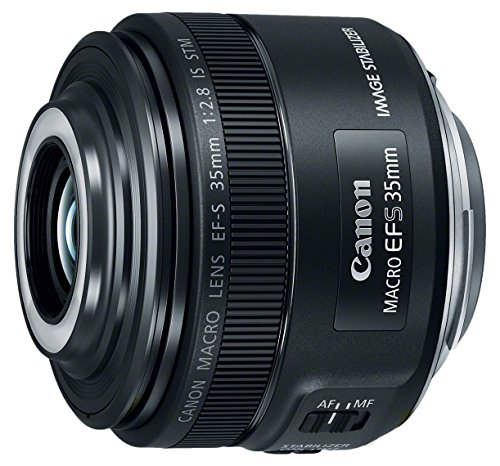
The Canon EF-S 35mm f/2.8 Macro IS STM is the most unusual lens on this list, and for many T8i owners it will be the most fun. It is a true macro lens that focuses down to 13 centimetres and reproduces subjects at life size, a 1:1 magnification that lets you fill the frame with a flower, a watch dial, or a plate of food. On the T8i it behaves like a 56mm lens, a flattering normal focal length for everyday shooting too, so this is not a one-trick lens that only comes out for close-ups.
What sets it apart is the built-in Macro Lite: a small LED ring around the front element that throws soft light onto subjects sitting just centimetres from the glass. In macro work the lens itself often blocks the light, and this ring solves that problem without extra gear. Hybrid Image Stabilization steadies the frame in stills and video, and the STM stepping motor focuses quietly. At 190 grams it is one of the lightest lenses Canon makes for this mount.
Use it for flowers, insects, food, jewellery, and product shots for a small shop. It also doubles as a compact walk-around prime: mount it, leave the zoom at home, and spend an afternoon learning to see like a 56mm lens sees. The f/2.8 aperture gives a gentle background blur for portraits, and the close focus isolates tiny details that a kit zoom renders as mush.
Specs: 35mm focal length (56mm equivalent on the T8i), f/2.8 maximum aperture, 1:1 maximum magnification, 0.13 m minimum focus distance, Hybrid IS, STM autofocus, 49mm filter thread, 190 g.
2. Canon EF 24mm f/1.4L II USM — Best for Low Light and Landscapes

The Canon EF 24mm f/1.4L II USM is a professional L-series prime that turns the T8i into a serious low-light camera. On the crop sensor it behaves like a 38mm lens, a versatile wide-normal view that suits landscapes, architecture, interiors, street photography, and environmental portraits. The f/1.4 aperture gathers far more light than any kit zoom, which lets you keep shutter speeds fast in dim rooms, churches, and evening streets without pushing the ISO into noisy territory.
Optically this is a flagship design: 13 elements in 10 groups, including two aspherical elements and two UD elements, with a coating that tames flare and ghosting when you shoot toward a window or a setting sun. The ring-type USM motor focuses quickly and allows full-time manual override, so you can nudge focus without flipping a switch. Weather sealing around the mount and controls adds confidence when the sky turns.
The 24mm focal length is also a good match for the T8i’s 4K video, where the camera applies an additional crop. A 24mm lens keeps your framing wide enough for vlogging and room tours even after that extra crop, while the f/1.4 aperture keeps backgrounds soft.
Specs: 24mm focal length (38mm equivalent on the T8i), f/1.4 maximum aperture, 13 elements in 10 groups, 0.25 m minimum focus distance, 0.17x maximum magnification, ring-type USM, weather-sealed construction, 77mm filter thread, 650 g.
3. Sigma 50mm f/1.4 DG HSM Art — Best for Portraits

Few focal lengths flatter a face like a short telephoto, and on the T8i the Sigma 50mm f/1.4 DG HSM Art behaves like an 80mm lens, the classic portrait focal length. That combination of an 80mm equivalent view and an f/1.4 aperture produces the creamy background blur that makes a subject stand out from a busy scene, without forcing you to stand across the room. Head-and-shoulders portraits, couples, and detail shots all fall naturally into this lens’s comfort zone.
The Art series earned its name through sharpness, and this lens delivers it from wide open. A moulded glass aspherical element keeps detail crisp across the frame, while the nine-blade rounded diaphragm keeps out-of-focus highlights round and smooth as you stop down. The Hyper Sonic Motor focuses fast and quietly, and full-time manual focus lets you fine-tune without changing modes.
Beyond portraits, this is a superb low-light lens for concerts, ceremonies, and evening events, where the f/1.4 aperture lets the T8i shoot at lower ISO settings and preserve colour and detail.
Specs: 50mm focal length (80mm equivalent on the T8i), f/1.4 maximum aperture, 13 elements in 11 groups, 9-blade rounded diaphragm, 0.40 m minimum focus distance, Hyper Sonic Motor, 77mm filter thread, 815 g.
4. Tamron 100-400mm f/4.5-6.3 Di VC USD — Best Lightweight Telephoto Zoom

Long lenses are usually heavy lenses, which is why the Tamron 100-400mm f/4.5-6.3 Di VC USD stands out. It weighs 1,115 grams and measures 193 millimetres long, making it the lightest lens in its class, and on the T8i it covers a 160-640mm equivalent range. That is enough reach for birds at a feeder, players on a distant field, and surfers off a beach, all from a lens you can carry on a strap all day without a monopod.
The optical design uses three low-dispersion elements and an eBAND coating to control flare and keep contrast high in harsh light. Vibration Compensation steadies the viewfinder image and the captured frame, which matters enormously at 400mm. The Ultrasonic Silent Drive focuses quickly and quietly, and a focus limiter switch restricts the focus range to distant subjects for faster acquisition when you track wildlife or sports.
For a T8i owner who wants to try wildlife or field sports without committing to a huge prime lens, this is the sensible middle ground. Pair it with the T8i’s 7 frames-per-second burst and its 45-point autofocus system, and you have a kit that can follow a moving subject across a field.
Specs: 100-400mm focal length (160-640mm equivalent on the T8i), f/4.5-6.3 maximum aperture, Vibration Compensation, USD autofocus, 1.5 m minimum focus distance, 1:3.6 maximum magnification, 67mm filter thread, 1,115 g.
5. Sigma 150-600mm f/5-6.3 DG OS HSM Contemporary — Best for Wildlife and Sports

When 400mm is not enough, the Sigma 150-600mm f/5-6.3 DG OS HSM Contemporary takes over. On the T8i it delivers a 240-960mm equivalent range, which brings a distant heron, a deer at the edge of a field, or a cyclist on a far bend right into the frame. Despite that reach it remains hand-holdable for short bursts, and its Optical Stabilizer offers four stops of correction to keep long shots steady.
The Contemporary line balances optical quality with a manageable size and weight. Twenty elements in 14 groups, including one FLD and three SLD elements, keep chromatic fringing under control at the long end, where cheaper super-telephoto zooms often fall apart. A Hyper Sonic Motor drives focus, and the lens offers full-time manual override plus a focus limiter. Dust- and splash-proof construction and a removable tripod foot round out a package built for field work.
This lens changes what a T8i can do outdoors. Mount it on a tripod at a hide or a sideline, set the camera to its fastest burst, and you can capture sequences of a bird taking off or a player striking a ball.
Specs: 150-600mm focal length (240-960mm equivalent on the T8i), f/5-6.3 maximum aperture, Optical Stabilizer, HSM autofocus, 2.8 m minimum focus distance, 1:5 maximum magnification, 95mm filter thread, 1,930 g.
How to Choose the Right Lens for Your T8i
Begin with the subjects you shoot most. If your days are filled with flowers, food, and small details, the 35mm macro opens a whole genre your kit zoom cannot touch. If you shoot indoors or at dusk, the 24mm f/1.4 or the 50mm f/1.4 will transform your results, because a wide aperture does more for image quality in dim light than any camera setting. If your subjects are far away, the Tamron 100-400mm or the Sigma 150-600mm will get you there, and the choice between them comes down to how much reach you need and how much weight you will carry.
Think about focal length in equivalents, not in barrel numbers. A 24mm lens is not ultra-wide on the T8i; it is a natural wide angle. A 50mm lens is not a normal lens here; it is a portrait telephoto. Write down the equivalent focal length of each lens you consider, and compare those numbers against the framing you already like in your own photos.
Weight and handling deserve a say too. The T8i is a light body, and a 1.9-kilogram super-telephoto changes how a day of shooting feels. Try the lens in a shop if you can, and be honest about whether you will carry it. A lens that stays at home takes no photographs. Finally, check that any third-party lens you buy is the Canon EF version, not the Nikon or Sony version.
Frequently Asked Questions
Can I use EF lenses on the Canon EOS Rebel T8i?
Yes. The T8i accepts both EF and EF-S lenses with no adapter. EF lenses are designed for full-frame cameras, so they work on the crop sensor with the 1.6x crop factor applied, while EF-S lenses are designed for APS-C cameras like the T8i and cannot be mounted on full-frame Canon DSLRs.
What focal length is best for portraits on the T8i?
A lens that behaves like an 80-135mm lens on a full-frame camera is ideal for portraits, which means a 50mm or 85mm lens on the T8i. The Sigma 50mm f/1.4 Art in this guide behaves like an 80mm lens, giving flattering proportions and smooth background blur for head-and-shoulders portraits.
Do I need image stabilization on a T8i lens?
The T8i has no in-body stabilization, so stabilization in the lens is the only kind you get. It matters most on telephoto lenses and in dim light, where it steadies handheld shots at slow shutter speeds. For wide-angle and normal primes shot in good light, you can work happily without it.
Is the T8i good for wildlife photography?
Yes, with the right lens. The 24.1-megapixel sensor captures fine feather and fur detail, the 7 frames-per-second burst follows action, and the 1.6x crop factor turns a 400mm lens into a 640mm equivalent. Pair the body with a long zoom like the Tamron 100-400mm or Sigma 150-600mm for the best results.
Final Thoughts
The Canon EOS Rebel T8i rewards good glass more than most entry-level bodies, because its 24.1-megapixel sensor and Dual Pixel AF system are ready for lenses far better than the kit zoom. The five lenses above cover the full range of what this camera can do: a 35mm macro for tiny worlds, a 24mm f/1.4 for dim rooms and wide landscapes, a 50mm f/1.4 for portraits, and two long zooms for wildlife and sports.
If you can only add one lens, choose the one that matches the subjects you already love to shoot, not the one that looks most impressive on paper. A macro lens for a gardener, a fast prime for a portrait shooter, a long zoom for a birdwatcher: the best lens is the one that gets used every week.
More from Amazon
Programs that pair well with the guide above. Offers and eligibility are set by Amazon and may change.
Free shipping on eligible items, Prime Video and more. Eligible new members can start with a free trial.
Start a Prime free trialAudiobooks and podcasts to listen to on the go. Eligible new members can start with a free trial.
Try Audible freeAd-free music streaming. Eligible new subscribers can start with a free trial.
Try Music Unlimited freeA free business account with business pricing and bulk-buying tools for work, shop or home office.
Create a business accountAs an Amazon Associate we earn from qualifying purchases.