Key takeaways
- Infrared resolution: 320 × 240 pixels
- Imaging: QuadIR multi-mode display system as named in the listing
- Measurement aids: hot spot tracking, cold spot tracking, live temperature readout
- Form factor: handheld with integrated display
- Temperature range: class-typical for a mid-range handheld — broadly ambient to several hundred degrees Celsius, which covers panels, cables and terminations comfortably
- Emissivity: user-adjustable, as expected in this tier
- Storage: on-device image capture
The best professional thermal imager for electrical work in 2026 is the Thermal Master Thor002 handheld with the 512 × 384 X³ sensor. Its higher native pixel count resolves individual breaker terminals, lug bolts and busbar joints from a safe working distance instead of leaving you squinting at an orange blob, and it sits in the mid-range tier rather than the premium bracket. It suits working electricians, maintenance technicians and inspectors who scan distribution boards, motor control centres and switchgear on a regular basis and have to document what they find. If your work is mostly residential panels and your budget is tighter, the GOYOJO GH192 at 240 × 240 with fusion imaging is the sensible entry point. If you do utility-scale, insurance-grade or industrial inspections where build quality, a larger screen and on-device reporting carry real weight, the FOTRIC Therm5 is the premium pick. Everything below is judged on the eight things that actually decide whether an imager earns its place in a tool bag: resolution, temperature range, accuracy, emissivity control, electrical safety features, image storage, reporting workflow and how well it survives life in a van.
Top 3 Picks
Best overall: Thermal Master Thor002 (512 × 384 X³ resolution). The extra resolution is the single biggest upgrade you can buy for electrical diagnostics, because most of what goes wrong in a panel happens at the scale of a terminal screw. It gives you a genuinely usable spot size at two to three metres, which is roughly where you want to be standing when a panel is energised. It is a mid-range tool with a premium sensor.
Best budget: GOYOJO GH192 (240 × 240 with fusion imaging). A standalone handheld at a budget-tier price that covers the core job — scanning for hot joints, overloaded breakers and loose neutrals — with a 25 Hz refresh rate that makes the image feel responsive rather than stuttery. Fusion imaging over a 2 MP visual camera means you can actually tell which terminal is hot in the saved picture.
Best premium: FOTRIC Therm5 (320 × 240 true IR, 3.2″ screen). The premium tier here is not about resolution — it is about build, screen size and the reporting side of the job. A 3.2-inch display makes a real difference when you are reading a 240-pixel image in a plant room with gloves on, and FOTRIC’s platform is aimed at people who file inspection reports rather than just look at them.
Best for smartphone-first workflows: Thermal Master P1 (USB-C, 320 × 240). If you already carry a modern phone and a decent case, the P1 is the cheapest way to get a genuine 320 × 240 sensor into your kit, with the phone doing the display, storage and sharing work.
Quick Comparison
All eight models below are real, currently listed thermal imagers that suit electrical work. Price tiers are general market bands only — the actual figure moves constantly, so treat “budget”, “mid-range” and “premium” as relative positions rather than numbers.
| Product | Best for | Key specs (per listing) | Price tier |
|---|---|---|---|
| RISION Magic | Standalone scanning with hot/cold spot tracking | 320 × 240 IR, QuadIR multi-mode imaging, hot and cold spot tracking, live temperature readout | Mid-range |
| Thermal Master Thor002 (512 × 384 X³) | Small-component detail in commercial and industrial panels | 512 × 384 X³ resolution, handheld form factor, multi-mode imaging | Mid-range |
| Thermal Master Thor002 (−4 °F to 1022 °F) | Wide-temperature diagnostics, motors and process heat | −4 °F to 1022 °F range (−20 °C to 550 °C), 5 imaging modes, handheld | Mid-range |
| Thermal Master P1 | Lowest-cost entry for phone-based workflows | USB-C for iOS and Android, 320 × 240 resolution, phone-powered display and storage | Budget |
| FOTRIC Therm5 | Premium build and on-device reporting | 320 × 240 true IR resolution, 3.2″ screen, handheld inspection platform | Premium |
| HSFTOOLS P2W | Wireless sharing and visual documentation | 640 × 480 super resolution, 8 MP visual camera, WiFi image transfer | Mid-range |
| GOYOJO GH192 | Budget standalone with usable frame rate | 240 × 240 super IR resolution, 2 MP visual camera, fusion imaging, 25 Hz | Budget |
| WEWECAR Mini Thermal Imager | Ultra-compact carry and HVAC crossover work | 240 × 240 infrared resolution, monocular handheld design, IR thermometer function | Budget |
How We Chose
This roundup is built from published specifications, listing documentation and the established conventions of the thermal imaging category — not from field trials. The selection criteria were chosen around what actually decides the outcome of an electrical inspection.
First, native infrared resolution, because it sets the smallest object you can measure accurately at a given distance. Second, temperature range and accuracy class, since most electrical work lives between ambient and roughly 150 °C while motor and process work pushes much higher. Third, emissivity control — a fixed 0.95 assumption is the single most common reason a scan produces a wrong number. Fourth, electrical safety features: usable standoff distance, a form factor that lets you scan without leaning into a panel, and image capture you can trigger without looking away from the target.
We also weighted category fit — whether a device is a standalone instrument or a phone accessory changes who it is for — along with storage and reporting workflow, and the upgrade path a buyer takes if their work grows from residential service into commercial and industrial maintenance. Brands with an established track record in thermal instrumentation were preferred, and nothing is included that is not currently listed.
1. RISION Magic – Best for Hot/Cold Spot Tracking
As an Amazon Associate we earn from qualifying purchases at no extra cost to you.

The RISION Magic is aimed at the electrician who wants a self-contained instrument — no phone, no tether, no app to open — and who spends a lot of a scan looking for extremes rather than reading every pixel. Its listing leads with 320 × 240 QuadIR imaging, hot and cold spot tracking, and live temperature readout, which together describe a workflow where the camera continuously flags the hottest and coldest point in frame while you sweep the panel. That matters more than it sounds. When you are moving across a row of twenty breakers, your eye is unreliable at catching which one is marginally hotter; an auto-tracking cursor does not get bored.
It suits commercial and light-industrial maintenance work, landlord electrical safety inspections, and anyone doing periodic thermal surveys of distribution boards. It is a mid-range device, so it is not competing on price with the budget tier — it is competing on the convenience of being a complete tool with its own screen and storage.
Key specs
- Infrared resolution: 320 × 240 pixels
- Imaging: QuadIR multi-mode display system as named in the listing
- Measurement aids: hot spot tracking, cold spot tracking, live temperature readout
- Form factor: handheld with integrated display
- Temperature range: class-typical for a mid-range handheld — broadly ambient to several hundred degrees Celsius, which covers panels, cables and terminations comfortably
- Emissivity: user-adjustable, as expected in this tier
- Storage: on-device image capture
The strongest argument for the RISION Magic is that the measurement features you use most often — spot tracking and live readout — are front and centre rather than buried in a menu. A 320 × 240 sensor is the resolution most working electricians settle on, because it is the point at which a lug at two metres stops being a smudge. Paired with tracking cursors, it turns a scan into a guided process: sweep, watch the cursor, capture when it stops moving.
The main limitation is the same one that applies to every 320 × 240 instrument. On a dense terminal block, or when you cannot get closer than three metres because of arc flash boundaries and PPE, you will be relying on interpolation more than you would like. And because the listing is not explicit about wireless transfer or PC software, you should assume the reporting step involves moving files manually unless you confirm otherwise before buying.
Pros
- Hot and cold spot tracking makes panel sweeps faster and less error-prone
- Live temperature readout without needing a second instrument
- 320 × 240 native resolution — the practical sweet spot for electrical work
- Fully standalone, so no phone dependency in the field
- Multi-mode QuadIR imaging gives you visual context alongside the thermal frame
Cons
- Not the highest resolution in this list, so small targets at long standoff suffer
- Reporting and transfer workflow is less clearly specified than on WiFi-equipped rivals
- Mid-range price for a sensor that budget models now approach
How it compares: against the Thermal Master Thor002 (512 × 384), the RISION Magic wins on guided measurement features and loses decisively on raw detail — if your panels are dense or your standoff is long, the Thor002’s extra pixels are worth more than spot tracking. Against the GOYOJO GH192, the RISION is the better instrument with the better sensor, but it costs roughly a tier more; for a sole trader doing residential work, the GH192 covers most of the same ground for less.
2. Thermal Master Thor002 (512 × 384) – Best Overall for Small-Component Detail

If you buy one thermal imager for electrical work and you want it to still be useful in five years, this is the one to shortlist. The listing specifies 512 × 384 X³ resolution in a handheld body, and that resolution figure is the whole story: it is roughly two and a half times the pixel count of a 320 × 240 sensor, and it translates directly into being able to measure smaller things from further away. In an electrical context, “smaller things from further away” is the entire job description.
It suits maintenance electricians in commercial and industrial settings, thermographic surveyors working to an inspection standard, and anyone who has to look at motor terminal boxes, busbar joints, contactor lugs and control-panel terminations where a 320 × 240 camera gives you a warm rectangle rather than a hot bolt. It is also the right pick for someone who is tired of buying tools twice — the resolution headroom means it will not feel outdated when their work shifts from light commercial into heavy industrial.
Key specs
- Infrared resolution: 512 × 384 X³
- Form factor: handheld with integrated display and controls
- Imaging: multi-mode thermal and visual presentation
- Target application: small-component detail at realistic working standoff
- Temperature range: class-typical handheld range, suitable for panels, cables and terminations
- Emissivity: user-adjustable with material presets
- Storage: on-device capture with removable media in this class
The practical advantage is easiest to see with numbers. A 320 × 240 sensor behind a typical wide lens resolves about 3 mrad per pixel; a 512 × 384 sensor behind a comparable lens resolves closer to 1.9 mrad. At three metres, that is the difference between a minimum reliable target of roughly 28 mm and one of roughly 17 mm. Seventeen millimetres covers an M8 lug, a terminal screw and most breaker connections. Twenty-eight millimetres does not reliably cover the lug itself — you are measuring the lug plus the air around it, and the air is cooler, which drags your reading down and can turn a genuine fault into a “probably fine”.
Beyond resolution, this is a conventional, well-specified handheld: adjustable emissivity, a display you can read in a plant room, and image capture you can trigger with the hand holding the tool. There is no exotic feature to explain, which is itself a point in its favour — the money has gone into the sensor.
Pros
- 512 × 384 native resolution is a genuine step change for small-target measurement
- Lets you keep a safer standoff distance while still resolving terminals
- Enough resolution headroom to stay useful as your work gets more industrial
- Adjustable emissivity, which is non-negotiable for bare metal work
- Handheld, self-contained, no phone or app in the loop
Cons
- Mid-range price is at the top of that band, and it is a real outlay for a sole trader
- Higher-resolution sensors produce larger files, so storage and transfer take longer
- Overkill if your work is genuinely limited to residential consumer units
How it compares: against the other Thermal Master Thor002 listing, which specifies the −4 °F to 1022 °F range and five imaging modes, the choice comes down to what you measure. If your work includes motors, bearings, process pipework or anything that runs hot, that variant’s wider range is the more valuable specification. If your world is panels and terminations that live between ambient and 100 °C, the higher-resolution version gives you more usable information per scan. Against the FOTRIC Therm5, this model has the better sensor while the Therm5 has the better screen, build and reporting platform.
3. Thermal Master Thor002 (−4 °F to 1022 °F) – Best for Wide-Temperature Diagnostics

This is the same Thor002 family, positioned around a different headline specification: a measurement range of −4 °F to 1022 °F, which is −20 °C to 550 °C, plus five imaging modes. That range is the reason to pick it over the resolution-focused variant. A 550 °C ceiling means you can point it at a stalled motor winding, a seized bearing housing, a failing contactor coil, a busbar joint under heavy load or a piece of process equipment and still be inside the calibrated range rather than staring at an over-range warning.
It suits industrial maintenance technicians, motor and drive specialists, and anyone whose electrical work sits inside a plant where heat is a process variable as well as a fault indicator. It also suits the electrician who does a bit of everything — panel work one day, mechanical fault-finding the next — and does not want to carry two instruments. The five imaging modes give you the flexibility to move between fully thermal, fully visual and blended views depending on whether you are measuring or explaining.
Key specs
- Temperature range: −4 °F to 1022 °F (−20 °C to 550 °C)
- Imaging modes: five, spanning thermal and visual presentations
- Form factor: handheld with integrated display
- Resolution: Thor002-class sensor
- Emissivity: user-adjustable with presets
- Storage: on-device image capture
- Typical electrical use: terminations, breakers, motors, coils, bearings, cable trays
The range matters more than people expect, and not only at the top end. The −4 °F floor is useful for outdoor switchgear in winter and for cold-storage electrical rooms, where a camera that only starts at 0 °C will refuse to give you a number. The 1022 °F ceiling puts motor windings, brake resistors and overloaded conductors well inside range. The risk of running a narrow-range camera in an industrial setting is not just an error message — it is that you push a camera past its calibrated band repeatedly and drift its accuracy without noticing.
Five imaging modes is more flexibility than most electricians use daily, but the useful ones are predictable: a full thermal view for measurement, a full visual view for locating the asset, a blended view for the report, and a picture-in-picture style view for tight targets. The extra mode is usually a variant on blending, which is harmless.
The trade-off is resolution. Where the 512 × 384 variant buys you smaller measurable targets at distance, this version buys you temperature headroom and mode flexibility. On a dense low-voltage panel at three metres, the difference is visible: you will be measuring larger areas than you would like. On a motor terminal box at one metre, it makes almost no difference.
Pros
- −4 °F to 1022 °F covers nearly every electrical and light mechanical target in one tool
- Five imaging modes make it easy to produce explanatory images as well as measurement ones
- Sub-zero floor is genuinely useful for outdoor and cold-environment electrical rooms
- Same Thor002 platform, so controls and workflow carry across the family
- Works as a crossover instrument for electrical and mechanical fault-finding
Cons
- Lower resolution than the 512 × 384 variant, which hurts small-target work at distance
- Wide range can tempt users into measuring shiny metal without correcting emissivity
- Five modes is more menu depth than a panel-only electrician needs
How it compares: the direct rival is the 512 × 384 Thor002, and the decision is unusually clean. Choose this one if your targets run hot, if you work outdoors in winter, or if you need to explain findings to non-technical clients with blended images. Choose the higher-resolution version if your targets are small, dense and low-temperature. Against the FOTRIC Therm5, this model offers a broader range and more modes, while the Therm5 counters with a larger screen and a more report-oriented platform.
4. Thermal Master P1 – Best Budget Smartphone Attachment

The P1 is the cheapest sensible route into real thermal imaging for electrical work. It is a USB-C module for iOS and Android with a 320 × 240 sensor, and it uses your phone as the display, the storage and the sharing layer. That architecture is why it costs what it costs: you are paying for the sensor and the optics, not for a screen, a battery, a processor or a housing. The resolution is the same 320 × 240 class as instruments costing considerably more.
It suits apprentices and newly qualified electricians building out a tool kit, sole traders who do occasional thermal checks rather than full survey work, and anyone who wants to try thermal before committing to a standalone instrument. It also suits the electrician who already carries a rugged phone and does not want another device with another battery to charge.
Key specs
- Connection: USB-C, compatible with iOS and Android devices
- Infrared resolution: 320 × 240
- Display and storage: provided by the connected phone
- Power: drawn from the host device
- Form factor: pocket-sized plug-in module
- Typical electrical use: consumer units, sockets, light fittings, small distribution boards
The value proposition is straightforward and genuinely good. A 320 × 240 sensor at budget-tier pricing, with your phone’s screen doing the work, is a lot of measurement per unit of spend. The phone also solves the reporting problem cheaply — images land in your camera roll or an inspection app, and from there they go into a report or a message to a client without any cable or card reader.
The compromises follow from the design. Your phone’s battery powers the module, so a long scan session drains both. A phone case with a thick lip can block the connector, and a phone in a heavy-duty case may need to come out. Phone screens are bright but reflective, which is awkward under plant-room lighting. And if you drop the phone, you lose the display, the storage and the camera in one event — a risk that does not exist with a standalone instrument.
There is also a workflow point. The module lives in a pocket and gets plugged and unplugged repeatedly, which puts wear on the USB-C port of your phone rather than on a replaceable accessory. For occasional use that is irrelevant; for daily use, it is a real consideration.
Pros
- 320 × 240 resolution at the lowest entry price in this roundup
- No separate battery, screen or charging routine to manage
- Images go straight into your phone, which simplifies sharing and reporting
- Small enough to live permanently in a tool bag or pocket
- Works across both iOS and Android via USB-C
Cons
- Drains phone battery, which is a problem on a full day of inspections
- Phone cases, gloves and bright screens all make handling more fiddly
- Dropping the phone costs you the instrument as well as the phone
- No integrated hot-spot tracking or ergonomic trigger like a handheld
How it compares: against the GOYOJO GH192, the P1 has the better sensor resolution but no integrated visual camera, no fusion mode and no standalone operation. If you want a tool you can hand to a colleague or use with wet hands in a plant room, the GH192 is the more robust answer. If you want maximum resolution per unit of spend and you are comfortable with a phone-centric workflow, the P1 is hard to beat. Against the RISION Magic, the P1 gives up ergonomics, spot tracking and standalone operation in exchange for a much lower price.
5. FOTRIC Therm5 – Best Premium Build and On-Device Reporting

The Therm5 is the premium option here, and it is worth being precise about what you are paying for. Its listing specifies 320 × 240 true IR resolution and a 3.2-inch screen. That is not the highest resolution in this roundup — the Thor002 512 × 384 beats it on pixels and the HSFTOOLS P2W claims more on super resolution. What the Therm5 sells is the instrument around the sensor: a larger display, a build aimed at daily professional use, and a platform oriented toward producing inspection output rather than just capturing images.
It suits full-time thermographic surveyors, in-house maintenance teams with a formal inspection schedule, insurance and compliance inspection work, and organisations where the deliverable is a report that has to stand up to scrutiny. It also suits the buyer who has already owned a budget camera, knows exactly what they need, and wants the last one they will buy for a while.
Key specs
- Infrared resolution: 320 × 240 true IR resolution
- Display: 3.2-inch screen
- Form factor: handheld inspection instrument
- Accuracy class: professional handheld — the ±2 °C or ±2 % of reading band that defines this tier
- Emissivity: user-adjustable with material presets
- Workflow: oriented toward on-device capture and structured reporting
The 3.2-inch screen deserves more credit than it usually gets. Reading a 320 × 240 thermal image on a small display, in a plant room, wearing gloves, with your arms extended, is genuinely difficult. A larger screen means less squinting, faster identification of which terminal is hot, and fewer repeat captures because you could not tell what you were looking at the first time. That compounds over a day of inspections into a meaningful productivity difference.
Build quality is the other half of the premium argument. Instruments in this tier are designed around a longer service life: better sealing against dust and moisture, more robust connectors, housings that survive being set down on a cable tray. For a device that spends its life in vans, plant rooms and substations, that is not a luxury.
The counter-argument is straightforward: on pure measurement capability per unit of spend, a mid-range 512 × 384 handheld gives you more usable data for less money. If your scans are mostly “find the hot joint, photograph it, move on”, the extra pixels will help you more than the larger screen. The Therm5 makes sense when the reporting side of the job — structured capture, consistent file naming, defensible records — is a substantial part of what you are paid for.
Pros
- 3.2-inch display is a real usability advantage in the field
- Professional-tier build intended for daily industrial use
- Platform designed around inspection reporting rather than casual imaging
- 320 × 240 true IR resolution — no software interpolation involved
- Adjustable emissivity with presets, as required for bare-metal measurement
Cons
- Premium price for a resolution that mid-range models exceed
- Heavier and bulkier than phone-attached or pocket-sized options
- Its advantages are workflow and durability, which are hard to appreciate until you have used a cheaper tool for a year
How it compares: against the Thermal Master Thor002 (512 × 384), the Therm5 loses on resolution and wins on screen, build and reporting. Against the HSFTOOLS P2W, the Therm5 offers true 320 × 240 resolution against the P2W’s software-enhanced 640 × 480 super resolution — native pixels and interpolated pixels are not the same thing, and for measurement work the native figure is the one that matters. The P2W counters with its 8 MP visual camera and WiFi transfer.
6. HSFTOOLS P2W – Best for Wireless Sharing and Visual Documentation

The P2W is built around two things electrical work needs more than people admit: a good visual image and an easy way to get the thermal image off the camera. Its listing specifies an 8 MP visual camera, 640 × 480 super resolution, and WiFi. The 8 MP visual camera is the underrated part. Thermal images are hard to interpret — a client or a colleague looking at an orange square cannot tell which breaker it is. Pairing the thermal frame with a high-resolution visual image, in fusion or side by side, is what makes a finding communicable.
It suits contractors who send findings to clients, in-house teams who file inspection reports into a shared system, and anyone doing multi-site work where images need to reach a laptop or a cloud folder without a cable. It also suits the electrician who is not the only person who has to understand the scan — if a site manager or a building owner has to act on your report, image clarity matters.
Key specs
- Infrared resolution: 640 × 480 super resolution
- Visual camera: 8 MP
- Wireless: WiFi image transfer
- Imaging: thermal, visual and blended presentation
- Emissivity: user-adjustable
- Form factor: handheld with integrated display
The critical caveat is the phrase “super resolution”. This is a software technique that reconstructs additional detail from multiple frames and the visual camera, producing a 640 × 480 output from a lower native sensor. It is genuinely useful — the blended image looks sharper, edges are cleaner, and the visual overlay makes faults easier to locate. But it is not the same as a native 640 × 480 detector, and for absolute temperature measurement on a small target, native resolution remains the honest metric. Where super resolution helps most is interpretation and reporting; where it helps least is resolving a 10 mm lug at three metres.
WiFi transfer is the second pillar. Moving images wirelessly means you can capture a panel, walk to the next board, and have the previous images already on a laptop. On a multi-board survey, that removes the end-of-day file-shuffling step that eats an hour. It also means you can send a photograph of a hot joint to a client from site, which is often the difference between a job approved today and a job approved next week.
The trade-off is complexity. Wireless features mean menus, pairing, app or software updates, and occasionally a connection that will not cooperate in a metal-clad plant room. A camera with no wireless features never has a wireless problem.
Pros
- 8 MP visual camera makes thermal findings far easier to explain
- WiFi transfer removes the cable-and-card step from reporting
- 640 × 480 super resolution produces clean, presentable blended images
- Strong fit for multi-site surveys and client-facing reporting
- Handheld form factor with integrated display
Cons
- Super resolution is not the same as native 640 × 480 measurement capability
- Wireless workflows add setup, pairing and software maintenance overhead
- Connectivity can be unreliable inside metal enclosures and plant rooms
How it compares: against the FOTRIC Therm5, the P2W offers a bigger visual sensor and wireless transfer, while the Therm5 offers true native 320 × 240 resolution, a 3.2-inch screen and a more inspection-focused platform. If your bottleneck is producing readable reports for other people, the P2W is the better fit. If your bottleneck is measuring small targets accurately, the Therm5’s native resolution is worth more. Against the GOYOJO GH192, the P2W is a clear step up in both visual imaging and workflow, at a corresponding step up in price.
7. GOYOJO GH192 – Best Budget Standalone Handheld
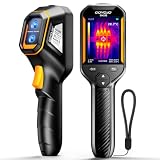
The GH192 is the budget pick that does not feel like a compromise. Its listing specifies 240 × 240 super IR resolution, a 2 MP visual camera, fusion imaging and a 25 Hz refresh rate. Of those, the 25 Hz figure is the one that separates it from the cheapest imagers on the market. Frame rate is the specification nobody lists and everybody notices: at 9 Hz the image lags behind your hand, which makes it hard to aim at a specific terminal; at 25 Hz it moves with you and the tool feels like a camera rather than a scanner.
It suits residential and light commercial electricians, landlords’ safety inspectors, HVAC technicians who also do electrical work, and anyone buying their first thermal imager. It is also a sensible second camera — a spare that lives in a van so you are never without one.
Key specs
- Infrared resolution: 240 × 240 super IR resolution
- Visual camera: 2 MP
- Imaging: fusion imaging, blending thermal and visual
- Frame rate: 25 Hz
- Form factor: handheld with integrated display
- Emissivity: adjustable in this class
- Typical electrical use: consumer units, sockets, light fittings, small three-phase boards
Fusion imaging at this price point is the second reason to consider it. Overlaying the thermal data on a visual image means the saved picture shows you which breaker it was, not just that something was warm. For anyone producing a report or sending a photo to a client, that transforms the usefulness of the output.
The 240 × 240 sensor is the honest limitation. Doing the IFOV arithmetic with a typical wide lens, a 240-pixel-wide sensor resolves around 4 mrad per pixel, which at three metres means the smallest reliable target — three pixels across — is roughly 36 mm. That is bigger than most terminals you care about. The practical answer is to work closer: at one metre, the same sensor resolves a reliable target of about 12 mm, which comfortably covers a breaker terminal. The GH192 rewards getting near the panel, which for a single-phase consumer unit is usually easy and for a large industrial board usually is not.
Two more realities of the budget tier: the housing and connectors are built to a price, so treat the USB port and the battery door as wear items, and the display will be smaller and less glare-resistant than on premium instruments.
Pros
- 25 Hz refresh rate makes aiming and scanning noticeably easier than 9 Hz rivals
- Fusion imaging over a 2 MP visual camera produces genuinely useful saved images
- Standalone handheld operation — no phone required
- Budget-tier price makes thermal imaging accessible for sole traders
- 240 × 240 resolution is adequate for close-range panel work
Cons
- 240 × 240 limits usable range — you must work close to the target
- Budget-tier housing and connectors will not take the abuse a premium instrument will
- Super IR resolution is not the same as a native detector at that size
How it compares: against the Thermal Master P1, the GH192 gives up sensor resolution and gains a visual camera, fusion imaging, standalone operation and ergonomics — for most working electricians, that is the better trade. Against the RISION Magic, the GH192 is a tier cheaper and a tier less capable: no spot tracking, fewer pixels, less refined. If you can stretch to the RISION, it is the better long-term instrument; if you cannot, the GH192 does the core job.
8. WEWECAR Mini Thermal Imager – Best Ultra-Compact Pocket Carry

The WEWECAR Mini is a monocular-style handheld with 240 × 240 infrared resolution and an infrared thermometer function, positioned as an HVAC tool as much as an electrical one. Its reason to exist is size and convenience: it is the imager you actually have with you, because it fits in a pocket rather than in a case in the van. In electrical work, the most common failure of a thermal imager is not being carried.
It suits service technicians who move between electrical and HVAC tasks, facilities staff doing routine walk-rounds, and anyone who wants a quick temperature check on a socket, a light fitting or a distribution board without unpacking a full inspection kit. The infrared thermometer function means it doubles as a spot-check tool for the tasks where a single number is enough — checking a radiator flow, a supply air temperature, or whether a breaker is running warm.
Key specs
- Infrared resolution: 240 × 240
- Form factor: compact monocular handheld
- Secondary function: infrared thermometer for spot temperature reads
- Positioning: HVAC tool with electrical crossover use
- Emissivity: adjustable in this class
- Typical use: quick checks, walk-rounds, HVAC diagnostics, socket and fitting inspection
The monocular layout is worth understanding before you buy. A single eyepiece display is compact and keeps the camera body small, but it means one eye is occupied and the other is not, which some users find tiring over a long survey and others find perfectly natural. It also makes it harder to show a colleague what you are seeing — you have to hand the device over rather than just turn a screen. For quick checks, neither matters. For a two-hour panel survey, a screen-based handheld is easier to live with.
The 240 × 240 resolution is the same class as the GH192, so the same IFOV arithmetic applies: you need to be close to small targets to measure them reliably. That is fine for a pocket tool used for spot checks and coarse scanning, and less fine for detailed termination-by-termination work.
Where it earns its place is in the carry habit. A device this small goes into a jacket pocket, comes out on every job, and gets used fifty times a year instead of five. That usage pattern catches far more developing faults than a better camera that stays in the van.
Pros
- Small enough to carry constantly, which is the real determinant of whether a fault gets found
- Doubles as an infrared thermometer for quick spot checks
- Monocular format keeps the body compact and light
- Budget-tier price makes it a low-risk addition to an existing kit
- Covers electrical and HVAC tasks with one device
Cons
- 240 × 240 resolution limits accurate measurement to close range
- Monocular eyepiece is harder to share and can tire the eye over long surveys
- No fusion imaging over a visual camera, so saved images are thermal-only
- Not a substitute for a full inspection instrument on formal survey work
How it compares: against the GOYOJO GH192, the Mini wins on portability and the thermometer function, and loses on fusion imaging and screen-based viewing. If you produce reports, the GH192’s blended images are more useful. If you want a device that is always on you, the Mini is the more likely to be there. Against the Thermal Master P1, the Mini is fully standalone and does not depend on a phone, but the P1’s 320 × 240 sensor resolves smaller targets.
How to Choose
Buying a thermal imager for electrical work comes down to a small number of decisions, and the marketing specifications are not the ones that matter most. Work through the criteria below in order and most of the shortlist eliminates itself.