Key takeaways
- 2100-joule surge rating, among the highest in this comparison
- 12 AC outlets in an extender layout
- USB charging built in, rated 20W
- Outlet-extender mounting so it sits against the wall rather than on the floor
- Anker’s power-protection warranty and connected-equipment coverage, as published by the brand
Top 3 Picks
The best surge protector for a TV is the Anker Power Strip with 2100J Surge Protector, Outlet Extender, 20W, 12 AC, because its 2100-joule rating sits at the top of this group while its outlet extender shape mounts flat against the wall behind a television. A close premium alternative is the Belkin 12-Outlet Surge Protector Power Strip with 8ft Flat Plug, which suits anyone who needs a long reach and a UL-listed heavy-duty cord. For the tightest budgets, the TESSAN Single Outlet Wall Surge Protector with 1050J replaces a single wall socket with surge protection for a modest outlay, which is all many single-TV setups actually require.
Quick Comparison
| Product | Best for | Key specs | Price tier |
|---|---|---|---|
| Anker Power Strip with 2100J Surge Protector, Outlet Extender, 20W, 12 AC | Best overall for a TV wall | 2100 joules, 12 AC outlets, USB charging, outlet-extender form, 20W USB | Premium |
| Belkin 12-Outlet Surge Protector Power Strip, 8ft Flat Plug | Long reach and heavy-duty cord runs | 12 AC outlets, 8 ft flat-plug cord, UL-listed, heavy-duty housing | Premium |
| ALESTOR Surge Protector Power Strip, 12 Outlets and 4 USB, 6 Ft | Many devices plus USB on one strip | 12 AC outlets, 4 USB ports, 6 ft cord | Premium |
| ECHOGEAR ShockBlocker 8 Outlet Surge Protector, Slim Design | Whole TV setup behind a slim console | 8 AC outlets, slim profile, wide-spaced outlets | Premium |
| Yintar 6Ft Surge Protector Power Strip, 6 Outlets & 3 USB, Black | Everyday TV corner on a mid budget | 6 AC outlets, 3 USB ports, 6 ft cord | Mid-range |
| SANUS On-Wall Low Profile 1080J Surge Protector, 6 AC | Wall-mount TVs with no floor access | 1080 joules, 6 AC outlets, on-wall low-profile mount, fire-resistant housing | Mid-range |
| Addtam Surge Protector, Outlet Extender, 5 AC and 4 USB, Black | Slim outlet extension beside a TV | 5 AC outlets, 4 USB ports, outlet-extender shape | Mid-range |
| QINLIANF Wall Charger, Surge Protector, 5 Outlet Extender with 4 USB | Small TV plus phone and tablet charging | 5 AC outlets, 4 USB ports, wall-mount extender | Budget |
| Cable Matters 1350J Single Outlet Surge Protector, White | Protecting one device at one socket | 1350 joules, single outlet, ETL-listed, white housing | Budget |
| TESSAN Single Outlet Wall Surge Protector, 1050J, Grey | Replacing a single wall socket cheaply | 1050 joules, single outlet, wall-mount, grey | Budget |
| YISHU Surge Protector Power Strip, 8 Widely Outlets & 4 USB, 6 Ft | Bulky adapters that overlap on other strips | 8 widely spaced outlets, 4 USB ports, 6 ft cord | Budget |
| HANYCONY Surge Protector Power Strip, 1080J, 5 Ft Braided Cord | Flexible routing along furniture edges | 1080 joules, braided 5 ft cord | Budget |
How We Chose
Televisions are unusual loads. They draw modest, steady power, but they sit at the center of a cluster of small electronics — streaming boxes, soundbars, game consoles, routers, lamps — and that cluster is what makes surge protector choice matter more than raw wattage. Our selection criteria started with joule rating, the standard measure of how much transient energy a protector can absorb before it fails. We treated 1000 joules as a reasonable floor for a single television and its accessories, and 2000 joules and above as generous headroom for a full entertainment wall.
Second, we weighed outlet layout. Wide-spaced or staggered outlets matter because TV setups attract brick-style power adapters and smart plugs that block neighboring sockets on a densely packed strip. Third, we considered cord length and plug style: a 5 to 8 foot cord gives enough slack to reach from a wall-mounted TV down to a baseboard or cabinet, while a flat plug lets furniture and panels sit flush. Fourth, we looked at wall-mount fit, since many modern setups hang on drywall with no shelf for a strip. Finally, we assessed protection for connected devices — coax or ethernet lines where present, USB charging ports, and whether the device includes a connected-equipment warranty. Category fit, upgrade headroom, and the reality of how each form factor behaves behind a television drove the final ordering. We did not test or benchmark these products; the criteria are based on published specifications, brand documentation, and established electrical-safety practice.
1. Anker Power Strip with 2100J Surge Protector, Outlet Extender, 20W, 12 AC — Best Overall for a TV Wall
As an Amazon Associate we earn from qualifying purchases at no extra cost to you.

Who it suits: a household with a television, soundbar, streaming stick, router, and a couple of chargers all within arm’s reach of one wall outlet. The outlet-extender form factor is the differentiator. Instead of a long strip lying on the floor, this device screws into the wall plate area and spreads outlets outward and downward, so adapters do not pile on top of each other.
Key specifications as stated by the listing:
- 2100-joule surge rating, among the highest in this comparison
- 12 AC outlets in an extender layout
- USB charging built in, rated 20W
- Outlet-extender mounting so it sits against the wall rather than on the floor
- Anker’s power-protection warranty and connected-equipment coverage, as published by the brand
Strengths
Joules are the headline. A 2100-joule rating gives meaningful margin for a large TV plus peripherals, and it means the metal-oxide varistors inside have more capacity to absorb repeated small surges over years of service. The extender shape solves a real problem in TV corners: floor strips collect dust, get kicked, and force you to bend behind furniture. Wall-mounted outlet extenders keep everything at outlet height and out of vacuum range.
The 20W USB output is genuinely useful here. Many people charge a phone or a tablet on the same wall as the TV, and having fast-enough USB power built into the surge protector removes a separate wall brick. Twelve AC outlets is more than most single-TV setups need, which means no daisy-chaining and no second strip.
Pros
- Very high 2100-joule rating for the category
- Wall-hugging extender layout keeps cords tidy behind a TV
- 12 outlets remove any temptation to chain another strip
- Built-in 20W USB charging replaces a wall adapter
- Brand-published connected-equipment coverage adds peace of mind
Cons
- Premium tier pricing for what is, electrically, a modest load
- The compact extender body concentrates outlets densely — large bricks can still crowd each other
- No long cord, so it must be installed at the wall rather than routed to a cabinet
Versus the nearest alternative
The Belkin 12-Outlet Surge Protector is the natural rival. Both offer 12 outlets and premium-tier pricing. The difference is physical: Belkin gives you an 8 foot flat-plug cord and a heavy-duty strip you place on the floor or in a cabinet, while Anker gives you a wall-mounted extender with a 2100-joule rating and USB. If your TV is on a stand with a cabinet below, Belkin’s reach wins. If your TV is wall-mounted or the outlet is behind the screen, Anker’s flat mounting wins.
2. Belkin 12-Outlet Surge Protector Power Strip with 12 AC Outlets & 8ft Flat Plug — Best for Long Reach and Heavy-Duty Cord Runs

Who it suits: anyone whose wall outlet is far from the equipment. Eight feet of cord is the practical answer when the TV sits on one side of a room and the only reachable outlet is across a doorway or behind a couch. This is also the pick for a heavy-duty installation — a media cabinet holding a TV, receiver, console, and router where the strip itself lives on a shelf.
Key specifications as stated by the listing:
- 12 AC outlets on a single strip body
- 8 foot cord with a flat plug, designed to sit flush behind furniture
- UL-listed as a heavy-duty extension and surge product
- Belkin’s published connected-equipment warranty, one of the more substantial in the category
Strengths
The UL listing is worth pausing on. Underwriters Laboratories listing means an independent body has evaluated the device against a recognized safety standard, which is more than can be said for a large share of unbranded strips. For a device that will sit behind a television absorbing surges for a decade, third-party listing is a legitimate tiebreaker.
The flat plug is a small feature with outsized benefit. Standard right-angle plugs still protrude; flat plugs let a cabinet or wall panel sit nearly flush against the wall, which matters when a TV stand is pushed back. Combined with 8 feet of cord, this protector can be placed where it is easy to reach and easy to see, rather than jammed into the only available socket.
Pros
- UL-listed construction
- 8 foot cord with flat plug solves awkward outlet placement
- 12 outlets support a full entertainment cabinet
- Strong brand reputation and published equipment warranty
Cons
- Premium tier pricing
- No USB ports, so chargers still need their own bricks
- It is a floor or shelf strip, not a wall-mount design — no help for a TV hung with no nearby surface
Versus the nearest alternative
Against the ALESTOR 12-outlet strip, Belkin trades USB ports for cord length, UL listing, and warranty depth. ALESTOR gives you four USB ports and a 6 foot cord at a similar tier; Belkin gives you two more feet, a flat plug, and the safety listing. If USB charging is the priority, ALESTOR is the more convenient device. If you want the most conservative, best-documented electrical product, Belkin is the safer recommendation.
3. ALESTOR Surge Protector Power Strip with 12 Outlets and 4 USB Ports, 6 Ft — Best for Many Devices Plus USB

Who it suits: a family TV setup where multiple people charge phones, tablets, and controllers on the same strip that powers the television. Twelve AC outlets plus four USB ports is the highest combined port count in this roundup, and it removes the need for any secondary charging station in the room.
Key specifications as stated by the listing:
- 12 AC outlets
- 4 USB ports for direct charging without adapters
- 6 foot power cord
- Compact strip body intended for floor, shelf, or cabinet placement
Strengths
Port density is the entire argument. A TV, soundbar, streaming device, game console, two lamps, a router, and a modem is eight devices — and that is before anyone plugs in a charger. With twelve AC outlets and four USB ports, this strip can absorb that load and still have room, which eliminates the single most common mistake in TV wiring: chaining one strip into another to gain outlets.
The six-foot cord is the practical middle ground. Long enough to reach from a wall outlet to a shelf or behind a stand, short enough that it does not coil into a mess. For most rooms, 6 feet is the sweet spot between the wall-mounted extenders and the 8-foot Belkin.
Pros
- Highest combined outlet and USB count here
- Eliminates daisy-chaining in busy rooms
- Six-foot cord suits most cabinet and shelf layouts
- USB ports cover phone and controller charging directly
Cons
- Premium pricing despite a mid-complexity layout
- Outlet spacing is not described as extra-wide, so brick adapters may overlap
- No wall-mount hardware — it is designed to sit on a surface
Versus the nearest alternative
The ECHOGEAR ShockBlocker is the closest comparison: both are premium strips aimed at a full TV setup. ECHOGEAR prioritizes outlet spacing and a slim profile that slides under or behind furniture; ALESTOR prioritizes raw port count and USB. Choose ALESTOR for station-style charging, and ECHOGEAR for tight, shallow spaces where a bulky strip will not fit.
4. ECHOGEAR ShockBlocker 8 Outlet Surge Protector Power Strip — Best for a Full Setup Behind a Slim Console

Who it suits: someone building a wall of electronics under a wall-mounted TV, where the strip needs to disappear. The slim design and wide outlet spacing are the two features that matter most in that scenario, and this protector is built around both.
Key specifications as stated by the listing:
- 8 AC outlets
- Slim, low-profile strip body
- Widely spaced outlets intended to accommodate large adapters
- Designed to power and protect an entire TV setup from one strip
Strengths
Wide spacing is an underrated feature. Transformer bricks and smart plugs are square and fat; on a standard strip, one brick can cover two or three neighboring outlets, silently cutting your usable capacity in half. A strip with genuinely wide-spaced outlets delivers the number of sockets it claims. For a TV area, where at least one brick (the TV itself, or a soundbar power supply) is common, this matters more than an extra outlet or two.
The slim body is the other half of the value. Thin strips slide behind low media consoles, fit under the lip of a sofa side table, and sit flat against the back panel of a cabinet. In a wall-mounted TV installation where there is no visible place for electronics, a slim strip can be mounted to the wall behind the screen.
Pros
- Widely spaced outlets preserve usable capacity
- Slim profile fits behind furniture and wall panels
- Right-sized 8-outlet count for a single TV setup
- Strong reputation for TV-oriented power accessories
Cons
- Premium tier pricing
- No USB ports
- No cord length advantage over standard strips
Versus the nearest alternative
Against the ALESTOR 12-outlet strip, ECHOGEAR gives up port count and USB in exchange for spacing and a slim footprint. Against the SANUS on-wall protector, ECHOGEAR is a surface strip rather than a wall-mounted unit — so if your TV hangs on drywall with no furniture beneath it, SANUS is the better physical fit even though its joule rating is lower.
5. Yintar 6Ft Surge Protector Power Strip with 6 Outlets & 3 USB Ports, Black — Best Everyday Mid-Range Pick
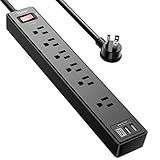
Who it suits: the ordinary living-room or bedroom TV corner. Six outlets covers a TV, a streaming box, a game console, a lamp, and two spare sockets; three USB ports covers a phone and a pair of headphones. Nothing here is overbuilt, and nothing is missing.
Key specifications as stated by the listing:
- 6 AC outlets
- 3 USB ports
- 6 foot cord
- Black housing
Strengths
The strongest argument for this strip is proportion. Overbuying outlets is common: people install a 12-outlet protector, use four sockets, and leave eight exposed to dust. Six outlets plus three USB is a realistic count for a television and its immediate companions, and the 6 foot cord handles the typical distance from a baseboard outlet to the side of a TV stand. Black housing hides better against dark furniture and behind black cable bundles than white or grey.
Pros
- Balanced outlet and USB count for a normal TV corner
- Six-foot cord covers most stand placements
- Mid-range tier pricing
- Black finish blends into dark furniture
Cons
- No wall-mount design
- Fewer outlets than the 12-outlet premium options if your setup grows
- USB output is not rated for high-wattage charging
Versus the nearest alternative
Compared with the Addtam outlet extender, Yintar is a floor or shelf strip with a cord, while Addtam replaces a wall outlet in place. Yintar wins when the outlet is behind furniture and hard to reach; Addtam wins when the outlet is visible and the television sits directly above it.
6. SANUS On-Wall Low Profile 1080J Surge Protector with 6 AC Outlets — Best for Wall-Mounted TVs
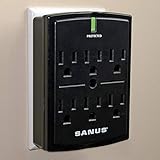
Who it suits: anyone with a television hung on drywall and no furniture beneath it. This is the specific problem this product exists to solve — a thin, on-wall surge protector that mounts directly to the wall and provides outlets plus three lines of protection where none exist.
Key specifications as stated by the listing:
- 1080-joule surge rating
- 6 AC outlets
- On-wall, low-profile mounting design
- Fire-resistant housing
- Three lines of protection (the standard hot, neutral, and ground paths)
Strengths
Physical form is the whole value proposition. When a TV is mounted on a wall, the cords for the TV, a streaming stick, and a soundbar all have to go somewhere, and the outlet is usually behind the screen where nothing else fits. An on-wall protector with a low profile solves this without requiring an electrician or adding an outlet. Fire-resistant housing is a meaningful detail in that location, where the device is pressed against the wall and often covered by the television itself.
The 1080-joule rating is moderate rather than exceptional, but it is honest for the job. A wall-mounted TV plus two or three small peripherals does not need 2000 joules. It needs a properly grounded three-line protector mounted where the cords actually are.
Pros
- Solves the wall-mounted TV outlet problem directly
- Low profile sits flat behind the display
- Fire-resistant housing for a covered installation
- Three lines of protection including ground
- Mid-range pricing for a specialty form factor
Cons
- 1080 joules is modest for a large entertainment wall
- Only 6 outlets and no USB
- Installed in place — no cord to relocate outlets to a more convenient spot
Versus the nearest alternative
The Anker 2100-joule extender is the obvious upgrade path if you want more joules and more outlets in a wall-adjacent package. Anker offers nearly double the joule capacity and twice the outlets; SANUS offers a genuinely low-profile mounting design and fire-resistant housing. For a display flush against drywall, SANUS is the better fit. For an outlet with a shelf nearby, Anker is the better protector.
7. Addtam Surge Protector, Outlet Extender with 5 AC and 4 USB Ports, Black — Best Slim Outlet Extension
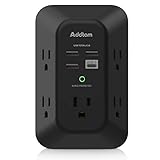
Who it suits: a bedroom or secondary TV where the wall outlet is visible and the goal is a tidy expansion rather than a floor strip. Five AC outlets plus four USB ports in a black extender body is a compact kit for a TV, a streaming stick, two chargers, and a lamp.
Key specifications as stated by the listing:
- 5 AC outlets
- 4 USB ports
- Outlet-extender form factor, black housing
Strengths
Four USB ports is generous for this size class. In a bedroom, the TV, a phone, a tablet, and a smartwatch can all charge from the same wall plate, and the five AC outlets remain available for the television and its accessories. The black finish is the practical choice behind most modern TVs.
The extender format keeps everything at outlet height. There is no cord to trip over, nothing to vacuum around, and nothing to slide under a rug. For a small room where floor space is at a premium, that is a real advantage over any strip.
Pros
- Compact outlet extender with no cord clutter
- Four USB ports for a small household’s charging needs
- Mid-range pricing
- Black housing disappears behind dark electronics
Cons
- The listing does not state a joule rating, so treat this as a convenience extender with surge protection rather than a high-capacity protector
- Only 5 AC outlets
- No cord, so it must be installed at the outlet itself
Versus the nearest alternative
Against the QINLIANF 5-outlet extender, Addtam is the mid-tier option with the same essential layout and a slightly higher price tier. If you need the absolute lowest cost for a secondary TV, QINLIANF is the budget equivalent; if you want the black finish and are willing to spend a little more for a similar design, Addtam is the pick.
8. QINLIANF Wall Charger, Surge Protector, 5 Outlet Extender with 4 USB Ports — Best Budget All-Rounder
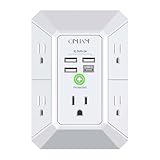
Who it suits: a small TV with a couple of gadgets attached, on the smallest reasonable budget. Five AC outlets and four USB ports in one wall-mounted extender is a lot of function for the money.
Key specifications as stated by the listing:
- 5 AC outlets
- 4 USB ports
- Wall-mounted outlet extender
Strengths
The port mix is the selling point. At the budget tier, most products give you either outlets or USB, not both in useful numbers. Here a television, a streaming device, a lamp, and two chargers fit on AC while four USB ports handle phones and accessories. The wall-mount format also means it works behind a TV mounted close to the wall, where a strip would not fit.
Pros
- Lowest-cost way to add both outlets and USB at a wall plate
- Four USB ports for a small setup
- Wall-mount extender keeps cords off the floor
Cons
- Budget construction — expect a lighter housing and less reinforcement than premium units
- The listing does not advertise a joule rating, so do not treat it as high-capacity protection for an expensive TV
- 5 outlets limits future expansion
Versus the nearest alternative
The Cable Matters and TESSAN single-outlet protectors each give you a stated joule rating — 1350J and 1050J respectively — which QINLIANF does not advertise. If you own a costly OLED or QLED panel and want documented protection, one of those two plus a separate USB charger is the more defensible budget route. If you want the most outlets and ports for the least money, QINLIANF is it.
9. Cable Matters 1350J Single Outlet Surge Protector, White — Best Single-Outlet Protection
![[ETL Listed] Cable Matters 1350J Single Outlet Surge Protector, White](https://m.media-amazon.com/images/I/31e0JpMEJvL._SL160_.jpg)
Who it suits: someone protecting exactly one device at one socket — a TV plugged into a wall outlet with nothing else nearby. It is the minimal, honest solution to a real problem.
Key specifications as stated by the listing:
- 1350-joule surge rating
- Single outlet
- ETL listed
- White housing
Strengths
A 1350-joule rating at a single outlet is a strong ratio. Because the entire varistor capacity is dedicated to one load, this device offers more protection per socket than a 1350-joule strip shared among twelve devices. The ETL listing provides independent safety verification, and the white housing suits light-colored walls and trim.
It also occupies almost nothing. For a wall-mounted TV where the screen sits close to the wall and the only cord to manage is the TV’s own, this is the cleanest possible answer: the protector hides entirely behind the display, and no outlets are wasted.
Pros
- High joule-to-outlet ratio
- ETL listed for independent safety verification
- Disappears behind a wall-mounted TV
- Budget pricing
Cons
- Only one outlet — accessories need their own protection
- No USB ports
- White shows dust and yellowing over many years
Versus the nearest alternative
The TESSAN 1050J single-outlet protector is the direct competitor, with a somewhat lower joule rating and a grey finish. Cable Matters wins on joules and listing; TESSAN wins on color for a dark wall. Either is a reasonable budget choice, and both are strictly single-device solutions — if you have more than one thing to plug in, step up to the QINLIANF or Yintar.
10. TESSAN Single Outlet Wall Surge Protector with 1050J Surge Protector, Grey — Best Budget Wall Socket Replacement

Who it suits: a renter or a spare-room TV where the goal is to add surge protection to one socket without buying anything elaborate. It mounts at the wall, replaces a plain socket visually, and protects one device.
Key specifications as stated by the listing:
- 1050-joule surge rating
- Single outlet
- Wall-mount design
- Grey housing
Strengths
It is the lowest-friction option in this list. There is no cord, no strip, no shelf space required — you plug it into the wall and plug the TV into it. The 1050-joule rating is modest but genuine, and adequate for a single television with a streaming stick. The grey finish is neutral against most wall paint and dark trim.
Pros
- Cheapest way to add surge protection at a single wall socket
- Wall-mounted, so it takes no floor or shelf space
- Grey finish suits most interiors
- Simple, no-configuration installation
Cons
- 1050 joules is the lowest rating in this roundup
- One outlet only
- No USB, no cord, no expansion
Versus the nearest alternative
Against the Cable Matters 1350J, TESSAN gives up 300 joules and the ETL listing in exchange for a lower price and a grey finish. For a cheap secondary TV, that trade is fine. For a primary television, spending slightly more on the Cable Matters unit or moving up to a multi-outlet protector is the better decision.
11. YISHU Surge Protector Power Strip with 8 Widely Outlets & 4 USB Ports, 6 Ft — Best for Bulky Adapters

Who it suits: anyone who has already been defeated by adapter overlap. If you have ever plugged in a TV power brick and watched it cover three sockets, widely spaced outlets are the fix, and this strip pairs that layout with four USB ports and a six-foot cord.
Key specifications as stated by the listing:
- 8 widely spaced AC outlets
- 4 USB ports
- 6 foot cord
Strengths
Widely spaced outlets change the arithmetic of a strip. A conventional 8-outlet strip with a large brick in every other socket may only give you four usable plugs. An 8-outlet strip with generous spacing gives you all eight. That is effectively double the capacity for the same outlet count, and it costs nothing extra.
Four USB ports on top of that covers charging without bricks at all, which reduces the number of large adapters competing for space in the first place. The 6 foot cord handles typical stand placements.
Pros
- Wide outlet spacing preserves full usable capacity
- Four USB ports reduce reliance on bulky adapters
- Six-foot cord for flexible placement
- Budget tier pricing with mid-tier outlet count
Cons
- Budget-tier construction
- No stated joule rating in the listing name, so confirm capacity before trusting it with an expensive panel
- No wall-mount design
Versus the nearest alternative
The ECHOGEAR ShockBlocker is the premium version of the same idea — slim and wide-spaced, at a much higher price tier. YISHU delivers the spacing benefit at budget pricing with fewer guarantees. If your priority is protecting a costly TV, ECHOGEAR’s premium build is the safer spend; if spacing is what you actually need, YISHU solves it cheaply.
12. HANYCONY Surge Protector Power Strip, 1080J, 5 Ft Braided Extension Cord — Best for Flexible Cord Routing

Who it suits: a setup where the strip needs to follow the edge of furniture or a wall corner. Braided cords resist kinking and abrasion better than smooth PVC, which matters when a cord is routed around a cabinet leg or along a baseboard rather than run in a straight line.
Key specifications as stated by the listing:
- 1080-joule surge rating
- 5 foot braided cord
- Strip body for floor or shelf placement
Strengths
The braided cord is the distinguishing feature, and it is a durability choice rather than a cosmetic one. A cord that bends around furniture edges repeatedly, gets pinched under a stand, or sits against a baseboard for years will eventually show wear at the stress points. Braided sleeving distributes that stress and resists the surface cracking that eventually exposes conductors on cheap cords.
The 1080-joule rating is a stated, moderate figure and enough for a television plus a couple of peripherals. The 5 foot cord is short but adequate when the strip lives directly beneath or beside the TV furniture.
Pros
- Braided cord resists kinking and abrasion
- Stated 1080-joule surge rating
- Budget tier pricing
- Compact 5-foot length suits close placements
Cons
- No USB ports
- 5 feet may be too short if the outlet is across the room
- 1080 joules is moderate for a large entertainment setup
Versus the nearest alternative
The YISHU 8-outlet strip offers more outlets, USB ports, and an extra foot of cord at the same budget tier, but a standard round cord. HANYCONY wins specifically on cord durability and on having a stated joule rating. If your strip lives on a shelf in one place, YISHU’s extra ports are more useful. If the cord has to bend around furniture, HANYCONY’s braiding is the better long-term choice.
How to Choose
Choosing a surge protector for a television is a short decision if you work through five variables in the right order: joule rating, connected equipment value, outlet layout, physical form, and cord length. Getting the order right prevents the two most common mistakes — overbuying capacity you will never use, and underbuying protection for equipment you cannot afford to replace.
Joule rating: how much is enough
The joule rating measures how much transient energy a protector can absorb before its protective components degrade and eventually fail. Higher is better, but there is a practical ceiling. For a single television with a streaming stick, 1000 to 1350 joules is a reasonable floor. For a television plus a soundbar, console, router, and modem — a full entertainment wall — aim for 2000 joules or more. Above roughly 2500 to 3000 joules, you are paying for capacity that a residential TV setup is unlikely to ever consume.
One important caveat: a surge protector’s joule capacity is consumed over time. After a major surge event, or after many years of small ones, a protector may absorb energy and stop protecting even though it still passes power. Better units include an indicator light that goes out when protection has been lost. If your strip has one, check it once a year. If it does not, replace a budget strip every few years as routine maintenance rather than waiting for a failure you will never see.
Match the protector to the value of what you plug in
This is the calculation that actually decides the purchase. A $120 budget TV in a spare room does not justify a premium protector; the protector would cost a meaningful fraction of the television. A large OLED panel, by contrast, costs enough that even a mid-range protector is cheap insurance. A rough rule: spend a small single-digit percentage of what the TV and its connected gear cost to protect them. That percentage lands most people in the mid-range tier for a primary TV and the budget tier for secondary screens.
Outlet count and layout
Count the devices before you shop, then add two. A typical primary TV setup runs eight to ten devices once you include the soundbar, console, streaming box, router, modem, and lamps. That argues for 8 to 12 outlets. Beyond count, look at spacing. Large power bricks can cover neighboring sockets, so a strip claiming 12 outlets may only deliver seven usable ones if the spacing is tight. Widely spaced or staggered layouts — and products designed around wall adapters — preserve the capacity you paid for.
| Setup type | Devices to protect | Suggested joules | Suggested outlet count | Form factor |
|---|---|---|---|---|
| Single wall-mounted TV | 1-2 | 1000-1400 | 1-6 | Single-outlet or on-wall |
| Bedroom TV, light charging | 3-5 | 1000-1400 | 5-8 plus USB | Outlet extender |
| Living room TV, streaming, console | 6-8 | 1400-2100 | 8-12 | Strip on shelf |
| Full entertainment wall | 9-12 | 2000-3000 | 12 plus USB | Strip or wall-mounted extender |
| Home theater with receiver | 10+ | 2500+ | 12 plus USB | Strip in cabinet |
Form factor and wall-mount fit
Where the protector physically lives determines which type to buy. If the television hangs on drywall with no furniture beneath it, you need an on-wall or outlet-extender design: a low-profile unit that mounts flat and hides behind the panel. If the TV sits on a stand with a cabinet, a strip placed inside the cabinet is easier to reach and easier to expand. If the outlet is in an awkward spot — behind a couch, next to a doorway — cord length becomes the deciding factor. Measure the distance from the outlet to where you want the strip before ordering. Six feet covers most rooms; eight feet covers awkward ones.
Wall-mount protections also have a thermal dimension worth mentioning. Any device tucked behind a television is enclosed and warm, and dust accumulates in that space. Fire-resistant or flame-retardant housings are a sensible specification for these locations, and cleaning behind a wall-mounted TV occasionally is a legitimate safety habit rather than fussiness.
Materials, build quality, and listings
Look for independent safety listings — UL or ETL — on any protector that will run continuously behind a television. These mean the device has been evaluated against a recognized standard for surge suppression devices. Cord construction matters too: braided sleeving resists the abrasion that eventually damages cords routed around furniture, and heavier gauge conductors handle sustained loads with less heating. Housing material varies from basic plastic to flame-retardant compounds; for wall-mounted installations behind a display, flame resistance is worth paying for.
USB ports: convenience or necessity
USB ports on a surge protector are convenience features rather than protection features. They charge phones, tablets, and accessories, and they reduce the number of wall adapters competing for outlet space — which indirectly helps outlet management. But USB output ratings vary widely, and inexpensive ports may charge slowly. Treat USB as a bonus, not as the reason to choose one protector over another. If fast charging matters, a dedicated wall adapter plugged into a protected outlet will outperform built-in ports.
What wears out first
Understanding the failure mode helps you judge value. The metal-oxide varistors inside a protector are sacrificial components: they absorb energy and degrade with each event, and once their capacity is exhausted, the protector becomes an ordinary power strip — it still passes electricity, but it no longer protects. Surge indicators exist to tell you when this has happened. Heat and dust are the other long-term factors: units tucked behind warm electronics accumulate dust that can trap heat, and cords that bend repeatedly at the same point fail before the electronics do. The practical maintenance routine is simple: vacuum behind the TV once a year, check any indicator light, and replace budget protectors every three to five years even if nothing appears wrong.
Common mistakes to avoid
- Daisy-chaining strips to gain outlets. Plugging one strip into another multiplies load on a single wall circuit and is the most common wiring error in TV setups. Buy enough outlets from the start.
- Buying only on joule count. A cheap 3000-joule strip with tight outlet spacing may be less useful than a well-built 1200-joule unit that fits where you need it.
- Ignoring the wall-mount reality. Buying a floor strip for a wall-mounted TV guarantees an unsightly cord and a protector balanced on trim or a shelf edge.
- Assuming surge protection lasts forever. It does not. Replacement is part of ownership.
- Confusing a power strip with a surge protector. A plain power strip has no protective components at all, regardless of how it looks.
Frequently Asked Questions
Does a TV actually need a surge protector?
Modern televisions contain sensitive power supply and logic circuitry that is vulnerable to voltage spikes, and a television sits on a wall circuit that also feeds other appliances. A surge protector is inexpensive relative to the cost of a panel replacement, so the case for using one is straightforward. It is not mandatory, and a TV on a well-behaved circuit may never experience a damaging event, but protection is cheap insurance.
Is 1000 joules enough for a TV?
For a single television with one or two small accessories, a rating in the 1000 to 1350 joule range is a reasonable baseline. If you are also protecting a soundbar, a console, a router, and a modem on the same strip, step up to 2000 joules or more. The rating should scale with both the number of devices and their value.
Do surge protectors expire?
Yes. The varistors that absorb surges degrade with each event, and once their capacity is exhausted the device behaves like a normal power strip. Units with a protection indicator light will show when this happens. Budget models without an indicator should be replaced every few years as routine practice.
Can I plug a surge protector into another surge protector?
You should not. Chaining protectors concentrates the electrical load on one wall circuit, can confuse the protection circuitry, and defeats the purpose of having outlets rated for the devices you own. If you need more sockets, buy a protector with more outlets instead of adding a second strip.
What is the difference between joule rating and clamping voltage?
Joule rating describes how much energy a protector can absorb over its life. Clamping voltage describes the threshold at which it begins to divert a surge — a lower clamping voltage means protection engages sooner. Both matter, and a product with a high joule rating paired with a low clamping voltage is generally preferable to one strong in only one measure.
Should I buy a wall-mounted surge protector or a floor strip?
It depends entirely on your installation. A wall-mounted or outlet-extender protector is the right answer when the TV hangs on drywall with no furniture beneath it, because it hides behind the panel and keeps cords off the floor. A floor strip is better when there is a cabinet or shelf, because it is easier to reach, easier to expand, and easier to clean around.
Are USB ports on a surge protector safe for phones and tablets?
Yes — the USB ports on a properly built protector deliver standard low-voltage charging and are not dangerous. The main limitation is speed rather than safety: built-in USB ports often charge more slowly than a dedicated fast charger. Treat them as a convenience for overnight charging rather than a replacement for a high-wattage adapter.
Do I need a protector with cable or ethernet protection?
If your television connects to the internet by coaxial cable or ethernet, surge protection on those lines closes a path that a power-only protector leaves open. For streaming-heavy setups and cable-fed TVs, a protector with coax or ethernet protection is worth the modest additional cost. If your TV uses Wi-Fi and a wall outlet only, that extra line protection adds nothing.
Final Recommendation by Situation
If you are protecting a primary television on a wall, buy the Anker Power Strip with 2100J Surge Protector — the highest joule rating here with an extender layout that keeps cords off the floor, and the safest overall recommendation for an expensive panel. If your outlet is far from your equipment and you want the most conservatively constructed option, the Belkin 12-Outlet Surge Protector with its UL listing and 8 foot flat-plug cord is the better fit. If a cabinet full of devices and a family of chargers is the reality, the ALESTOR 12-outlet, 4-USB strip gives you the most sockets in one place. And if your television is hung on drywall with nothing beneath it, skip the strips entirely and choose the SANUS on-wall protector — it is the only product in this list designed for exactly that installation. On a tight budget, the TESSAN single-outlet or the QINLIANF extender will do the job for a secondary screen; just do not expect a budget unit to carry a premium television for a decade without replacement.