Key takeaways
- Type: sit-on-top tandem
- Length: 13.6 ft
- Hull: rotomolded polyethylene — the standard for durability in recreational kayaks
- Seating: two molded/tunable seats
- Storage: rear tank well with tie-downs
- Best water: calm lakes, ponds, slow rivers
TL;DR
The best tandem kayak for most couples is the Perception Rambler 13.5 Sit-on-Top Tandem, a 13.6 ft rotomolded hull with tie-down storage that hits the sweet spot between stability, tracking, and weight for calm lakes and easy rivers. If you want to spend less and store the boat in a closet, the Niphean 12’6″ Inflatable Tandem is the value pick with a 500 lb capacity. If you fish or want to stand and cast, the BKC Brooklyn 13.0 Pro Tandem is the premium sit-on-top built for it. This guide compares twelve real tandem kayaks on length, weight capacity, hull stability, and transport needs so you can match a boat to how you actually paddle.
Top 3 Picks
Best Overall: Perception Rambler 13.5 Sit-on-Top Tandem
The Rambler 13.5 is the most balanced tandem here: long enough at 13.6 ft to track straight across a lake, wide enough to feel stable with two adults and a cooler, and light enough for two people to car-top without a trailer. It is a sit-on-top, so it self-drains and you can re-enter it from the water, which matters on bigger lakes. Rear tie-downs hold a dry bag and a soft cooler for a half-day paddle.
Best Budget: Niphean Inflatable Kayak 2 Person
At 12’6″ with a stated 500 lb capacity, the Niphean packs into a bag and inflates in minutes, which makes it the right answer for apartment dwellers, RV owners, and couples who paddle a handful of times a season. You trade hull stiffness and glide for portability and price. It suits calm lakes and slow rivers, not open water.
Best Premium / Fishing: BKC Brooklyn 13.5 Tandem Pedal Fishing Kayak
If your tandem is really a fishing platform, the Brooklyn 13.5 Pedal is the top of this list: a hands-free pedal drive lets one or both paddlers fish while moving, and the 13.5 ft hull carries two adults plus gear. It is heavy and expensive, and it needs a truck bed, roof rack, or trailer. For a couple who fishes tournaments or long days on the water, the trade is worth it.
Quick Comparison
| Product | Best For | Type & Length | Stated Capacity | Transport Reality | Price Tier |
|---|---|---|---|---|---|
| Perception Rambler 13.5 Tandem | All-around couples on lakes | Sit-on-top, 13.6 ft | Two adults + gear | Two-person car-top, ~65–80 lb class | Mid-range |
| Pelican Argo 136XP | Dry, stable sit-in paddling | Sit-in, 13 ft | Two adults + day gear | Two-person car-top, Ram-X shell | Premium |
| Perception Tribe Tandem | Recreation with big rear storage | Sit-on-top, 13.5 ft | Two adults + cooler | Two-person car-top | Mid-range |
| Perception Rambler 13’6″ (Sunset) | Stable rec paddling, sunset finish | Sit-on-top, 13’6″ | Two adults | Two-person car-top | Premium |
| BKC Brooklyn 13.0 Pro Tandem | Fishing 2–3 people | Sit-on-top fishing, 13 ft | Two adults + tackle | Roof rack or truck bed, heavy | Premium |
| Niphean 12’6″ Inflatable Tandem | Budget portability | Inflatable, 12’6″ | 500 lb | Fits in a duffel/trunk | Budget |
| TIGERXBANG 12’8″ Inflatable Tandem | Family lake days on a budget | Inflatable, 12’8″ | Two adults + child | Fits in a bag | Budget |
| Starcity Inflatable Tandem | Wide, stable touring | Inflatable, ~12 ft, 36 in wide | 600 lb | Fits in a bag | Budget |
| BKC Brooklyn 13.5 Pedal Tandem | Hands-free fishing | Sit-on-top pedal, 13.5 ft | Two adults + gear | Trailer/truck, very heavy | Premium |
| Lifetime Spitfire 12T | Turnkey couple kit | Sit-on-top, 12 ft | Two adults | Two-person car-top, includes paddles | Mid-range |
| Brone Inflatable Tandem Set | Complete starter bundle | Inflatable, ~12 ft | Two adults | Ships with pump, bag, paddles | Budget |
| BKC Brooklyn 12.5 Tandem | Entry-level fishing tandem | Sit-on-top, 12.5 ft | Two adults + light gear | Two-person car-top | Mid-range |
How We Chose
We built this list from manufacturer specifications, published hull dimensions, and how each boat is positioned in the tandem category — not from paddling them ourselves. The core criteria were length, beam, stated weight capacity, hull material, and seated layout, because those four or five numbers decide whether a tandem works for a given couple. Length drives tracking and speed; beam and hull shape drive stability; capacity decides whether two adults plus a cooler and a dog are safe or overloaded; and weight decides whether you can actually get the boat on the roof. We also weighted category fit: a fishing couple needs different features than a couple who just wants quiet lake laps. Finally, we looked at upgrade path — does the boat leave you room to grow into longer trips or fishing, or will you outgrow it in one season? Every product here is a common, currently listed tandem from a recognizable brand, so parts, paddles, and accessories stay available.
1. Perception Rambler 13.5 Sit-on-Top Tandem – Best for All-Around Couples
As an Amazon Associate we earn from qualifying purchases at no extra cost to you.

The Rambler 13.5 is the tandem most couples should start with. It is a sit-on-top recreational kayak at 13.6 ft, which is long enough to hold a straight line on a lake without being so long that it is a pain to store. Sit-on-top means no cockpit to bail: water that washes over the deck drains out through scupper holes, and if you flip it on a warm day you can climb back on. That combination is exactly what a couple paddling calm lakes and gentle rivers wants.
Who it suits
Two adults chasing flat-water exercise, birdwatching, and half-day outings. It is also a good fit for a parent plus a child, since the sit-on-top deck is forgiving and easy to remount. The rear storage with tie-downs handles a dry bag, a soft cooler, and a small tackle box.
Key specs
- Type: sit-on-top tandem
- Length: 13.6 ft
- Hull: rotomolded polyethylene — the standard for durability in recreational kayaks
- Seating: two molded/tunable seats
- Storage: rear tank well with tie-downs
- Best water: calm lakes, ponds, slow rivers
Strengths
- Length-to-beam ratio gives it decent glide for a recreational hull, so paddling two-up is not a slog.
- Self-draining deck and easy re-entry — the safest setup for beginners on open lakes.
- Tie-down storage is genuinely usable, not decorative.
- Rotomolded polyethylene handles scrapes on gravel launches and rocky riverbanks without drama.
Pros
- Balanced length and stability for couples
- Self-bailing, easy to remount
- Good resale because Perception is a well-known recreational brand
- Fast to launch — no cockpit covers, no sponges
Cons
- Sit-on-top means a wetter, breezier ride than a sit-in, which shortens the shoulder seasons.
- Heavier than an inflatable when you have to carry it alone.
- No rudder or pedal option — you steer by paddle.
How it compares
Against the Perception Tribe Tandem, the Rambler 13.5 is the all-rounder while the Tribe leans toward recreation with a bigger rear storage layout — pick the Tribe if you carry more gear. Against the Pelican Argo 136XP, the Rambler is a sit-on-top and the Argo is a sit-in: choose the Rambler for warm-weather, wet-fun paddling and the Argo if you want a drier cockpit and more wind protection.
2. Pelican Argo 136XP – Best Sit-In Tandem for Dry Paddling

The Argo 136XP is the sit-in option here, and that matters. A sit-in cockpit shields your legs from wind and spray and keeps you drier on cool mornings, which extends your paddling season on both ends. It is built from Pelican’s patented Ram-X material, a multi-layer polyethylene that Pelican has used for years in recreational boats, and it is a 13 ft hull — long enough to track well with two paddlers.
Who it suits
Couples who paddle cool lakes, early-spring and late-fall water, or simply prefer a drier ride. Also a good pick for paddlers who like the enclosed feeling of a cockpit and want a bit more glide than a short sit-on-top gives.
Key specs
- Type: sit-in tandem
- Length: 13 ft
- Material: patented Ram-X™ multi-layer polyethylene
- Profile: lightweight and stable, per manufacturer positioning
- Best water: lakes and calm rivers; not surf or whitewater
Strengths
- The sit-in cockpit is warmer and drier — a real advantage on shoulder-season paddles.
- 13 ft length tracks well with two people, so you spend less energy correcting.
- Ram-X hull resists abrasion and UV, which matters if the boat lives outdoors.
- Pelican’s recreational lineup has strong parts and accessory availability.
Pros
- Dry, warm ride for cool-water paddling
- Good tracking at 13 ft
- Durable, UV-resistant hull material
- Popular enough that aftermarket seats and covers are easy to find
Cons
- A sit-in cockpit holds water if you swamp it — you need a bilge pump and float bags for open water.
- Harder to re-enter from the water than a sit-on-top.
- More care needed: dry the cockpit after every paddle to avoid mildew on the seats.
How it compares
Versus the Perception Rambler 13.5, this is the dry-weather trade: the Argo keeps you warmer and drier but is harder to recover, while the Rambler self-bails and is easier to remount. Versus the Lifetime Spitfire 12T, the Argo is longer and more efficient for two adults, while the Spitfire is shorter, comes as a turnkey kit with paddles, and is easier to maneuver in tight coves.
3. Perception Tribe Tandem – Best for Recreation with Big Rear Storage

The Tribe Tandem is Perception’s recreational sit-on-top tandem at 13.5 ft, and its calling card is a large rear storage area with tie-downs. If your version of a tandem kayak day involves a cooler, a dry bag, a beach blanket, and a change of clothes, the Tribe gives you somewhere to put all of it without stacking gear on your lap.
Who it suits
Couples doing full-day lake outings and river floats who carry a lot of stuff. It is a recreation-first boat: think picnics at a sandbar, fishing from a stable platform, and lazy downstream drifts.
Key specs
- Type: sit-on-top tandem
- Length: 13.5 ft
- Finish shown: Sunset
- Storage: large rear tank well with tie-downs
- Best water: calm lakes, slow rivers
Strengths
- The rear storage is the roomiest in the Perception rec tandem lineup here — good for cooler-plus-gear days.
- Sit-on-top deck drains and is easy to climb back onto.
- 13.5 ft gives a good stability-to-tracking compromise for two paddlers.
- Rotomolded polyethylene construction shrugs off launch-ramp abuse.
Pros
- Excellent gear capacity for a rec tandem
- Stable, forgiving platform for beginners
- Simple, low-maintenance design
- Well-known brand with strong resale
Cons
- Recreational hull — it is not a fast touring boat, and two strong paddlers will notice.
- Sit-on-top ride is wet and cool in shoulder seasons.
- Heavier than an inflatable to store and carry.
How it compares
Against the Rambler 13.5, the two are close in length and type; the Tribe is the pick if storage volume is your priority, and the Rambler is the pick if you want the most balanced all-rounder. Against the BKC Brooklyn 12.5, the Tribe is longer and more efficient for pure paddling, while the Brooklyn is set up for fishing.
4. Perception Rambler 13’6″ (Sunset) – Best Premium Sit-on-Top for Stable Rec Paddling

This is the Rambler platform in a 13’6″ sit-on-top configuration finished in Sunset, listed at the premium tier. It is the same core idea as the Rambler 13.5 — a long, stable, self-draining recreational tandem — packaged in a slightly different trim and colorway. For a couple who wants a proven, low-maintenance lake boat and does not mind paying for the brand’s build quality, this is the straightforward choice.
Who it suits
Couples who want a durable, no-fuss sit-on-top and expect to keep it for a decade. Also a good fit for a vacation-rental owner or a family that will hand the boat between paddlers of different sizes, since sit-on-top seating adjusts easily.
Key specs
- Type: sit-on-top tandem for recreation
- Length: 13’6″
- Finish: Sunset
- Hull: rotomolded polyethylene
- Best water: lakes and gentle rivers
Strengths
- 13’6″ is the sweet spot where stability and tracking both feel right for two adults.
- Self-draining deck and easy remount — beginner-friendly and safe on open water.
- Perception’s build quality and parts ecosystem mean long-term serviceability.
- Colorway and trim make it a nicer-looking boat than the base rec options.
Pros
- Proven, durable hull
- Stable enough for new paddlers, long enough for fitness paddling
- Simple maintenance — rinse, dry, store
- Strong brand support and resale value
Cons
- Premium-tier price for a recreational hull; you are paying for brand and trim.
- No pedal drive or rudder option.
- Heavy to car-top solo.
How it compares
Against the Rambler 13.5 (mid-range), this is essentially the same boat with different trim and tier — if budget matters, the mid-range version does the same job. Against the BKC Brooklyn 13.0 Pro, the Rambler is a pure paddling boat while the Brooklyn adds fishing-specific rigging and a higher weight ceiling for gear.
5. BKC Brooklyn 13.0 Pro Tandem – Best for Fishing Couples
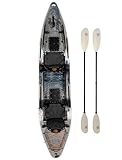
The Brooklyn 13.0 Pro is a 13 ft sit-on-top tandem built as a fishing kayak for two to three people. That “2 to 3” framing matters: it is a wide, high-capacity platform where a couple can fish side by side, or two adults plus a child can ride. This is the boat you buy when fishing is the point of owning a tandem, not an afterthought.
Who it suits
Couples who fish lakes and slow rivers, want rod holders and deck space for tackle, and are willing to handle a heavier boat to get the platform they need. Also works for one angler plus a non-paddling partner who just wants to ride along.
Key specs
- Type: sit-on-top tandem fishing kayak
- Length: 13.0 ft
- Capacity: designed for 2 to 3 people
- Deck: fishing-oriented with mounting points (BKC’s Brooklyn line is rigged for accessories)
- Best water: lakes, ponds, slow rivers
Strengths
- Wide, stable platform — you can cast while your partner shifts weight without feeling tippy.
- Fish-specific layout: room for rod holders, crates, and tackle without cluttering the paddling space.
- 13 ft length handles two anglers and gear without wallowing.
- BKC’s Brooklyn family shares accessory patterns, so rigging is straightforward.
Pros
- Genuinely rigged for fishing out of the box
- High stability for standing casts and gear movement
- Room for two or three people
- Strong accessory ecosystem within the Brooklyn line
Cons
- Heavy — plan on a roof rack, truck bed, or cart.
- Slower and less efficient to paddle than a slimmer recreational tandem.
- Premium price, and fishing rigging adds cost on top.
How it compares
Against the BKC Brooklyn 12.5, the 13.0 Pro is longer and more stable with more fishing room — the 12.5 is the entry point for the same idea. Against the Perception Tribe Tandem, the Tribe is a better pure paddling boat while the Brooklyn 13.0 Pro is a better fishing boat. Against the Brooklyn 13.5 Pedal, the 13.0 Pro is paddle-only, which keeps it simpler and lighter (relatively) at the cost of hands-free fishing.
6. Niphean Inflatable Tandem – Best Budget Pick for Portability

The Niphean is a 12’6″ inflatable two-person kayak with a stated 500 lb capacity, and it solves the problem that stops most couples from buying a kayak at all: storage and transport. It packs into a bag you can keep in a closet or car trunk, and it inflates in a few minutes at the water’s edge. For a couple in an apartment, an RV, or a small car, that is the whole argument.
Who it suits
Couples who paddle a handful of times a year, live without garage space, or travel to different lakes each outing. Also a good second boat for a family that already has a hard-shell and wants something to toss in the trunk.
Key specs
- Type: inflatable tandem
- Length: 12’6″
- Stated capacity: 500 lb
- Storage: packs into a carry bag
- Best water: calm lakes, ponds, slow rivers
Strengths
- Fits in a trunk or closet — no rack, no trailer, no garage.
- 500 lb capacity covers two adults plus day gear.
- Forgiving to bump into docks and shore; the air chambers absorb impact.
- Low entry price means you can try tandem paddling before committing to a hard shell.
Pros
- Best portability per dollar in this list
- Easy to stow during the off-season
- Soft sides are comfortable to lean against
- Simple to launch almost anywhere you can walk to the water
Cons
- Inflatable hull flexes, so it is slower and tracks worse than a rigid boat.
- Wind pushes it around more on open water.
- You must fully dry and store it to avoid mildew; seams need periodic inspection.
- Not a boat for rough water or long open crossings.
How it compares
Against the TIGERXBANG 12’8″, both are budget inflatables in the same size class — the Niphean’s 500 lb claim is the number to check against your combined weight plus gear. Against a hard-shell like the Lifetime Spitfire 12T, you give up stiffness, speed, and durability in exchange for packing into a bag and saving several hundred dollars.
7. TIGERXBANG 12’8″ Inflatable Tandem – Best Budget Family Kayak

The TIGERXBANG is a 12’8″ inflatable tandem with two seats and adjustable paddles, positioned for fishing and touring and marketed for family use. It is the type of boat that gets a family on the water for the price of a single hard-shell — and the adjustable paddles mean you do not have to buy two more before your first trip.
Who it suits
Families and casual couples who want an all-in-one package for lake days. Two seats plus room for a child or a cooler makes it a practical choice for short outings close to shore.
Key specs
- Type: inflatable tandem
- Length: 12’8″
- Seats: two, with adjustable paddles included
- Use: fishing and touring on calm water
- Storage: packs down for transport
Strengths
- Adjustable paddles included — a real cost saving versus boats that ship bare.
- Long enough at 12’8″ to seat two adults without crowding.
- Inflatable build is forgiving around rocks and docks.
- Converts easily between two paddlers and one paddler plus cargo.
Pros
- Complete package at a budget price
- Portable and quick to set up
- Stable enough for calm-water fishing
- Good option for occasional paddlers
Cons
- Flexible hull limits speed and tracking.
- Included paddles are basic; serious paddlers will upgrade.
- Not suited to wind, waves, or fast current.
- Needs careful drying and storage to last.
How it compares
Against the Niphean 12’6″, the TIGERXBANG includes paddles while the Niphean leads on stated capacity — weigh which matters more to you. Against the Brone set, both are budget bundles; the Brone package adds a pump and bag, which is worth checking against what each boat includes before you buy.
8. Starcity Inflatable Tandem – Best Wide, Stable Budget Touring Boat

The Starcity is a 12 ft inflatable tandem with a broad 36-inch beam and a stated 600 lb capacity — the highest capacity figure among the budget inflatables here. That width is the story: a wider inflatable sits higher and feels steadier under two adults, which is exactly what nervous first-time paddlers want. It is marketed for stable touring and fishing on lakes.
Who it suits
Couples who prioritize stability over speed, plus larger paddlers who need the extra capacity. Good for lake fishing, wildlife photography, and relaxed paddling with a dog or a child aboard.
Key specs
- Type: inflatable tandem
- Length: ~12 ft
- Beam: 36 in
- Stated capacity: 600 lb
- Use: lake touring and fishing
Strengths
- 600 lb capacity means two adults plus gear, a dog, or a child without exceeding the limit.
- 36-inch beam is wide and confidence-inspiring for beginners.
- Inflatable construction handles bumps and beach landings gently.
- Packs down for apartment or RV storage.
Pros
- Highest stated capacity of the budget inflatables
- Very stable for its class
- Room for gear and a pet
- Easy transport and storage
Cons
- Wider beam means slower paddling and more effort over distance.
- Inflatable flex and wind drift limit open-water use.
- Requires full drying and careful seam care.
How it compares
Against the Niphean, the Starcity wins on capacity and stability while the Niphean wins on packed size. Against the TIGERXBANG, the Starcity is the wider, higher-capacity boat; the TIGERXBANG includes paddles. For a heavier couple or one paddling with a dog, the Starcity’s numbers are the ones to pick.
9. BKC Brooklyn 13.5 Pedal Tandem – Best for Hands-Free Fishing

The Brooklyn 13.5 Pedal is the most specialized boat on this list: a 13.5 ft sit-on-top tandem with a pedal drive, so at least one paddler can move the boat with their feet and keep both hands on a rod. For a couple who fishes seriously and wants to cover water while trolling or holding position in wind, this is a different category of capability than any paddle tandem here.
Who it suits
Fishing couples and tournament-style anglers who spend long days on the water and value hands-free propulsion. Best for lakes and large slow rivers where you can launch from a ramp and do not need to portage.
Key specs
- Type: sit-on-top pedal tandem
- Length: 13.5 ft
- Drive: pedal propulsion for hands-free movement
- Capacity: two people plus fishing gear
- Best water: lakes and slow rivers
Strengths
- Pedal drive keeps hands free for casting and fighting fish — the single biggest advantage over a paddle tandem.
- 13.5 ft hull is stable and carries two anglers plus gear.
- Holds position better in wind than a paddle boat, because you can keep light pressure on the drive.
- Fits the Brooklyn accessory ecosystem, so rigging rod holders and electronics is well-trodden ground.
Pros
- Hands-free propulsion for fishing
- Large, stable platform for two
- Good wind and current management
- Serious long-term fishing capability
Cons
- Very heavy — realistically needs a trailer or a truck bed plus help.
- Highest price tier here, and the drive adds maintenance (grease, cables, fin or prop care).
- Pedal drives dislike shallow water, weeds, and gravel — you will be pulling the drive up often.
How it compares
Against the Brooklyn 13.0 Pro, the Pedal is the same fishing mission with hands-free drive and a steeper price and weight penalty. Against the Brooklyn 12.5, the Pedal is longer and far more capable, but the 12.5 remains the simple, light, paddle-only entry to tandem fishing.
10. Lifetime Spitfire 12T – Best Turnkey Kit for New Couples

The Spitfire 12T is a 12 ft sit-on-top tandem that ships with two paddles and padded seats, so a couple can buy one thing and go paddling. That bundle matters more than it sounds: buying a bare hull, two paddles, two PFDs, and a pump separately is how first-time buyers end up overspending or under-equipped. Lifetime’s Spitfire is a well-known recreational sit-on-top platform, and the 12T is its two-person version.
Who it suits
New couples and families who want the shortest path from purchase to water. The 12 ft length is easy to handle and maneuver, which suits small lakes, ponds, and gentle rivers.
Key specs
- Type: sit-on-top tandem
- Length: 12 ft
- Included: two paddles, padded seats
- Finish: Sunset Fusion
- Model: 91051
Strengths
- Complete kit — paddles and padded seats included, so no surprise add-ons.
- Shorter 12 ft hull is nimble in coves and easy to car-top.
- Sit-on-top deck drains and is simple to remount.
- Padded seats are a comfort upgrade over bare molded seats on all-day paddles.
Pros
- Turnkey package for beginners
- Maneuverable and easy to transport
- Comfortable stock seating
- Simple, low-maintenance design
Cons
- At 12 ft it tracks worse than 13.5 ft tandems over distance.
- Less gear capacity than the Perception rec tandems.
- Included paddles are basic — upgrade if you paddle often.
How it compares
Against the Perception Rambler 13.5, the Rambler is longer, tracks better, and carries more gear, while the Spitfire comes as a complete kit at a lower buy-in. Against the BKC Brooklyn 12.5, both are 12-ish ft tandems; the Spitfire is the recreation pick and the Brooklyn is the fishing pick.
11. Brone Inflatable Tandem Set – Best Complete Budget Bundle

The Brone set is an inflatable tandem that ships with seats, paddles, a pump, and a bag. In the budget inflatable category, the bundle is the product: a pump you do not have to buy, paddles you do not have to size, and a bag that makes storage a non-issue. It sits in the same ~12 ft class as the other budget inflatables, aimed at calm-water recreation.
Who it suits
Couples and families buying their first kayak who want everything in one purchase, and anyone with limited storage who needs the boat to disappear into a bag between trips.
Key specs
- Type: inflatable tandem
- Length: ~12 ft class
- Included: seats, paddles, pump, carry bag
- Use: calm lakes, ponds, slow rivers
Strengths
- Everything needed to launch is in the box — the lowest-friction way to start.
- Pump included means you can inflate at the water rather than at home.
- Packs into a bag for closet or trunk storage.
- Soft, forgiving hull is comfortable and safe to bump around docks.
Pros
- Complete kit at a budget price
- Extremely portable and storable
- Beginner-friendly stability
- Low financial commitment to try paddling
Cons
- Inflatable performance — slower, flexier, more wind-affected than a hard shell.
- Included accessories are basic; plan to upgrade paddles if you paddle regularly.
- Requires disciplined drying and seam checks to last more than a few seasons.
How it compares
Against the Niphean, the Brone includes a pump and bag up front while the Niphean advertises a 500 lb capacity — compare the included kit list against your combined weight. Against the Starcity, the Starcity’s 600 lb rating and 36-inch beam favor heavier couples, while the Brone favor buyers who want the full package in one order.
12. BKC Brooklyn 12.5 Tandem – Best Entry-Level Fishing Tandem

The Brooklyn 12.5 is the smallest and simplest sit-on-top tandem fishing kayak in the Brooklyn family: 12.5 ft, two to three people, stable and paddle-driven. It is the boat for a couple who wants fishing capability without the weight, cost, and complexity of the bigger Brooklyn models.
Who it suits
Couples getting into kayak fishing, or an angler plus a partner, who fish smaller lakes and ponds and want a boat that is still easy to car-top and paddle efficiently.
Key specs
- Type: sit-on-top tandem fishing kayak
- Length: 12.5 ft
- Capacity: 2 to 3 people
- Drive: paddle only
- Best water: lakes, ponds, slow rivers
Strengths
- The lightest and least expensive way into the Brooklyn sit-on-top fishing lineup.
- 12.5 ft is short enough to maneuver in coves and load onto a rack with two people.
- Stable enough for casting, with deck space for a crate and rod holders.
- Shares the Brooklyn family’s rigging-friendly deck.
Pros
- Affordable entry to tandem fishing
- Manageable length and weight
- Stable, gear-friendly deck
- Upgrade path to the 13.0 Pro and 13.5 Pedal if you outgrow it
Cons
- Shorter hull tracks worse than 13.5 ft boats, especially with two paddlers.
- Less deck room than the 13.0 Pro.
- Paddle-only — no hands-free option.
How it compares
Against the Lifetime Spitfire 12T, both are 12-ish ft tandems; the Brooklyn is the fishing platform and the Spitfire is the recreation kit. Against the Brooklyn 13.0 Pro, the 12.5 is lighter and cheaper but shorter and less stable with gear — if you fish often, the 13.0 Pro is worth the jump.
How to Choose a Tandem Kayak for Couples
Four numbers decide almost everything: length, weight capacity, beam (width), and boat weight. Get those right and the rest is trim and color. Here is how to think about each one, with the trade-offs spelled out.
Length: 10-12 ft vs 12.5-14 ft vs longer
Length does three things at once. It sets tracking (how well the boat holds a straight line), speed potential, and how much room there is between the two seats.
- 10-12 ft: nimble and easy to store or car-top, but two adults paddling off-line will feel every correction. Best for small lakes, ponds, and short outings. The Lifetime Spitfire 12T and the ~12 ft inflatables live here.
- 12.5-14 ft: the tandem sweet spot. At 12.5-13.5 ft, tracking is noticeably better with two paddlers, and there is usually enough cockpit or deck length that the rear paddler is not hitting the front seat back. This is where the Rambler 13.5, Tribe, Argo 136XP, and Brooklyn 13.0 Pro sit.
- 14 ft and longer: better for distance and touring, but heavier, harder to store, and overkill for a couple paddling the same cove every weekend.
A practical rule: if your typical paddle is under 2 miles round trip on a pond, 12 ft is plenty. If you cross a lake or paddle upstream-and-down, 13 to 13.5 ft earns its length.
Weight capacity: the number people get wrong
Manufacturer capacity is the maximum safe load, not a target. You should aim to use 60-70% of it for comfortable, dry paddling. Two adults plus gear adds up faster than couples expect: two paddlers at 180 lb each is 360 lb before you add paddles (2-3 lb each), PFDs (5-8 lb each), a soft cooler with drinks and ice (15-25 lb), a dry bag (5-10 lb), and any fishing gear (10-30 lb). That is easily 420-460 lb on a two-person outing.
This is why the 500 lb and 600 lb ratings on the budget inflatables matter, and why a sit-on-top fishing tandem designed for 2 to 3 people gives you the headroom. If your combined weight as a couple is over 350 lb, treat a low-capacity recreational tandem as a one-adult-plus-child boat, and look at the higher-capacity options instead.
Also check the per-seat reality: a canoe-style “two adult” spec usually assumes average-sized adults. If either paddler is tall or heavy, add capacity margin rather than subtracting gear.
Hull stability: width, shape, and what “stable” really means
Stability comes in two flavors that beginners confuse. Primary stability is how hard it is to tip the boat when you are sitting still — a wide, flat-bottomed hull wins. Secondary stability is how the boat behaves when it does lean, and how much it resists going all the way over — a rounder or V-shaped hull wins.
- Wide and flat (30-36 in beam): high primary stability, ideal for beginners, fishing, and paddling with a dog or child. The Starcity’s 36-inch beam is the extreme example here; the Brooklyn fishing tandems also lean wide.
- Narrower with more rocker: faster and easier to paddle, but twitchier for new paddlers. Recreational tandems in the 28-31 in range trade some steadiness for glide.
- Sit-on-top vs sit-in: sit-on-top boats self-drain and are easier to remount, which is a safety advantage for beginners on open water. Sit-in boats feel more secure and keep you drier, but a swamped cockpit needs a pump and float bags.
If you are new to paddling or paddling with kids, prioritize beam and a sit-on-top deck. If you are experienced and want to cover distance, accept a narrower hull and learn its lean.
Boat weight and transport: the constraint that kills kayak ownership
The most common mistake couples make is buying a boat they cannot move. A 13-14 ft sit-on-top fishing tandem can be well over 80 lb rigged; a pedal tandem is heavier still. Compare that to a ~25-35 lb inflatable in a bag. Before you buy, decide how the boat gets from storage to water every time:
| Transport Method | Realistic Boat Weight | Notes |
|---|---|---|
| Trunk / back seat | Under ~35 lb (deflated inflatable) | Only inflatables in a bag qualify |
| Two-person roof lift | ~50-80 lb | Two people lifting together; add roof pads and straps |
| Roof rack with load assist / cart | ~80-110 lb | Kayak cart plus a roller bar makes solo loading possible |
| Truck bed | ~80-120 lb | Simple, but you need a bed extender for 13+ ft hulls |
| Trailer | Any weight | The only sane answer for heavy pedal tandems |
Add up the accessories you will actually need: two quality paddles, two PFDs, a pump for inflatables, roof pads and two cam straps for hard shells, and a cart if you launch alone. For an inflatable, budget for a hand pump with a gauge and a repair patch kit. For a hard shell, budget for a cockpit cover (sit-in) or scupper plugs (sit-on-top, if you paddle cold water).
Paddling environment: lake, river, or longer trips
- Calm lakes and ponds: almost anything works. Prioritize stability and easy launching. A 12-13 ft recreational tandem or an inflatable is plenty.
- Slow rivers: length and tracking matter more, because current pushes you off line. Choose 13 ft and up, and avoid very wide, flat hulls that get shoved around. Inflatables can handle gentle current but you have less control.
- Larger lakes and longer trips: 13.5-14 ft, decent secondary stability, and real cargo capacity. Sit-on-top for self-bailing, or a sit-in with bulkheads and float bags for a drier ride. This is also where a rudder or pedal drive starts to pay off in wind.
- Fishing-focused days: prioritize a wide, stable deck and rigging points over pure paddling efficiency. The Brooklyn tandems are built for this; the recreational Perception boats can fish but are not laid out for it.
Material: rotomolded polyethylene vs inflatable drop-stitch vs Ram-X-type laminates
Rotomolded polyethylene is the standard for hard-shell recreational and fishing kayaks. It is tough, easy to repair with a plastic welder or patch, UV-stable enough to live outdoors for years, and heavy. It dents rather than cracks in most impacts. If you store outdoors and paddle rocky launches, this is the material to choose.
Laminate and multi-layer polyethylene hulls — like Pelican’s Ram-X — combine layers for stiffness and abrasion resistance at a lower weight than some rotomolded hulls. They are durable and UV-resistant, though deep gouges are harder to repair than rotomolded polyethylene.
Inflatable hulls use coated fabric with air chambers. They are light, packable, and forgiving on impact, but they flex under load, track worse, and depend entirely on seams and valves. The failure modes differ: a hard shell gets scratched, an inflatable gets a slow leak. Inspect seams and valves every season, and never store an inflatable folded wet.
Seating and paddling together without fighting
Tandem paddling has a rhythm problem: the front paddler sets the cadence and the rear paddler steers. If the two seats are too close, the rear paddler’s knuckles meet the front seat back. If the rear seat is too far back, the bow rides high and the boat weathervanes. Look for adjustable seats so you can shift weight forward or back to trim the boat with different-sized paddlers.
Agree on roles before you launch: front paddler keeps a steady cadence, rear paddler controls direction with sweep and draw strokes. Couples who fight in a tandem almost always have the same issue — the rear paddler trying to steer with rudder strokes only, and the front paddler changing rhythm. Practice a straight-line cadence for a few minutes each trip and the boat stops feeling like a tug-of-war.
Ownership realities and what wears first
Every tandem kayak wears in the same predictable order. Knowing this saves money:
- Seats and seat hardware first: foam compresses, straps fray, and rivets loosen within a few seasons of regular use. Replacement seats are usually the first purchase.
- Scupper plugs and hatch covers: rubber and plastic degrade in UV. Cheap to replace, easy to lose.
- Paddle blades and ferrules: if you paddle often, blades wear thin and the joint loosens. Budget for upgraded paddles in year two.
- Hull bottom: scratches are cosmetic; deep gouges at the keel line from dragging on concrete are not. Carry the boat to the water; do not drag it.
- Inflatable seams and valves: the highest-wear items on an inflatable. Keep the boat out of direct sun when inflated and stored, and do not overinflate in hot weather.
- Pedal drives: cables, fins or props, and seals need periodic service on pedal tandems. Factor that into the cost of ownership.
Cleaning is simple: rinse with fresh water after salt or muddy water, dry thoroughly — especially cockpits and inflatable folds — and store out of direct sun. A sit-in left wet will grow mildew on the seats within weeks. An inflatable stored wet will develop seam problems within a season.
Cost per use: the calculation that reframes the decision
Compare options honestly with cost per outing. Suppose a hard-shell tandem at a mid-range price plus two paddles, two PFDs, and roof straps totals roughly the price of the kayak plus about a third again. An inflatable bundle costs less up front and includes more of the accessories. A premium pedal tandem costs two to three times a recreational tandem before you add a trailer.
Now divide by outings. A couple who paddles 20 times a year for five years is at 100 outings — the mid-range boat is cheap per trip. A couple who paddles three times a year for three years is at nine outings — the budget inflatable is the smarter math, and the premium pedal boat is hard to justify unless fishing is central to your life. Count the trips you will actually take, not the ones you imagine, and the right tier usually becomes obvious.
Upgrade path: buy the boat that fits year three, not year one
Think about what you will want after a season. If you will paddle more lakes and longer distances, you want a 13.5 ft hull with good tracking now rather than replacing a 12 ft boat next year. If you will drift toward fishing, choose a deck with rigging points. If storage is tight and you paddle occasionally, an inflatable is not a compromise — it is the correct answer. Match the boat to the couple you will be two seasons from now, and you will not buy twice.
Frequently Asked Questions
What length tandem kayak is best for a couple?
For most couples, 13 to 13.5 ft is the sweet spot: long enough to track straight with two paddlers and short enough to store and car-top. If you paddle small ponds under 2 miles, 12 ft is easier to handle. If you cross big lakes or do longer trips, 13.5 ft and up is worth the extra weight.
Is a sit-in or sit-on-top tandem better for beginners?
Sit-on-top is generally better for beginners because the deck self-drains, and if you flip, you can climb back on without bailing. Sit-in cockpits feel more secure and keep you drier in cold weather, but they need a bilge pump and float bags, and re-entry from the water is harder.
How much weight can a two-person kayak carry?
It varies widely. Budget inflatables in this class often state 500 to 600 lb, while several recreational tandems are rated for two average adults plus day gear. Aim to use only 60-70% of the stated capacity for comfortable, dry paddling, and remember that two adults plus paddles, PFDs, a cooler, and fishing gear can easily reach 420-460 lb.
Can one person paddle a tandem kayak alone?
Yes, but trim matters. Sit in the seat closest to the middle of the boat — usually the rear seat reversed or a designated solo position — so the bow does not ride up in wind. A tandem paddled solo is heavier and slower than a solo kayak, but it works fine for short trips.
Are inflatable tandem kayaks good enough for a lake?
For calm lakes, ponds, and slow rivers, yes. An inflatable like the Niphean, Starcity, or Brone is stable, easy to store, and inexpensive. What you give up is stiffness and glide — inflatables flex, track worse, and get pushed by wind, so they are not the right choice for open water or long crossings.
What else do I need to buy with a tandem kayak?
At minimum: two paddles, two properly fitted PFDs, and a way to transport the boat (roof pads and cam straps for hard shells, or a pump and repair kit for inflatables). Add a bilge pump and float bags for a sit-in, and a kayak cart if you often launch alone.
How do I stop arguing about steering in a tandem?
Assign roles before you launch. The front paddler sets a steady cadence and does not steer; the rear paddler handles direction with sweep and draw strokes. Practice straight-line paddling for a few minutes at the start of each trip, and adjust the seats fore and aft until the boat sits level.
How long do tandem kayaks last?
A rotomolded polyethylene hard shell that is rinsed and stored out of direct sun can last a decade or more, though seats and hardware wear out first. Inflatables last several seasons with careful drying, seam inspection, and valve care; storing one folded and wet is the fastest way to shorten its life.
Which Tandem Kayak Should You Buy?
If you want one boat that does everything well on calm lakes and easy rivers, buy the Perception Rambler 13.5 Sit-on-Top Tandem — it is the best balance of length, stability, and gear capacity for most couples. If you want a drier, warmer ride and paddle cool water, choose the Pelican Argo 136XP. If fishing is the reason you are buying a tandem, go straight to the BKC Brooklyn 13.0 Pro, or the Brooklyn 13.5 Pedal if you want hands-free propulsion and have a trailer. If storage and budget are your constraints, the Niphean 12’6″ is the value pick, the Starcity is the choice for heavier couples or paddling with a dog, and the Brone set gets you on the water with everything in one box. And if you just want the simplest possible start, the Lifetime Spitfire 12T arrives ready to paddle.