
Our Top Picks
 Sony Alpha 7 IV Full-frame Mirrorless Interchangeable Lens5.45 x 3.80 x 2.83 inches9.6 x 6.5 x 6.7 inches2.2 PoundsCheck on Amazon


The Sony A7 IV and the Canon EOS R6 II sit in the same crowded middle of the full-frame mirrorless market, and they chase the same kind of buyer: a photographer who wants one body for stills and video, without stepping up to a flagship body. Both shoot 4K 60p, both offer strong subject detection, and both accept a deep catalog of native lenses. Yet they were built with different priorities. Sony packed a 33-megapixel sensor and a hybrid photo-video feature set into a compact body, while Canon leaned into speed, with a 40 fps electronic shutter and class-leading stabilization. This guide compares the two bodies head to head, then adds three accessories that work with either camera.

As an Amazon Associate, we earn from qualifying purchases.
1. Sony A7 IV (Body Only)
The A7 IV is the do-everything body of the Sony full-frame line. Its 33-megapixel back-illuminated sensor delivers more detail than most 24-megapixel rivals, which matters when you crop a wildlife frame or print a landscape large. The BIONZ XR processor drives Real-time Eye AF for people, animals and birds, and the 759-point phase-detection system covers nearly the whole frame. For video, the camera records 4K 30p oversampled from the full sensor width, and 4K 60p from a Super 35 crop, both in 10-bit 4:2:2 with S-Log3 and S-Cinetone profiles. The vari-angle screen, dual card slots and the long-lived NP-FZ100 battery round out a body that suits weddings, travel, portraits and hybrid shoots alike. Its main limits are the 10 fps burst ceiling and the 4K 60p crop, both of which matter more to action shooters than to everyone else.
Specs
- 33MP full-frame BSI CMOS sensor; BIONZ XR processor; 759-point phase-detection AF; 4K 60p (Super 35 crop) 10-bit 4:2:2; 5.5-stop 5-axis IBIS; 3.68M-dot EVF; dual slots (CFexpress Type A / SD + SD UHS-II); NP-FZ100 battery; 659 g body
2. Canon EOS R6 II (Body Only)
The R6 II is Canon’s speed-first all-rounder. Its 24.2-megapixel sensor may trail the Sony on resolution, but it reads out fast, and the DIGIC X processor turns that speed into a 12 fps mechanical burst and a 40 fps electronic burst, the fastest in this class. Dual Pixel CMOS AF II tracks people, animals and vehicles across 1,053 AF points, and it holds focus on erratic subjects with a confidence that action photographers notice at once. Video is a strong suit too: 4K 60p oversampled from 6K with no crop, Canon Log 3, and 6K RAW output over HDMI. The in-body stabilization is rated up to 8 stops with a compatible RF lens, the best figure here, and the dual SD UHS-II slots keep the workflow simple. The trade-off is resolution: heavy crops and very large prints show the 24-megapixel ceiling sooner than the Sony’s 33-megapixel files do.
Specs
- 24.2MP full-frame CMOS sensor; DIGIC X processor; Dual Pixel CMOS AF II, 1,053 AF points; 12 fps mechanical / 40 fps electronic burst; 4K 60p uncropped, oversampled from 6K; up to 8-stop IBIS; 3.69M-dot EVF; dual SD UHS-II slots; LP-E6NH battery; 588 g body
3. Lexar Professional 2000x 128GB SDXC UHS-II Card
Both cameras in this comparison write to SD cards, and both reward a fast one. The Lexar Professional 2000x is a UHS-II card rated V90, with read speeds up to 300 MB/s, so it clears the buffer quickly after a long burst and keeps up with 4K video recording. The 128GB capacity holds a full day of RAW stills and video clips for most shooters, and the card fits slot 2 of the A7 IV and both slots of the R6 II. A UHS-II card is no luxury here: the R6 II at 40 fps and the A7 IV shooting 10-bit 4K both fill a slow card fast. Buy two and rotate them, so one card is always in the camera and one is always backed up.
Specs
- 128GB SDXC UHS-II; V90 video speed class; up to 300 MB/s read; U3, Class 10; fits both cameras
4. Peak Design Slide Lite Camera Strap (Black)
A good strap matters more on a full day of shooting than most buyers expect, and the Slide Lite is one of the best. It configures as a sling, neck or shoulder strap, and the Anchor Link quick-release system lets you detach the camera in seconds to mount it on a tripod or hand it to someone else. One side of the webbing is smooth for sliding the camera up to your eye, the other is grippy to hold it in place on your shoulder. The strap is rated to hold 200 lb, far more than either body with any lens in this guide, and the compact Lite width suits the A7 IV and R6 II better than the wider full-size Slide. It clips to the standard strap lugs on both cameras with no adapter, and the low-profile anchors stay out of the way when the camera sits in a bag.
Specs
- Configures as sling, neck or shoulder strap; Anchor Link quick-release system; smooth and grippy sides; 200 lb capacity; fits both cameras via standard lugs
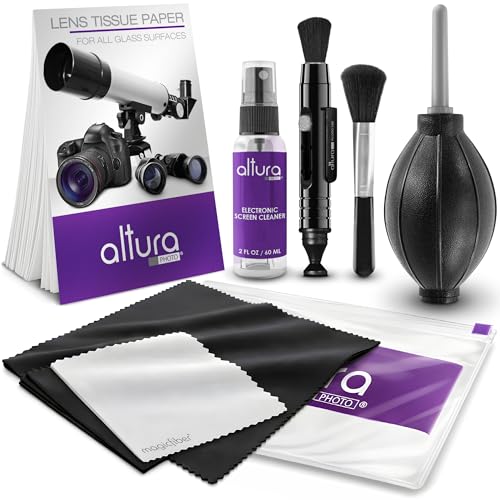
5. Altura Photo Camera Cleaning Kit
Sensor dust and smudged front elements ruin more images than most camera settings ever will, and a cleaning kit is the cheapest insurance for either body. The Altura Photo kit bundles a lens cleaning pen, a brush, an air blower, cleaning spray, 50 lens tissue sheets and three microfiber cloths, all in a carry bag that fits in a camera backpack side pocket. The blower clears loose dust from the sensor area without touching glass, the pen lifts fingerprints from a front element, and the spray is alcohol-free and ammonia-free. This kit works with any mirrorless camera, so it stays useful if you later switch systems, and it covers both the A7 IV and the R6 II from day one.
Specs
- Lens pen, brush, air blower, spray, 50 tissues, 3 cloths; alcohol-free and ammonia-free spray; carry bag included; fits any mirrorless camera
Head to Head: Sensor and Image Quality
The A7 IV’s 33-megapixel sensor gives it a clear edge in resolution. Cropping a 33-megapixel file to half its width still leaves a usable image, and large prints hold fine detail that the R6 II’s 24.2-megapixel files soften sooner. The R6 II answers with cleaner high-ISO files and a faster readout, which reduces rolling shutter in electronic shutter mode and keeps the camera responsive during long bursts. In good light, the Sony wins on detail. In dim light or fast action, the Canon’s cleaner files and quicker sensor make up the gap. Both sensors are full-frame, and neither will limit a photographer who exposes well.
Head to Head: Autofocus
Both cameras offer eye detection for people and animals, and both track subjects across the frame. Sony’s Real-time Eye AF is slightly more tenacious on birds and on eyes at the edge of the frame, thanks to the 759-point system and the BIONZ XR processor. Canon’s Dual Pixel CMOS AF II covers more AF points, 1,053 in total, and adds vehicle detection, which helps with motorsport and aviation. In practice, both systems lock on fast and hold focus through a burst. The difference shows up at the margins: Sony edges ahead on bird photography, Canon edges ahead on vehicles and on subjects that move toward the camera at high speed. For portraits, weddings and general use, either system is more than enough.
Head to Head: Burst and Buffer
This is the R6 II’s clearest win. Its mechanical shutter reaches 12 fps and its electronic shutter reaches 40 fps, against 10 fps for the A7 IV. At 40 fps the R6 II captures moments the Sony simply misses, such as the exact frame a ball leaves a bat or a bird takes off. The trade-off is file volume: 40 fps fills cards and hard drives fast, and the electronic shutter can show rolling shutter with very fast movement. The A7 IV at 10 fps is plenty for weddings, portraits, travel and most wildlife, and its dual slots let you write RAW to the CFexpress Type A slot for the fastest clearing. If action is your main subject, the Canon is the better tool. If it is not, the Sony’s 10 fps is enough.
Head to Head: Video
Both bodies shoot 4K 60p, but they get there differently. The R6 II oversamples 4K 60p from 6K with no crop, which keeps wide-angle framing intact and delivers very sharp footage. The A7 IV records 4K 30p from the full sensor width, but 4K 60p comes from a Super 35 crop, which narrows the field of view and effectively multiplies focal length by about 1.5x. The Sony counters with S-Cinetone, S-Log3 and CFexpress Type A media for the highest bitrates. The Canon counters with Canon Log 3 and 6K RAW output over HDMI for external recorders. For a videographer who shoots mostly at 4K 60p, the Canon’s uncropped mode is the better choice. For a hybrid shooter who mostly shoots 4K 30p, the two are close, and the Sony’s extra resolution helps stills taken from the same session.
Head to Head: EVF, IBIS, Handling and Size
The electronic viewfinders are nearly identical on paper: 3.68 million dots for the Sony, 3.69 million for the Canon, both with a vari-angle rear screen. Stabilization is a Canon win: up to 8 stops with a compatible RF lens, against 5.5 stops for the Sony. In practice that means the R6 II holds slower shutter speeds handheld, which helps in dim churches and at dusk. Handling splits along brand lines. The A7 IV is the smaller body at 659 g, with a deep grip and a familiar Sony control layout, while the R6 II is lighter at 588 g but slightly wider, with Canon’s excellent mode dial and a joystick that many photographers prefer. Both take the same kind of SD card, both use vari-angle screens, and both feel well built in the hand.
Which One Should You Choose?
Choose the Sony A7 IV if resolution, cropping freedom and hybrid photo-video balance matter most. The 33-megapixel sensor suits landscape, portrait and travel photographers who crop or print large, and the S-Log3 and S-Cinetone profiles suit video work at 4K 30p. The E-mount catalog is the widest in mirrorless, with strong third-party options from Sigma and Tamron.
Choose the Canon EOS R6 II if speed, stabilization and uncropped 4K 60p matter most. The 40 fps electronic burst and the 8-stop stabilization suit sports, wildlife and event photographers, and the RF lens line, while younger than E-mount, now covers the key focal lengths with excellent optics. The 24-megapixel ceiling is the real compromise, so weigh how often you crop hard or print very large.
Either way, the three shared accessories in this guide fit both bodies, so your support kit does not need to change if you switch sides later. The Lexar card, the Peak Design strap and the Altura cleaning kit move between Sony and Canon without a second thought, which keeps the total cost of switching low.
Frequently Asked Questions
Can the Sony A7 IV and Canon EOS R6 II use the same memory cards?
Yes. Both cameras accept SD cards, and the Lexar Professional 2000x UHS-II card in this guide fits the A7 IV and both slots of the R6 II. The A7 IV also accepts CFexpress Type A cards in slot 1, while the R6 II uses SD cards in both slots.
Which camera is better for bird photography?
The R6 II has the edge for birds in flight, thanks to its 40 fps electronic burst and strong animal detection. The A7 IV counters with more resolution for cropping, which helps when a bird is far away. Many bird photographers would pick the Canon for action and the Sony for perched birds at a distance.
Does the Sony A7 IV shoot 4K 60p without a crop?
No. The A7 IV records 4K 60p from a Super 35 crop, which narrows the field of view. Its 4K 30p mode uses the full sensor width. The Canon R6 II records 4K 60p with no crop, oversampled from 6K.
Is the Canon EOS R6 II good for video as well as stills?
Yes. It records uncropped 4K 60p oversampled from 6K, offers Canon Log 3, and outputs 6K RAW over HDMI to an external recorder. Combined with up to 8 stops of stabilization, it is one of the strongest hybrid bodies in this class.
Conclusion
The Sony A7 IV and the Canon EOS R6 II are both excellent cameras, and neither is a bad choice. The A7 IV wins on resolution and lens choice, the R6 II wins on speed, stabilization and uncropped 4K 60p. Match the camera to the work you do most: detail and cropping point to Sony, action and video point to Canon. Whichever body you pick, a fast SD card, a reliable strap and a cleaning kit are the first three accessories to add.
More from Amazon
Programs that pair well with the guide above. Offers and eligibility are set by Amazon and may change.
Free shipping on eligible items, Prime Video and more. Eligible new members can start with a free trial.
Start a Prime free trialAudiobooks and podcasts to listen to on the go. Eligible new members can start with a free trial.
Try Audible freeAd-free music streaming. Eligible new subscribers can start with a free trial.
Try Music Unlimited freeA free business account with business pricing and bulk-buying tools for work, shop or home office.
Create a business accountAs an Amazon Associate we earn from qualifying purchases.









