Our Short List of 3
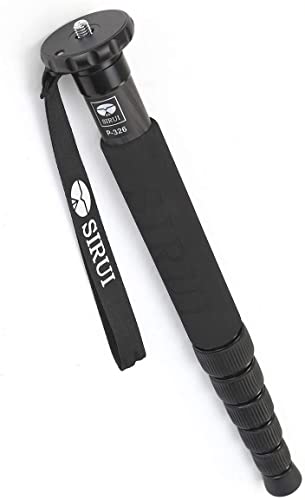
- Carbon fiber; 6 sections; 60.6 in max height; 15 in folded length; 0.9 lb; 22 lb load limit; reversible 1/4-inch-20 and 3/8-inch-16 mounting plate; wrist strap included; no head included.

- Carbon fiber; 4 sections; model MPMXPROC4US; 64.76 in max height; 20.47 in folded length; 1.3 lb; 20 kg load limit per the Amazon listing; 1/4-inch and 3/8-inch attachment; flip locks; no head included.

- Anodized aluminum; flexible jointed legs; 9.6 oz; holds up to 3 kg (6.6 lb); accepts BallHead 3K PRO (sold separately); grip, wrap, and stand design; no head included with the stand alone.
All 5 Picks at a Glance
| Product | Specs | Action |
|---|---|---|
| 1. Sirui P-326 |
| Check price on Amazon |
| 2. Manfrotto XPRO Carbon Monopod |
| Check price on Amazon |
| 3. JOBY GorillaPod 3K PRO Stand |
| Check price on Amazon |
 4. Manfrotto 290 Carbon Monopod |
| Check price on Amazon |
 5. NEEWER T222 |
| Check price on Amazon |
Our Top Picks
Annual pearlwort is a plant that rewards a slow walk and a low camera. Sagina apetala, a member of the Caryophyllaceae family, grows in thin tufts on dry sandy ground, between paving slabs, and along the worn edges of paths. Its stems are thread-thin, its leaves are narrow and pointed, and its flowers are tiny white four-petalled blooms, only a few millimetres across. A camera held at ankle height can turn this modest plant into a fine subject, but only if you work from the edge of the ground where it grows.
This guide names five monopods that suit that kind of low, careful work. If you already own a monopod, one of these five may serve you well.
As an Amazon Associate, we earn from qualifying purchases.
Annual Pearlwort at a Glance
Annual pearlwort is a small annual plant, which means it completes its whole life in a single growing season. It germinates, flowers, sets seed, and dies within months, and the next generation depends on the seed that falls into cracks and thin sandy soil. That short life makes it fragile: a foot on a tuft in flower can end that plant for the year.
The plant favours dry, open, sandy ground: sandy paths, pavement edges, gaps between paving slabs, and thin soil over gravel. Its leaves are short, narrow, and slightly fleshy, set in opposite pairs along wiry stems that spread low over the ground. The best time to look for it is late spring and early summer, when the flowers are open and the tufts are at their fullest. Morning light suits it well. Stay on paths wherever you can, and do not pick the plant.
The Honest Truth About Monopods and Annual Pearlwort
Let us be direct. A monopod is barely useful for annual pearlwort photography, and this guide would be dishonest if it claimed otherwise. The plant is a few centimetres tall and grows at ground level, while a monopod is a tall stick made to hold a camera at waist height or above. For a plant at ankle height, a bean bag, a small ground pod, or kneeling on the path will serve you better.
A monopod can still help in a narrow set of cases. If you have a heavy camera, a monopod can take the weight while you work low. If your knees or back make kneeling hard, a monopod can hold the camera steady at a low angle while you remain upright. Anyone who does not already own a monopod should not buy one only for annual pearlwort, because the plant is too small and too low for that purchase to make sense. Work only at the edge of the area where the plant grows, and keep walkways clear.
Annual Pearlwort and Knotted-Pearlwort: Telling Them Apart
Annual pearlwort is not knotted-pearlwort, and the difference matters for accurate captions. Annual pearlwort is Sagina apetala. Knotted-pearlwort is Sagina nodosa. The two share the genus Sagina, but they are different species.
Annual pearlwort is a tiny annual plant. It lives for one season and carries small white flowers with four petals. Its stems are fine and wiry, and the whole plant rarely rises more than a few centimetres above the ground.
Knotted-pearlwort is a perennial plant, which means it lives for more than one year and comes back from the same roots. Its stems are knotted, with visible joints where the leaves meet the stem, and that knotted look gives the plant its common name. It grows in damper ground, often on wet heaths and the edges of bogs. Its flowers are also white, but the plant is sturdier and more upright.
Habitat is often the quickest clue: dry cracks and thin sandy soil point to annual pearlwort, while damp ground and a knotted, jointed stem point to knotted-pearlwort. Knotted-pearlwort was covered in an earlier guide in this series, in a different batch. There is no delivered generic pearlwort guide on this site, so use the full common name for each plant.
How to Photograph Annual Pearlwort Without Harming It
The method rests on three habits: stay on the path, keep low, and take your time. Find a tuft within reach of the path edge, and set yourself up on the paved surface. If it grows between slabs, kneel on the slab beside it. On a sandy bank, work from the track at its base with a longer lens.
Get the camera low. The most appealing frames are taken at the level of the flowers, looking across the tuft. A downward shot flattens the plant, while a low, level shot shows the flowers against a soft background. A monopod shortened to its lowest setting can hold the camera at that height, with the foot on the path and the column leaning gently toward you.
Light matters more than gear for this plant. Early morning and late afternoon give warm, low light that shows the fine leaves, while overcast light is soft and even and suits the white flowers. Focus with care: use a single focus point on the nearest open flower, and take several frames while you adjust focus by a hair in each direction. A small aperture, such as f/8 or f/11, gives enough depth to hold the whole tuft in focus. Leave the site as you found it.
The Five Monopods
1. Sirui P-326
- Carbon fiber; 6 sections; 60.6 in max height; 15 in folded length; 0.9 lb; 22 lb load limit; reversible 1/4-inch-20 and 3/8-inch-16 mounting plate; wrist strap included; no head included.
The Sirui P-326 is the lightest monopod in this guide, and that lightness is its main strength for path-side work. It is made from carbon fiber, it has six sections, and it weighs about 0.9 lb, which is 400 g. It folds to 15 inches, extends to 60.6 inches, and the mounting plate reverses between a 1/4-inch-20 screw and a 3/8-inch-16 screw. No head is included, and it needs your hand on it at all times.
2. Manfrotto XPRO Carbon Monopod
- Carbon fiber; 4 sections; model MPMXPROC4US; 64.76 in max height; 20.47 in folded length; 1.3 lb; 20 kg load limit per the Amazon listing; 1/4-inch and 3/8-inch attachment; flip locks; no head included.
The Manfrotto XPRO Carbon Monopod, model MPMXPROC4US, is a professional carbon fiber monopod with four sections. It extends to 64.76 inches and folds to 20.47 inches, it weighs 1.3 lb, and the Amazon listing gives its load limit as 20 kg. Four sections mean a stiffer column, which helps with a heavy camera or a long lens. Used low, with only two or three sections extended, it is a solid support for a camera at ground level, and the upper disc takes a 1/4-inch or 3/8-inch attachment. No head is included.
3. JOBY GorillaPod 3K PRO Stand
- Anodized aluminum; flexible jointed legs; 9.6 oz; holds up to 3 kg (6.6 lb); accepts BallHead 3K PRO (sold separately); grip, wrap, and stand design; no head included with the stand alone.
The JOBY GorillaPod 3K PRO Stand is the odd one out here, because it is not a tall monopod at all. It is a short, flexible stand with jointed legs that can grip, wrap, and stand on uneven ground, made from anodized aluminum, weighing 9.6 oz, and holding up to 3 kg, which is 6.6 lb. For annual pearlwort, that low shape is a genuine advantage: set it on the path beside a tuft, bend the legs to level the camera, and shoot at flower height without holding a tall column. It accepts the BallHead 3K PRO, sold separately, but it cannot act as a walking aid.
4. Manfrotto 290 Carbon Monopod
- Carbon fiber; 4 sections; model MM290C4US; 59.4 in max height; 19.29 in folded length; 1.1 lb; 5 kg safe working load from the datasheet; 1/4-inch and 3/8-inch attachment; rubber leg warmers; angled wrist strap; no head included.
The Manfrotto 290 Carbon Monopod, model MM290C4US, is a four-section carbon fiber monopod that balances weight and rigidity well. It extends to 59.4 inches and folds to 19.29 inches, it weighs 1.1 lb, and the datasheet gives a safe working load of 5 kg, which is the figure to trust, not the 22 lb figure on some listings. Four sections and aluminum leg locks make it quick to set and solid in the hand. The upper disc takes a 1/4-inch or 3/8-inch attachment, and no head is included.
5. NEEWER T222
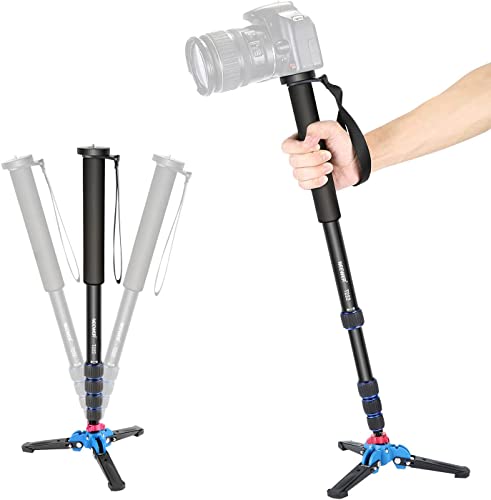
- Aluminum alloy; 5 sections; 66 in max height; 20.5 in folded length; 1.3 lb; 5 kg (11 lb) maximum load; detachable foldable stand base with 360-degree pan and 15-degree tilt; 1/4-inch mounting screw reversible to 3/8 inch; wrist strap and spike foot included.
The NEEWER T222 is an aluminum alloy monopod with a detachable, foldable stand base, and that base is what sets it apart here. It extends to 66 inches, which is 168 cm, and it folds to 20.5 inches, which is 52 cm. It has five sections, it weighs 1.3 lb, and its maximum load is 5 kg. With the base attached, it can stand on the path with three small feet, and the base allows a full turn and a tilt of 15 degrees. A stand base is not a tripod, so keep the column short and the camera light when the base is in use.
How the Five Compare
The five monopods fall into two groups. The Sirui P-326, the Manfrotto XPRO, and the Manfrotto 290 are tall carbon fiber columns, and they differ mainly in weight, folded length, and the number of sections. The Sirui is the lightest and the shortest when folded. The Manfrotto 290 sits in the middle, with a clear 5 kg safe working load from its datasheet. The Manfrotto XPRO is the tallest and the stiffest, and it suits a heavy camera best.
The other two are different in kind. The JOBY GorillaPod 3K PRO Stand is a short, flexible ground-level tool, and it is the best match for a plant that grows at ankle height. The NEEWER T222 is a tall monopod with a detachable stand base, and it is the only one here that can stand on the path while you check the frame. None of the five is a tripod, and none should be left standing alone while you walk away.
Field Etiquette on Pavements and Sandy Ground
Annual pearlwort grows where people walk, so field etiquette is part of the photography. Keep to the path, keep your kit on the path, and keep the walkway clear for other people. If someone needs to pass, step aside and lift the monopod clear of the way. Do not set up where a wheelchair, a pushchair, or a cyclist cannot get past. Do not pick the plant, and do not move it. Do not pull up nearby plants to tidy the frame. The thin sandy ground where annual pearlwort grows is easily damaged, and a patch scuffed by boots or by a monopod foot may take a season to recover. Set the monopod foot on bare paving or on trodden ground, never in the middle of a tuft.
Frequently Asked Questions
Is a monopod worth carrying for annual pearlwort photography?
In most cases, no. Annual pearlwort is a few centimetres tall and grows at ground level, so a monopod is often the wrong tool. A bean bag or kneeling on the path will usually serve you better. A monopod helps only if you already own one. If you do not own a monopod, do not buy one only for this plant.
How do I tell annual pearlwort from knotted-pearlwort?
Annual pearlwort, Sagina apetala, is a tiny annual plant with fine, wiry stems and small white flowers with four petals. It grows on dry sandy ground and between paving slabs. Knotted-pearlwort, Sagina nodosa, is a perennial plant with knotted, jointed stems, and it grows in damper ground. Habitat and the knotted stem are the quickest clues in the field.
Which of the five monopods works best at ground level?
The JOBY GorillaPod 3K PRO Stand works best at ground level, because it is a short, flexible stand that sits on the path beside the plant and holds the camera at flower height. The NEEWER T222 comes next, because its detachable stand base lets it stand on the path while you check the frame. The three tall carbon monopods can all be shortened low, but they still need your hand on them.
Can I photograph annual pearlwort without stepping off the path?
Yes, in most cases. Annual pearlwort often grows at the very edge of a path, in cracks between paving slabs, or on thin sandy soil beside a track. Work from the paved surface, and use a longer lens if the tuft sits a little beyond reach. Do not pick the plant, and do not step onto the patch.
More from Amazon
Programs that pair well with the guide above. Offers and eligibility are set by Amazon and may change.
Free shipping on eligible items, Prime Video and more. Eligible new members can start with a free trial.
Start a Prime free trialAudiobooks and podcasts to listen to on the go. Eligible new members can start with a free trial.
Try Audible freeAd-free music streaming. Eligible new subscribers can start with a free trial.
Try Music Unlimited freeA free business account with business pricing and bulk-buying tools for work, shop or home office.
Create a business accountAs an Amazon Associate we earn from qualifying purchases.