Our Short List of 3

- Lens: 38-170mm ED glass zoom, 4.5x
- Focus: Advanced combination autofocus, active and passive modes, 2.6 ft to infinity
- Flash: Variable-power built-in flash with auto color-balancing and red-eye reduction; auto, off, fill-in, and night scene modes
- Film: 35mm, DX-coded, ISO 100 and 400

- Lens: 38-105mm zoom, f/3.7-9.5, two aspherical elements
- Focus: 525-step autofocus system
- Flash: Intelligent variable-power flash with six modes, including red-eye reduction
- Film: 35mm, DX-coded, ISO 50-3200
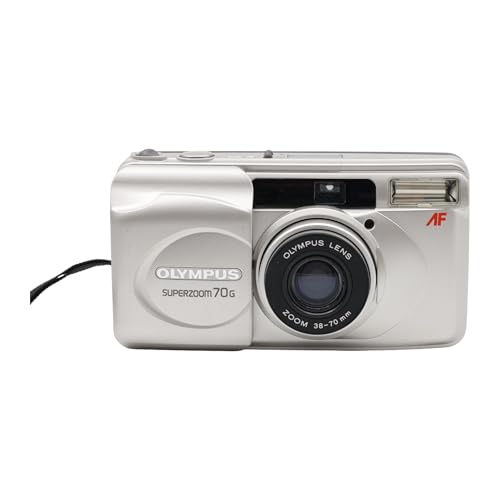
- Lens: 38-70mm zoom, f/4.5-8.5
- Focus: 525-step autofocus system
- Flash: Built-in with red-eye reduction and multiple modes
- Film: 35mm, DX-coded, ISO 100-800
All 5 Picks at a Glance
| Product | Specs | Action |
|---|---|---|
| 1. Olympus Stylus Epic Zoom 170 |
| Check price on Amazon |
| 2. Olympus Superzoom 105G |
| Check price on Amazon |
| 3. Olympus Superzoom 70 G |
| Check price on Amazon |
 4. Olympus Stylus AF |
| Check price on Amazon |
 5. Olympus Stylus Epic Zoom 115 Deluxe |
| Check price on Amazon |
Our Top Picks
A point and shoot 35mm film camera does one thing well: it gets out of the way. Load a roll of 35mm film, point the lens, press the shutter, and the camera handles focus, exposure, and film advance on its own. That simplicity is why these compact cameras have stayed popular decades after they left the factory floor. The five cameras below are all autofocus compacts with a built-in flash and a zoom or fast prime lens, and each one is available through Amazon US listings as of this writing.
One thing to know before buying: nearly every classic point and shoot 35mm film camera is out of production, so most listings on Amazon are Renewed models — cameras that have been inspected, tested, and restored to working order by Amazon-qualified suppliers. That is the normal way to buy one of these cameras today, and every model in this guide is presented as a Renewed listing where that applies. Focus-free and fixed-focus cameras are a different slice of the market and do not appear here; every camera below has a real autofocus system.
Disclosure: As an Amazon Associate, we earn from qualifying purchases made through links on this page, at no extra cost to you.
What Makes a Good Point and Shoot 35mm Film Camera
Autofocus is the first thing to check. The best autofocus compacts lock onto a subject quickly and hold focus even in dim light, and several of the cameras below use multi-step autofocus systems with hundreds of focus steps for fine accuracy. A zoom lens adds framing flexibility without changing lenses, while a fixed prime lens usually means a sharper image and a smaller body. Built-in flash matters more than it seems, since film needs light and many of these cameras are used indoors or at dusk. Finally, look at the battery: most of these cameras run on a single CR123A lithium cell, which lasts for many rolls and is easy to find.
1. Olympus Stylus Epic Zoom 170
- Lens: 38-170mm ED glass zoom, 4.5x
- Focus: Advanced combination autofocus, active and passive modes, 2.6 ft to infinity
- Flash: Variable-power built-in flash with auto color-balancing and red-eye reduction; auto, off, fill-in, and night scene modes
- Film: 35mm, DX-coded, ISO 100 and 400
The Olympus Stylus Epic Zoom 170 is the most versatile camera in this guide, and the most capable. Its 4.5x zoom lens reaches from 38mm at the wide end to 170mm at the telephoto end, the longest zoom of any camera here, and it uses an ED glass element to keep long-distance shots sharp. The all-weather clamshell body shrugs off rain and splashes, and the advanced combination autofocus system switches between active and passive modes to lock focus from 2.6 feet to infinity.
2. Olympus Superzoom 105G
- Lens: 38-105mm zoom, f/3.7-9.5, two aspherical elements
- Focus: 525-step autofocus system
- Flash: Intelligent variable-power flash with six modes, including red-eye reduction
- Film: 35mm, DX-coded, ISO 50-3200
The Olympus Superzoom 105G balances a useful zoom range with a light, pocketable body. Its 38-105mm zoom lens covers wide scenes and short telephoto portraits alike, and the 525-step autofocus system aims for sharp results in varied light. At 225 grams it is one of the lighter cameras here, and its six flash modes give it more low-light flexibility than most compacts of its era.
3. Olympus Superzoom 70 G
- Lens: 38-70mm zoom, f/4.5-8.5
- Focus: 525-step autofocus system
- Flash: Built-in with red-eye reduction and multiple modes
- Film: 35mm, DX-coded, ISO 100-800
The Olympus Superzoom 70 G is the simplest zoom camera in this guide, and that is its appeal. The 38-70mm zoom lens handles everyday scenes from group shots to close portraits, while fully automatic exposure and motorized film advance and rewind remove the fiddly parts of shooting film. A single CR123A battery powers everything, and the built-in flash includes a red-eye reduction mode for indoor portraits.
4. Olympus Stylus AF
- Lens: 35mm f/3.5 fixed
- Focus: 100-step autofocus system
- Flash: Built-in with multiple modes
- Film: 35mm, ISO 100-400
The Olympus Stylus AF is the original 1991 camera that started the Stylus line, and it remains one of the smallest autofocus compacts ever made. Its fixed 35mm f/3.5 lens is sharp and simple, with no zoom to fuss over, and the 100-step autofocus system keeps everyday shots in focus. At 5.6 ounces it disappears into a jacket pocket, and its clamshell sliding cover protects the lens when the camera is off.
5. Olympus Stylus Epic Zoom 115 Deluxe
- Lens: 38-115mm zoom, f/4.5-9.7
- Focus: Multi-autofocus with contrast detection
- Flash: Built-in with auto, fill-in, red-eye reduction, and flash-off modes
- Film: 35mm, DX-coded
The Olympus Stylus Epic Zoom 115 Deluxe sits in the middle of the Stylus Epic zoom range, with a 38-115mm lens that covers more ground than the 70G while staying smaller than the 170. Its all-weather construction handles drizzle and dust, the panorama mode masks the top and bottom of the frame for wide-format shots, and the quartz date function imprints the date on the film. Autofocus, auto exposure, auto film loading, and auto rewinding are all fully automatic.
How to Choose Between Them
Start with the zoom range you actually need. The Stylus Epic Zoom 170 is the pick for travelers who want one camera for landscapes and distant subjects, while the Superzoom 105G and the Stylus Epic Zoom 115 Deluxe cover the middle ground with less bulk. The Superzoom 70 G is the lightest zoom option here and the easiest to carry every day. If you prefer a fixed lens and the smallest possible body, the Stylus AF is the classic choice, with a sharp 35mm lens and nothing to zoom.
Check the autofocus system next. The 525-step systems in the Superzoom 105G and Superzoom 70 G give finer focus control than the 100-step system in the Stylus AF, and the Zoom 170 adds an active-passive combination system that adapts to the scene. In practice, all five lock focus quickly in daylight; the differences show up most in dim light and at the long end of a zoom.
Flash modes are worth a look too. The Superzoom 105G offers six flash modes, the Zoom 170 adds night scene and fill-in modes with auto color-balancing, and the Stylus AF and Zoom 115 Deluxe cover the essentials with auto, fill-in, and red-eye reduction. If you shoot indoors often, a camera with a fill-in mode is worth having.
Buying a Renewed Film Camera
Since these cameras are no longer made, condition matters as much as the model. Amazon Renewed listings are inspected and tested, which takes much of the guesswork out of buying a camera that is decades old. When the camera arrives, run through a quick check before loading a roll of film: open and close the lens cover, press the shutter halfway and listen for the autofocus, fire the flash once, and confirm the film counter advances. Look through the lens for haze or fungus, and check the battery contacts for corrosion. A camera that passes those checks is ready to shoot.
Film choice shapes the results as much as the camera. A 200-speed color negative film is a good all-round starting point for daylight, while a 400-speed film handles shade and interiors better. Black and white film gives a classic look and is forgiving to shoot. Remember that the camera, the film, and the lab that develops it all shape the final image, so try one film stock for a few rolls before switching.
When the camera arrives, also check the viewfinder for dust and confirm the date imprint works if the model has one. A faint haze inside the lens can soften images, so hold the camera up to a bright window and look through the lens from both ends. The shutter should fire crisply at every speed setting, and the zoom should move smoothly from end to end without sticking. If anything feels off, use the return window rather than trying to fix a decades-old mechanism yourself.
Why Film Still Works
Shooting film slows the process down in a good way. With 24 or 36 frames on a roll, each shot gets a moment of thought, and the camera handles the technical side so the photographer can focus on framing. The grain, color, and soft highlights of film look different from digital images, and many photographers keep a film compact in their bag precisely for that look. A point and shoot 35mm film camera is also a practical travel companion: it is small, light, silent, and needs no charging beyond a single lithium cell.
FAQ
Do these cameras need a special battery?
Most of the cameras in this guide run on a single CR123A lithium battery, which is widely available and lasts for many rolls of film. The Stylus AF uses the same type of cell. Keep a spare in your bag, since a weak battery is the most common cause of sluggish autofocus or film advance.
Can I use any 35mm film in these cameras?
Yes. All five cameras take standard 35mm film, and most read the DX code on the canister to set the film speed automatically. Color negative film is the easiest starting point, and black and white film works in the same cameras. Slide film also works, though it is less forgiving of exposure errors.
What does Renewed mean for a film camera?
A Renewed listing on Amazon is a used camera that has been inspected, tested, and cleaned by an Amazon-qualified supplier, and restored to working order. Cosmetic wear may remain, but the camera should function as intended. Renewed purchases are covered by the Amazon Renewed guarantee alongside the standard return policy.
Which camera is best for a first roll of film?
The Superzoom 70 G is the easiest starting point: its zoom range is modest, its controls are fully automatic, and its motorized film handling removes the most common beginner mistakes. The Stylus AF is a close second for anyone who prefers a fixed lens and the smallest body. Either one will teach the basics of film shooting without demanding technical knowledge.
Conclusion
The best point and shoot 35mm film cameras share a simple formula: reliable autofocus, automatic exposure, a built-in flash, and a lens that suits the way you shoot. The Olympus Stylus Epic Zoom 170 leads on reach and weather sealing, the Superzoom 105G balances zoom range and weight, the Superzoom 70 G is the lightest everyday zoom, the Stylus AF is the pocket classic with a sharp fixed lens, and the Stylus Epic Zoom 115 Deluxe splits the difference with all-weather build and panorama mode. Pick the zoom range and size that fit your habits, buy a Renewed model from a listing you trust, load a roll of film, and start shooting.
More from Amazon
Programs that pair well with the guide above. Offers and eligibility are set by Amazon and may change.
Free shipping on eligible items, Prime Video and more. Eligible new members can start with a free trial.
Start a Prime free trialAudiobooks and podcasts to listen to on the go. Eligible new members can start with a free trial.
Try Audible freeAd-free music streaming. Eligible new subscribers can start with a free trial.
Try Music Unlimited freeA free business account with business pricing and bulk-buying tools for work, shop or home office.
Create a business accountAs an Amazon Associate we earn from qualifying purchases.