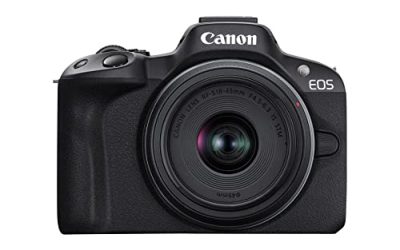
Our Short List of 3

- Best for: Overhead table shots, dim restaurants and anyone who films as well as photographs their food.
- 20.1MP 1-inch stacked Exmor RS CMOS sensor with DRAM
- 24-70mm f/1.8-2.8 ZEISS Vario-Sonnar T lens
- Side flip-out 3.0-inch LCD touchscreen
- Product Showcase Setting for focus shifts to objects

- Best for: Everyday food blogging where natural colour and a straightforward workflow matter more than a long zoom.
- 20.1MP 1.0-inch stacked CMOS sensor
- DIGIC 8 image processor
- 24-100mm f/1.8-2.8 lens with 4.2x optical zoom
- Optical image stabilizer

- Best for: Travel food photography and daytime markets, where a huge zoom range and a light body matter more than low-light performance.
- 20.3MP 1/2.3-inch CMOS sensor
- DIGIC 8 image processor
- 40x optical zoom, 24-960mm equivalent, f/3.3-6.9
- 3-inch tilting LCD with 180-degree flip-up
All 4 Picks at a Glance
| Product | Specs | Action |
|---|---|---|
| Sony ZV-1 |
| Check price on Amazon |
| Canon PowerShot G7 X Mark III |
| Check price on Amazon |
| Canon PowerShot SX740 HS |
| Check price on Amazon |
 Ricoh GR IIIx |
| Check price on Amazon |
Our Top Picks
Food photography asks a camera to do a very specific job. The subject sits still, the light is often dim and warm, and the difference between an appetising shot and a flat one comes down to colour, focus distance and how the lens handles a shallow depth of field. A phone can get close, but a dedicated compact camera gives you a larger sensor, a genuinely fast lens and controls that let you decide exactly what stays sharp.
This guide is for home cooks who photograph their own dishes, food bloggers shooting at a table or a market stall, and restaurant owners who want menu photos without hiring a studio. Every camera below is a fixed-lens compact chosen from its Amazon listing specifications, with an eye on close focusing, low-light performance and a screen that works for overhead shots.
Quick Picks
As an Amazon Associate we earn from qualifying purchases.
| Product | Best for | Key spec from title |
|---|---|---|
| Sony ZV-1 | Overhead table shots and dim restaurants | 24-70mm f/1.8-2.8 ZEISS lens with side flip-out screen |
| Canon PowerShot G7 X Mark III | Everyday food blogging with natural colour | 24-100mm f/1.8-2.8 lens with 3-inch tilt touch LCD |
| Sony Cyber-shot DSC-RX100 VII | Tight detail shots and fast focusing | 24-200mm f/2.8-4.5 ZEISS lens with 357 AF points |
| Canon PowerShot SX740 HS | Travel food photography on a smaller sensor | 40x optical zoom, 24-960mm equivalent, with 4K video |
| Ricoh GR IIIx | Single-dish close-ups with a fixed lens | 24.2MP APS-C sensor with 40mm f/2.8 GR lens |
How to Choose
Start with the sensor and the lens aperture
A larger sensor collects more light and produces cleaner images when you shoot indoors, and a wide maximum aperture lets you blur a busy background while keeping the plate in focus. The three 1-inch sensor cameras in this guide all open to f/1.8 or f/2.8 at the wide end, which is a real advantage over a typical phone or a small-sensor compact when you are shooting a candlelit dinner. Look at the aperture at the wide end first, because that is where most food shots happen, and check whether the lens stays reasonably fast as you zoom in. A camera that drops to a slow aperture when you zoom will force a higher ISO or a darker image.
Check how close the lens can focus
Food shots are usually taken from arm’s length or closer, so minimum focus distance matters more than it does for landscapes. A camera that focuses down to a few centimetres at the wide end lets you fill the frame with a single dish, a garnish or the texture of a crust, while a camera with a long minimum focus distance will force you to step back and crop. The wide end of the zoom is where close focusing is usually at its best, so test the wide setting rather than the telephoto end. If the listing mentions a macro mode, that is a good sign, but the plain wide-angle close focus is what you will use most often.
Pick a screen that works above a table
Overhead flat-lay shots are the signature angle of food photography, and they are awkward with a fixed rear screen because you end up guessing the framing or standing on a chair. A flip-out or tilt screen changes that completely: you can hold the camera above the table and still see the composition. A side flip-out screen is the most flexible option because it works for overhead shots and for filming yourself talking about a dish. A tilt screen that flips up 180 degrees is nearly as useful for table work, though it is less handy when the camera sits on a tripod facing you.
Think about colour, files and sharing
Food colour is unforgiving. Warm tungsten light can turn a fresh salad yellow, and a camera that lets you set a custom white balance or shoot RAW gives you a way to correct it later. RAW files take more storage and need editing software, but they let you recover highlights on a glossy sauce or lift shadows under a bowl without the image falling apart. Wi-Fi transfer matters too, because most food photos end up on a phone for posting, and a camera that sends images to your phone in seconds keeps the workflow short. Check the connectivity in the listing before you buy, since older compacts sometimes rely on a cable.
The 5 Best Options
Sony ZV-1
- Best for: Overhead table shots, dim restaurants and anyone who films as well as photographs their food.
- 20.1MP 1-inch stacked Exmor RS CMOS sensor with DRAM
- 24-70mm f/1.8-2.8 ZEISS Vario-Sonnar T lens
- Side flip-out 3.0-inch LCD touchscreen
- Product Showcase Setting for focus shifts to objects
Overhead table shots, dim restaurants and anyone who films as well as photographs their food.
The battery runs down faster than on simpler compacts when the screen and Wi-Fi are in constant use, so carry a spare if you shoot a full dinner service.
The ZV-1 is built around a 20.1MP 1-inch sensor and a 24-70mm f/1.8-2.8 ZEISS lens, a combination that suits food photography unusually well. The fast aperture keeps backgrounds soft at typical table distances, the sensor handles dim restaurant light without heavy noise, and the side flip-out screen makes overhead flat-lays easy to frame. Its Product Showcase setting shifts focus from a face to an object held up to the lens, handy for presenting a dish to the camera. Real-Time Eye AF keeps a cook sharp when they are part of the shot, and the camera records JPEG and RAW so you can correct warm indoor colour afterwards.
Watch out for: The battery runs down faster than on simpler compacts when the screen and Wi-Fi are in constant use, so carry a spare if you shoot a full dinner service.
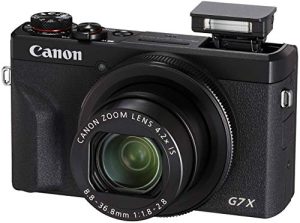
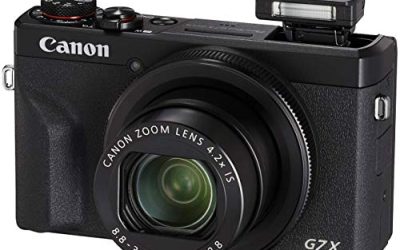
Canon PowerShot G7 X Mark III
- Best for: Everyday food blogging where natural colour and a straightforward workflow matter more than a long zoom.
- 20.1MP 1.0-inch stacked CMOS sensor
- DIGIC 8 image processor
- 24-100mm f/1.8-2.8 lens with 4.2x optical zoom
- Optical image stabilizer
Everyday food blogging where natural colour and a straightforward workflow matter more than a long zoom.
The lens is at its best at the wide end; at full telephoto the aperture narrows and the camera leans harder on higher ISO settings in low light.
The G7 X Mark III pairs a 20.1MP 1-inch stacked CMOS sensor with a 24-100mm f/1.8-2.8 lens, giving you useful reach beyond the ZV-1 without giving up the fast aperture that matters for food. Canon’s colour handling renders warm dishes and fresh produce in a natural, appetising way, and the DIGIC 8 processor keeps the camera responsive when you are working through a multi-course meal. The 3-inch tilt touch LCD flips up for overhead and selfie-style angles, the camera shoots 4K video, and Wi-Fi plus NFC move images to a phone quickly. It also supports an external microphone, which is a bonus if your food content includes talking to camera.
Watch out for: The lens is at its best at the wide end; at full telephoto the aperture narrows and the camera leans harder on higher ISO settings in low light.
Sony Cyber-shot DSC-RX100 VII
The RX100 VII is the most capable stills camera in this guide, and it shines in detail work. The 20.1MP 1-inch stacked sensor and 357 phase-detection AF points lock onto a subject in an instant, which helps with steam rising from a bowl or a hand pouring sauce. The 24-200mm ZEISS lens covers a wide table scene and a tight close-up of a garnish, and it focuses close at the wide end. A pop-up electronic viewfinder gives a bright, glare-free way to compose in sunlight, and the tilting LCD touchscreen handles overhead angles. It records 4K HDR video and shoots RAW, so files hold up to serious editing.
Specs
- 20.1MP 1-inch Exmor RS stacked CMOS sensor
- ZEISS Vario-Sonnar T* 24-200mm f/2.8-4.5 lens
- 357 focal-plane phase-detection AF points
- Up to 20 fps blackout-free continuous shooting
- Pop-up 2.35M-dot OLED electronic viewfinder
- 3-inch tilting LCD touchscreen
- 4K HDR (HLG) video recording
- JPEG and RAW file formats
- Wi-Fi and Bluetooth connectivity
Best for: Tight detail shots, fast-moving kitchen action and photographers who want the strongest autofocus in a pocket camera.
Watch out for: The lens is slower than the f/1.8 options at the wide end, so in very dim rooms you will lean on the sensor and higher ISO settings more often.
Canon PowerShot SX740 HS
- Best for: Travel food photography and daytime markets, where a huge zoom range and a light body matter more than low-light performance.
- 20.3MP 1/2.3-inch CMOS sensor
- DIGIC 8 image processor
- 40x optical zoom, 24-960mm equivalent, f/3.3-6.9
- 3-inch tilting LCD with 180-degree flip-up
Travel food photography and daytime markets, where a huge zoom range and a light body matter more than low-light performance.
This camera does not shoot RAW, so white balance and exposure corrections are limited to what the JPEG file allows, and the smaller sensor shows noise sooner in dim light.
The SX740 HS takes a different approach: a smaller 1/2.3-inch sensor and a huge 40x zoom in a pocket-sized body. For food photography its case is about versatility rather than low-light finesse. The 24-960mm equivalent range lets you photograph a market stall from across the street and then step in close for a plate, and the 180-degree flip-up screen works well for overhead shots and for filming yourself. It records 4K video, connects over Wi-Fi and Bluetooth, and the DIGIC 8 processor keeps the camera quick. The smaller sensor means it prefers good light, so it shines at daytime markets, bright cafes and outdoor tables rather than candlelit dining rooms.
Watch out for: This camera does not shoot RAW, so white balance and exposure corrections are limited to what the JPEG file allows, and the smaller sensor shows noise sooner in dim light.
Ricoh GR IIIx
- Best for: Single-dish close-ups and photographers who want the largest sensor and the most natural perspective in a pocket camera.
- 24.24MP APS-C CMOS sensor
- 40mm equivalent f/2.8 GR prime lens
- Macro focus down to approx. 12 cm
- 3-inch fixed touchscreen LCD
Single-dish close-ups and photographers who want the largest sensor and the most natural perspective in a pocket camera.
There is no zoom, no flip screen and no built-in flash, so framing overhead shots and lighting a dark table both need more effort than with the other cameras here.
The GR IIIx is the only fixed-lens camera here, and its 40mm f/2.8 lens is why it earns a place. A 40mm field of view matches how a dish looks from across a table, with natural depth and no wide-angle distortion stretching the plate. Behind it sits a 24.2MP APS-C sensor, the largest in this guide, delivering clean files in dim light and detail to spare for cropping. A macro mode focuses down to about 12 cm for garnishes and textures, and the camera shoots RAW files for colour correction. At 262 g it slips into a pocket, though the fixed rear screen makes overhead shots harder to frame.
Watch out for: There is no zoom, no flip screen and no built-in flash, so framing overhead shots and lighting a dark table both need more effort than with the other cameras here.
Which One Fits Your Situation
You shoot mostly overhead flat-lays at home
Pick the Sony ZV-1. Its side flip-out screen is the easiest to use above a table, the fast f/1.8 lens keeps the plate sharp against a soft background, and the Product Showcase setting is built for presenting a dish to the lens. The 1-inch sensor also handles kitchen lighting better than the smaller sensor in the SX740 HS.
You run a food blog and want natural colour with little fuss
Pick the Canon PowerShot G7 X Mark III. Its colour rendering suits food straight out of camera, the 24-100mm range covers a whole table without changing position, and the tilt touch screen plus Wi-Fi transfer keep the workflow short from plate to post. The fast lens also helps in dim cafes where a phone would struggle.
You want the sharpest single-dish shots
Pick the Ricoh GR IIIx. Its 40mm lens frames a single dish the way your eye sees it, the APS-C sensor keeps detail clean in low light, and the macro mode gets close enough for garnishes and textures. If you need a zoom or a flip screen instead, the Sony RX100 VII is the more flexible alternative for fast kitchen moments.
You travel and photograph food at markets and cafes
Pick the Canon PowerShot SX740 HS. The 40x zoom covers a market stall and a plate from the same spot, the body is light enough to carry all day, and the flip-up screen works for overhead shots at a cafe table. Just plan to shoot in good light, since the smaller sensor prefers it.
Common Mistakes
- Shooting with the wrong white balance and letting warm restaurant lighting turn fresh food yellow or orange.
- Standing too far back and cropping later instead of moving close and using the wide end of the lens, where close focusing is at its best.
- Using the built-in flash head-on, which flattens texture and throws harsh shadows across the plate.
- Ignoring the background and letting clutter, hands or a messy table edge creep into the frame.
- Saving only JPEG files and then discovering you cannot fix an overexposed highlight on a glossy sauce or a dark shadow under a bowl.
Frequently Asked Questions
Do I need a 1-inch sensor for food photography?
A 1-inch sensor is not a strict requirement, but it makes indoor shooting noticeably easier. It gathers more light than the smaller sensors in most budget compacts, so images stay cleaner at higher ISO settings and backgrounds blur more smoothly. If you mostly shoot in bright daylight, a smaller sensor camera like the SX740 HS still works well.
What focal length works best for food photos?
The wide end of the zoom, around 24mm equivalent, is the workhorse for food. It lets you get close to the plate, keeps the whole dish in frame and gives you the shortest minimum focus distance. A short telephoto around 50 to 70mm is useful for isolating a single dish and compressing the background, which is why the 24-70mm and 24-100mm lenses in this guide are a good fit.
Should I shoot RAW or JPEG for food pictures?
RAW is the safer choice when the lighting is tricky, because it lets you adjust white balance and recover highlights or shadows without degrading the image. JPEG is fine for bright, even light and for quick posting, and it needs no editing software. If your camera supports both, shoot RAW plus JPEG so you keep the flexibility and still have a file ready to share.
Is a flip screen really necessary for food photography?
It is not necessary, but it makes overhead shots far easier. Without one you have to guess the framing or hold the camera above your head and hope. A flip-out or tilt screen lets you see the composition while the camera sits above the table, which is how most flat-lay food photos are made.
More from Amazon
Programs that pair well with the guide above. Offers and eligibility are set by Amazon and may change.
Free shipping on eligible items, Prime Video and more. Eligible new members can start with a free trial.
Start a Prime free trialAudiobooks and podcasts to listen to on the go. Eligible new members can start with a free trial.
Try Audible freeAd-free music streaming. Eligible new subscribers can start with a free trial.
Try Music Unlimited freeA free business account with business pricing and bulk-buying tools for work, shop or home office.
Create a business accountAs an Amazon Associate we earn from qualifying purchases.