Our Top Picks

The Canon EOS 7D Mark II remains a serious tool for action, wildlife, and event photography. Its 20.2 megapixel APS-C sensor, 65 point autofocus system, and 10 frames per second burst rate reward glass that can keep up. A slow or soft lens wastes the best qualities of this body, while a well matched lens turns it into a fast, confident machine for sports, birds, portraits, and close-up detail work.
Choosing lenses for this camera calls for one habit above all others. Remember the 1.6x crop factor every time you read a focal length. A lens marked 24mm behaves like a 38mm lens on a full frame body, and a 400mm lens behaves like a 640mm lens. That change is a gift for wildlife and sports photographers, because it brings distant subjects closer without extra bulk. Every pick below lists its equivalent focal length on the 7D Mark II, so you can judge each lens by the view you will actually get.
As an Amazon Associate, we earn from qualifying purchases.
How to Choose a Lens for the Canon EOS 7D Mark II
Begin with the subjects you shoot most often, then let focal length follow. A photographer who covers indoor events needs a wide aperture and a useful middle range, while a wildlife photographer needs reach above almost everything else. A portrait photographer needs a flattering focal length and smooth background blur, while a macro photographer needs close focusing and a flat field of focus.
Autofocus speed matters more on this body than on a slower camera. The 7D Mark II tracks moving subjects with a dense autofocus array, and a lens with a ring type ultrasonic motor or a stepping motor keeps up with that system far better than an older micro motor design. Lenses with ultrasonic motors also allow full time manual focus override, which lets you nudge focus by hand without flipping a switch.
Image stabilization earns its place in a different way. On a telephoto lens, stabilization steadies the viewfinder image and lets you shoot handheld at slower shutter speeds when light fades. It does not freeze a moving subject, and it cannot replace a fast shutter speed for action, but it widens the range of conditions in which a lens stays useful. The 7D Mark II has no in-body stabilization, so the stabilizer in the lens is the only help you get.
1. Canon EF 24-70mm f/2.8L II USM

The Canon EF 24-70mm f/2.8L II USM is the workhorse standard zoom for the 7D Mark II, and it is the lens to choose if you want one professional optic that handles events, weddings, portraits, and documentary work without fuss. On this body its 24-70mm range behaves like a 38-112mm lens, a classic span for people photography. The wide end suits environmental portraits and group shots in a room, while the long end reaches far enough for head and shoulders portraits with gentle background separation. It is not a wide angle lens on this camera, so landscape photographers who need a sweeping view should look elsewhere.
Its constant f/2.8 aperture is the feature that defines the lens. You can zoom from one end of the range to the other without the aperture closing down, which keeps shutter speeds high and exposure consistent in changing light. There is no image stabilization, so you rely on shutter speed and steady technique in low light, but the f/2.8 aperture compensates for much of that.
Specs: Focal length 24-70mm, 38.4-112mm equivalent on the 7D Mark II; constant f/2.8 maximum aperture; Canon EF mount; ring type ultrasonic motor autofocus; no image stabilization; 82mm filter thread; minimum focus distance 0.38 m; 9 diaphragm blades; 18 elements in 13 groups; 805 g; weather sealed construction.
2. Canon EF-S 55-250mm f/4-5.6 IS STM

The Canon EF-S 55-250mm f/4-5.6 IS STM is the light telephoto zoom that makes the most sense for 7D Mark II owners who want real reach without a heavy bag. On this body its 55-250mm range behaves like an 88-400mm lens, which covers youth sports from the sideline, wildlife in a park, candid portraits across a room, and travel detail shots that a standard zoom cannot reach.
Its strongest quality is how little it asks of you. At 375 grams it is easy to carry all day, and it balances on the 7D Mark II without pulling the camera forward. The stepping motor autofocus is smooth and quiet, which suits video as well as stills, and the optical image stabilizer steadies the viewfinder at the long end, where camera shake is hardest to control. Image quality is strong for a lens of this class. Detail is crisp in the middle of the range at moderate apertures, and the lens holds up well when you stop down a little from wide open at the long end. The variable aperture narrows to f/5.6 at 250mm, so this is not a low light lens, and it will not isolate a subject with the same smooth background blur as a fast prime.
Specs: Focal length 55-250mm, 88-400mm equivalent on the 7D Mark II; f/4-5.6 maximum aperture; Canon EF-S mount; stepping motor autofocus; optical image stabilization; 58mm filter thread; minimum focus distance 0.85 m; 7 diaphragm blades; 15 elements in 12 groups; 375 g.
3. Canon EF 85mm f/1.8 USM
The Canon EF 85mm f/1.8 USM is the classic portrait prime for the 7D Mark II, and it is the lens to choose when you want beautiful background blur and flattering perspective in a small, fast package. On this body its 85mm focal length behaves like a 136mm lens, a long portrait length that flattens facial features gently and lets you work at a comfortable distance from your subject. That distance suits head and shoulders portraits, outdoor sessions, and quiet candid work where you do not want to crowd the person in front of the lens.
Its f/1.8 aperture is the heart of the lens. It gathers enough light for indoor portraits without flash, and it creates the soft background blur that separates a subject from a cluttered scene. At f/1.8 the depth of field is thin, so careful focus on the eyes matters, and the 7D Mark II autofocus system rewards that care with precise focus when you place a focus point on the eye. Autofocus is fast and nearly silent thanks to the ring type ultrasonic motor, and full time manual focus lets you adjust by hand when autofocus locks onto the wrong detail. There is no image stabilization, so you need a steady hand or a faster shutter speed in dim light, but the wide aperture gives you room to raise the shutter speed without pushing sensitivity too far.
Specs: Focal length 85mm, 136mm equivalent on the 7D Mark II; f/1.8 maximum aperture; Canon EF mount; ring type ultrasonic motor autofocus; no image stabilization; 58mm filter thread; minimum focus distance 0.85 m; 8 diaphragm blades; 9 elements in 7 groups; 425 g.
4. Canon EF 100mm f/2.8L Macro IS USM

The Canon EF 100mm f/2.8L Macro IS USM is the close-up lens for the 7D Mark II, and it is the pick for photographers who want true macro capability alongside a fine portrait lens. On this body its 100mm focal length behaves like a 160mm lens, which gives you a comfortable working distance from small subjects. You can photograph a flower, an insect, or a piece of jewelry at life size magnification without casting a shadow over it or frightening a living subject away.
The lens focuses as close as 0.30 metres, and its Hybrid image stabilization compensates for both angular and shift camera shake, which is the kind of movement that ruins close-up shots when you work handheld. The stabilizer is a real advantage in the field, where a tripod is not always practical and where light under leaves or indoors is often dim. Optically, this is an L series lens in every sense. Detail is crisp from the centre to the corners, even at wide apertures, and the flat field of focus keeps the edges of a flat subject sharp when you work parallel to it. The ring type ultrasonic motor focuses quickly for a macro lens, and full time manual focus is essential for fine adjustments at high magnification.
Specs: Focal length 100mm, 160mm equivalent on the 7D Mark II; f/2.8 maximum aperture; Canon EF mount; ring type ultrasonic motor autofocus; Hybrid image stabilization; 1.0x maximum magnification; 67mm filter thread; minimum focus distance 0.30 m; 9 diaphragm blades; 15 elements in 12 groups; 625 g; weather sealed construction.
5. Canon EF 100-400mm f/4.5-5.6L IS II USM
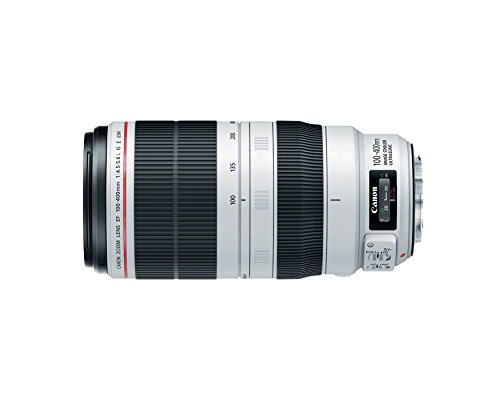
The Canon EF 100-400mm f/4.5-5.6L IS II USM is the long wildlife and sports zoom for the 7D Mark II, and it is the lens that makes the fullest use of the 1.6x crop factor. On this body its 100-400mm range behaves like a 160-640mm lens, which brings distant birds, animals on a far bank, and athletes across a field into comfortable reach. No other lens in this guide gets you that close to a distant subject, and for wildlife photographers that reach is the difference between a frame filled with the subject and a frame filled with empty space.
The push-pull zoom of the first version is gone, replaced by a rotating zoom ring that is smoother and easier to control, with adjustable tension so you can set the feel to suit your hand. The optical design is sharper across the range, and the image stabilizer gives up to four stops of correction with three modes, including a mode designed for panning with a moving subject. That panning mode matters for birds in flight and for motorsport, where the camera must follow a subject across the frame while the stabilizer steadies only the vertical axis. This is a large lens, and it should be chosen with open eyes. At 1,570 grams it is the heaviest lens in this guide by a wide margin, and a monopod or a comfortable strap makes a real difference on a long day in the field.
Specs: Focal length 100-400mm, 160-640mm equivalent on the 7D Mark II; f/4.5-5.6 maximum aperture; Canon EF mount; ring type ultrasonic motor autofocus; optical image stabilization with three modes; 77mm filter thread; minimum focus distance 0.98 m; 9 diaphragm blades; 21 elements in 16 groups; 1,570 g; weather sealed construction; removable tripod collar included.
A Simple Kit for the Canon EOS 7D Mark II
If you are building a kit from nothing, begin with the lens that matches your main subject, then add the lens that covers the gap you feel most often. An event photographer can begin with the 24-70mm f/2.8L II and add the 85mm f/1.8 for portraits in low light. A wildlife photographer can begin with the 100-400mm f/4.5-5.6L IS II and add the 55-250mm f/4-5.6 IS STM as a light lens for walks when the big zoom stays at home. A photographer who loves small subjects can begin with the 100mm f/2.8L Macro and add the 24-70mm for everything else. Pay attention to how the crop factor shapes each choice. A 24mm lens is not wide on this camera, and a 100mm lens is already a long telephoto.
FAQ
Is the Canon EOS 7D Mark II still worth buying lenses for?
Yes, the 7D Mark II remains a capable body for action, wildlife, and event work, and good EF and EF-S lenses hold their value well because they also work on other Canon DSLRs and on mirrorless bodies with an adapter.
Do EF-S lenses work on the Canon EOS 7D Mark II?
Yes, EF-S lenses mount and work fully on the 7D Mark II, including autofocus, metering, and image stabilization. They are built for APS-C sensors, so they cannot be used on full frame Canon DSLRs.
What focal length is best for portraits on the Canon EOS 7D Mark II?
A lens in the 85mm to 135mm equivalent range suits most portraits, and the 85mm f/1.8 in this guide behaves like a 136mm lens on this body.
Can I use these lenses for video on the Canon EOS 7D Mark II?
Yes, all five lenses in this guide work for video, and the 55-250mm IS STM is the quietest choice thanks to its stepping motor.
Conclusion
The best lens for the Canon EOS 7D Mark II is the one that matches the subjects you shoot most, with the crop factor doing the conversion for you. The 24-70mm f/2.8L II covers events and general work, the 55-250mm IS STM adds light reach, the 85mm f/1.8 brings portrait character, the 100mm f/2.8L Macro opens up close-up detail, and the 100-400mm f/4.5-5.6L IS II turns the camera into a serious wildlife tool. Choose the lens that fills the gap in your bag and the 7D Mark II will reward you with sharp, detailed photographs for years to come.
More from Amazon
Programs that pair well with the guide above. Offers and eligibility are set by Amazon and may change.
Free shipping on eligible items, Prime Video and more. Eligible new members can start with a free trial.
Start a Prime free trialAudiobooks and podcasts to listen to on the go. Eligible new members can start with a free trial.
Try Audible freeAd-free music streaming. Eligible new subscribers can start with a free trial.
Try Music Unlimited freeA free business account with business pricing and bulk-buying tools for work, shop or home office.
Create a business accountAs an Amazon Associate we earn from qualifying purchases.