
Key takeaways
- Load capacity: choose a head with a stated capacity well above the combined weight of the camera, lens and accessories. Makers give differing figures, and reviewers often suggest leaving a safety margin.
- Ball diameter: a larger ball typically holds more weight, but also makes the head heavier.
- Friction control: an adjustable friction knob lets you set how much resistance the ball has before you fully lock it, avoiding sudden drops.
- Panning base: a separate pan lock helps with panoramas and level rotation.
- Quick release: Arca-Swiss compatible clamps are the most common, letting you swap plates across brands.
For most photographers, a good ball head is the best tripod head; a pan-tilt (three-way) head suits architecture and precise composition, a fluid head suits video, and a gimbal head suits long telephoto lenses on birds and wildlife. The head decides how smoothly you aim, how quickly you set up and whether heavy gear stays put, so it matters as much as the legs. Match the head type to your main subject, then confirm that its stated load rating comfortably exceeds the weight of your camera and lens.
Our top picks



As an Amazon Associate we earn from qualifying purchases at no extra cost to you.
Tripod Heads at a Glance
| Head type | Best for | Strengths | Limits |
|---|---|---|---|
| Ball head | General photography, travel, landscapes | Fast, compact, one knob to loosen and reposition | Harder to make tiny single-axis adjustments |
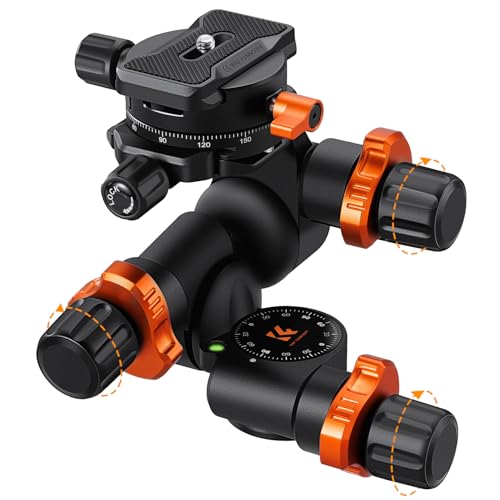
| Pan-tilt (three-way) head | Architecture, product, precise framing | Independent control per axis | Bulkier, slower to set up |
| Fluid head | Video panning and tilting | Smooth damped movement | Heavier, less suited to still shooting |
| Gimbal head | Long telephoto lenses for wildlife and sports | Balanced lens swings freely | Larger and specialized |
| Geared head | Macro, studio, landscape fine tuning | Very precise geared adjustments | Slow and heavy |
| Panoramic head | Stitched panoramas | Rotates around the lens’s nodal point | Specialist use |
Ball Heads: The Default Choice
Ball heads use a spherical joint that locks with a single knob, and many have a separate panning base and friction control. Brands commonly discussed by reviewers include Really Right Stuff (BH series), Arca-Swiss, Manfrotto (XPRO and Befree series), Benro (B and GX series), Sirui (K series) and Acratech. Premium makers machine heads from aluminum or titanium and publish a load capacity, while budget models come with a lower stated capacity and simpler locking.
What to look for
- Load capacity: choose a head with a stated capacity well above the combined weight of the camera, lens and accessories. Makers give differing figures, and reviewers often suggest leaving a safety margin.
- Ball diameter: a larger ball typically holds more weight, but also makes the head heavier.
- Friction control: an adjustable friction knob lets you set how much resistance the ball has before you fully lock it, avoiding sudden drops.
- Panning base: a separate pan lock helps with panoramas and level rotation.
- Quick release: Arca-Swiss compatible clamps are the most common, letting you swap plates across brands.
Pan-Tilt and Geared Heads
A three-way head, such as the Manfrotto 804RC2 and similar designs, has separate levers for pan, tilt and roll. This control is valuable for architecture where lines must be straight, or in product and studio work where small adjustments are common. Geared heads provide even finer control through knobs but are slower to use and weigh more, so they suit studio and macro rather than travel.
Fluid Heads for Video
Video heads use fluid damping to give smooth, resistance-controlled pans and tilts. Manufacturers such as Manfrotto, Sachtler, Benro and Sirui list counterbalance settings that offset the weight of the camera so it stays level when you release the handle. A longer pan bar gives more leverage for smooth movements. Hybrid heads that handle stills and video exist but are a compromise, since a pure video head is bulkier than a ball head.
- Check the counterbalance range against your camera’s weight.
- Look for a bubble level and a locking pan bar.
- Consider a flat base or a 75mm bowl, depending on your tripod’s mounting style.
Gimbal Heads for Big Lenses
A gimbal head lets a long telephoto lens hang from its balance point and move freely in all directions. Wildlife photographers use it for 400mm to 600mm lenses because the lens stays put when released and moves with little effort. Makers like Wimberley, Benro and Jobu produce these heads. They are heavy and tailored to long lenses, so they are not suitable for general use. If your telephoto is under about 300mm, a sturdy ball head may be enough.
Compatibility and Safety Notes
- Thread size: tripod heads usually mount on a 3/8-inch thread, with a 1/4-inch adapter available. Confirm the thread on your tripod legs.
- Leg and head match: a heavy head on light legs can make the setup unstable. Check the legs’ load rating as well.
- Quick-release plate: use the plate that fits your clamp. Loose plates risk dropping a camera.
- Locking: double-check that the clamp is fully tightened before removing your hand from the camera, especially on a slope or in wind.
- Cold and grit: sand and salt water can damage ball surfaces. Rinse and dry the head after use near a coast as the maker advises.
Budget Tiers Without Prices
| Tier | Typical choices | Trade-off |
|---|---|---|
| Budget | Entry ball heads from Sirui, Benro, Neewer and Manfrotto’s lighter lines | Lower load ratings and simpler finishes |
| Mid-range | Manfrotto XPRO, Benro and Sirui higher-grade ball heads, entry fluid heads | Better locking and smoother feel |
| Premium | Really Right Stuff, Arca-Swiss, Acratech, Wimberley, Sachtler | Tight tolerances and long-term durability, larger investment |
Pick X If…
| If you… | Pick | Reason |
|---|---|---|
| Shoot landscapes and travel | Compact ball head with Arca-Swiss clamp | Quick and light |
| Photograph buildings or products | Pan-tilt or geared head | Independent axis control |
| Record video | Fluid head with counterbalance | Smooth pans and tilts |
| Shoot birds with a 500mm lens | Gimbal head | Lens swings freely |
| Make panoramas | Ball head with panning base or a panoramic head | Level rotation |
Alternatives
- Monopod head: a small ball or tilt head for monopods used in sports.
- Travel tripods with integrated heads: products such as the Peak Design Travel Tripod use proprietary built-in ball heads to save space.
- Table-top tripods: small support with a mini ball head for compact cameras.
- Beanbags and clamps: useful when a tripod is not allowed or practical.
Care Tips
Wipe the head after use, avoid over-lubricating the ball, and keep the clamp’s threads clean. Do not exceed the maker’s rated load, and store with knobs loosened slightly so seals are not compressed for long periods. If the head slips under load, contact the maker rather than modifying it.
How Head and Legs Work Together
A tripod is only as stable as its weakest link. A premium head on thin, lightweight legs can vibrate in wind, and a flimsy head on strong legs will creep under load. Makers publish load ratings for both, and reviewers suggest choosing legs and a head that are matched in capability. Carbon-fiber legs damp vibration well and weigh less, while aluminum legs are more budget-friendly and heavier. Hanging a camera bag from the center column hook can add stability in wind when the manual allows it.
Leg angle and extension also affect rigidity. Extending the thinnest leg sections last, keeping the center column low, and spreading the legs wider all increase stability. A low, wide stance is the best choice for long exposures and strong breezes.
Setup and Everyday Technique
- Level the legs first, then use the head’s bubble level or built-in level for fine adjustment.
- With a ball head, partially loosen the friction knob and compose, then fully lock before the shot. This avoids sudden drops of the camera when you release the main knob.
- Use a remote release or the camera’s timer to avoid vibration at the moment of exposure.
- Turn off lens or body stabilization when the maker advises it for tripod use, as some systems can introduce small shifts on a rigid support.
- Re-tighten the plate and clamp periodically, since vibration and temperature changes can loosen them.
For heavy telephotos, mount the lens’s tripod collar rather than the camera body, if the lens has one, because it keeps the balance point close to the head and reduces strain on the camera mount.
Buying Smart
Start by listing your heaviest camera and lens combination, then add accessories such as a flash or L-bracket. Choose the head type that matches your main subject, then look at the stated load capacity, clamp type and weight. If you travel, a lighter ball head is often the best compromise, while studio and wildlife work can justify a heavier specialist head. Keep the receipt window in mind and handle the head in person if possible, since the feel of the knobs is hard to judge from a spec sheet.
Frequently Asked Questions
Which tripod head is best for beginners?
A ball head with a friction control and an Arca-Swiss compatible clamp is the most flexible starting point. It is fast and works for most photography.
How much load capacity do I need?
Add up the camera, lens and accessories, then choose a head with a stated capacity comfortably above that figure. Reviewers often advise leaving a generous margin, particularly for long lenses.
Is a pan-tilt head better than a ball head?
It is better for precise, axis-by-axis adjustments, such as architecture. A ball head is faster and more compact, so it wins for general use.
Do I need a fluid head for video?
For smooth panning and tilting, a fluid head is strongly preferred. A ball head can work for locked-off shots but is difficult to move smoothly.
Can I use any head on any tripod?
Most use a standard 3/8-inch or 1/4-inch thread, but some tripods use a bowl or flat-base system. Check the mounting type and ensure the legs can carry the combined weight.
What is Arca-Swiss compatible?
It is a dovetail clamp and plate standard used by many makers. Plates and clamps from different brands often fit each other, though minor tolerances can differ, so test the fit before relying on it.





