Key takeaways
- Platform: Nintendo Switch family of systems; physical game card
- Players: one for the main story; up to four in the Union Room and Grand Underground multiplayer spaces
- Main story length: roughly 25 to 30 hours for a first playthrough at a normal pace
- Completionist length: well past 100 hours if you chase the full Pokédex, Super Contest ribbons and Ramanas Park legendary encounters
- Online: requires a Nintendo Switch Online membership for internet trading and battling; local wireless works without one
- Transfer: compatible with Pokémon HOME for moving creatures in and out
- Save data: one save file per user profile, so a household can run separate games on separate profiles
If you want one answer: the best Pokémon game for most people in 2026 is Pokémon Shining Pearl on Nintendo Switch. It is the most complete single purchase on this list — a full 25-to-30-hour role-playing campaign through the Sinnoh region, a post-game legendary hunt, Union Room play for up to four trainers, and the largest active trading pool of any title here, all on hardware that is still widely stocked and still supported. It suits lapsed fans returning to the series, parents buying a first “real” Pokémon game, and anyone who wants a cartridge they can hand to a friend across the room. If your household plays at a table rather than on a couch, the best budget pick is Monopoly Pokémon Edition, which covers two to four players from age eight for roughly the price of a family cinema trip. If you want the deepest premium purchase and you already own a 3DS, the Omega Ruby and Alpha Sapphire Dual Pack delivers two full Hoenn adventures in one box — with one important 2026 caveat about online services that this article explains in full.
Top 3 Picks
Best overall: Pokémon Shining Pearl (Nintendo Switch)
The strongest all-rounder because it is a complete, self-contained role-playing game rather than a companion product. You get a 25-to-30-hour main story, a sprawling underground to explore, a competitive battle layer that runs on the same mechanics as the modern tournament scene, and a trading community that is still busy. It is the one item here that a single player can enjoy alone for a month and then share with three friends.
Best budget: Monopoly Pokémon Edition Board Game
For the lowest outlay on this list you get a full board game that works for two to four players aged eight and up, needs no console, no batteries and no internet, and stores flat in a box barely larger than a hardback book. It is the safest gift in the roundup because almost every household already knows the rules, and the Pokémon reskin gives younger players a reason to sit through a long game.
Best premium: Pokémon Omega Ruby and Alpha Sapphire Dual Pack
Two complete Hoenn adventures in a single physical package, each with its own version-exclusive Pokémon, its own legendary, and a post-game Delta Episode. It is the pick for collectors and for anyone who wants the maximum number of playable hours per box. Buy it knowing that Nintendo’s online services for 3DS software ended in April 2024, so the multiplayer is now local-wireless only.
Quick Comparison
| Product | Best for | Key specs | Price tier |
|---|---|---|---|
| Pokémon Shining Pearl (Nintendo Switch) | The classic trainer journey | 1 player story; up to 4 in Union Room; ~25–30 h campaign; Switch game card; Pokémon HOME transfer supported | Premium |
| Monopoly Pokémon Edition Board Game | Family game night | 2–4 players; ages 8+; 60–180 min per game; box roughly 10.5 × 10.5 × 2 in | Budget |
| Ravensburger Labyrinth Pokémon | Strategic family play | 2–4 players; ages 7+; 20–30 min; shifting maze board; no batteries | Mid-range |
| Buffalo Games Pokémon Fan Favorites Puzzle | Quiet solo or small-group play | 100 pieces; ages 6+; finished size in the 15 × 11 in range; 45–90 min build | Budget |
| Lite-Brite Super Bright HD, Pokémon Edition | Creative screen-free play | LED peg screen; multiple character templates; battery powered; hundreds of reusable pegs | Budget |
| Guess Who? Pokémon Edition Game | Quick two-player rounds | 2 players; 48 Pokémon; 15 min per round; ages 6+; two flip panels with a divider | Budget |
| Pokémon Battle Academy Board Game | Learning the trading card game | 3 ready-to-play 60-card decks; 2 players; ages 6+; boards, counters, coin and rulebook included | Mid-range |
| 50+ Official Pokémon Cards Collection | Starting a collection | 50+ official cards; 5 foils; at least one premium rarity; standard 63 × 88 mm card size | Budget |
| Pokémon Mystery Dungeon: Rescue Team DX | Story-first players | 1 player; ~20–25 h main story; roguelike dungeon runs; hundreds of recruitable Pokémon; Switch card | Premium |
| Pokémon Omega Ruby & Alpha Sapphire Dual Pack | Collectors and double value | 2 full games; Nintendo 3DS; 1–4 players locally; online services ended April 2024 | Premium |
How We Chose
This roundup is built from published product specifications, manufacturer documentation, platform compatibility notes and widely reported session lengths — not from testing units, benchmarking or owning the products. Every entry had to clear four filters. First, category fit: it has to be a genuine Pokémon product that does the job its category promises, whether that is a role-playing campaign, a maze game or a card-game tutorial. Second, specification substance: we only include items whose player counts, age bands, session lengths, piece counts or platform requirements can be stated concretely, because vague products are impossible to recommend honestly. Third, use-case clarity: each pick must solve a distinct problem, so no two entries compete for the same shelf space — a solo campaign, a party game and a puzzle should never be interchangeable. Fourth, upgrade path: we favour products a player can grow out of into something bigger, such as a starter card set that leads into tournament-legal deck building, or a family board game that leads into deeper strategy titles. Price is expressed only as a tier — budget, mid-range or premium — because listings move daily and a specific figure would be stale within a week.
1. Pokémon Shining Pearl – Best for the Classic Trainer Journey
As an Amazon Associate we earn from qualifying purchases at no extra cost to you.

This is the entry that answers the question in the title most directly. Pokémon Shining Pearl is the Nintendo Switch remake of the original Pokémon Pearl, rebuilt for modern hardware with a chibi-styled overworld, a fully modernised battle engine and a set of additions that the original 2006 release never had. It suits three groups especially well: adults who played the DS-era games and want the nostalgia hit with quality-of-life fixes, children graduating from mobile games to a proper console role-playing game, and anyone who wants a single purchase that will occupy them for a month rather than a weekend.
Key specs
- Platform: Nintendo Switch family of systems; physical game card
- Players: one for the main story; up to four in the Union Room and Grand Underground multiplayer spaces
- Main story length: roughly 25 to 30 hours for a first playthrough at a normal pace
- Completionist length: well past 100 hours if you chase the full Pokédex, Super Contest ribbons and Ramanas Park legendary encounters
- Online: requires a Nintendo Switch Online membership for internet trading and battling; local wireless works without one
- Transfer: compatible with Pokémon HOME for moving creatures in and out
- Save data: one save file per user profile, so a household can run separate games on separate profiles
Why it holds the top spot
The Sinnoh region is the most structurally interesting map the series has produced, and the remake keeps that structure intact while smoothing the friction. Routes branch, the mountain in the middle forces you to plan a route rather than walk a corridor, and the Grand Underground turns traversal into an optional second game — a digging minigame that yields fossils, evolution stones and hidden-base furniture. That underground layer is the single biggest reason this pick beats a straightforward nostalgia purchase: it gives a second activity that does not depend on the story, which matters enormously when a younger player hits a gym leader they cannot beat and needs something else to do that evening.
Battle depth is the other half of the argument. The remake runs on the modern type chart and the physical/special split, so abilities, held items, natures and effort values all matter. That means the game you learn on is the same game the competitive community plays. A player who finishes Shining Pearl understands the vocabulary of the wider series — entry hazards, priority moves, speed tiers — well enough to watch tournament coverage without a glossary. Fewer than half the titles on this list can claim that.
Exploration and multiplayer round it out. The Pokétch returns as a second-screen toolkit, Super Contest Shows give the Pokémon a non-combat career path, and the Union Room lets two to four trainers play together locally or online, trading and battling in the same session. It is the only item here that scales from a solo six-year-old to a group of four adults on a sofa.
Pros
- Full-length role-playing campaign with a genuine 25-to-30-hour main story
- Modern battle mechanics that transfer directly to competitive play
- Up to four players in local or online multiplayer spaces
- Separate save files per console profile, so siblings can each keep their own progress
- Strong second activity in the Grand Underground when the story stalls
Cons
- Faithful to a fault — the route layout is almost identical to a 2006 handheld game
- Online features need a paid Nintendo Switch Online subscription
- The art style divides opinion compared with the more realistic look of later entries
- Premium tier pricing for a game that is, structurally, a remake
How it compares
Against Pokémon Mystery Dungeon: Rescue Team DX, the nearest alternative in tone and price, Shining Pearl wins on battle depth and multiplayer but loses on narrative risk. Mystery Dungeon tells an emotional story with a twist ending; Shining Pearl tells a familiar gym-badge story competently. Against the Omega Ruby and Alpha Sapphire Dual Pack, Shining Pearl wins decisively on availability and support — it runs on current hardware and its online features still work, while the 3DS pair is now a local-play-only experience.
2. Monopoly Pokémon Edition – Best for Family Game Night

If the household has a table, a spare two hours and at least two people who can read a property card, this is the most reliable purchase on the list. Monopoly Pokémon Edition takes the most widely understood board game ruleset in the world and re-skins it with Pokémon locations, Pokémon-themed tokens and Pokémon artwork on the Chance and Community Chest equivalents. It suits families with children aged eight and up, mixed-age gatherings where nobody wants to learn new rules, and anyone buying a gift for a household you do not know well enough to pick a video game for.
Key specs
- Players: two to four
- Age band: eight and up
- Session length: 60 minutes at a brisk pace, and commonly 90 to 180 minutes if players trade aggressively
- Components: folding board, themed tokens, property cards, themed event cards, paper money, dice
- Footprint in play: plan on roughly a 30 × 30 inch square of table once the money and card piles are laid out
- Storage: the box sits in the 10.5 × 10.5 × 2 inch class — shelf-friendly, roughly the footprint of two hardbacks
- Power: none. No batteries, no app, no internet connection
Why it works
The genius of the licensed Monopoly format is that the rules are already installed in most adults’ heads. That means the first game starts within five minutes of opening the box, which is the single hardest problem in family board gaming. The Pokémon layer does real work too: the property names give younger players a reason to care about which spaces they buy, and the themed event cards replace the dry Community Chest flavour text with something a child will actually read aloud.
Ownership realities are mild compared with most of this list. There are no consumables to replace, no batteries to leak and no small pieces that vanish — the money, cards and tokens all live in the box. The components that wear first are the cardboard money and the folding hinge on the board, and both survive years of normal use if the game is stored flat rather than stacked under heavier boxes. The most common mistake is playing on a soft surface such as a rug or a bed, which makes the board flex and eventually splits the centre hinge. A hard table with a tablecloth is the correct setup.
The one thing to plan for is time. Standard Monopoly ends when one player bankrupts the rest, and with four engaged players that can run past three hours. Two fixes work well: agree a fixed end time before the first roll and declare the richest player the winner, or play the shortened variant where properties are dealt out at the start rather than bought. Either turns a marathon into a reliable 60-to-90-minute evening.
Pros
- Rules almost everyone already knows, so setup to first turn is minutes
- Two to four players and a wide age band make it flexible for mixed groups
- No batteries, no screen, no subscription
- Very low storage footprint for a full board game
- Genuinely good value at the budget tier
Cons
- Player elimination means someone can sit out the last hour
- Games can run long without a house rule on the end condition
- Luck-heavy — dice decide more than strategy does
- The Pokémon theme is a reskin, not a new ruleset
How it compares
Against Ravensburger Labyrinth Pokémon, Monopoly wins on familiarity and player count ceiling but loses badly on session length and skill expression. Labyrinth is a 20-to-30-minute game where every turn is a decision; Monopoly is a two-hour game where most turns are a dice roll. Against Guess Who? Pokémon Edition, Monopoly is the better group game and the worse two-player game — if your household is exactly two people, Guess Who? finishes in 15 minutes and gets replayed five times in an evening.
3. Ravensburger Labyrinth Pokémon – Best for Strategic Family Play

This is the quiet overachiever of the roundup. Ravensburger’s Labyrinth system is a shifting-maze game: players slide tiles into the board to change the corridors, then move their piece along the newly formed paths to collect treasures. The Pokémon edition swaps the traditional treasure set for Pokémon to collect. It suits families with children aged seven and up who are ready for a game with real decisions, two-to-four-player groups who want something that finishes inside half an hour, and adults who want a board game that is genuinely competitive rather than merely tolerable.
Key specs
- Players: two to four
- Age band: seven and up
- Session length: roughly 20 to 30 minutes, with the four-player game at the longer end
- Board: a fixed outer frame with a grid of sliding tiles, one of which is always spare
- Setup time: under two minutes once the tile pattern is memorised
- Footprint in play: approximately a 20 × 20 inch square — noticeably smaller than a Monopoly board
- Power: none
Why it earns its place
Labyrinth’s core mechanic is elegant: on your turn you insert the spare tile somewhere on the board, which pushes a row or column along and ejects a different tile at the far end. That single action changes the maze for everyone, including you. It means every turn has two decisions — where to insert and where to move — and both decisions affect other players directly. For a child aged seven or eight, that is the moment board games click: the realisation that you can help yourself by blocking someone else.
Session length is the practical advantage. A full game finishes in the time it takes to eat dinner, which means it actually gets played on a school night. It also means a bad game is over quickly, which matters enormously with younger players who can become discouraged. Compare that with a three-hour Monopoly session where a losing child has to sit through two more hours of it.
Durability is excellent. The board is thick cardstock with a rigid frame, the tiles are sturdy and the only real wear point is the printed surface on the most frequently handled tiles, which tends to fade after several years of heavy play rather than crack or tear. There are no consumables. The common mistake is storing the game with the tiles loose in a bag rather than in the moulded insert — the insert keeps the stack flat so the frame seats properly, and a warped tile stack makes the maze jam.
Pros
- Real strategic decisions on every single turn
- 20-to-30-minute sessions that fit a weeknight
- Compact playing footprint and quick setup
- Scales cleanly from two to four players without rule changes
- No batteries, no consumables, no screen
Cons
- Mid-range pricing for a game with a modest component count
- Younger children who cannot plan ahead will lose repeatedly
- Tile-sliding can physically disturb the board if the table is uneven
- Less immediately recognisable to non-gamers than a Monopoly box
How it compares
Against Monopoly Pokémon Edition, Labyrinth is the better game and the less familiar one. It rewards planning and punishes carelessness in 25 minutes; Monopoly rewards patience and dice. Against Pokémon Battle Academy, the nearest mid-range competitor, Labyrinth is easier to teach and needs no card knowledge, but it offers no route into a wider organised-play scene. If your group wants a hobby rather than a pastime, Battle Academy is the better mid-range spend; if your group wants something that hits the table weekly without argument, Labyrinth is it.
4. Buffalo Games Pokémon Fan Favorites, 100-Piece Puzzle – Best for Quiet Solo Play

Not every Pokémon purchase needs a rules explanation or a second player. This 100-piece jigsaw from Buffalo Games is aimed at children aged six and up and delivers something the rest of the list cannot: a completely silent, screen-free activity that one person can do alone and stop and restart at will. It suits younger children building fine-motor skills, a child who needs a wind-down activity after school, and families who want a shared table activity where conversation happens naturally rather than being forced by a game.
Key specs
- Piece count: 100
- Age band: six and up
- Finished size: in the 15 × 11 inch range — roughly the footprint of a large hardback opened flat
- Build time: 45 to 90 minutes for a first attempt at age six; closer to 30 minutes once the image is familiar
- Box: standard Buffalo Games puzzle box, shelf depth comparable to a cereal box
- Power: none
Why it belongs here
One hundred pieces is a deliberate number. Below about 60 pieces a puzzle becomes a five-minute activity that offers no persistence; above about 300 pieces it stops being completable in a single sitting for a six-year-old and becomes a permanent table occupant. At 100 pieces the task is long enough to feel like an achievement and short enough to finish before bedtime, which is exactly the band parents are looking for.
The Buffalo Games cut quality is the reason to choose this over a generic puzzle. Pieces are thick, the image is printed at high resolution so the character artwork stays legible, and the die-cut is clean enough that the classic puzzle frustration — two pieces that almost fit but do not — is rare. A ribbon cut also means the puzzle can be assembled in sections and moved in chunks, which is essential if the table is needed for dinner.
The ownership realities are simple and worth stating. A 100-piece puzzle loses pieces over time; the practical defences are to build it on a felt mat or a large tray so it can be lifted whole, and to count the pieces back into the box rather than sweeping them in. Buffalo Games puzzles also hold resale and hand-me-down value well because the pieces are durable, so a puzzle that survives one child usually survives two. The main failure mode is water damage from a drink placed on the finished puzzle, which swells the card and makes the pieces fit badly forever after.
Pros
- Completable in a single sitting at the stated age band
- Thick pieces with a clean cut and legible artwork
- No screen, no batteries, no second player required
- Packs away flat and stores in very little shelf space
- Budget-tier price for an activity that gets reused
Cons
- Single-use entertainment once the image is memorised
- Loose pieces are easy to lose in carpet
- No replay value for older children or adults
- Card damage from spills is permanent
How it compares
Against Lite-Brite Super Bright HD, Pokémon Edition, the puzzle is the calmer and cheaper option and the Lite-Brite is the more repeatable one — pegs can be re-arranged indefinitely, whereas a puzzle is solved once. Against Guess Who? Pokémon Edition, the puzzle is solo and the Guess Who? is strictly two-player, so the two sit in different slots in a household rotation rather than competing. If you are buying for one child who needs quiet time, take the puzzle; if you are buying for two children who need something to do together, take Guess Who?.
5. Lite-Brite Super Bright HD, Pokémon Edition – Best for Creative Screen-Free Play

Lite-Brite is one of the few toys from the 1960s that still works exactly as intended, and the Pokémon edition applies it to a franchise children already recognise. You place translucent coloured pegs into a black grid and the built-in LEDs light them from behind, producing a glowing picture. It suits younger children in the preschool-to-early-primary range who are not yet ready for a full board game, families who want a screen-free activity that produces something worth showing, and anyone buying for a child who responds to visual and tactile play more than to rules.
Key specs
- Format: illuminated peg board with a black grid screen and LED backlighting
- Pegs: hundreds of reusable translucent pegs in multiple colours; the HD line uses a finer peg than the classic version
- Templates: several Pokémon character designs included, with blank templates for free drawing
- Power: battery operated, so no cable and no wall socket needed
- Session length: a single template runs 20 to 45 minutes depending on the child’s pace
- Cleanup: pegs are loose, so a tray or a rimmed table mat is essential
Why it earns a slot
The value proposition here is repeatability. Unlike a puzzle, a Lite-Brite board is never finished — the pegs come out and go back in, and the same template can be rebuilt in a different colour scheme or replaced with a freehand design. That gives it an unusually long active life for a budget-tier item, and it means two children can use it in sequence without the second one feeling they got a used toy.
The HD branding matters more than it sounds. Earlier Lite-Brite models used a coarse peg on a large grid, which limited the detail in the finished picture. The finer peg spacing in the HD line means the character artwork is actually recognisable when lit, which is the entire point — a child who builds a Pikachu that does not look like Pikachu will not build a second one.
Ownership realities are worth planning around. The pegs are the consumable: they get dropped, sat on and vacuumed up, so a household that uses the board regularly should expect to lose a few each month and keep the board topped up rather than waiting for a critical colour to run out. The LED panel is the part that eventually fails, and it is generally the reason a Lite-Brite gets retired rather than the pegs. Cleaning is a dry-cloth job only — the screen is a printed panel and liquid cleaners will cloud the surface. The most common mistake is storing the board with the pegs still in it, which presses the pegs into the grid and can crack the panel in a packed cupboard.
Pros
- Reusable — the picture can be rebuilt or redesigned indefinitely
- Finer HD peg spacing produces genuinely recognisable artwork
- Battery powered and portable, so it works on a lap or in a car
- Screen-free, tactile and quiet
- Budget-tier price for a long-lived toy
Cons
- Loose pegs are easily lost and need a tray
- Batteries are a recurring running cost
- The LED panel is the eventual failure point and is not user-serviceable
- Limited appeal once a child outgrows the templates
How it compares
Against the Buffalo Games 100-piece puzzle, Lite-Brite costs about the same at the budget tier but delivers repeat use where the puzzle delivers one solve. Against Pokémon Battle Academy, Lite-Brite is far easier for a young child and requires no reading, but it offers no progression — there is no skill ladder to climb. For a five- or six-year-old, Lite-Brite is the correct first Pokémon product; for an eight-year-old who wants to win something, Battle Academy is.
6. Guess Who? Pokémon Edition Game – Best for Quick Two-Player Rounds

Guess Who? is a deduction game: each player holds a secret character card and eliminates candidates by asking yes-or-no questions until only one remains. This Pokémon edition replaces the classic human faces with 48 Pokémon, which is a genuine improvement — Pokémon have obvious visual traits such as type, colour, wings, horns and tails, so the question space is richer than “does your person wear a hat?” It suits exactly two players, works from around age six, and finishes in 15 minutes, which makes it the most replayable item in this roundup.
Key specs
- Players: two
- Characters: 48 Pokémon across the two flip panels
- Session length: about 15 minutes per round
- Age band: six and up, in practice
- Components: two flip panels with a central divider, plus a deck of secret character cards
- Footprint in play: roughly 24 × 12 inches once the divider is upright — small enough for a coffee table
- Portability: the panels fold flat, which makes it the most travel-friendly game here
- Power: none
Why it earns a slot
Fifteen minutes is the killer spec. Most board games fail not because they are bad but because the setup-to-payoff ratio is wrong for a weeknight. Guess Who? gets from box to first question in under a minute and completes before a child’s attention drifts. That means it gets played in short bursts — three rounds before dinner, two rounds while waiting for a sibling’s practice to finish — and short repeated sessions are how deduction skills actually develop.
The Pokémon theming does real mechanical work here. Because Pokémon are visually differentiated by design, questions like “does your Pokémon have wings?” or “is it green?” split the 48 candidates efficiently, and children learn to think about which question eliminates the most options. That is a genuine reasoning skill, and it transfers directly to the logic puzzles and probability questions they will meet at school.
Ownership realities are minimal. The panels are hinged and the hinges are the first thing to wear; the flip mechanism uses small plastic tabs that can snap if a child forces a panel. Storing the game flat, with the divider out and the cards in the deck slot, prevents most damage. There are no consumables and no batteries. The one structural limitation is player count — this is strictly a two-player game, so it cannot absorb a third child without someone waiting, which is the main reason a family of four should pair it with a group game rather than buying it alone.
Pros
- 15-minute rounds mean it actually gets played
- 48 visually distinct characters create a rich question space
- Teaches elimination logic and question strategy
- Folds flat and travels well
- Budget-tier price with no running costs
Cons
- Strictly two players — no way to include a third
- Panel hinges and flip tabs are the weak points
- Deduction depth is limited once both players know the roster
- Not a game for adults playing without children
How it compares
Against Monopoly Pokémon Edition, Guess Who? is the better two-player game by a wide margin and the worse group game by an equally wide margin. Against Ravensburger Labyrinth Pokémon, Guess Who? is faster and cheaper but shallower — Labyrinth has a spatial strategy layer that Guess Who? does not. For a household of exactly two, Guess Who? plus Labyrinth covers both the quick-round and the proper-session slot for less than the price of a single premium item.
7. Pokémon Battle Academy Board Game – Best for Learning the Trading Card Game
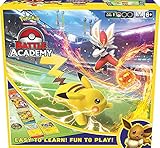
Pokémon Battle Academy is the official on-ramp to the Pokémon Trading Card Game, packaged as a self-contained board game rather than a booster pack. It includes three complete ready-to-play decks, two playmats, damage counters, a coin and a rulebook, and it is designed so that a player who has never seen a trading card game can be playing within 20 minutes. It suits families with children aged six and up who want to learn the real rules rather than a simplified version, and it is the correct first purchase for anyone who has watched the tournament scene and wants to understand it.
Key specs
- Decks: three complete 60-card decks, each built around a different featured Pokémon, so two players can start immediately and a third can join with a different deck
- Players: two at a time, with the third deck available for rotation
- Age band: six and up
- Session length: 20 to 30 minutes per match once both players know the rules
- Components: playmats, damage counters, a rules booklet, a coin and code cards for the digital client
- Card size: standard 63 × 88 mm, so every card is sleeve-compatible and legal in the wider game
- Upgrade path: decks can be modified with any standard Pokémon TCG cards, and the rules taught here are the full tournament rules
Why it is the best mid-range pick
The difference between a starter set and a tutorial is whether the rules you learn are the real ones. Battle Academy teaches the genuine game: prize cards, evolution, energy attachment limits, status conditions, and the win conditions. A child who learns from this box can sit down at a local league event and not need the rules explained twice. That is a meaningfully different product from a simplified “my first card game” package.
The three-deck structure is the other smart decision. A two-deck starter set forces a household to buy a second product to involve a third player. Three decks means a family of four can run a rotation with one person watching or acting as referee, which is a real consideration in households with more than two children.
Ownership realities are where card products differ from everything else on this list. Cards bend, scuff and crease — the fix is a set of standard 66 × 91 mm sleeves, which cost very little and add roughly 1 mm of thickness per card to the deck. Damage counters are small and will be lost; a small resealable bag keeps them together. The playmats are paper rather than rubber in most versions, so they crease if folded rather than rolled. The most common mistake is storing the decks loose in the box, which lets the cards slide and bend against the cardboard insert; a deck box or two elastic-free bands keeps them flat.
Pros
- Teaches the full, tournament-legal ruleset rather than a simplified version
- Three complete decks support a household of three or four
- Everything needed to play is in the box — no extra purchases to start
- Cards are standard size and compatible with the entire card pool
- Clear upgrade path into organised play and deck building
Cons
- Mid-range price is higher than a simple starter deck
- Only two players play at once, despite three decks
- Cards need sleeves to survive heavy use
- The decks are balanced against each other and are not competitive at tournament level out of the box
How it compares
Against the 50+ Official Pokémon Cards Collection, Battle Academy is the better purchase for anyone who wants to play and the collection is the better purchase for anyone who wants to own. The collection gives you more individual cards but no decks, no counters and no rulebook, so it cannot produce a game on its own. Against Ravensburger Labyrinth Pokémon, Battle Academy is harder to teach and far more rewarding long-term, because it connects to a global organised-play scene that Labyrinth simply does not have.
8. 50+ Official Pokémon Cards Collection with 5 Foils – Best for Starting a Collection

This is a bundle rather than a game: 50-plus official Pokémon cards, five of them foil, with at least one card from a premium rarity class such as GX, EX, Full Art or Tag Team. It suits collectors at the very start of the hobby, children who want a stack of cards to trade at school, and anyone filling gaps in a binder without buying randomised booster packs. It is the cheapest way on this list to own a meaningful number of real cards.
Key specs
- Card count: 50 or more official cards
- Foils: five foil cards included
- Guaranteed rarity: at least one card from a premium class — GX, EX, Full Art or Tag Team
- Card size: standard 63 × 88 mm, so they fit any standard binder page or sleeve
- Sleeve size: 66 × 91 mm standard sleeves
- Contents: cards only — no deck, no counters, no rulebook, no playmat
- Price tier: budget
Why it is worth buying
The honest case for a bundle like this is that it removes randomness. Booster packs are a lottery: you pay a fixed price for an unknown outcome, and a child who opens ten packs and finds nothing shiny learns that the hobby is disappointing. A fixed bundle with a stated minimum — 50-plus cards, five foils, one premium rarity — gives a known return. For a first purchase, certainty beats the thrill of the gamble.
The five foils are the practical centre of the product. Foil cards are the ones children show each other, and they are also the ones that hold condition-sensitive value, so they should be sleeved immediately. A single pack of standard 66 × 91 mm sleeves will protect the whole foil set and costs a fraction of what a damaged foil loses in trade value.
Storage is the ownership reality here. Cards stored loose in a tin or an elastic band will bend and edge-wear within months. The correct setup is a nine-pocket binder page for the showcase cards and a deck box for the bulk. Cards should be kept away from direct sunlight, because the foil layer fades, and away from humid rooms such as bathrooms and garages, because the card stock absorbs moisture and warps. None of this is expensive; it is just the difference between a collection that still looks new in five years and one that looks used in five months.
One important expectation to set: a bundle like this is not a deck. There is no guarantee the cards work together as a playable 60-card list, so it should not be bought as a substitute for a structured starter product.
Pros
- Guaranteed card count and guaranteed premium rarity remove booster-pack luck
- Five foils give an immediate centrepiece for a binder
- Standard card size fits all common binders, sleeves and deck boxes
- Excellent budget-tier entry point to the collecting side of the hobby
- Good trading material for children building a school-yard collection
Cons
- Not a playable deck — no counters, no rules, no consistency guarantee
- Exact contents vary, so the bundle is not a fixed list
- Cards arrive unsleeved and need immediate protection
- Duplicate cards are common in bundles of this type