
Key takeaways
- Stated capacity: 32 oz, about 946 ml — the standard desk and gym size
- Colour: Black
- Core function: water intake tracking with a drink reminder
- Brand: WATERH
- Price tier: mid-range
- Material and lid type: confirm on the product page — bottles in this class are typically double-wall vacuum-insulated stainless steel or BPA-free Tritan
The best smart water bottle with hydration tracking for most people is the Hidrate Spark PRO: a 32 oz vacuum-insulated stainless steel bottle with a sensor puck in the base that logs each sip automatically, glows when you fall behind, and syncs the day’s total to a phone app. If you want the same track-and-remind loop for less money, the WATERH BOOST 32 oz keeps the bottle, the tracker and the nudge while trimming the premium sensor hardware. If you would rather never charge anything, the QLUR 32 oz straw bottle and the RYI 64 oz motivational bottle turn hydration into a printed hourly schedule you can read at a glance, and the HANDYSPRING smart bottle adds lights plus a sound cue for people who ignore a silent bottle. This guide compares all five on tracking accuracy, reminder method, battery expectations, app integration, capacity and cleaning, then maps each one to the routine it actually fits.
Top 3 Picks
Best overall: Hidrate Spark PRO
The Hidrate Spark PRO is the only bottle here that measures intake for you rather than asking you to remember it. A sensor puck in the base detects each sip, the LED ring glows on a schedule you set, and the companion app turns the day into a live progress figure with streaks and adjustable goals. It suits anyone who wants the data to be automatic and is willing to charge a small puck and hand-wash a sensor base.
Best budget: QLUR 32 oz Straw Bottle
The QLUR 32 oz is a BPA-free sports bottle with a straw and printed time markers down the side, which makes hydration a visual checklist rather than an electronic one. There is no battery, no app, no charging cable and no sensor to protect from water, so the total cost of ownership stays close to the purchase price. It is the right first step for someone who wants structure around drinking without adding a device to their life.
Best for one-fill workdays: RYI 64 oz Motivational Bottle
The RYI half-gallon bottle holds 64 oz, which is roughly two full 32 oz bottles in a single fill, and its time markers and motivational wording run the length of the body. It suits people who work at a fixed desk, dislike refilling, and want a visible “how much is left” signal without electronics. The trade-off is weight and bulk: 64 oz of water alone weighs about 4.2 lb.
Quick Comparison
| Product | Best for | Stated capacity | Tracking method | Reminder style | Price tier |
|---|---|---|---|---|---|
| WATERH BOOST 32 oz | Simple electronic reminders at a desk | 32 oz / about 946 ml | Bottle-mounted intake tracker | Reminder alert from the tracker | Mid-range |
| Hidrate Spark PRO | Automatic, app-backed tracking | 32 oz / about 946 ml (also sold in a smaller 21 oz class) | Base sensor puck logs sips automatically | Glowing LED ring, app notifications | Premium |
| QLUR 32 oz Straw Bottle | Lowest-cost structure with zero maintenance | 32 oz / about 946 ml | Manual — printed time markers | Visual hourly markers | Budget |
| HANDYSPRING Smart Bottle | Audible reminders for people who ignore silent cues | Not stated in the listing title; confirm on the product page | Bottle-mounted intake tracker | Lights and sound | Mid-range |
| RYI 64 oz Motivational Bottle | One fill covering a full workday | 64 oz / about 1.9 L (half gallon) | Manual — printed time markers | Visual time and motivation markers | Budget |
The price tiers above describe where each bottle sits relative to the others in this group, not a fixed figure — listings move with sales, bundles and colour options, so treat budget, mid-range and premium as bands rather than prices. The bigger split is between bottles that sense your drinking and bottles that display a schedule you follow. Sensing bottles cost more and carry a charging and cleaning routine; schedule bottles cost less and put the discipline on you. Everything else — capacity, lid type, insulation, whether the mouth is wide enough for ice — is a comfort decision you make after that first one.
How We Chose
This roundup is built from published manufacturer specifications, the details stated in each product listing, and established norms for how reusable bottles and hydration sensors behave. None of these bottles were tested, benchmarked or handled for this article; every claim comes from what the makers publish or from well-documented facts about the category, and where an exact figure was not stated we describe the spec class instead of guessing a number.
Five criteria shaped the picks. First, tracking method, because a sensor that logs sips automatically and a printed time marker solve different problems. Second, reminder modality — glow, sound, notification or printed line — because the best reminder is the one you actually notice in your environment. Third, power and maintenance, including what has to be charged, what can go in a dishwasher and what has to be hand-washed. Fourth, capacity against real routines: 21 oz, 32 oz and 64 oz bottles suit commuters, desk workers and one-fill users differently. Fifth, upgrade path — whether the bottle you buy first still makes sense if you later decide you want app data or a bigger volume. Price tier was the last filter, not the first.
1. WATERH BOOST 32 oz – Best for Straightforward Daily Reminders
As an Amazon Associate we earn from qualifying purchases at no extra cost to you.
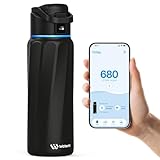
The WATERH BOOST is the sensible middle of this list: a 32 oz bottle in black that carries an intake tracker and a reminder, so the bottle itself tells you when to drink. It suits the person who wants an electronic nudge but does not want to manage a premium sensor ecosystem, charge a puck every week, or read a dashboard of graphs. If your goal is simply “stop finishing the day having drunk almost nothing,” this is the shape of product that fixes it.
Key specs
- Stated capacity: 32 oz, about 946 ml — the standard desk and gym size
- Colour: Black
- Core function: water intake tracking with a drink reminder
- Brand: WATERH
- Price tier: mid-range
- Material and lid type: confirm on the product page — bottles in this class are typically double-wall vacuum-insulated stainless steel or BPA-free Tritan
Where it does well
Thirty-two ounces is the most flexible capacity in this group. It is light enough to carry in a bag, small enough to sit next to a keyboard without dominating the desk, and large enough that two fills cover a typical 64 oz day. That matters more than it sounds: a bottle you refill twice is a bottle you interact with twice, which is two extra chances to notice how much you have actually had.
The tracking-plus-reminder loop is the real point of the product. Instead of relying on memory or on a printed schedule you have to read, the BOOST class of bottle tracks intake and prompts you when you drift. For someone who works through lunch and looks up at 4 p.m. wondering why they have a headache, an active reminder is a different experience from a passive marker — the bottle comes to you rather than waiting to be read.
It also sits in the most comfortable price band. You get electronics and a reminder without the premium tier, which means replacing it after a dropped-bottle accident or a lost lid stings far less than losing a top-of-the-line sensor model. For a first smart bottle, that lower stakes profile is a genuine advantage.
Pros
- 32 oz is the sweet spot for desk, commute and gym use
- Active reminder rather than a passive printed schedule
- Mid-range price keeps the stakes low for a first smart bottle
- Neutral black finish suits an office or a car
- Simple enough that there is no app learning curve to fight through
Cons
- Tracker hardware means something to charge or maintain, unlike a marker bottle
- Material, lid type and dishwasher guidance need checking on the listing
- No premium-grade sensor accuracy or deep app analytics
- Only one capacity option in this listing
How it compares
Against the Hidrate Spark PRO, the WATERH BOOST trades sensor sophistication and app depth for a lower price and a simpler routine — the PRO measures each sip automatically, while a bottle-mounted tracker of this class typically depends on how consistently you use it. Against the HANDYSPRING, the two are direct mid-range rivals, and the deciding factor is reminder style: the HANDYSPRING leans on lights and sound, which is louder and more noticeable but less discreet in a shared office. Against the QLUR, the BOOST costs more but removes the burden of remembering to look at a marker line. If you want the least expensive structure, buy the QLUR; if you want the bottle to chase you, buy the BOOST.
2. Hidrate Spark PRO – Best Overall for Accurate, Automatic Tracking

The Hidrate Spark PRO is the most capable bottle in this roundup and the one that best matches the phrase “smart water bottle.” It is a vacuum-insulated stainless steel bottle — the listing covers a 32 oz version, and the line is also sold in a smaller 21 oz class — with a sensor puck that sits at the base and a “Chug & Straw” lid arrangement that gives you both a wide mouth and a straw option. It suits the reader who wants the data to be collected for them and is willing to accept a charging routine and a hand-washed sensor base in exchange.
Key specs
- Stated capacity: 32 oz, about 946 ml, with a 21 oz class also available
- Construction: vacuum-insulated stainless steel body
- Tracking: base sensor puck logs intake automatically as you drink
- Reminder: LED ring glows to prompt you, plus app notifications
- Lids: chug lid and straw lid both referenced in the listing
- Connectivity: Bluetooth sync to a companion app for goals and history
- Price tier: premium
Where it does well
The sensor puck is what separates this bottle from every other pick here. It works by measuring the change in the bottle as you drink, which means it does not depend on you pressing a button, tapping a lid or remembering to log anything. Over a week, that difference compounds: manual systems fail on the days you are busiest, which are exactly the days you most need the reminder. A bottle that logs sips on its own gives you an honest daily number even when your attention is elsewhere.
The LED reminder is the second advantage. Glow is a discreet modality — it reads across a room and in a dark car, but it does not announce itself to everyone within earshot the way a sound alert does. You can set it to pulse when you fall behind your pace rather than at fixed clock times, which is closer to how hydration actually works across a day of meetings, commutes and gym sessions.
Insulation matters too. A vacuum-insulated stainless body holds cold water for hours and does not sweat onto a desk, a bag or a car seat, which is a genuine practical difference from a single-wall plastic sports bottle on a warm day. The dual lid setup means the same bottle can be a straw sipper at a desk and a wide-mouth chugger at the gym.
The app is where the tracking turns into behaviour. Goals, streaks and history give you something to adjust: if you consistently hit 50 oz and your target is 70 oz, you can see exactly where the shortfall happens and change the reminder timing rather than just resolving to try harder. Apps in this class typically sync with mainstream health platforms, so the intake data can sit alongside the rest of your activity log rather than in a silo.
Pros
- Automatic sip logging — nothing to remember or press
- Glowing LED reminder is discreet but highly visible
- Vacuum-insulated stainless steel keeps drinks cold without condensation
- Chug and straw lids cover desk and workout use in one bottle
- App history and goal adjustment make trends visible
Cons
- Premium price tier, the highest in this group
- Powered sensor base means a charging routine and careful hand-washing
- More parts to lose or misplace, including lids and the puck
- Overkill if you only want a reminder and never look at data
How it compares
Against the WATERH BOOST, the Hidrate Spark PRO is the more accurate and more informative bottle: automatic sensing versus a bottle-mounted tracker, LED pacing versus a basic alert, and app depth versus a simpler interface. The BOOST wins on price and on how little attention it demands of you as a device. Against the QLUR and the RYI, the comparison is philosophical rather than technical — those bottles hand you a printed schedule, while the PRO hands you a measurement. If you have ever followed a time-marker bottle for a week and still had no idea whether you drank enough, the PRO answers that question directly.
3. QLUR 32 oz Straw Bottle – Best Budget, Zero-Maintenance Pick

The QLUR 32 oz is a BPA-free sports water bottle with a straw and time markers printed along the body. It has no electronics, no battery, no app and nothing to charge, which makes it the lowest-effort option in this roundup to own. It suits readers who want structure around their drinking — a visible schedule that turns “drink more water” into “finish this line by 2 p.m.” — without adding a device, a cable or a subscription to their routine.
Key specs
- Stated capacity: 32 oz, about 946 ml
- Material: BPA-free plastic, per the listing
- Lid: straw lid for hands-free sipping
- Tracking: manual — printed time markers on the bottle
- Power: none required
- Brand: QLUR
- Price tier: budget
Where it does well
The time-marker system is underrated precisely because it is so simple. Markers divide the bottle into hourly or two-hourly targets, so progress is legible from across the room and requires no interaction at all. There is no battery to die mid-week, no sensor to keep out of the sink, no sync that fails when your phone updates, and no firmware that stops being supported. The bottle will work exactly as well in five years as it does today, which is not something you can say about any powered device.
Thirty-two ounces is the same flexible capacity as the two mid-range smart bottles here, so the QLUR fits the same routines: desk, commute, gym bag, cup holder. The straw lid makes it easy to sip while working or driving without tipping the bottle, and the wide body is straightforward to fill from most taps and fountains. For a first hydration bottle, or a second one to keep in a bag, it removes every excuse about complexity.
Cleaning is also simpler in the ways that matter. There is no powered puck, no charging contacts and no electronic module to keep dry, so the cleaning routine is the ordinary one: wash the bottle and lid, and pay attention to the straw and the gasket, which are the parts that accumulate residue fastest in any straw bottle. Compared with a sensor bottle, that is a meaningful reduction in weekly chores.
The other strength is cost of ownership. Nothing in this bottle is a consumable in the electronic sense, so there is no battery to replace and no accessory to buy. If the straw discolours or the lid seal wears out, you replace a lid rather than a device.
Pros
- No battery, no app, no charging — nothing to maintain
- Printed time markers make progress readable at a glance
- BPA-free plastic keeps the bottle light in a bag
- Straw lid supports hands-free sipping at a desk or in a car
- Budget tier with effectively no ongoing costs
Cons
- No automatic logging — the marker only works if you look at it
- Plastic bodies can cloud and scratch with heavy use over time
- Single-wall plastic does not hold cold as long as insulated steel
- Straw and gasket need regular, deliberate cleaning
- No data history, so you cannot review a week or spot patterns
How it compares
Against the RYI 64 oz, the QLUR is the same manual philosophy in a smaller, lighter, more portable package — choose the QLUR for a bag and the RYI for a desk that never moves. Against the WATERH BOOST and the HANDYSPRING, the QLUR gives up active reminding but also gives up charging, cleaning around electronics and any risk of a dead battery. Against the Hidrate Spark PRO, it is not a tracking device at all; it is a schedule printed on a bottle. If you already know you will not remember to check a marker line, spend more and buy something that prompts you.
4. HANDYSPRING Smart Bottle – Best for Reminders You Cannot Ignore

The HANDYSPRING is a smart water bottle with an intake tracker and a reminder that uses both lights and sound, and the listing notes that it is rechargeable. It suits a specific kind of reader: the person who has tried a silent glow reminder or a printed marker and still forgets, because their attention is on a screen, a call or a task. Sound is the one reminder modality that interrupts whatever else is happening, and for some people that is the difference between a feature and a decoration.
Key specs
- Core function: water intake tracking with drink reminders
- Reminder type: lights and sound
- Power: rechargeable, per the listing
- Capacity: not stated in the listing title — confirm the exact figure on the product page
- Brand: HANDYSPRING
- Price tier: mid-range
Where it does well
The dual reminder is the whole argument for this bottle. Lights handle the visual case: a glance across the desk catches a pulsing indicator without any noise. Sound handles the case where you are not looking — deep in a document, on a call with your camera off, or moving around a room. Having both means you are covered in more situations than a bottle that offers only one, and you can usually choose which one is active depending on where you are.
Rechargeability is the second advantage over coin-cell designs. A rechargeable bottle does not leave you hunting for a specific battery size when the reminder quietly stops working; you plug it in, and the habit is a familiar one because you already charge a phone, a watch and headphones. That is a small thing that removes a real friction point, since the failure mode of a dead reminder is silent — you simply stop being reminded and may not notice for days.
As a mid-range pick it also sits in the practical band for a daily-use item. You are paying for electronics, but not the premium tier that comes with a full sensor and app ecosystem. For someone whose goal is behavioural — actually drinking during the workday — rather than analytical, that is a reasonable place to land.
The tracker-plus-reminder loop gives you the same basic feedback as any bottle in this class: how much you have logged today and whether you are behind. Combined with an audible cue, that is enough for most people to close the gap between intending to drink and actually drinking.
Pros
- Lights plus sound covers both visual and inattentive moments
- Rechargeable, so no proprietary battery to source later
- Mid-range price tier with a full track-and-remind loop
- Sound reminders are the hardest cue to overlook
- Works without depending on you remembering to check a marker
Cons
- Sound alerts can be disruptive in a shared office or on a call
- Capacity is not stated in the listing title, so verify before buying
- Recharging is a recurring routine, unlike a marker bottle
- Powered components mean the base needs careful washing
- Less analytical depth than a premium sensor-and-app bottle
How it compares
Against the WATERH BOOST, this is a near-tie on category and price, decided almost entirely by reminder style: the HANDYSPRING adds sound, which is more intrusive but harder to miss, while the BOOST is the quieter option for a shared space. Against the Hidrate Spark PRO, the HANDYSPRING gives up automatic sip sensing and app history but costs less and, for some users, reminds more effectively — a glowing ring can be ignored by someone staring at a monitor, while a chime generally cannot. Against the QLUR and the RYI, it is the opposite approach: those bottles wait for you to look, and this one comes and gets you.
5. RYI 64 oz Motivational Bottle – Best for One-Fill Workdays

The RYI motivational bottle is a half-gallon (64 oz, about 1.9 L) BPA-free bottle with a straw and time markers, finished in a pink-to-blue gradient. It suits people who work from a fixed spot — a desk, a workshop bench, a home office — and who find refilling a 32 oz bottle twice a day an unnecessary interruption. One fill covers a 64 oz daily target, so the bottle is also the goal, which removes an entire layer of arithmetic from the habit.
Key specs
- Stated capacity: 64 oz, about 1.9 L — half a gallon
- Material: BPA-free, per the listing
- Lid: straw lid with a handle for carrying
- Tracking: manual — time markers plus motivational wording
- Finish: pink and blue gradient
- Power: none required
- Price tier: budget
Where it does well
The arithmetic is the selling point. Most adults aiming for roughly 64 oz a day would need two fills of a 32 oz bottle, or three fills of a 21 oz bottle. A 64 oz bottle needs one. That means one trip to the tap in the morning, one cap to open and close, and a single visual reference for the whole day — the level in the bottle is your remaining target. Every refill you remove is one more decision you do not have to make.
The markers and motivational text reinforce that. Because the bottle is tall, the time markers are spaced generously and read clearly from a seated position, so you can see at a glance whether you are ahead of or behind the line without picking it up. For someone whose problem is not forgetting to drink but losing track of how much they have drunk, that constant ambient feedback is genuinely useful.
It is also the most forgiving bottle here in cost terms. There is nothing to charge, nothing to sync, nothing to update and nothing to break electronically. The consumables are limited to the lid, the straw and the gasket, and those are the same wear items every bottle in this list has. If the goal is a high-volume daily target with the least possible friction and the smallest possible ongoing cost, this is the straightforward answer.
Finally, the straw lid plus handle makes it practical to keep filled and nearby rather than treating it as a travel bottle. It is designed to sit and be sipped, which is exactly how a desk-based hydration habit works.
Pros
- 64 oz in one fill covers a full daily target for many adults
- Large, legible time markers and motivational text along the body
- BPA-free and completely unpowered — no charging, no app
- Straw lid and handle make it easy to keep within reach
- Budget tier with essentially no running costs
Cons
- Heavy when full: 64 oz of water alone weighs about 4.2 lb (1.9 kg)
- Too large for most car cup holders and many backpack pockets
- May not fit under a shallow tap or a standard water-cooler spout
- No automatic logging, so accuracy depends entirely on your discipline
- Wide, tall body and straw take longer to clean than a small bottle
How it compares
Against the QLUR 32 oz, the RYI is the same manual approach scaled up: pick the QLUR if the bottle has to travel, and the RYI if it lives on a desk. Against the Hidrate Spark PRO and the WATERH BOOST, the RYI wins decisively on capacity and on maintenance — no charging, no sensor, no app — but loses on measurement, because a printed marker tells you nothing unless you read it. Against the HANDYSPRING, the contrast is total: the HANDYSPRING interrupts you, the RYI waits to be checked. If you know you will check, the RYI is the cheaper, larger, more durable answer.
How to Choose
Choosing a hydration-tracking bottle is really three decisions stacked in order: how you want intake measured, how you want to be reminded, and how much volume fits your routine. Everything else — material, insulation, lid style, colour — is a preference you can settle once those three are fixed.
Step 1: Decide how intake gets measured
There are three methods in this roundup and they are not equivalent.
Automatic sensing (Hidrate Spark PRO) logs each sip for you using a powered base that detects the change as the bottle empties. It produces the most complete record and asks the least of you, but it costs the most, needs charging and requires care around water when cleaning.
Bottle-mounted trackers (WATERH BOOST, HANDYSPRING) record intake events and daily totals, and their accuracy depends on how consistently you engage with them. They sit between the two extremes on both price and effort.
Printed time markers (QLUR, RYI) record nothing at all. They display a schedule you follow. They are the cheapest and the most reliable in the sense that nothing can fail, but the entire burden of accuracy is on you.
A useful test before you buy: think about last week. Did you fail to drink because you did not know how much you had had, or because you did not think about it at all? If it is the first, a marker bottle solves your problem for the least money. If it is the second, you need a reminder, and probably an automatic one.
Step 2: Pick a reminder that fits where you drink
Reminder modality is the most underrated spec in this category, because a reminder you tune out is worse than no reminder at all — it gives you false confidence.
- Glow or light: discreet, works in an open office, visible in low light, easy to ignore if you are focused on a screen. Best for shared spaces and for people who glance at their desk regularly.
- Sound: the hardest cue to overlook and the most disruptive to others. Best for a home office, a workshop or a private space, and for people who genuinely do not notice visual cues.
- Printed time markers: silent and constant, but passive. Best for people who already have the habit of looking at their bottle and just need a target line.
- App notifications: effective when your phone is with you and notifications are on, useless when it is in a bag on silent.
If you work in an open-plan office, avoid sound. If you work alone and have repeatedly ignored a glow, buy sound.
Step 3: Match capacity to your day
Capacity drives refill count, and refill count drives how often you actually engage with the bottle. Here is the arithmetic for a 64 oz daily target, which is a reasonable general benchmark for many adults:
| Bottle size | Metric equivalent | Fills to reach 64 oz | Weight of water when full | Fits in a car cup holder |
|---|---|---|---|---|
| 21 oz | About 620 ml | 3.0 fills | About 1.4 lb / 0.62 kg | Usually yes |
| 32 oz | About 946 ml | 2.0 fills | About 2.1 lb / 0.95 kg | Often yes |
| 64 oz | About 1.9 L | 1.0 fill | About 4.2 lb / 1.9 kg | Rarely |
Two fills of a 32 oz bottle is the most common balance: light enough to carry, large enough that you are not constantly at the tap. One fill of a 64 oz bottle is the best fit for a stationary desk but a poor fit for commuting, because four pounds of water plus the bottle itself is a real load, and the diameter usually exceeds a cup holder. Note also that daily fluid needs vary with body size, activity, climate and health conditions; the 64 oz figure here is a planning benchmark for sizing a bottle, not a medical recommendation.
Step 4: Check the cleaning and durability details
This is where most buyers get surprised after a few months.
Powered bases are hand-wash items. A sensor puck or electronic module at the base of a bottle cannot be submerged or run through a dishwasher cycle. In practice that means removing the module, washing the body separately, and drying the contacts — a routine that takes longer than washing an ordinary bottle. If you know you will not do that, buy an unpowered bottle.
Straws and gaskets wear first. On every bottle in this list, the parts that fail are the soft parts: the straw, the lid seal, the gasket inside the cap. They discolour, they hold flavour, and they eventually stop sealing. Treat them as consumables and expect to replace or deep-clean them periodically.
Plastic clouds, steel dents. A BPA-free plastic body is light and inexpensive but scratches and clouds with heavy use, which matters more on a transparent marker bottle because the markers become harder to read. A stainless steel body keeps its look but dents if dropped, and powder-coated finishes can chip at the base over time. Neither failure changes function immediately.
Narrow mouths are harder to clean than wide ones. If a bottle has a straw lid, the straw itself is the cleaning bottleneck, not the body. Bottle brushes sized for straws solve this, and so does rinsing immediately after use rather than leaving residue to dry.
Insulation is a comfort spec, not a tracking spec. Vacuum-insulated steel keeps water cold for hours and prevents condensation on your desk. Single-wall plastic does neither, but it is lighter and cheaper. If you drink more when the water is cold, insulation is a tracking feature in disguise.
Step 5: Decide whether you want the app
App support is only worth paying for if you will use it. A hydration app in this class typically offers a daily goal, a running total, history and streaks, and often syncs with mainstream health platforms so intake sits alongside steps and workouts. That is genuinely useful if you like reviewing trends or if your goal changes with training load. It is dead weight if you never open it — and worse, a bottle that depends on an app can feel broken when the app is not set up. If you dislike managing accounts and permissions, choose a bottle that reminds you without one.
A decision matrix for common situations
| Your situation | Best fit | Why |
|---|---|---|
| Open-plan office, need quiet reminders | Hidrate Spark PRO | Glow reminder is visible but silent; automatic logging needs no button presses |
| Want tracking without the premium price | WATERH BOOST 32 oz | Mid-range tracker and reminder in the most flexible capacity |
| Repeatedly ignore silent cues | HANDYSPRING | Sound plus light is the hardest reminder combination to overlook |
| Refuse to charge another device | QLUR 32 oz | Unpowered marker bottle; nothing to charge, sync or update |
| Desk-based, want one fill to last | RYI 64 oz | Half-gallon capacity covers a full day without a refill trip |
| Commute, gym and desk in one day | WATERH BOOST or QLUR, 32 oz | 32 oz is the most portable size that still limits refills to two |
| Want to review weekly trends | Hidrate Spark PRO | Only pick here with automatic logging and app history |
| Buying a first hydration bottle | QLUR 32 oz | Lowest cost, no maintenance, establishes the habit before you invest |
Common mistakes to avoid
- Buying the biggest bottle first. A 64 oz bottle is excellent on a desk and miserable in a bag. Match the bottle to where it will live.
- Assuming a reminder equals a habit. The first week goes well for everyone; the test is week three, when the novelty has gone.
- Ignoring the charging cycle. A dead tracker is silent, so put charging on the same schedule as your phone.
- Dishwashing a powered base. This is the most common way sensor bottles die. Remove the electronics first, every time.
- Never replacing the gasket. A leaking lid usually means a worn seal, not a broken bottle.
- Treating a printed marker as data. It is a target, not a record. If you want a record, you need a sensor.
Tracking Accuracy, Reminder Style, and Battery Life Compared
Because these three attributes are what the marketing language blurs together, it helps to separate them by tracking method rather than by product.
| Tracking method | What it records | Accuracy class | Power | Typical failure mode |
|---|---|---|---|---|
| Base sensor puck (Hidrate Spark PRO) | Each sip, timestamped, with a running daily total | Highest of the three; still an estimate of intake, not a measurement of body hydration | Rechargeable; expect a recurring charge routine in the weeks-to-months class depending on reminder frequency | Forgetting to charge; washing the module |
| Bottle-mounted tracker (WATERH BOOST, HANDYSPRING) | Intake events and a daily total; depends on how consistently you use it | Moderate; accurate if you engage with it, sparse if you do not | Rechargeable or replaceable-battery class depending on model | Dead battery with no visible warning; inconsistent logging |
| Printed time markers (QLUR, RYI) | Nothing electronic — a visual schedule only | Entirely dependent on the reader; no record to review | None | Markers become hard to read as plastic clouds; you stop checking |
Two honest caveats apply to all of it. First, no consumer bottle measures your hydration status — they measure how much liquid left the bottle. That is a useful proxy and nothing more; genuine hydration assessment involves factors a bottle cannot see, and if you have a medical reason to monitor fluid intake, that is a conversation with a clinician rather than a product decision. Second, “accuracy” in this category mostly means consistency. A bottle that logs every sip approximately is more useful than one that logs some sips perfectly and misses the rest, because the trend is what changes behaviour.
On battery, the practical guidance is simple: assume any powered bottle will need attention on a regular cycle, and choose based on whether you would rather plug something in or replace a battery. Rechargeable designs are more convenient in a household that already has charging cables everywhere; replaceable batteries are better for a bottle that lives in a bag and might sit unused for weeks. Either way, put the maintenance on a fixed rhythm — the first of the month, or every Sunday evening — because the failure is always silent.
Frequently Asked Questions
Do smart water bottles actually track how much you drink?
Sensor-based bottles such as the Hidrate Spark PRO do track intake automatically, by detecting the change in the bottle as you drink, and they produce a running daily total. Bottles with a bottle-mounted tracker record intake events


