Key takeaways
- Material: moulded plastic — the only non-metal unit in this roundup
- Configuration: 4 shelves
- Listed dimensions: 48 x 23 x 14 in (check which dimension is height on the listing, since plastic utility shelving is sold in both tall and low configurations)
- Stated capacity: 200 lb for the unit, not per shelf — a meaningful distinction covered in the load math below
- Assembly: press-fit, no tools
- Corrosion risk: none
For the typical unfinished basement — poured concrete floor, roughly 8-foot ceiling, a dehumidifier running in the corner, and a mix of paint cans, holiday bins, tools and canned goods — the best shelving unit is the REIBII 2400 lb 5-tier rack at 36 in W x 16 in D x 72 in H. Its footprint slips through standard door openings and between joist bays, its 72-inch height clears most basement ductwork and water lines, and its rated 2,400 lb total capacity is enough for the dense loads — paint, tile, canned food, hand tools — that bow lighter plastic and wire racks. It suits anyone outfitting a normal basement wall without measuring twice. If your basement is genuinely damp and your loads are light, a plastic or wire unit costs less and tolerates moisture better; if you are storing tile pallets, engine parts or a full workshop, step up to a 3,200 lb or dual-pack steel rack. Everything below is matched to four things: humidity, floor space, load, and how hard the unit is to get down the stairs and assemble.
Top 3 Picks
Best overall: REIBII 2400 lb 5-Tier (36 in W x 16 in D x 72 in H). The best balance of capacity, footprint and price tier for a standard basement. It fits where wider racks will not, holds loads that plastic shelving cannot, and assembles in place with basic hand tools.
Best budget: GH 5-Tier Garage Shelving (36 x 16 x 72 in, 2,500 lb). The same footprint and a higher rated total capacity than several mid-range racks, at a budget price tier. The trade-off is finish quality, packaging and hardware tolerances rather than raw strength.
Best premium: REIBII 3200 lb 5-Tier (55.5 in W). For a long basement wall and heavy, dense storage — tile, power tools, bulk pantry — this is the widest and highest-rated rack here, and the one that makes a single wall do the work of two.
Quick Comparison
| Product | Best for | Key specs | Price tier |
|---|---|---|---|
| Plano 4-Shelf Plastic Storage Shelves | Damp floors, light dry goods, renters | 4 shelves; listed 48 x 23 x 14 in; 200 lb stated capacity; plastic | Budget |
| Sakugi Storage Shelves 5-Tier | Low-cost bolt-together starter rack | 5 tiers; leveling feet; steel frame; adjustable shelf positions | Budget |
| Amazon Basics 4-Shelf Steel Wire Storage Shelves | Ventilated storage in humid rooms | 4 shelves; 200 lb per shelf stated (≈800 lb total); adjustable | Budget |
| ROOMFAVE Garage Shelving Heavy Duty | Narrow gaps between appliances and joists | 5 tier; 72 H x 35.56 W x 16 D in; black powder-coat finish | Mid-range |
| REIBII 3200 lb Storage Shelves | Wide, heavy bulk storage on one wall | 5 tier; 55.5 in wide; 3,200 lb stated total; adjustable wire shelving | Premium |
| KORVENA Storage Shelves 5-Tier | Reconfiguring as storage needs change | 5-tier adjustable steel; garage/basement duty | Mid-range |
| REIBII 2400 lb Garage Shelving | Most standard basements | 36 W x 16 D x 72 H in; 2,400 lb stated total; 5 tiers | Mid-range |
| REIBII 2 Pack Garage Shelving | Outfitting a whole wall at once | 2 units; 2,400 lb each (4,800 lb combined); 5 tiers each | Premium |
| Garvee 71 in Wide Storage Shelves | Long, shallow walls and flat bins | 71 in wide; 5 tier; 1,325 lb stated total | Premium |
| GH 5-Tier Garage Shelving | Maximum capacity per dollar | 36 x 16 x 72 in; 2,500 lb stated total; 5 tiers | Budget |
| WORKPRO 5-Tier Storage Shelf | All-purpose basement storage | 72 in H; 2,180 lb stated total; adjustable; 5 tiers | Premium |
| VEVOR Storage Shelves 5-Tier | Deeper bins and bulky items | 36 x 18 x 72 in; 2,000 lb stated total; adjustable; 5 tiers | Mid-range |
How We Chose
Every unit here was assessed on published specifications and category behaviour rather than hands-on use. The first filter was basement fit: stated width, depth and height against the two most common constraints in a below-grade room — a 32-inch door opening and a ceiling that is often 84 to 96 inches to the joists, with ducts and drain lines hanging lower. The second filter was stated load rating, split into total capacity versus per-shelf capacity, because a 2,400 lb total spread across five shelves behaves very differently from a 200 lb per-shelf rating on a four-shelf wire unit. The third filter was material and finish, which decides how a rack survives a room that typically runs 50–65% relative humidity even with a dehumidifier. The fourth was assembly and access: whether a unit bolts together in place, what tools it needs, and whether its box will physically make it down a basement stair with a turn. Finally, we weighed upgrade path — adjustability, add-on tiers, multi-packs and spare-part availability — so a pick still makes sense two years after purchase, not just on delivery day.
1. Plano 4-Shelf Plastic Storage Shelves – Best for damp floors and light loads
As an Amazon Associate we earn from qualifying purchases at no extra cost to you.

This is the unit to choose when the basement is the problem rather than the storage. Plastic shelving does not rust, does not care about a weeping floor slab, and can be hosed down if something leaks on it. It suits renters, households storing seasonal decorations, light pantry overflow and cleaning supplies, and anyone who wants shelving they can move alone without tools.
Key specs
- Material: moulded plastic — the only non-metal unit in this roundup
- Configuration: 4 shelves
- Listed dimensions: 48 x 23 x 14 in (check which dimension is height on the listing, since plastic utility shelving is sold in both tall and low configurations)
- Stated capacity: 200 lb for the unit, not per shelf — a meaningful distinction covered in the load math below
- Assembly: press-fit, no tools
- Corrosion risk: none
Strengths
The case for plastic in a basement is moisture and mobility, not strength. A poured concrete floor wicks ground moisture and stays cool, which drives condensation on metal surfaces during humid summer weeks; plastic is immune to that cycle. The unit is light enough for one person to reposition when the water heater is replaced or the sump pump is serviced, and there is no finish to chip, scratch or rust through. Because the shelves are solid rather than wire, small items — screws, seed packets, craft supplies, batteries — do not fall through, and nothing sits on a metal edge that can stain or scuff over years of contact. For a basement that floods occasionally, plastic also survives a soaking in a way that bare steel does not.
Pros
- Immune to rust and humidity damage
- No tools and no assembly hardware to lose
- Solid shelves contain small items
- Light enough to move single-handed
- Survives minor flooding without permanent damage
Cons
- 200 lb total is roughly a tenth of what the steel racks here carry
- Plastic shelves can creep and sag under a sustained load left in place for years
- Shorter service life than steel if loaded near its limit
- No meaningful adjustability or add-on tiers
How it compares
The nearest alternative in this list is the Amazon Basics 4-shelf steel wire unit, which sits in the same budget tier and carries a stated 200 lb per shelf — four times the Plano’s total rating on paper. That gap is the whole decision. Choose the Plano when the room is damp enough that rust is the real risk and the contents are light: holiday bins, empty jars, paper goods in sealed totes. Choose the wire unit when the room is dry enough to trust steel and you need real load capacity at the same price tier. Neither belongs under a workbench or beneath a stack of tile.
2. Sakugi Storage Shelves 5-Tier – Best for a low-cost bolt-together starter rack

The Sakugi 5-tier unit is the entry point into real metal shelving: five tiers, a steel frame, and leveling feet that let it sit flat on a basement slab that slopes toward a floor drain. It suits a first basement setup — someone moving from stacked totes to actual shelving — or a secondary storage zone behind the furnace where a full-price rack is hard to justify.
Key specs
- Type: heavy-duty garage shelving, 5 tiers
- Frame: steel, bolt-together construction
- Leveling feet: yes — the standout feature at this tier
- Adjustability: shelf positions can be moved on the uprights
- Footprint: full-height 5-tier class, comparable to the 36 x 16 x 72 in units here
- Assembly: hand tools; two people recommended for the top tier
Strengths
Leveling feet are the detail that matters most in a basement and the one most budget racks omit. Concrete slabs are rarely flat: they slope toward a drain, they spall and pit near the walls, and they are often out of level by half an inch or more across a six-foot run. A rack with adjustable feet can be brought to level after assembly, which keeps the uprights vertical and the shelves from tilting contents forward. Bolted construction also means the rack can be disassembled and moved rather than dragged, and individual shelf heights can be reset as storage changes from tall totes to flat tool cases. For the money, it delivers the structural basics — steel uprights, five load surfaces, and a stable stance — without the finish and tolerance of the mid-range options.
Pros
- Leveling feet compensate for sloped or pitted basement slabs
- Five tiers make good use of vertical space
- Adjustable shelf heights
- Bolted joints can be re-tightened as the rack settles
- Budget tier with genuine steel construction
Cons
- No published total capacity figure to plan loads against
- Hardware and packaging are the usual weak points at this tier
- Finish is typically thinner than mid-range powder coat
- Assembly is slower than snap-together systems
How it compares
The closest alternative is the GH 5-tier rack, which shares the budget tier and the 36 x 16 x 72 in footprint but publishes a 2,500 lb total capacity — a much easier number to plan around. The trade-off runs the other way on leveling: the GH’s stated strength assumes a reasonably flat floor, while the Sakugi’s leveling feet solve a problem the GH does not address out of the box. If your slab is visibly uneven near the walls, the Sakugi’s feet are worth more than the capacity difference for light-to-medium loads. If you are storing dense, heavy items and your floor is flat, the GH is the better budget buy.
3. Amazon Basics 4-Shelf Steel Wire Storage Shelves – Best for ventilated storage in humid rooms

Wire shelving is the classic basement answer for one reason: air moves through it. This 4-shelf adjustable steel wire unit, rated at a stated 200 lb per shelf, suits damp rooms where you are storing things that must not sit in still, humid air — paint cans, chemical bottles, garden supplies, tools that would otherwise sweat in a closed cabinet. It also suits anyone who wants to set shelf heights once and forget them.
Key specs
- Type: steel wire shelving, 4 shelves
- Stated capacity: 200 lb per shelf — roughly 800 lb across four shelves if evenly loaded
- Adjustability: shelf heights set on numbered collars, typically at 1-inch increments
- Assembly: slip-sleeve and collar construction, no bolts on most configurations
- Ventilation: open wire deck allows airflow around stored items
- Footprint: utility-shelf class rather than full-height rack
Strengths
Per-shelf ratings are more useful than a single total figure, because they tell you what one shelf can take rather than what the whole unit can take if perfectly balanced. Four shelves at 200 lb each means a basement wall can hold paint, detergents and bulk dry goods without any single shelf being overloaded. Wire construction also lets you see what you own — a real advantage when you are hunting for a specific box in a dim basement — and it resists the moisture-trapping that solid shelves create. Assembly is fast, shelf heights move without tools, and the modular format means you can often buy a second unit later and share the same footprint logic. For a rental or a first basement setup, it is the least complicated way to get real capacity.
Pros
- Published per-shelf capacity is easy to plan against
- Open wire deck keeps air moving around stored items
- Fast, tool-light assembly
- Shelf heights adjust in fine increments
- Contents are visible at a glance
Cons
- Small items fall through the wire unless you add shelf liners
- Bare or thinly plated wire is the first thing to rust in a wet basement
- Point loads from heavy items with small feet can dent the wire deck
- Lower total capacity than any full-height steel rack here
How it compares
The nearest alternative is the Plano plastic unit in the same budget tier — plastic versus wire is the whole argument. Wire wins on capacity (200 lb per shelf versus 200 lb total) and on ventilation; plastic wins on corrosion immunity and on containing small parts. If your basement stays under about 55% relative humidity, wire is the better buy. If it climbs past 65% in summer and the floor stays damp, expect surface rust on wire within a season or two, and either add a dehumidifier or choose plastic. Against the REIBII 3200 lb wire rack, this unit is a lighter-duty version of the same idea: same ventilation advantage, a fraction of the capacity and footprint.
4. ROOMFAVE Garage Shelving Heavy Duty 5 Tier – Best for narrow gaps between appliances and joists

At 35.56 inches wide and 16 inches deep, this is the narrowest full-height rack in the roundup — which is exactly why it earns a place. It suits basements where the usable wall is a strip between the furnace, the water heater, the electrical panel and the stair stringer, and where a 55-inch rack simply will not fit.
Key specs
- Configuration: 5 tiers
- Dimensions: 72 in H x 35.56 in W x 16 in D
- Finish: black powder coat
- Footprint class: full-height, narrow-width storage rack
- Assembly: bolt-together; assemble in place rather than moving it assembled
- Clearance: 72 in height leaves roughly 12–24 in under typical basement joists
Strengths
Thirty-five and a half inches is the magic number for basement utility strips. It clears the clearance requirements in front of an electrical panel, slips beside a standard furnace and water heater without blocking service access, and leaves a walkable aisle in a room that is only ten or twelve feet wide. At 72 inches tall, it stops short of the ductwork and drain lines that hang below the joists in most basements, and the black powder coat hides scuffs and shop dust better than bare galvanised finishes. The 16-inch depth means stored items sit flush rather than protruding into the walkway — a detail that matters when the rack is on the same wall as the sump pump or the laundry sink. For narrow, awkward basement zones, the width is the feature.
Pros
- Fits strips too narrow for 48–55 in racks
- 72 in height clears most basement obstructions
- Powder-coated black finish resists scuffing
- 16 in depth keeps aisles walkable
- Five tiers of vertical storage in a small footprint
Cons
- Narrow width limits how much fits on each shelf
- No published capacity figure to plan against
- Long, flat items will not fit the 35.56 in span
- Assembled unit is heavy to reposition once loaded
How it compares
The direct competitor is the KORVENA 5-tier adjustable unit, the other mid-range rack here. Both are five-tier steel, both are adjustable, and both are aimed at the same buyer. The deciding factor is geometry: the ROOMFAVE’s 35.56 in width is the narrowest in this list, so it wins anywhere the wall is short. The KORVENA is the better choice when you have a wider wall and want the rack to grow with your storage rather than being capped by its own footprint. Against the 36-inch REIBII and GH units, the ROOMFAVE is effectively the same width with a mid-range finish and hardware package.
5. REIBII 3200 lb Storage Shelves 5-Tier – Best for wide, heavy bulk storage on one wall
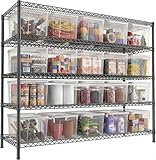
This is the highest-rated unit in the roundup at a stated 3,200 lb total across five tiers, and at 55.5 inches wide it is one of the two widest. It suits basements being used as real bulk storage — tile and mortar, cases of canned goods, power tools, engine parts, long-term archives in banker’s boxes — where you want one wall to do the job rather than three narrow racks.
Key specs
- Configuration: 5 tiers, adjustable wire shelving
- Width: 55.5 in
- Stated total capacity: 3,200 lb
- Even-split per shelf: roughly 640 lb if the load is distributed evenly across all five tiers
- Material: steel, wire-deck shelving
- Assembly: bolt-together, two people strongly recommended
Strengths
Capacity is the headline, but width is the practical benefit. A 55.5-inch span lets you store banker’s boxes two-deep or lay out flat items — saws, levels, lengths of conduit — that would overhang a 36-inch rack. Distributing 3,200 lb across five tiers gives roughly 640 lb per shelf, which comfortably covers dense categories: a case of 24 canned goods runs about 20 lb, a box of ceramic tile can run 40–60 lb, and a full banker’s box of paper typically lands between 30 and 40 lb. That means three or four full boxes per shelf with capacity to spare, rather than a rack loaded to its limit on day one. Wire decks keep air moving, which matters for anything stored long-term against a concrete wall, and the adjustable tiers let you dedicate one tall gap to a shop vacuum or a pressure washer and keep the rest at even spacing.
Pros
- Highest stated capacity here at 3,200 lb
- 55.5 in width handles long and bulky items
- Roughly 640 lb per shelf on an even split
- Adjustable tiers for tall items
- Wire deck resists moisture trapping
Cons
- Premium tier and the heaviest box in this list to move downstairs
- 55.5 in width will not fit between many basement obstructions
- Wire shelves need liners for small parts
- Two-person assembly is effectively mandatory
How it compares
The nearest alternative is the Garvee 71-inch-wide unit — the other premium wide rack. The Garvee gives you 15.5 more inches of width but a stated 1,325 lb total, less than half the REIBII’s rating. So the split is clean: choose the Garvee when you are storing wide, light, flat things along a long wall; choose the REIBII 3200 when the load is dense and heavy and you can only spare one wall. Against the REIBII 2-pack, this single wide rack costs less and takes one assembly session instead of two, but the 2-pack spreads the same total capacity across two locations in the basement — better if your storage is split between two rooms.
6. KORVENA Storage Shelves 5-Tier – Best for reconfiguring as storage needs change

The KORVENA 5-tier adjustable unit is the flexible middle of this list. It suits a basement whose purpose will shift — a home gym one year, a workshop the next, holiday storage after that — because adjustable five-tier steel shelving can be re-spaced and re-loaded without buying anything new.
Key specs
- Configuration: 5-tier adjustable shelving
- Type: garage/basement-duty steel shelving unit
- Adjustability: shelf positions move on the uprights
- Footprint class: full-height 5-tier, comparable to 36 x 16 x 72 in units
- Assembly: bolt-together; assemble at the final location
- Maintenance: wipe-down only; check bolt torque after the first month
Strengths
Adjustability is the whole point. A basement shelf that works for paint cans in March is the wrong shape for a pressure washer in June and a stack of archive boxes in December. With movable tiers you can drop one shelf to floor level for a heavy item and compress the remaining four into the top of the rack, or spread all five evenly for maximum box count. That flexibility is what separates a mid-range rack from a budget one: the hardware is more consistent, the finish is usually a proper powder coat rather than a thin spray, and the components are designed to be unbolted and rebuilt without stripping. Mid-range steel also tends to hold its tolerances better, so the uprights stay square after a couple of reconfigurations rather than loosening at the joints.
Pros
- Shelf heights reconfigure without new parts
- Mid-range finish and hardware hold up to repeated adjustment
- Five tiers make full use of vertical space
- Standard footprint fits most basement walls
- Simple maintenance — inspect and re-tighten
Cons
- No published capacity figure to plan against
- Bolt-together assembly takes longer than slip-sleeve systems
- Mid-range price without the premium capacity of the REIBII racks
- Heavier than it looks once fully assembled
How it compares
The closest alternative is the ROOMFAVE 5-tier, the other mid-range rack here. The KORVENA’s advantage is width and general-purpose flexibility; the ROOMFAVE’s advantage is its 35.56-inch footprint, which fits narrow strips the KORVENA cannot. If you are choosing between them, measure your wall first: below about 36 inches of usable width the ROOMFAVE is the only sensible option, and above that the KORVENA gives you more storage per tier. Against the budget GH rack, the KORVENA costs more but is the one you can rebuild three times without the joints going soft — worth it if your basement’s job description changes often.
7. REIBII 2400 lb Garage Shelving (36 x 16 x 72 in) – Best overall for most basements

This is the pick for the average unfinished basement. Thirty-six inches wide, 16 inches deep, 72 inches tall and rated at a stated 2,400 lb across five tiers, it hits the sweet spot where capacity, footprint and price tier all land in the right place. It suits anyone outfitting a normal basement wall who wants to buy once and not think about it again.
Key specs
- Dimensions: 36 in W x 16 in D x 72 in H
- Configuration: 5 tiers
- Stated total capacity: 2,400 lb
- Even-split per shelf: roughly 480 lb across five tiers
- Material: steel, basement-duty construction
- Height clearance: leaves roughly 12–24 in below standard basement joists
Strengths
The dimensions are the reason this wins. Thirty-six inches is the widest rack that still passes easily through a standard 32-inch basement door when disassembled, fits between the stair stringer and a side wall, and slots into the strip beside most water heaters. Sixteen inches of depth keeps the unit off the walkway in a room that is often only 10 to 12 feet wide, while still being deep enough for a banker’s box (typically about 15 inches deep) and standard storage totes. Seventy-two inches of height clears the ductwork, drain lines and joist-mounted plumbing that hang below the ceiling in most basements. And 2,400 lb — about 480 lb per shelf on an even split — is enough for dense storage without drifting into overkill: cases of canned goods, paint, tools, tile boxes and boxes of books all sit comfortably inside that envelope.
Pros
- Footprint fits doors, joist bays and narrow wall strips
- 2,400 lb total is more than most basements ever need
- Five tiers use the full 72 in of height
- 16 in depth preserves aisle width
- Mid-range tier with a straightforward upgrade path to a second unit
Cons
- Not wide enough for long flat items like conduit or shelving planks
- Assembles in place — plan the location before you start
- Mid-range price versus the same footprint in a budget tier
- Single unit, so a long wall needs two purchases
How it compares
Two alternatives bracket this pick. The GH 5-tier at 36 x 16 x 72 in is the budget version of the same footprint with a stated 2,500 lb total — technically a higher rating for less money, and the right call if cost is the deciding factor. What you give up is finish consistency, hardware quality and the tolerance that keeps a mid-range rack square after years of loading. The VEVOR 5-tier at 36 x 18 x 72 in is the opposite trade: two extra inches of depth for larger bins and bulkier items, at the cost of two inches of aisle. If your basement aisle is tight, stay at 16 inches. If you are storing big coolers or deep totes, the VEVOR’s 18-inch depth earns its space.
8. REIBII 2 Pack Garage Shelving, 2400 lb Each – Best for outfitting a whole wall at once

Two 2,400 lb five-tier racks in one purchase. This is the pick for anyone who has already decided the basement needs a full storage wall, or who needs matching racks in two separate zones — one beside the stairs, one behind the furnace. It suits a move-in or a post-renovation clear-out, when a large volume of stuff needs a home in a single weekend.
Key specs
- Contents: 2 matching shelving units
- Capacity: 2,400 lb stated per unit — 4,800 lb combined
- Configuration: 5 tiers per unit
- Footprint class: standard full-height rack per unit
- Assembly: two build sessions; hardware for both included
- Placement: can be placed side by side or in separate rooms
Strengths
Buying two units at once solves the problem that single-rack buyers run into three months later: the first rack fills up, and a second, slightly different rack ends up beside it with mismatched heights and depths. Matching units can be aligned flush, loaded with the same bin system, and treated as one continuous wall of storage with consistent tier heights. The combined 4,800 lb rating means the pair handles essentially any residential basement load — a full workshop, a pantry’s worth of canned goods, archives, seasonal gear — without either unit running near its limit. Two units also give you a fallback: if one zone turns out to be the wrong spot, you have a spare to relocate rather than a purchase to regret. For a household doing a one-time clear-out, this is the fastest path from a floor full of boxes to an organised room.
Pros
- 4,800 lb combined capacity across two units
- Matched heights and depths make a clean storage wall
- Can be split between two basement zones
- One purchase instead of two, usually at a better tier per unit
- Ideal for a single large clear-out session
Cons
- Premium tier — a larger upfront commitment than one rack
- Twice the assembly time
- Two large boxes to get down the stairs
- Overkill if you only have one small storage corner
How it compares
Against a single REIBII 2400 lb unit, the 2-pack is the right choice only if you already know you need more than one rack — otherwise buy one, live with it for a month, and see what actually fills up. Against the REIBII 3200 lb single rack, the trade is concentration versus distribution: the 3200 gives you more capacity in one wide unit on one wall, while the 2-pack spreads 4,800 lb across two locations and two footprints that each fit a standard 36-inch strip. If your basement has two usable walls, the 2-pack is more practical. If it has one long wall and nothing else, the 3200 lb rack does more with the space.
9. Garvee 71 in Wide Storage Shelves, 5 Tier, 1325 lb – Best for long, shallow walls and flat items

Seventy-one inches wide is a different category of shelving. This unit suits a long, uninterrupted basement wall — the kind that runs the full length of the house under the main floor — where you want one continuous horizontal surface rather than three separate racks. It suits flat and awkward items: shelving planks, trim, long tool cases, folding tables, holiday trees in long boxes.
Key specs
- Width: 71 in — the widest unit in this roundup
- Configuration: 5 tiers
- Stated total capacity: 1,325 lb
- Even-split per shelf: roughly 265 lb across five tiers
- Material: steel shelving unit
- Assembly: two people; the wide span makes a second set of hands essential
Strengths
Width changes what a shelf can hold. A 71-inch span lets you lay a six-foot folding table flat, store trim and moulding without cutting it, keep long tool cases horizontal, and set out banker’s boxes three across instead of two. For a basement used partly as a workshop or a staging area, that continuous surface is worth more than raw capacity. The five tiers also give you a natural organisation scheme: heavy or long items low, frequently used items at waist height, and rarely touched items on top. Because the load is spread across a wide span, each tier stays shallow in the sense that nothing is stacked high — which makes retrieval easier and reduces the chance of an avalanche when you pull a box from the middle of a stack.
Pros
- 71 in width handles long, flat and awkward items
- Five tiers with a clean low-to-high organisation scheme
- Wide span means boxes can be laid out rather than stacked deep
- Good for workshop staging and flat-goods storage
- Premium build with a long continuous deck per tier
Cons
- 1,325 lb total is the lowest of the full-height steel racks here
- Roughly 265 lb per shelf on an even split — fine for bulky, light items only
- 71 in will not fit most basement walls without blocking access
- Two-person assembly and a large box to manoeuvre downstairs
How it compares
The obvious alternative is the REIBII 3200 lb rack at 55.5 inches wide. The Garvee gives you 15.5 more inches of span but less than half the rated capacity, so the choice comes down to what you store. Flat, bulky and light — trim, tables, empty totes, long tool cases — favours the Garvee. Dense and heavy — tile, cans, tools, books — favours the REIBII 3200, which spreads roughly 640 lb per shelf against the Garvee’s roughly 265 lb. Against the standard 36-inch racks, the Garvee is a specialist: buy it for the width, not for the capacity.
10. GH 5-Tier Garage Shelving (36 x 16 x 72 in, 2500 lb) – Best budget heavy-duty pick

This is the value play of the roundup: the same 36 x 16 x 72 in footprint as the best overall pick, with a stated 2,500 lb total capacity, at a budget price tier. It suits anyone whose basement has a flat floor and a standard wall strip and who wants maximum load rating per pound spent.
Key specs
- Dimensions: 36 in W x 16 in D x 72 in H
- Configuration: 5 tiers
- Stated total capacity: 2,500 lb
- Even-split per shelf: roughly 500 lb across five tiers
- Material: steel, heavy-duty construction
- Price tier: budget
Strengths
On paper this is the best capacity-per-cost ratio in the list: 2,500 lb in the most useful basement footprint at the lowest tier. About 500 lb per shelf covers dense residential storage comfortably — cases of canned goods, paint cans, toolboxes, tile boxes, boxes of books — with headroom that budget racks of the plastic and wire variety do not offer. The 36-inch width and 16-inch depth mean it fits where the wide racks cannot, and 72 inches of height clears the usual basement obstructions. Because the footprint is standard, a GH can later be paired with a mid-range rack of the same dimensions and aligned flush, giving you a cheap way to extend a storage wall without rebuilding it. For a first basement rack on a tight budget, it is the rational starting point.
Pros
- Highest stated capacity in the budget tier
- Standard 36 x 16 x 72 in footprint fits most basement walls
- Roughly 500 lb per shelf on an even split
- Pairs cleanly with same-footprint mid-range racks later
- Lowest-cost route to genuine heavy-duty capacity
Cons
- Budget-tier finish and hardware — the first things to show age
- No leveling feet, so an uneven slab needs shims
- Packaging and edge protection are typical of the tier
- Joints may need re-tightening after the first few months of load
How it compares
The direct comparison is the REIBII 2400 lb rack, which is the mid-range version of the same footprint. The GH actually publishes a higher rating — 2,500 lb against 2,400 lb — for less money, so the difference is not capacity but longevity: better powder coat, more consistent hardware, and tolerances that survive repeated reconfiguration. Buy the GH if you will load it once and leave it. Buy the REIBII 2400 if you expect to move shelves around, disassemble the rack during a renovation, or hand it down. Against the Sakugi, the GH trades leveling feet for a published capacity figure — worth it on a flat slab, not worth it on a sloped one.
11. WORKPRO 5-Tier Storage Shelf (72 in H, 2180 lb) – Best all-purpose basement rack

The WORKPRO 5-tier is the generalist: 72 inches tall, rated at a stated 2,180 lb, adjustable, and explicitly aimed at basement use. It suits a household that wants one rack to handle everything — pantry overflow, tools, seasonal gear, cleaning supplies — without specialising.
Key specs
- Height: 72 in
- Configuration: 5 tiers, adjustable
- Stated total capacity: 2,180 lb
- Even-split per shelf: roughly 436 lb across five tiers
- Intended use: garage and basement storage
- Assembly: bolt-together with hand tools
Strengths
This rack is designed for the room it is going into, which shows in the practical details: a height that clears basement obstructions, five adjustable tiers, and a capacity rating that sits in the useful middle — about 436 lb per shelf, enough for a full shelf of canned goods, a stack of tool cases, or several loaded totes, without the bulk of a 55-inch-wide unit. Adjustability matters more than it sounds in a basement, because the tallest items you own — a shop vacuum, a pressure washer, a dehumidifier you rotate out seasonally — rarely fit a fixed 14-inch tier gap. The premium tier buys better finish and more consistent hardware, which is what keeps a rack stable after years of loading and unloading rather than developing a wobble at the joints.
Pros
- Purpose-built for basement and garage conditions
- Adjustable tiers accommodate tall equipment
- 2,180 lb total is ample for mixed household storage
- Premium finish resists scuffing and surface corrosion
- 72 in height leaves room for ceiling obstructions
Cons
- Premium price tier for mid-tier capacity
- Less capacity than the GH at a fraction of the cost
- Not wide enough for long flat items
- Adjustment hardware takes time to reset
How it compares
The nearest alternatives are the REIBII 2400 lb and VEVOR 2000 lb racks, both five-tier and both in a similar footprint class. The WORKPRO sits between them on capacity and above them on finish, which is the whole argument: you are paying for a rack that still looks and behaves like new after several years in a damp room. If the basement is dry and the rack will be loaded once, the GH or the REIBII 2400 delivers more capacity for less. If the rack is going to be worked — shelves moved, items cycled, the unit wiped down regularly — the WORKPRO’s premium build is the part you actually feel.
12. VEVOR Storage Shelves 5-Tier (36 x 18 x 72 in, 2000 lb) – Best for deeper bins and bulky items

Eighteen inches of depth instead of sixteen is a small number with an outsized effect. This rack suits basements storing deep totes, large coolers, bulky appliances in boxes and anything that overhangs a standard 16-inch shelf. It is a mid-range unit with a stated 2,000 lb total across five adjustable tiers.
Key specs
- Dimensions: 36 in W x 18 in D x 72 in H
- Configuration: 5 tiers, adjustable
- Stated total capacity: 2,000 lb
- Even-split per shelf: roughly 400 lb across five tiers
- Depth advantage: 18 in accommodates oversized totes and appliances
- Assembly: bolt-together, standard hand tools
Strengths
Depth is the feature. Standard 16-inch racks are sized around banker’s boxes and 15-inch totes; anything larger — a 20-gallon tote laid on its side, a window air conditioner, a boxed microwave, a large cooler — either overhangs the front edge or has to be stored on the floor. An 18-inch deck swallows those items whole, which keeps the aisle clear and stops the shelf edge from pressing into whatever is stored below. Combined with five adjustable tiers and 2,000 lb of capacity — about 400 lb per shelf on an even split — it handles the awkward, mid-weight items that make basements feel cluttered: bulky but not heavy, oversized but not dense. The 36-inch width keeps it compatible with standard doorways and wall strips.
Pros
-
Affiliate disclosure. As an Amazon Associate we earn from qualifying purchases at no extra cost to you. Prices accurate as of the date shown.Best Shelving Units for BasementsCheck price on Amazon