Key takeaways
- Platform: 4 ft x 8 ft, or 32 square feet of ceiling footprint
- Drop range: 24 in to 45 in below the ceiling, adjustable during install
- Finish: White
- Included hardware: Ceiling-mount brackets and the 5-piece hook pack
- Capacity class: SafeRacks’ 4×8 platforms sit in the 600 lb class; confirm the exact figure printed for this configuration on the listing
- Usable volume: Roughly 64 cubic feet at a 24-inch drop, up to about 120 cubic feet at 45 inches
The best SafeRacks garage storage system for most buyers is the SafeRacks White 4×8 Overhead Storage Rack with the 5-piece hook pack. It pairs the largest platform SafeRacks sells in its standard line — 4 feet by 8 feet, or 32 square feet of ceiling footprint — with a 24-inch to 45-inch adjustable drop that clears the typical two-car garage door track, and the included hooks handle ladders, cords, and long-handled tools without extra hardware. If your ceiling is low, or your garage door tucks up close to it, the 3×6 and 2×6 low-profile models with the 12-inch to 21-inch drop are the safer fit. If you want two matching bays of ceiling storage in one purchase, the gray 4×8 600 lb two-pack is the cleaner route. And if your clutter already lives in totes rather than loose piles, a rolling bin rack will do more for you than any ceiling platform. This guide maps ceiling height, platform size, capacity, and layout to the system that actually fits your garage.
Top 3 Picks
Best overall: SafeRacks White 4×8 Overhead Storage Rack with 5-Piece Hook Pack
A 4×8 platform is the sweet spot between usable volume and structural sanity, and this version adds the hook pack so you are not shopping for bike hooks and ladder hangers separately. The white finish disappears against a painted ceiling, which matters more than people expect in a space you walk under every day. The 24-inch to 45-inch drop range covers the vast majority of two-car garages with 9-foot to 12-foot ceilings.
Best budget: SafeRacks 4×4 Overhead Garage Storage Rack, Hammertone
Half the footprint at a fraction of the commitment, the 4×4 is the right first ceiling rack if you are unsure how much overhead storage you will actually use or you have a single-car bay. The hammertone finish is the most forgiving of the finishes on offer when it comes to scuffs from sliding boxes. It is also the easiest of the full platforms to install solo, because you are handling a smaller, lighter frame.
Best premium: SafeRacks Gray 4×8 Overhead Garage Storage Rack 600 lb, 24″–45″ (2-Pack)
Two 4×8 platforms rated at 600 lb each turns a two-car garage into roughly 64 square feet of overhead storage — enough to empty most of the floor. The gray finish reads as a deliberate shop look rather than a hidden utility. This is the pick for households that have already outgrown one rack and know they will fill a second.
Quick Comparison
| Product | Best for | Key specs | Price tier |
|---|---|---|---|
| SafeRacks White 4×8 Overhead Storage Rack w/ 5-pc Hook Pack | Most two-car garages; loose gear that needs hanging | 4×8 platform (32 sq ft); 24″–45″ adjustable drop; white finish; 5-piece hook pack included; steel frame; ceiling-mount hardware | Premium |
| SafeRacks Gray 4×8 Overhead Garage Storage Rack 600 lb (2-Pack) | Whole-garage coverage in one purchase | Two 4×8 platforms (64 sq ft total); 600 lb rated each; 24″–45″ drop; gray finish | Premium |
| SafeRacks 4×4 Overhead Garage Storage Rack, Hammertone | First overhead rack; single-car bays; budget builds | 4×4 platform (16 sq ft); 24″–45″ drop; hammertone finish; lighter frame for solo install | Budget |
| SafeRacks Storage Bin Dolly, Fits 27 & 12 Gallon Totes (2-Pack) | Anyone moving loaded totes in and out of a rack | Set of two dollies; fits 27-gallon and 12-gallon totes; rolling base | Budget |
| SafeRacks Side-Load Bin Storage Rack for 27 Gallon Totes (2-Pack) with wheels | Tote-based organization where bins stay loaded | Two side-load racks; sized for 27-gallon totes; wheels included; side-access design | Mid-range |
| SafeRacks 3×6 Overhead Garage Storage Rack, White, 12″–21″ | Low ceilings and tight garage door clearance | 3×6 platform (18 sq ft); 12″–21″ drop; white finish | Mid-range |
| SafeRacks 4×6 Overhead Garage Storage Rack, White, 24″–45″ | Middle-ground footprint with full drop range | 4×6 platform (24 sq ft); 24″–45″ drop; white finish | Mid-range |
| SafeRacks Bin Storage Rack for 12 Gallon Storage Totes (Bins Not Included) | Holiday decorations and small-batch seasonal bins | Rack sized for 12-gallon totes; bins not included; floor-standing | Budget |
| Torin Garage Storage Cabinets System, 9 Piece Workshop Cabinet Set, Black | Floor-level tool and workshop storage | Nine-piece steel cabinet set; black finish; workshop configuration | Premium |
| FLEXIMOUNTS 4×8 Overhead Garage Ceiling Storage Rack, Black | Buyers who want a black 4×8 alternative | 4×8 platform (32 sq ft); adjustable drop; black finish; ceiling-mount design | Mid-range |
| SafeRacks 2×6 Overhead Garage Storage Rack, White, 12″–21″ | Narrow ceiling strips and shallow bays | 2×6 platform (12 sq ft); 12″–21″ drop; white finish | Budget |
| FERO Overhead Garage Storage Rack 4×8, 500 lb Heavy-Duty Capacity | Heavy, dense loads on a single 4×8 platform | 4×8 platform (32 sq ft); 500 lb stated capacity; heavy-duty frame | Premium |
How We Chose
Every pick here was evaluated on published specifications and category logic rather than any kind of physical trial. The first filter was fit: drop range and platform dimensions have to match real ceiling heights and garage door travel, because a rack that fouls a door track is worse than no rack at all. The second was capacity class — how much weight the platform is rated for, and whether that rating is stated clearly enough to plan around. Third came installation reality: how many people the frame needs, whether the hardware suits standard joist spacing, and how much ceiling prep is involved. Fourth was layout fit, which is why bin racks and dollies appear alongside ceiling platforms — the best overhead rack in the world is undermined by thirty loose totes and no way to move them. Finally, we weighed upgrade path: whether a product is a sensible first purchase, a sensible second purchase, or a dead end once your storage needs grow.
1. SafeRacks White 4×8 Overhead Storage Rack with 5-Piece Hook Pack – Best for Most Two-Car Garages
As an Amazon Associate we earn from qualifying purchases at no extra cost to you.

This is the rack to buy if you have a two-car garage with a ceiling at roughly 9 feet or higher and you want the maximum amount of stuff off the floor in a single purchase. The 4×8 footprint is the largest platform in SafeRacks’ standard ceiling line, and the white powder-coat finish is chosen specifically to recede against a white or light-gray ceiling — you stop noticing it, which is the point of overhead storage.
Key specs
- Platform: 4 ft x 8 ft, or 32 square feet of ceiling footprint
- Drop range: 24 in to 45 in below the ceiling, adjustable during install
- Finish: White
- Included hardware: Ceiling-mount brackets and the 5-piece hook pack
- Capacity class: SafeRacks’ 4×8 platforms sit in the 600 lb class; confirm the exact figure printed for this configuration on the listing
- Usable volume: Roughly 64 cubic feet at a 24-inch drop, up to about 120 cubic feet at 45 inches
The hook pack is the detail that makes this the best overall pick rather than just the biggest one. Ladders, folding chairs, extension cords, garden hoses, and long-handled tools are the items that actually cause floor clutter in a garage, and they are also the items that fit worst in a box on a shelf. Five hooks hanging under or beside the platform convert dead overhead space into the kind of vertical storage that keeps a wheelbarrow and a ladder off the ground permanently.
The adjustable drop is the other meaningful feature. A 24-inch drop keeps the rack tucked high for a tall vehicle or an SUV roof, while a 45-inch drop puts the platform at a height where you can load it without a stepladder — genuinely useful for anyone who stores heavy items regularly. Choosing between those two extremes is a one-time decision made during installation, but it changes how the rack feels for the next ten years.
Construction is steel, powder-coated, with the platform built from slats that let you see what is up there from below and let dust fall through rather than collecting. The frame bolts to ceiling joists using the supplied brackets; the practical requirement is solid framing above the platform’s four corners, not a specific joist spacing.
Pros
- Largest standard platform available — 32 sq ft clears a serious amount of floor
- Hook pack included, so no second shopping trip for ladder and bike storage
- 24″–45″ drop range covers most two-car garages
- White finish visually disappears against a light ceiling
- Open slat design resists dust buildup and lets you spot stored items from underneath
Cons
- Premium tier — the most expensive single-platform route in this roundup
- A 4×8 frame is a two-person install; the platform is awkward to lift and hold overhead alone
- Requires sound ceiling framing across the full span, which not every garage has
- Overkill for a single-car garage or a low ceiling
Compared with the gray 4×8 two-pack: this is one rack plus hooks; that is two racks with a stated 600 lb rating each. If you already know you will fill two platforms, the two-pack is the better value per platform and the gray finish suits a workshop aesthetic. If you want one clean install with hanging storage built in, this version is the more complete purchase.
2. SafeRacks Gray 4×8 Overhead Garage Storage Rack 600 lb 24″–45″ (2-Pack) – Best for Whole-Garage Coverage

Two 4×8 platforms is not twice the storage — it is a different category of storage. Sixty-four square feet of overhead footprint, split into two bays, is enough to relocate the seasonal items, the camping gear, the kids’ outgrown bikes, and the holiday bins that normally colonize the walls and floor. This is the pick for a household that has already run out of wall space and is ready to commit the ceiling.
Key specs
- Platforms: Two 4×8 racks, 32 sq ft each, 64 sq ft total
- Capacity: 600 lb rated per rack
- Drop range: 24 in to 45 in, adjustable
- Finish: Gray
- Hardware: Ceiling-mount brackets included for both units
- Install note: Two separate ceiling locations, so you need framing at eight anchor points, not four
The 600 lb figure per rack is the headline number, and it is worth understanding what it means in practice. That is a rating for a properly anchored rack distributing load across its frame — roughly the weight of a small motorcycle, a stack of eight to ten full 27-gallon totes, or a full set of winter tires plus rims. The failure mode for overhead racks is almost never the steel; it is the anchors pulling out of framing that was not adequate, which is why the install matters more than the number.
Two platforms also let you split by category rather than by volume. One bay for tools and long items, one for seasonal bins, is a system that survives contact with real life because you never have to unload the whole rack to reach the thing at the back. That layout advantage is the strongest argument for the two-pack over buying one rack twice.
The gray finish is a practical choice: it hides the scuffs and handprints that white shows after a few years of sliding storage bins across the frame, and it reads as shop equipment rather than a hidden utility. If your garage has a black or gray palette, this is the version that looks intentional.
Pros
- 64 sq ft of overhead storage from a single purchase
- 600 lb rated per rack, clearly stated
- Two bays allow category-based organization instead of one crowded platform
- Gray finish tolerates scuffs and suits workshop styling
- Same 24″–45″ drop range as the single-rack version, so it fits the same ceiling heights
Cons
- Premium tier and the highest total outlay in this roundup
- Eight anchor points across two ceiling locations — more planning, more drilling
- No hook pack, so hanging storage is a separate purchase
- Overkill for a single-car garage or anyone with less than about 20 feet of usable ceiling length
Compared with the white 4×8 with hook pack: the two-pack wins on total capacity and value per platform; the white single rack wins on convenience and aesthetics for a light ceiling. If you are unsure whether you need a second bay, buy the single rack first — both use the same drop range and mounting approach, so a later addition is straightforward.
3. SafeRacks 4×4 Overhead Garage Storage Rack, Hammertone – Best Budget Overhead Rack

The 4×4 is the entry point to ceiling storage, and it is the right answer for three specific situations: a single-car garage, a two-car garage where you only want to move the worst of the clutter, and any first-time buyer who wants to test whether overhead storage suits how they actually live. Sixteen square feet does not sound like much until you are standing in the space it clears.
Key specs
- Platform: 4 ft x 4 ft, or 16 square feet
- Drop range: 24 in to 45 in, adjustable
- Finish: Hammertone — a textured finish that hides scratches and fingerprints well
- Construction: Steel frame with ceiling-mount brackets
- Capacity class: Smaller SafeRacks platforms are rated lower than the 4×8 line; check the listing for the stated figure
- Usable volume: Roughly 32 cubic feet at a 24-inch drop
The hammertone finish is a genuine advantage rather than a cosmetic one. Textured powder coat does not show the swirl marks and scuffs that a smooth finish picks up when you drag a plastic tote across it twice a year, and it does not show dust the way a white frame does. In a garage, that means it looks the same in year five as it did in month one.
The smaller frame is also the practical reason this is the best budget pick. A 4×4 platform is manageable for one person with a ladder and a helper for the final lift, whereas a 4×8 realistically needs two people for the whole install. Fewer anchor points means less time on a ladder, less drilling, and less risk of a misaligned hole.
Where the 4×4 gives up ground is ceiling efficiency. Because it is half the length, you use roughly the same amount of drop hardware and anchor points per square foot of platform as a 4×8, and you may end up buying a second rack within a year. It is a good starting point, not a final answer, for anyone with a two-car garage and a real clutter problem.
Pros
- Lowest-cost way to get a real overhead platform installed
- Hammertone finish resists scuffs and hides dust
- Manageable for a solo install with a helper for the lift
- Full 24″–45″ drop range, so it fits the same ceilings as the larger racks
- Easy to add a second unit later without redesigning the layout
Cons
- Only 16 sq ft of platform — the smallest capacity in the overhead lineup here
- No hook pack included
- Higher cost per square foot of storage than the 4×6 or 4×8
- Buyers with a large clutter problem will likely outgrow it
Compared with the 4×6: the 4×6 adds eight square feet and a longer platform for a mid-range outlay, which is the better value if your ceiling has the length. The 4×4 wins if you are space-constrained along the ceiling, unsure about committing, or working in a single bay.
4. SafeRacks Storage Bin Dolly, Fits 27 & 12 Gallon Totes (2-Pack) – Best for Moving Loaded Totes
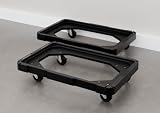
This is the accessory that quietly determines whether an overhead rack system actually works. A 27-gallon tote packed with holiday decorations, camping gear, or paperwork weighs enough that carrying it up a stepladder is a two-person job and a bad idea. A dolly that fits both 27-gallon and 12-gallon totes turns that into a single controlled lift.
Key specs
- Quantity: Two dollies per pack
- Compatibility: Sized for 27-gallon and 12-gallon storage totes
- Design: Rolling base that cradles the tote
- Best paired with: Any bin rack in this roundup, or ceiling platforms you load from a ladder
The case for a dolly is arithmetic. A 27-gallon tote at capacity holds roughly 3.5 cubic feet of contents; loaded with books, tools, or dense decorations, it can easily weigh 40 to 60 pounds. Lifting that overhead while balanced on a step stool is the single most common way people hurt themselves in a garage. Sliding a loaded tote onto a dolly, rolling it to position, and lifting from a stable stance is slower by maybe ten seconds and dramatically safer.
Two dollies in the pack is the right number. One lives under the tote you are currently unpacking; the other is spare or holds a second tote mid-sort. Because the same base fits both 27-gallon and 12-gallon totes, you are not maintaining two separate dolly systems for the two most common bin sizes in North American garages.
What this product is not is a storage solution on its own. It does not hold anything permanently, and it does not reduce the number of totes you own. Its value is entirely in making the bin racks and ceiling platforms in this list usable by one person instead of two.
Pros
- Fits both 27-gallon and 12-gallon totes — the two dominant bin sizes
- Two per pack, so you always have one free during a sort
- Dramatically reduces the awkwardness of loading overhead racks
- Budget tier, so it adds little to the cost of a full system
Cons
- Stores nothing on its own — pure accessory
- Only useful if your organization is tote-based
- Takes up a small amount of floor space when not in use
Compared with the side-load bin rack: the dolly moves bins; the rack stores them. Buy the dolly first if you already have a ceiling platform or a shelf system; buy the rack first if your totes currently live in a stack on the floor.
5. SafeRacks Side-Load Bin Storage Rack for 27 Gallon Totes (2-Pack) with Wheels – Best for Tote-Based Organization

If your garage clutter is already sorted into 27-gallon totes, a side-load rack is a more direct solution than a ceiling platform. Side-loading means the tote slides in from the end rather than being lifted over a lip and dropped in from above, which is the difference between a system you use weekly and one you avoid.
Key specs
- Quantity: Two racks per pack
- Compatibility: Sized for 27-gallon totes
- Access style: Side-load — totes slide in and out from the end
- Mobility: Wheels included, so the racks can be repositioned
- Footprint: Floor-standing, unlike the ceiling platforms in this list
Side-loading solves a specific problem that top-load racks create: the moment you stack three totes vertically, reaching the bottom one means unloading the top two. With side access, every tote stays independently reachable, which is why this format is common in workshop and warehouse settings. In a home garage, that translates directly into fewer abandoned bins at the back of the rack.
The wheels are the second half of the value. A loaded 27-gallon rack is heavy, and the ability to roll it out from a wall to reach the back, or move it entirely when you need the floor space for a project, changes how the garage functions. Mid-range pricing reflects both the rack structure and the caster hardware.
Two racks in a pack means you can build a small aisle or place them against opposite walls. Either way, plan the layout before you load them: a rack that rolls needs clear floor in front of it, and a rack placed in a corner wastes the side-load advantage entirely.
Pros
- Side-load access keeps every tote independently reachable
- Wheels allow repositioning without unloading
- Two racks per pack supports an aisle or split-wall layout
- Purpose-built for 27-gallon totes rather than a generic shelf
- Keeps totes off the floor without any ceiling work
Cons
- Consumes floor space, unlike overhead racks
- Only fits 27-gallon totes — 12-gallon bins need a different rack
- Mid-range tier; a full wall of these adds up
- Needs clear floor in front to make use of the wheels
Compared with the 12-gallon bin rack: they serve different bin sizes and different volumes of clutter. The 27-gallon side-load rack is the heavier-duty option for dense contents; the 12-gallon rack suits lighter seasonal items and decorations. Many garages end up needing both.
6. SafeRacks 3×6 Overhead Garage Storage Rack, White, 12″–21″ Height – Best for Low Ceilings

This is the rack for the garage that defeats every other rack: an 8-foot ceiling with a door that tracks up close to it. The 12-inch to 21-inch drop range keeps the platform tight to the ceiling, which is exactly what you need when there is no room for a 24-inch drop without clipping the door.
Key specs
- Platform: 3 ft x 6 ft, or 18 square feet
- Drop range: 12 in to 21 in below the ceiling
- Finish: White
- Best for: Ceilings around 8 feet and garage doors with tight overhead travel
- Usable volume: Roughly 18 to 31 cubic feet depending on drop setting
Eighteen square feet is a meaningful amount of storage when it is the only overhead space you can safely use. The 3×6 proportions also suit the geometry of a single-car bay or the section of a two-car garage beside the door track, where a 4×8 would simply not fit without interfering with the door.
Low-drop racks are less forgiving to load. At a 12-inch drop, the platform sits about a foot below the ceiling, so you are lifting items into a narrow band and sliding them sideways rather than dropping them in from above. In practice, this rack works best for flat, light, regularly shaped items — folding chairs, sleds, flattened boxes, camping pads, and shallow storage bags — rather than heavy totes.
The white finish matters more here than on taller racks, because the platform sits close to the ceiling and becomes a visual element of the room. Matching your ceiling color keeps the garage feeling open rather than capped.
Pros
- The 12″–21″ drop range fits low ceilings that rule out standard racks
- 3×6 footprint threads between door tracks and wall obstructions
- White finish blends with a light ceiling
- Mid-range tier rather than premium, despite the specialized fit
Cons
- Only 18 sq ft of platform
- Shallow drop makes loading awkward — best for flat, light items
- Lower capacity class than the 24″–45″ platforms
- Not the right rack if your ceiling is actually tall; you would be wasting the height
Compared with the 2×6 low-profile rack: both use the same 12″–21″ drop range, so the decision is purely about length along the ceiling. The 3×6 adds six square feet and is the better choice whenever you have the room; the 2×6 exists for genuinely tight spans.
7. SafeRacks 4×6 Overhead Garage Storage Rack, White, 24″–45″ Height – Best Middle-Ground Footprint

The 4×6 is the compromise rack that rarely disappoints. Twenty-four square feet is three-quarters of a 4×8 platform, and for many two-car garages that is exactly the amount of usable ceiling length between the door track and the back wall — a 4×8 would be squeezed or would block something.
Key specs
- Platform: 4 ft x 6 ft, or 24 square feet
- Drop range: 24 in to 45 in, adjustable
- Finish: White
- Usable volume: Roughly 48 cubic feet at a 24-inch drop, up to about 90 cubic feet at 45 inches
- Install note: Shorter span than a 4×8, so it is easier to find adequate ceiling framing
The full 24-inch to 45-inch drop range is what separates this from the low-profile models. You get the same flexibility — high and tucked for a tall vehicle, lower and reachable for frequent access — without needing the ceiling length a 4×8 demands. That combination makes it the most broadly compatible rack in the SafeRacks line.
Forty-eight cubic feet at the shallowest setting is not a small number. That is roughly the volume of five full 27-gallon totes plus change, or a full set of seasonal decorations, a camping kit, and a stack of folding furniture. Because the platform is 4 feet deep rather than 3, loading is more comfortable than on the narrower 3×6 — you are not fighting a shallow ledge.
Structurally, the 4×6 hits a useful middle point: shorter than the 4×8, so it spans less framing and is less demanding on the ceiling, but wide enough that the platform remains stable under load. It is also easier to install with two people than the full 4×8, since there is less frame to maneuver into position.
Pros
- 24 sq ft is enough for real storage without the space demands of a 4×8
- Full 24″–45″ drop range for both tall and reachable configurations
- 4-foot depth makes loading far easier than on a 3-foot-deep platform
- Shorter span is more forgiving of imperfect ceiling framing
- Mid-range tier — the best value per square foot in the overhead lineup
Cons
- Still a two-person install
- Twenty-four sq ft will not clear a very cluttered two-car garage on its own
- White finish shows scuffs over time
- No hooks or bin accessories included
Compared with the 4×8: if you have the ceiling length, the 4×8 gives you eight more square feet for a modest step up in cost. If your ceiling is broken up by door tracks, lights, or a beam, the 4×6 is the smarter fit and will actually get installed.
8. SafeRacks Bin Storage Rack for 12 Gallon Storage Totes (Bins Not Included) – Best for Holiday Decorations

Twelve-gallon totes are the standard size for holiday decorations, small seasonal items, and light household overflow — and they are exactly the wrong size for most generic shelving, which is either too deep or too wide to hold them neatly. This rack is built around that specific tote size.
Key specs
- Compatibility: Sized for 12-gallon storage totes
- Bins: Not included — rack only
- Type: Floor-standing bin rack
- Best for: Holiday decorations, seasonal items, and light overflow
- Price tier: Budget
The advantage of a purpose-built rack over a generic shelving unit is that the shelves are spaced and sized for the bins, so a 12-gallon tote sits flush and does not overhang. That matters in a garage where the rack sits against a wall: an overhanging tote is a tote that gets knocked off when you walk past it carrying something else.
Because the bins are not included, this is a rack for people who already own 12-gallon totes — a common situation after a move or a holiday season. If you are starting from zero, budget for the bins alongside the rack, and check that the tote brand you buy matches the rack’s intended dimensions.
Twelve-gallon totes suit light contents: ornaments, wreaths, gift wrap, table linens, small seasonal décor, and children’s outgrown clothing. They are not the right container for tools, books, or anything dense, both because the bins flex under heavy loads and because this rack is not built for that kind of weight. Treat it as a light-duty organization rack and it performs well.
Pros
- Purpose-built for 12-gallon totes, so bins sit flush without overhang
- Budget tier — an inexpensive way to get seasonal bins off the floor
- Keeps holiday storage in one predictable location
- Simple, tool-light assembly compared with ceiling racks
Cons
- Bins are not included, which adds to the real cost
- Light-duty: not intended for dense or heavy contents
- Only fits 12-gallon totes, not the larger 27-gallon size
- Uses floor space rather than ceiling space
Compared with the 27-gallon side-load rack: the side-load rack is the heavier-duty, wheeled option for larger bins with denser contents. This rack is the budget-friendly choice for light seasonal storage. If you own both 27-gallon and 12-gallon totes — as most households eventually do — the two racks complement each other rather than compete.
9. Torin Garage Storage Cabinets System, 9 Piece Workshop Cabinet Set in Black – Best Floor-Level Workshop Storage

Not everything belongs on the ceiling. Tools, chemicals, small parts, and anything you need weekly want to be at waist height in a closed cabinet, and a nine-piece steel cabinet set is the most complete way to build that out in one purchase. This is the pick for a garage that is also a workshop.
Key specs
- Configuration: Nine-piece workshop cabinet set
- Material class: Steel cabinetry
- Finish: Black
- Orientation: Floor-level and wall-level storage rather than overhead platforms
- Price tier: Premium
The core advantage of a matched set over a collection of mismatched cabinets is dimensional consistency. Pieces from the same line line up along a wall, share a common height and depth, and can be rearranged as your needs change without leaving awkward gaps. In a garage where the wall is also the workspace, that alignment is worth more than it sounds.
Steel cabinets also solve a problem that open shelving cannot: dust, sawdust, and overspray. A closed cabinet keeps tools clean in a garage where you grind, sand, or spray paint, and it hides the visual clutter of mismatched containers. The black finish is the practical choice for that environment, since it does not show the grime that accumulates in a working shop.
The trade-off is footprint. A nine-piece set occupies a substantial run of floor and wall space — think in terms of a full wall of a two-car garage. That floor space is the same space an overhead rack is designed to preserve, so cabinets and ceiling storage are complements, not substitutes: use the ceiling for bulky seasonal items, and the cabinets for the tools and small parts you touch every week.
Pros
- Nine matched pieces create a complete, aligned workshop wall
- Closed steel storage keeps tools clean and clutter hidden
- Black finish suits a working shop environment
- Modular pieces can be rearranged as needs change
- Complements overhead racks rather than competing with them
Cons
- Premium tier and the largest single outlay in this roundup
- Consumes significant floor and wall space
- Heavy — assembly and positioning are multi-person jobs
- Does nothing for bulky items like ladders, bikes, or kayaks
Compared with an overhead rack: these solve different halves of the same problem. A rack reclaims the ceiling for things you touch twice a year; cabinets organize the tools you touch twice a week. A well-planned garage usually wants both, with the cabinets along one wall and the platform above the car.
10. FLEXIMOUNTS 4×8 Overhead Garage Ceiling Storage Rack, Black – Best Alternative to the SafeRacks 4×8

FLEXIMOUNTS is the other established name in ceiling storage, and its 4×8 rack is the closest direct alternative to the SafeRacks platform. If you want the largest footprint in black rather than white, or you are comparing brands before committing, this is the one to weigh against the SafeRacks 4×8.
Key specs
- Platform: 4 ft x 8 ft, or 32 square feet
- Drop: Adjustable ceiling mount, in the same general range as other full-depth 4×8 racks
- Finish: Black
- Construction class: Steel frame with ceiling brackets
- Price tier: Mid-range
The obvious difference is the finish. Black reads as equipment and disappears against a dark or unfinished ceiling, while white disappears against a painted one. In an unfinished garage with exposed joists, black often looks better because it does not create a bright rectangle overhead.
Beyond color, the practical comparison points are capacity rating, hardware quality, and how adjustable the drop really is. Both brands use a slatted steel platform and ceiling brackets, and both are installed the same way: locate solid framing, anchor the brackets, hang the frame, drop in the platform. The differences show up in the details — the thickness of the steel, the quality of the anchor hardware, and how clearly the capacity is stated.
Mid-range pricing is the other reason this rack is worth considering. If your priority is maximum platform area at the lowest cost, a mid-range 4×8 from a known brand is a rational choice, and you can spend the difference on hooks and bin racks. If your priority is the specific finish, hardware, or accessory ecosystem, the premium tier buys something real.
Pros
- Same 32 sq ft platform as the top SafeRacks 4×8
- Black finish suits unfinished or dark ceilings
- Mid-range tier, so it undercuts the premium 4×8 options
- Established ceiling-storage brand with a track record in this category
Cons
- No hook pack or accessory bundle in the base configuration
- Still a two-person install at this platform size
- Black shows dust more than white in a bright garage
- Fewer matching accessories than the SafeRacks line
Compared with the SafeRacks White 4×8 with hook pack: the SafeRacks version costs more but arrives with hanging storage included and matches the SafeRacks bin racks and dollies as a system. The FLEXIMOUNTS rack is the leaner purchase if you only need the platform and prefer black.
11. SafeRacks 2×6 Overhead Garage Storage Rack, White, 12″–21″ Height – Best Narrow Ceiling Strip

Twelve square feet is the smallest platform in this roundup, and it exists for one reason: garages where nothing else fits. A narrow strip of ceiling between a door track and a wall, or above a workbench where headroom is limited, can still hold a useful amount of long, flat gear.
Key specs
- Platform: 2 ft x 6 ft, or 12 square feet
- Drop range: 12 in to 21 in below the ceiling
- Finish: White
- Usable volume: Roughly 12 to 21 cubic feet
- Best for: Long, flat, light items — pipes, trim, planks, folding tables
The 2×6 format is genuinely useful for materials rather than bins. Offcuts of lumber, lengths of PVC, trim pieces, and folding tables are all awkward to store anywhere else, and they fit a narrow platform well because they are long and flat. A 12-inch drop keeps the rack out of the way above a workbench, and the 6-foot length holds material that a 4-foot platform would not.
The shallow drop means loading from the side rather than from above, so this is a rack for items you slide in and leave for months. It is not a rack for weekly access, and it is not a rack for heavy totes — the platform is narrow, and the weight distribution on a 2-foot-deep platform is less forgiving than on a 4-foot one.
Budget pricing reflects the smaller frame and simpler install. With only two anchor points along each side, this is the least demanding ceiling rack in the SafeRacks lineup to mount, and the easiest to place in a constrained garage where larger racks are simply not an option.
Pros
- Fits ceiling strips and low-clearance zones where nothing else will
- 6-foot length handles long materials and folding furniture
- Budget tier and the simplest install in the overhead lineup
- 12″–21″ drop keeps it clear of a workbench and door tracks
- White finish blends with a painted ceiling
Cons
- Only 12 sq ft — the smallest platform here
- Shallow drop makes loading awkward for bulky items
- Narrow depth limits what you can safely stack
- Buyers with real ceiling space will want at least a 3×6 or 4×6
Compared with the 3×6 low-profile rack: both share the 12″–21″ drop. The 3×6 gives you 50 percent more platform area for a modest step up, so it is the better buy whenever the ceiling allows it. The 2×6 is the fallback for the tightest spots.
12. FERO Overhead Garage Storage Rack 4×8, 500 lb Heavy-Duty Capacity – Best for Heavy Dense Loads

This rack exists for one buyer: the person who is going to load a 4×8 platform with genuinely heavy things. A stated 500 lb capacity on a 4×8 frame puts it squarely in the heavy-duty class, and that rating is the reason to choose it over a cheaper platform of the same size.
Key specs
- Platform: 4 ft x 8 ft, or 32 square feet
- Capacity: 500 lb stated heavy-duty rating
- Construction class: Heavy-duty steel frame
- Mounting: Ceiling-mounted, in the same general install pattern as other 4×8 racks
- Price tier: Premium
Five hundred pounds across 32 square feet is a load that requires respect for the ceiling above it. Before buying any heavy-duty overhead rack, confirm what your framing can actually carry: ceiling joists in a typical garage are engineered for the roof and ceiling loads they were designed for, not for an added point load hanging beneath them. A rack rated at 500 lb is only as strong as the anchors and the framing behind them.
Where this rack makes sense is dense, compact storage: engine parts, a stack of full tool cases, tile boxes, or heavy shop equipment that cannot go on a wall shelf. It also suits anyone who wants headroom on the capacity rating — using a 500 lb rack at 200 lb is a comfortable margin, whereas loading a light-duty platform to its limit is not.
Premium pricing reflects the heavier frame and the higher stated rating. If your storage is seasonal decorations and camping gear, that capacity is wasted money; if it is dense and heavy, it is the difference between a rack that holds and a rack that sags.
Pros
- 500 lb stated capacity — among the highest ratings in this roundup
- Heavy-duty frame construction suited to dense loads
- Full 4×8 platform for maximum footprint
- Comfortable margin if you are not loading it to the limit
Cons
- Premium tier for a single platform
- Capacity is only meaningful with framing and anchors that can match it
- Two-person install at this frame weight
- Overkill for light seasonal storage
Compared with the SafeRacks 4×8 two-pack: that pair gives you two 600 lb platforms for whole-garage coverage; this gives you one heavy-duty platform for dense loads. If your problem is volume, buy the two-pack. If your problem is weight, buy this.
How to Choose
Choosing a garage storage system is really four decisions in sequence: how much ceiling height you actually have, how big a platform your ceiling can physically accept, how much weight you need to hold, and whether your clutter is loose or already binned. Get those four right and the product choice becomes obvious.
Start with ceiling height and door clearance, not platform size
Measure the distance from the floor to the lowest obstruction in your garage, which is usually the open garage door or its track rather than the ceiling itself. A standard 7-foot door on an 8-foot ceiling leaves roughly 12 to 18 inches of clear space above the door when it is open. That measurement, not the ceiling height, determines which drop range you can use.
- 12″–21″ drop racks (the 2×6 and 3×6 low-profile models) are built for this situation. They tuck tight to the ceiling and clear the door.
- 24″–45″ drop racks (the 4×4, 4×6, and 4×8 platforms) need a ceiling around 9 feet or higher, or a door that stops well short of the ceiling.
A simple test: open the garage door fully and measure from the top of the door to the ceiling. If that gap is under 24 inches, you are in low-profile territory. If it is 30 inches or more, you have the full range.
Match platform size to ceiling length, not to ambition
| Platform | Area | Volume at shallow drop | Volume at deep drop | Typical fit |
|---|---|---|---|---|
| 2×6 | 12 sq ft | ~12 cu ft | ~21 cu ft | Narrow strips, above workbenches |
| 3×6 | 18 sq ft | ~18 cu ft | ~31 cu ft | Low ceilings, single-car bays |
| 4×4 | 16 sq ft | ~32 cu ft | ~60 cu ft | Single bays, first racks |
| 4×6 | 24 sq ft | ~48 cu ft | ~90 cu ft | Most two-car garages with obstructions |
| 4×8 | 32 sq ft | ~64 cu ft | ~120 cu ft | Full two-car garages with clear ceilings |
The volume column is where the real comparison happens. A 4×8 at a 45-inch drop holds nearly twice what the same rack holds at 24 inches, which means the drop setting you choose is as important as the platform you buy. If you have the height, use it.
Also walk the ceiling with a stud finder before ordering. You need solid framing at each anchor point, and a platform that spans a beam, a duct, or a plumbing run may not be installable where you want it. This is the single most common reason a rack gets returned unused.
Understand what weight capacity actually means
Published capacity ratings assume correct installation into adequate framing. A 600 lb rack anchored into drywall or into a single thin joist will fail at a fraction of that. In practice:
- Light loads (under 100 lb): decorations, empty bins, folding furniture, sports gear.
- Medium loads (100–250 lb): full bins, camping equipment, seasonal clothing, small power tools.
- Heavy loads (250–500 lb): full tool cases, tile, engine parts, dense shop equipment.
Spread heavy items across the platform rather than clustering them at one end, and never load the rack before checking that the anchors are fully seated. Overhead storage fails at the connection to the structure, almost never in the steel itself.
Decide between overhead platforms and floor-level systems
Overhead racks and floor-standing systems do different jobs. An overhead platform reclaims the floor for cars and projects, but it is awkward to access and suits items you touch a few times a year. A cabinet set or bin rack organizes items you use regularly, but it consumes the floor space you were trying to clear.
The most functional garages combine them: cabinets along one wall for tools and small parts, bin racks for seasonal totes, and overhead platforms for bulky, infrequent items like ladders, kayaks, folding tables, and holiday bins. If you are buying one thing first, buy the overhead platform — floor space is the scarcer resource.
Think about the tote ecosystem before you buy
Most garage clutter eventually ends up in totes, and totes come in two dominant sizes: 27-gallon and 12-gallon. Buying a rack that fits only one size locks you in. If you are building a system, standardize on one tote size where you can, then match racks accordingly — side-load racks for 27-gallon bins, purpose-built racks for 12-gallon bins, and a dolly that fits both.
Also count the lift. A loaded 27-gallon tote can weigh 40 to 60 pounds.