Key takeaways
- Compare inverted biological microscopes for microscopy photography, with trinocular ports, phase contrast objectives, stages and included cameras compared.
An inverted microscope flips the usual layout: the objectives sit beneath the stage and look up through the bottom of a dish or flask, which is exactly what living cell cultures need. For photography, the decision that matters is whether the microscope gives you a proper trinocular photo port, phase contrast optics for unstained specimens, and a camera path that records what your eyes see at the eyepieces.
This guide is written for cell-culture users photographing living specimens, teaching and research labs documenting growth in petri dishes and flasks, and microscopy photographers who need an inverted platform rather than an upright one. The three models below were chosen from their Amazon product names and specifications, and all three include a digital camera in the package, so the imaging chain is complete from the start.
Quick Picks
As an Amazon Associate we earn from qualifying purchases
| Product | Best for | Key spec from title |
|---|---|---|
| OMAX K832INV-C140U3 | High-resolution stills with a 14MP USB 3.0 camera included | 40X-400X, infinity plan phase contrast objectives |
| AmScope IN300TC-5MA | A wider magnification range with eyepieces for two power steps | 40X-1000X, includes 5MP USB 2.0 camera |
| AmScope IN480TC-16M3 | The broadest objective set with a 16MP USB 3.0 camera | 40X-1500X, brightfield plus phase contrast LWD objectives |
How to Choose
Understand Why Inverted Optics Suit Living Specimens
On an inverted microscope the objectives approach from below, leaving the top of the stage open for petri dishes, flasks and multiwell plates. Long working distance objectives focus through the vessel bottom, so cultures stay sealed and undisturbed while you observe and photograph them. The OMAX model lists a 4X objective with a 22.3mm working distance, which shows the clearance involved. If your photography centres on living, unstained material in culture vessels, this layout is not a preference but a requirement, and an upright microscope with a standard stage will not substitute for it.
Check the Photo Port Before the Magnification Numbers
Microscopy photography lives or dies at the trinocular port. A Siedentopf trinocular head with both a C-mount and a 23.2mm path, like the OMAX here, accepts cameras directly or through adapters, and a reduction lens such as the 0.5X lenses bundled with these models widens the camera’s field so the recorded image better matches the eyepiece view. Interpupillary adjustment ranges around 50-76mm across these models keep binocular viewing comfortable while the camera works. Prioritise the port standard and the reduction lens over headline magnification, which is easy to inflate with stronger eyepieces.
Know What Phase Contrast Adds to Unstained Samples
Living cells in culture are nearly transparent, so brightfield images look washed out. Phase contrast converts tiny differences in the specimen into visible contrast without staining, which is why all three models here carry phase contrast objectives. The OMAX uses a phase contrast slider with a centering telescope, while the AmScope IN300TC-5MA pairs phase-contrast 10X and 20X objectives with a plain long working distance 4X. Check which objectives in the set are phase models, because the powers you photograph most, often 10X and 20X, are the ones that need the phase rings matched in the condenser.
Judge the Included Camera as Part of the Instrument
Two of these packages include USB 3.0 cameras, at 14MP and 16MP, while the IN300TC-5MA includes a 5MP USB 2.0 camera. Sensor resolution shapes the detail in still photographs of cultures, and the faster USB 3.0 connection moves those large frames to the computer more comfortably. For documentation and publication stills, the higher-resolution USB 3.0 packages hold an advantage. For teaching screens and routine records, the 5MP camera is workable. Either way, an included camera with a reduction lens means the microscope photographs on the day it arrives.
The 3 Best Options
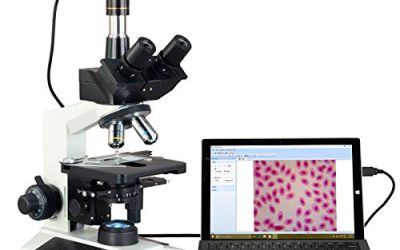
OMAX K832INV-C140U3 Inverted Phase Contrast Microscope

This OMAX package is built around infinity-corrected optics: a plan achromatic 4X objective with a long 22.3mm working distance, plus infinity plan phase contrast objectives at 10X, 20X and 40X on a quintuple nosepiece. Magnification runs 40X to 400X through WF10X eyepieces with a 20mm field. The trinocular Siedentopf head tilts at 45 degrees and provides two photo ports with C-mount and 23.2mm adapters. A phase contrast slider and centering telescope handle alignment, the 230x170mm stage takes an X-Y attachment with petri dish holders, and the included 14MP USB 3.0 camera records at 4096×3286 through a 0.5X reduction lens.
Specs
- Magnification: 40X, 100X, 200X and 400X
- Head: trinocular Siedentopf, 45 degree incline, interpupillary distance 50-70mm
- Photo ports: two ports with C-mount and 23.2mm adapters
- Eyepieces: WF10X with 20mm field of view
- Objectives: infinity plan achromatic 4X with 22.3mm working distance, infinity plan phase contrast 10X, 20X and 40X
- Nosepiece: quintuple
- Stage: 230x170mm, X-Y attachment with 120x80mm stroke, petri dish holders included
- Illumination: halogen 6V/30W
- Phase equipment: phase contrast slider and centering telescope
- Included camera: 14MP USB 3.0, 4096×3286, with 0.5X reduction lens
Best for: Photographing cell cultures at high still-image resolution with aligned phase contrast optics.
Watch out for: Magnification stops at 400X, so it is specialised for culture work rather than high-power slide examination.
ASIN: B00FG8DPQW
AmScope IN300TC-5MA

The IN300TC-5MA stretches magnification from 40X to 1000X in seven steps by pairing WH10X and WH25X eyepieces with its objective set, which mixes a long working distance plan 4X, phase-contrast 10X and 20X objectives, and a 40X objective. The quadruple nosepiece sits under the oversize 242x172mm stage, which travels 115x75mm to scan dishes. Illumination is a 12V/30W halogen lamp with a rheostat for brightness control, working through an Abbe condenser of 0.3 NA. The trinocular head offers 23mm and C-mount ports, and the package includes a 5MP CMOS USB 2.0 camera with a 0.5X reduction lens and software.
Specs
- Magnification: 40X to 1000X in 7 steps
- Head: Siedentopf trinocular, 45 degree incline, interpupillary distance 50-75mm
- Photo ports: 23mm and C-mount
- Eyepieces: WH10X with 20mm field, plus WH25X
- Objectives: long working distance plan 4X, phase-contrast 10X and 20X, and 40X
- Nosepiece: quadruple, mounted under the stage
- Illumination: halogen 12V/30W with rheostat control
- Condenser: Abbe, 0.3 NA
- Stage: oversize 242x172mm, travel 115x75mm
- Included camera: 5MP CMOS USB 2.0 with 0.5X reduction lens and software
Best for: Labs that want a broad magnification range and a large stage for scanning culture dishes.
Watch out for: The included camera connects over USB 2.0 at 5MP, so stills carry less detail than the USB 3.0 packages here.
ASIN: B006L0W01K
AmScope IN480TC-16M3

The IN480TC-16M3 carries the deepest objective bench of the three: brightfield long working distance infinity plan objectives at 4X, 10X, 20X, 40X and 60X, plus phase-contrast long working distance infinity plan objectives at 10X, 20X and 40X, giving magnification from 40X to 1500X. That split lets you photograph the same culture in brightfield and phase without swapping instruments. Koehler illumination with a 30W halogen source supports even, controlled lighting for photography. The trinocular head adjusts from 50 to 76mm interpupillary distance, eyepieces are WH10X plan with a 22mm field and WH25X plan, and a 16MP USB 3.0 camera is included.
Specs
- Magnification: 40X to 1500X
- Head: trinocular, 45 degree incline, interpupillary distance 50-76mm
- Eyepieces: WH10X plan with 22mm field, WH25X plan with 10mm field
- Objectives: brightfield LWD infinity plan 4X, 10X, 20X, 40X and 60X
- Phase objectives: phase-contrast LWD infinity plan 10X, 20X and 40X
- Illumination: Koehler illumination, halogen 30W
- Included camera: 16MP USB 3.0
Best for: Photographers who switch between brightfield and phase contrast across a wide objective range.
Watch out for: With this many objectives to manage, keeping phase annuli matched to the right objective takes care during setup.
ASIN: B01E5IKG56
Which One Fits Your Situation
You Photograph Cultures for Documentation and Publication
Choose the OMAX K832INV-C140U3. Its infinity plan phase contrast objectives, dedicated phase slider with centering telescope and 14MP USB 3.0 camera form the most photography-focused chain here. The 40X to 400X range matches the magnifications culture work actually uses, and the petri dish holders on the stage attachment keep vessels steady while you compose and capture stills of the same field over time.
Your Bench Handles Teaching as Well as Recording
The IN300TC-5MA suits a shared teaching bench. The seven magnification steps up to 1000X give students more to explore, the oversize stage makes demonstrating dish scanning easier, and the included camera and software feed a screen without extra purchases. The halogen rheostat helps match brightness for a room of viewers. It trades camera resolution for range and stage size, which is the right exchange when the audience is a class rather than a journal.
You Need Brightfield and Phase on the Same Samples
Take the IN480TC-16M3. Its two full objective sets, brightfield and phase contrast, mean one microscope covers stained slides brought to the inverted bench and living cultures alike, across 40X to 1500X. The 16MP USB 3.0 camera records the detail those objectives resolve, and Koehler illumination keeps the field evenly lit, which matters when photographs from both techniques are compared side by side.
Your Priority Is a Complete Package on Day One
All three include cameras, so the real choice is which specification you will lean on daily. If that is phase alignment and stills quality, the OMAX leads. If it is magnification range and stage room, the IN300TC-5MA leads. If it is objective depth across two contrast methods, the IN480TC-16M3 leads. Decide by the specimens you photograph weekly, not the longest specification list.
Common Mistakes
- Buying an upright microscope for flask and dish work, then discovering the objectives cannot reach through the vessel.
- Judging by maximum magnification, which often comes from stronger eyepieces rather than better objectives.
- Forgetting that phase objectives need their matching condenser annuli aligned, or the contrast effect disappears.
- Mounting a camera without a reduction lens and recording only a small central crop of the eyepiece field.
- Ignoring stage size and travel, then struggling to scan a large dish or flask systematically.
Frequently Asked Questions
Why does an inverted microscope suit cell culture photography?
The objectives sit below the stage and focus up through the bottom of a dish or flask, so sealed cultures can be observed and photographed without opening the vessel or disturbing the medium. Long working distance objectives provide the clearance this requires. An upright microscope cannot do this comfortably, because its objectives approach from above where the vessel walls and lids are.
Do these microscopes include a camera for photography?
Yes, each package here includes one. The OMAX includes a 14MP USB 3.0 camera, the AmScope IN480TC-16M3 includes a 16MP USB 3.0 camera, and the IN300TC-5MA includes a 5MP USB 2.0 camera with software. All three connect through the trinocular photo port, and the OMAX and IN300TC-5MA bundle a 0.5X reduction lens to widen the recorded field.
What does phase contrast do for unstained specimens?
Phase contrast turns the slight delays that transparent structures impose on light into differences in brightness, so living cells and other unstained material become clearly visible without dyes that would kill or alter them. It depends on phase objectives matched with the correct condenser annuli, which is why these microscopes include phase sliders or phase objective sets and centering tools.
What magnification do I actually need for culture work?
Most culture observation and photography happens between 40X and 400X, which is why the OMAX range ends there. Higher totals, such as the 1000X and 1500X reached by the AmScope models through stronger eyepieces and objectives, help with smaller organisms and detailed inspection. Choose based on your specimens rather than assuming the largest number is automatically the most useful.
More from Amazon
Programs that pair well with the guide above. Offers and eligibility are set by Amazon and may change.
Free shipping on eligible items, Prime Video and more. Eligible new members can start with a free trial.
Start a Prime free trialAudiobooks and podcasts to listen to on the go. Eligible new members can start with a free trial.
Try Audible freeAd-free music streaming. Eligible new subscribers can start with a free trial.
Try Music Unlimited freeA free business account with business pricing and bulk-buying tools for work, shop or home office.
Create a business accountAs an Amazon Associate we earn from qualifying purchases.