Key takeaways
- Pros: Self-supporting, no cabinet or countertop needed. Usually deeper than drop-ins. Easiest to retrofit into an unfinished basement or garage-adjacent laundry. Exposed plumbing makes repairs simple. Often includes integrated side ledges for a faucet and can support wall-mounted faucets.
- Cons: Open underneath, so no hidden storage. Can look utilitarian. Legs take up floor space and can be less stable on uneven floors without leveling.
- Best for: Rentals, basements, homes where the washer and dryer are not surrounded by cabinetry, and anyone who prioritizes depth and durability over aesthetics.
For most laundry rooms, a 20 to 25-inch wide freestanding utility sink with a 13 to 15-inch basin depth is the best balance of soaking capacity, floor space, and simple plumbing, while a drop-in laundry sink in a countertop is better if you want a built-in look and extra folding space.
Our top picks


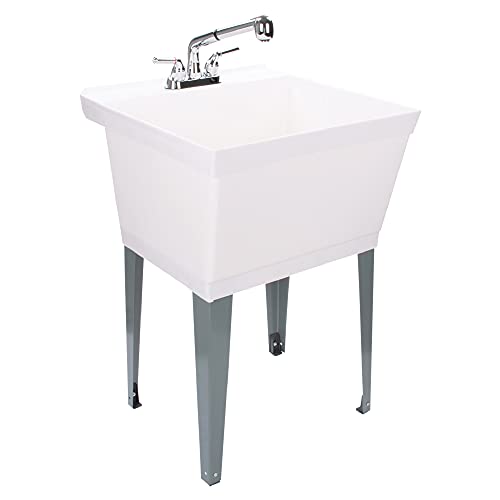
As an Amazon Associate we earn from qualifying purchases at no extra cost to you. Ratings are shown as listed on Amazon.
Freestanding vs. Drop-In: Which Type Fits Your Laundry Room?
Both types give you the deep basin you need for soaking clothes, hand-washing delicates, and draining a mop bucket, but they install and function very differently. Your choice should start with your layout and how you use the room.
Freestanding Utility Sinks
This is the classic laundry tub on four legs or a pedestal base with an integrated floor-standing basin. Models like the E.L. Mustee Utilatub series, Kohler Whitecap, and Swanstone Utilatub are the most common examples.
- Pros: Self-supporting, no cabinet or countertop needed. Usually deeper than drop-ins. Easiest to retrofit into an unfinished basement or garage-adjacent laundry. Exposed plumbing makes repairs simple. Often includes integrated side ledges for a faucet and can support wall-mounted faucets.
- Cons: Open underneath, so no hidden storage. Can look utilitarian. Legs take up floor space and can be less stable on uneven floors without leveling.
- Best for: Rentals, basements, homes where the washer and dryer are not surrounded by cabinetry, and anyone who prioritizes depth and durability over aesthetics.
Drop-In (and Undermount) Laundry Sinks
These are set into a countertop or laundry cabinet base, similar to a kitchen sink. Brands like Elkay, Kohler, and Ruvati make stainless steel and composite drop-in models specifically sized for laundry cabinets.
- Pros: Clean, built-in appearance. Countertop around the sink gives you a folding and sorting surface. Can be paired with base cabinet storage for detergents. Easier to contain splashes if the counter has a backsplash.
- Cons: Requires a sturdy cabinet and countertop, which adds cost and complexity. Basin depth is often shallower to fit standard 34 to 36-inch counter height. Harder to replace without modifying the counter cutout.
- Best for: Main-floor or upstairs laundry rooms, laundry closets, and remodels where you are already installing cabinets and want the laundry to look like a finished room.
How Deep Is Deep Enough for Soaking?
Depth is the main reason to choose a laundry sink over a standard bathroom or kitchen sink. For effective soaking, you need enough water column to fully submerge bulky items without having to fill the basin to the brim.
A basin depth of 12 inches is the minimum for a useful laundry sink. At 12 inches, you can soak sweaters, baby clothes, and small loads of delicates. A 13 to 15-inch depth lets you submerge a queen-size comforter corner, sports uniforms, or a full mop bucket without overflow. Anything deeper than 15 inches is excellent for soaking but requires you to bend further to reach the bottom, which can be uncomfortable for shorter users or at a lower freestanding height.
Also consider interior volume. A 24-inch wide freestanding tub that is 24 inches front-to-back and 14 inches deep holds roughly 20 to 24 gallons to the overflow, compared to about 12 to 15 gallons for a typical 25 x 22-inch drop-in that is 10 to 12 inches deep. That extra volume means fewer refills when pre-treating heavily soiled work clothes and better dilution of detergents like OxiClean or vinegar soaks.
If your primary use is hand-washing and stain treatment, prioritize depth over width. If you plan to wash pets or store laundry baskets in the sink, prioritize width and front-to-back depth.
Spec Comparison: Common Deep Laundry Sink Options
Use this table to see how material, size, and weight affect installation and durability. Dimensions are basin interior unless noted.
| Model Type (Example) | Material | Overall Size (W x D x H) | Basin Depth | Capacity to Overflow | Weight (Empty) | Faucet Holes |
|---|---|---|---|---|---|---|
| Freestanding Single Tub (Mustee Utilatub 24) | Thermoplastic / Polypropylene | 24 x 24 x 34 in | 14 in | ~22 gallons | 19 lbs | 2 (4-inch centers) |
| Freestanding Double Tub (Mustee Utilatub 46) | Thermoplastic | 46 x 24 x 34 in | 13.5 in | ~19 gallons per side | 38 lbs | 4 (2 per basin) |
| Drop-In Stainless Steel (Elkay Dayton 25 x 22) | 20-gauge 304 Stainless Steel | 25 x 22 x 12 in | 10.5 in | ~13 gallons | 11 lbs | 1-3 pre-punched |
| Drop-In Composite (Kohler Neoroc / Swanstone) | Solid Surface / Composite | 25 x 22 x 13.5 in | 12 in | ~15 gallons | 22 lbs | 1-3 |
| Heavy-Duty Freestanding (Advance Tabco / Ruvati Stainless) | 14-gauge 304 Stainless Steel | 28 x 28 x 36 in | 15 in | ~24 gallons | 52 lbs | 0 (wall-mount faucet) |
Thermoplastic freestanding tubs dominate the general market range of $120 to $300 because they are light, chemical-resistant, and will not rust. Stainless steel freestanding and composite drop-ins typically run $250 to $550. Heavy-gauge commercial-style stainless units are $500 to $900+ and are overkill for most homes but last decades in high-use settings.
Decision Matrix: Pick by Your Situation
Match your space, budget, and plumbing access to the right configuration before you buy.
| Your Situation | Recommended Choice | Why |
|---|---|---|
| Small laundry closet or apartment (under 40 sq ft), no counter | 24-inch wide freestanding thermoplastic, single basin, 13-14 in deep | Smallest footprint, no cabinet needed, deepest soak for the size |
| Large basement or garage laundry with exposed walls | Freestanding double-tub or extra-wide single 28-inch stainless | Sort soak and rinse in separate basins, holds mop buckets and handles heavy soil |
| Main-floor laundry with cabinets and you want folding space | 25 x 22-inch drop-in stainless or composite, 10.5-12 in deep | Integrates with countertop, adds usable work surface, easier to keep tidy |
| Tight budget, DIY install | Freestanding thermoplastic with 4-inch center faucet pre-drill | Lightest weight, no countertop templating, connects with standard 1-1/2 in P-trap |
| Need to wash pets, dye fabrics, or clean paint tools | Freestanding stainless 14-15 in deep with wall-mount faucet | Chemical and scratch resistant, wall-mount faucet gives full clearance for large items |
Plumbing Requirements You Must Check First
A deep laundry sink can overwhelm undersized plumbing or create code issues if you do not plan the connections. These are the non-negotiables:
1. Drain Size and Location
Most laundry sinks use a 1-1/2 inch drain tailpiece and P-trap, which then ties into a 2-inch branch drain. In many homes, the washer standpipe already uses that 2-inch line. You cannot simply double-stack both fixtures on a single 1-1/2 inch trap arm – it will siphon and gurgle. If you are adding a sink where only a washer drain exists, you will need a separate trap and ideally a dedicated vent or an air admittance valve where allowed by local code. Freestanding tubs often have a rear-center drain, so measure from the finished wall to the centerline – usually 12 to 14 inches – to ensure your trap will line up without sharp offsets.
2. Venting
Every sink trap needs a vent within 3.5 to 6 feet depending on code. An unvented sink will drain slowly and can pull water from the washer trap, letting sewer gas in. If you are far from the main vent stack, a licensed plumber can add a studor vent or tie into an existing vent line. This is the most common reason DIY laundry sink installs fail inspection.
3. Water Supply
Freestanding tubs typically have two 1/2 inch supply lines with a 4-inch centerset faucet, mounted directly to the tub ledge. Drop-ins use a standard kitchen-style single-hole or 3-hole faucet. For laundry use, choose a faucet with a high-arc swivel spout and an 8-inch or greater clearance above the basin rim – otherwise you cannot get a bucket underneath. Add quarter-turn shutoff valves on both hot and cold lines at the wall; compression valves are more reliable than saddle valves for future maintenance.
4. Height and Trap Arm Alignment
Freestanding tubs are 33 to 34 inches high to the rim. Drop-ins in a 36-inch counter will be slightly higher. The horizontal trap arm must slope 1/4 inch per foot toward the wall. If your wall drain stub-out is too high (common in older homes at 22 to 24 inches), a deep 14-inch basin may sit too low to drain properly by gravity. Measure the stub-out height before you buy: the bottom of the basin should be at least 6 to 8 inches above the trap weir.
5. Washer Drain Integration
Do not drain the washing machine directly into the laundry sink basin unless the sink is rated for it and has an overflow and a 2-inch drain. Most modern washers pump 15 to 20 gallons per minute, which will overflow a 1-1/2 inch sink drain. Keep the washer on its own 2-inch standpipe with a P-trap. The sink should be a separate fixture on the same branch.
Materials, Durability and Ownership Realities
What wears first is not the basin itself but the plumbing and surface finish around it.
- Thermoplastic (polypropylene): Will not chip, rust, or stain from bleach and laundry chemicals. It can warp if you pour boiling water or hot dye baths over 180F directly into it, and it will scratch if you drag concrete-filled buckets. Clean with non-abrasive cleaners; avoid acetones.
- Stainless steel: Most durable long-term, especially 16 to 18-gauge 304 steel. It will show water spots and can dent if you drop a heavy tool. Chlorine bleach left standing can pit lower-grade 403 steel, so rinse after soaking with bleach. Use a stainless grid at the bottom to prevent scratches and improve drainage.
- Composite / solid surface: Best appearance and quietest, but can stain from hair dye, fabric dye, or rust if not wiped quickly. Avoid abrasive pads; use a Magic Eraser-type sponge and reseal if the manufacturer recommends it.
- Faucets and strainers: The cheapest failure points. Low-cost plastic strainers crack and leak within 1-2 years. Spend extra on a stainless steel basket strainer and a faucet with ceramic disc valves. Replace supply hoses every 5 to 7 years or use braided stainless lines.
- Common mistakes: Over-tightening the drain nut on a thermoplastic tub (it cracks the tailpiece), using plumber’s putty on composite (use silicone), and leaving the sink full for days (weight can stress freestanding legs and loosen the P-trap). If you soak overnight, do not fill to the rim – the static load of 150+ lbs of water can cause a thermoplastic leg base to creep on an uneven floor.
For maintenance, flush the trap monthly if you dump lint-heavy soak water. A simple mesh lint trap over the drain catches fibers that would otherwise clog the branch line shared with the washer. Wipe down the basin after each use with a damp cloth to prevent detergent residue from dulling the finish.
Installation Complexity by Model
Freestanding installation is typically a 2 to 4-hour DIY job if you have existing water stub-outs and a wall drain at the correct height: level the legs, anchor to the wall if anti-tip hardware is included, connect supplies, and solvent-weld or slip-joint the P-trap. Drop-in installation requires templating the countertop cutout, sealing the rim with silicone, and securing clips from below – often better as a combined countertop and plumber appointment. If you need to run new supply lines or add a vent, budget for a plumber for 3 to 6 hours of labor in addition to the sink cost.
Frequently Asked Questions
Can I put a deep laundry sink on the same drain as my washing machine?
They can share the same 2-inch branch drain, but each fixture needs its own trap and vent. Do not route the washer discharge hose into the sink basin as a substitute for a standpipe; the flow rate is too high for a standard 1-1/2 inch sink drain and will overflow.
What is the ideal faucet for a deep laundry sink?
A high-arc laundry or utility faucet with a pull-out sprayer and at least 7 to 9 inches of spout clearance. Wall-mount faucets are ideal for freestanding deep tubs because they leave the entire rim clear for buckets. Look for a flow rate of 1.8 to 2.2 GPM for faster bucket filling.
Do I need a deep sink if I have a front-load washer with a soak cycle?
The washer soak cycle is good for large loads, but it is not practical for hand-wash-only items, pre-treating stains with direct scrubbing, or cleaning items you do not want in the washer like muddy boots or paint rollers. A sink gives you control over water temperature, detergent concentration, and soak time without tying up the machine.