Key takeaways
- For seamless cleaning and modern stone counters: choose undermount.
- For laminate counters, rentals, or easy swap-outs: choose drop-in.
- For maximum depth, statement look, and forward-leaning comfort: choose farmhouse.
- For utility rooms with wall-mounted faucets or freestanding cabinets: consider a wall-mount or top-mount laundry sink with 12-inch depth and integral drainboard.
The best deep basin sink for most kitchens is a 30 to 33-inch single-basin sink with a 9 to 10-inch depth and 16-gauge stainless steel or fireclay, because it fits standard base cabinets, comfortably handles stockpots and sheet pans, and avoids the splash-back you get with shallower basins.
Our top picks


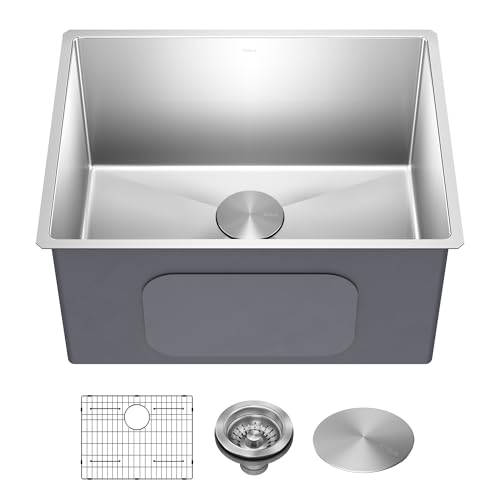

As an Amazon Associate we earn from qualifying purchases at no extra cost to you. Ratings are shown as listed on Amazon.
Single vs. Double Deep Basin: Which Depth Actually Helps?
Depth matters more than width for comfortable washing, but how that depth is divided changes usability. A deep basin sink is generally defined as 9 inches or deeper from rim to drain, compared to standard 7 to 8-inch basins.
Single Deep Basin
A single deep basin gives you one uninterrupted space, typically 9 to 12 inches deep. It excels at soaking, washing large cookware, bathing pets, and cleaning utility buckets. The trade-off is you lose the ability to separate wash and rinse zones or keep dirty dishes out of prep space.
Best for: Home cooks who use large pots, sheet pans, and cutting boards; utility rooms, laundry rooms, and garages; smaller kitchens where one large basin is more flexible than two small ones.
Double Deep Basin (Equal and Low-Divide)
Traditional double basins split the depth into two 50/50 or 60/40 compartments, often 8 to 9 inches deep each. The newer low-divide or double-bowl deep basin keeps full depth but lowers the center divider to 4 to 6 inches, so you can still lay a long pan across both sides.
Best for: Households that hand-wash and air-dry frequently; cooks who want to soak in one side and rinse in the other; families who need a dedicated side for food prep and another for dishwashing.
Depth Comfort and Ergonomics
Deeper is not always more comfortable. A 10-inch depth is ideal for most users between 5’4″ and 6’0″ with standard 36-inch counter height. Go to 11 to 12 inches and shorter users or those with back issues will need to bend further and reach down to scrub, which causes fatigue. If you are under 5’5″ or have a lower counter height, stay at 9 to 10 inches. If your primary use is utility mopping and bucket filling, the extra depth is worth the reach.
Deep Basin Sink Spec Comparison
Use concrete dimensions, not just marketing terms like “extra deep,” to check fit and function. Pay attention to interior depth, gauge (for stainless steel), and minimum cabinet size.
| Type / Example Model | Overall Size (L x W) | Basin Depth | Material & Gauge/Thickness | Min. Base Cabinet | Weight (Empty) |
|---|---|---|---|---|---|
| Farmhouse Fireclay Single – Kohler Whitehaven K-6489 | 35-11/16″ x 21-9/16″ | 9-5/8″ | Fireclay, ~1″ wall | 36″ | ~148 lbs |
| Stainless Undermount Single – Kraus Standart PRO KHU100-30 | 30″ x 18″ x 10″ | 10″ | 16-gauge 304 stainless steel | 33″ | ~28 lbs |
| Stainless Workstation Single – Elkay Crosstown ECTRU24179R | 24-3/4″ x 18-1/4″ x 9″ | 9″ | 16-gauge 304 stainless steel | 27″ | ~22 lbs |
| Granite Composite Single – Blanco Precis 30 Single | 30″ x 18-1/16″ x 9-1/2″ | 9-1/2″ | Silgranit granite composite | 33″ | ~48 lbs |
| Stainless Laundry/Utility Single – Ruvati RVM4250 | 32″ x 19″ x 12″ | 12″ | 16-gauge 304 stainless steel | 36″ | ~34 lbs |
Note that fireclay and cast iron sinks are significantly heavier and may require reinforced cabinetry and two-person installation, while composite and stainless models are lighter but need proper support clips and silicone sealing to prevent flex.
Installation Type Determines Usability and Fit
Undermount
Undermount deep basin sinks mount beneath the countertop for a flush edge that lets you wipe crumbs directly into the basin. They maximize usable bowl space because the rim does not eat into the opening, and they pair best with stone, quartz, and solid surface counters. They require precise cutouts and professional sealing to prevent water intrusion at the seam.
Top-Mount / Drop-In
Drop-in sinks rest on top of the counter with a visible rim. They are more forgiving for DIY installation, work with any countertop including laminate, and make future replacement easier. The rim can trap debris and slightly reduces the interior opening by about 1/2 to 3/4 inch on each side.
Farmhouse / Apron-Front
Farmhouse sinks expose the front apron and typically offer the deepest basins, 9 to 10+ inches, with a more ergonomic reach because you stand closer to the bowl without a counter edge in front of you. They require a farmhouse-style base cabinet or modification to a standard cabinet, and fireclay versions need exact cabinet sizing – a 36-inch fireclay farmhouse sink will not fit a 36-inch standard cabinet box without modification due to wall thickness.
Undermount vs. Drop-In vs. Farmhouse at a Glance
- For seamless cleaning and modern stone counters: choose undermount.
- For laminate counters, rentals, or easy swap-outs: choose drop-in.
- For maximum depth, statement look, and forward-leaning comfort: choose farmhouse.
- For utility rooms with wall-mounted faucets or freestanding cabinets: consider a wall-mount or top-mount laundry sink with 12-inch depth and integral drainboard.
Room-Size Fit: Matching Sink to Cabinet and Kitchen
A common buying mistake is ordering a sink that is too large for the base cabinet. The sink’s overall length must be 3 inches narrower than the cabinet interior for undermount installations to allow for mounting clips and side clearance.
Worked Sizing Calculation
To check fit quickly:
Available Bowl Width = Cabinet Outer Width – 3 inches (walls and clips) – Counter Overhang
Example 1 – Compact kitchen with a 30-inch base cabinet: 30 – 3 = 27 inches maximum sink overall length. A model like the Elkay Crosstown 25-inch workstation (24-3/4″ overall) fits comfortably and leaves room for a side-mounted soap dispenser. A 30-inch single-basin would require a 33-inch cabinet and would not fit.
Example 2 – Standard 36-inch base cabinet: 36 – 3 = 33 inches maximum. This accommodates most 30 to 33-inch deep single basins, including 30-inch composite and 33-inch stainless options, with space for faucet holes behind the basin.
Example 3 – Utility room with open floor space: If you have 42+ inches of width and 25+ inches of depth, a 32 x 19 x 12-inch laundry sink like the Ruvati RVM4250 gives true bucket depth without crowding. You gain about 35% more usable volume than a 9.5-inch kitchen basin (approx. 28 gallons vs. 20 gallons total capacity before overflow).
Also verify front-to-back depth. Many deeper sinks are 19 to 22 inches front to back. Ensure your countertop is at least 25.5 inches deep and that plumbing and disposal will still clear the back wall.
Decision Matrix: Pick by Your Situation
| Your Situation | Recommended Deep Basin Sink | Why It Fits |
|---|---|---|
| Small kitchen, 24-30″ cabinet, frequent hand-washing | 25-27″ single-bowl undermount, 9″ depth, 16-18 gauge stainless | Maximizes bowl space in a tight footprint, lightweight, affordable market range $250-$550 |
| Large family, batch cooking, big pans | 30-33″ single-bowl workstation, 9.5-10″ depth, with ledge and accessories | Accessories (cutting board, colander, roll-up rack) create zones without a divider |
| Want separation for wash/rinse and garbage disposal | 32-36″ low-divide double, 9″ depth each side, divider 5-6″ | Keeps two zones but still fits long pans across the low center |
| Utility, laundry, or garage cleaning | 32″ top-mount stainless, 12″ depth | Deepest capacity for buckets, mops, and pet washing; resists chemicals |
| Design-focused kitchen with shaker cabinets | 33-36″ fireclay or cast iron farmhouse, 9-10″ depth | Aesthetic appeal and durable enamel, but requires reinforced cabinet and higher budget $700-$1,400+ |
| Rental or laminate countertop | 33″ x 22″ drop-in double or single, 8-9″ depth | No stone fabrication needed, easy to reinstall when moving out |
Material Durability and Ownership Realities
A deep basin gets more abuse because you drop heavier pots further. Long-term care varies by material.
Stainless Steel (304, 16 vs. 18 Gauge)
16-gauge is noticeably quieter, less prone to denting, and holds its shape around the drain better than 18-gauge, but both will show water spots and fine scratches. What wears first is the brushed finish and sound pads. Avoid steel wool and bleach; use a microfiber cloth, mild dish soap, and occasionally a paste of baking soda to maintain luster. Hard water will leave mineral films faster in deep basins because water sits longer – wipe dry after use.
Fireclay and Enameled Cast Iron
Extremely durable against heat and chipping is limited to the enamel layer. What wears first is the glossy glaze if you drag cast iron pans or use abrasive cleaners. They resist stains but can craze or chip if a heavy pot is dropped from height into a deep bowl. Always use a bottom grid to protect the surface. Both materials are very heavy and can crack counters if not fully supported from below with reinforced rails.
Granite Composite (Silgranit, Quartz Composite)
Non-porous, heat resistant to about 535F, and much quieter than steel. What wears first is the matte finish – it can develop a chalky haze from lye-based cleaners or hard water. Clean with pH-neutral cleaners and apply a small amount of mineral oil occasionally if the manufacturer recommends it to restore color depth. Avoid prolonged exposure to strong dyes (beet juice, red wine) even though the material is stain-resistant.
Common Mistakes That Shorten Lifespan
- Over-tightening drains and strainers, which warps thin-gauge steel and cracks composite.
- Leaving standing bleach or drain cleaner in the basin overnight – it pits steel and dulls composite.
- Installing a deep 10 to 12-inch sink without extending the faucet spout height; a low-arc faucet will cause excessive splashing and awkward wrist angles.
- Skipping the bottom grid on fireclay or steel; the grid prevents direct impact and keeps the drain clear for faster draining.
Cost and Setup Considerations
General market ranges in 2026: stainless drop-in singles $200-$500, stainless undermount workstations $400-$900, granite composite $400-$800, fireclay farmhouse $700-$1,400, cast iron farmhouse $800-$1,500. Installation adds $150-$400 for drop-in and $300-$700 for undermount or farmhouse when counter modification and support are needed. Factor in accessories – custom-fitted grids, colanders, and roll-up racks run $40-$120 each but significantly improve the function of a single deep basin.
Pair your deep basin sink with a faucet that has at least 8 to 10 inches of spout clearance above the basin rim and a pull-down sprayer with 360-degree swivel, otherwise the depth advantage is lost to poor reach. For kitchen use, ensure the garbage disposal and P-trap can be lowered enough to accommodate the deeper bowl – older homes with high drain outlets may need plumbing adjustment to maintain proper slope.
Frequently Asked Questions
Is a 10-inch deep basin too deep for everyday dishes?
For most adults, 9 to 10 inches is comfortable and reduces splashing. If you are shorter than 5’4″, have a lower-than-standard counter, or hand-wash small items frequently, a 9-inch depth with a bottom grid (which raises the effective floor by about 1 inch) is more ergonomic than a 10 to 12-inch basin.
Do deep basin sinks drain slowly?
Not if they are installed correctly. Choose a sink with a rear or offset drain rather than a center drain – it improves usable space below and creates better slope for drainage. Ensure the drain assembly is fully tightened and the disposal flange is flush; deep basins hold more water volume, so a high-quality basket strainer and clear P-trap are essential.
Can I put a deep farmhouse sink in an existing standard cabinet?
Sometimes, but it usually requires cutting the cabinet face frame and adding support rails. Measure the interior width and confirm the sink manufacturer’s template. Fireclay farmhouse models often need 1/8 to 1/4 inch of clearance on each side for expansion and may not retrofit into a 33-inch cabinet without modification.