Key takeaways
- Fraction scale: Most tapes label 1/2, 1/4, and 1/8. Better models label every 1/16. Only specialized tapes label every 1/32, which can make the blade look cluttered if the print is too small.
- Print contrast and size: Look for high-contrast black fractions on a matte white or yellow blade with red highlights for 16-inch stud centers. Glossy blades cause glare under work lights. Dual-printed text (fractions above the hash, decimal equivalent below) is the easiest for beginners.
- Blade width and standout: A 1-inch wide blade is compact for a tool belt, but a 1-1/4 inch wide blade allows larger font for fractions without crowding. Standout is how far the blade extends without collapsing, which affects one-person measuring.
The best measuring tape with fractions for most people is the Stanley PowerLock 25-foot with fractional markings or the Milwaukee STUD 25-foot, because both print clear 1/8, 1/4, 1/2 fractions directly on the blade down to 1/16 with excellent readability and a strong blade lock that holds for daily DIY and pro use.
Our top picks

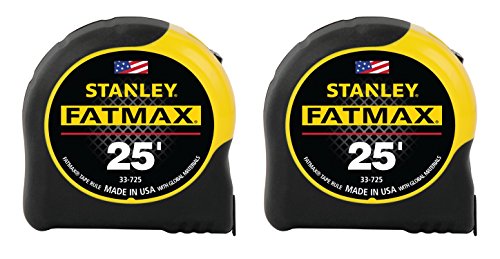


As an Amazon Associate we earn from qualifying purchases at no extra cost to you. Ratings are shown as listed on Amazon.
What Makes a Fraction-Marked Tape Readable in Real Use?
Not all measuring tape with fractions are equal. A standard tape forces you to count tiny hash marks between inches, which slows you down and introduces errors. A true fraction-printed tape labels those marks for you, but readability depends on three details:
- Fraction scale: Most tapes label 1/2, 1/4, and 1/8. Better models label every 1/16. Only specialized tapes label every 1/32, which can make the blade look cluttered if the print is too small.
- Print contrast and size: Look for high-contrast black fractions on a matte white or yellow blade with red highlights for 16-inch stud centers. Glossy blades cause glare under work lights. Dual-printed text (fractions above the hash, decimal equivalent below) is the easiest for beginners.
- Blade width and standout: A 1-inch wide blade is compact for a tool belt, but a 1-1/4 inch wide blade allows larger font for fractions without crowding. Standout is how far the blade extends without collapsing, which affects one-person measuring.
Do You Need 1/16 or 1/32?
For woodworking, general carpentry, drywall, and home DIY, 1/16 inch accuracy is the standard. The joint gap, saw kerf, and wood movement are larger than 1/32 inch in most cases, so a tape marked to 1/16 is faster to read and less confusing. Choose 1/32 markings only if you regularly do finish carpentry, trim work, metal layout, or craft projects where you need to split a 1/16. If you use a 1/32 tape for general use, you will see twice as many labels and smaller text, which reduces readability for daily tasks.
Best Measuring Tapes With Fractions Compared
This comparison focuses on widely available 25-foot models in 2026 that offer printed fractions, since 25-foot is the most versatile length for both DIY and professional daily carry. All are generally priced in the $15 to $45 range depending on series and width.
| Model | Length x Blade Width | Smallest Printed Fraction | Lock Type | Standout | Weight | Best For |
|---|---|---|---|---|---|---|
| Stanley PowerLock 25′ x 1-1/4″ | 25 ft x 1.25 in | 1/16 in (1/8, 1/4, 1/2 labeled) | Side slide lock, chrome | ~10 ft | ~1.1 lbs | All-around readability and value |
| Milwaukee STUD Gen 2 25′ x 1-1/4″ | 25 ft x 1.29 in | 1/16 in, fully labeled | Heavy-duty friction lock | ~13 ft | ~1.4 lbs | Pro standout and durability |
| DEWALT ToughSeries 25′ x 1-1/4″ | 25 ft x 1.25 in | 1/16 in, fractional | Auto-lock + manual lock | ~13 ft | ~1.3 lbs | Blade lock strength |
| Crescent Lufkin Shockforce G2 25′ x 1-1/4″ | 25 ft x 1.25 in | 1/16 in, dual fraction/decimal | Wide blade lock | ~14 ft | ~1.35 lbs | Drop protection |
| FastCap ProCarpenter FlatBack 16′ x 1″ | 16 ft x 1.0 in | 1/16 in, plus pencil sharpener | Standard thumb lock | ~7 ft | ~0.7 lbs | Compact DIY and finish work |
| FastCap Lefty/Righty 16′ x 1″ | 16 ft x 1.0 in | 1/16 in (printed left and right) | Standard thumb lock | ~7 ft | ~0.7 lbs | Left-handed or tight space reading |
Top Picks by Situation: Decision Matrix
Use your primary use case to choose, not just length. Fraction labeling and lock strength matter more than an extra 5 feet for accuracy.
Best Overall for DIY and Homeowners: Stanley PowerLock Fractional
Stanley remains the benchmark for readability. The yellow blade with large black fractions for 1/16 increments and red 16-inch stud marks is easiest to read in dim garages or outdoors. The Mylar coating resists abrasion without excessive glare, and the side lock holds firmly without blade creep when marking. It is lighter than pro magnum frames, so it is comfortable for occasional use. Choose this if you want the clearest fractions without paying for heavy-duty housing.
Best for Pros and Heavy Daily Use: Milwaukee STUD and DEWALT ToughSeries
If you measure all day on a job site, standout and lock strength are more important than compact size. The Milwaukee STUD and DEWALT ToughSeries both use a wider, nylon-coated blade that resists kinking when extended over 10 feet and a reinforced frame that survives 80+ foot drops. The fraction font is slightly bolder than the Stanley, and the lock engages with one thumb press without slipping when the blade is under tension. The tradeoff is weight and bulk on the belt.
The Crescent Lufkin Shockforce G2 is the alternative if you want diamond-coated blade protection and a dual-sided print that shows fractions on top and decimal inches on the bottom, helpful if you switch between fractional and decimal plans.
Best for Learning Fractions and Teaching: FastCap ProCarpenter
FastCap tapes are designed specifically for fraction readability. The ProCarpenter prints every fraction in large text and includes a built-in pencil sharpener and erasable notepad. The Lefty/Righty version prints fractions readable from either direction, so you do not have to flip the tape when measuring in a corner. Both are 16-foot, which keeps the housing small and the blade less cluttered. This is ideal for beginners, students, and finish carpenters who need to call out fractions quickly.
Need True 1/32 Markings?
Most 25-foot tapes do not print 1/32 fractions as text because the label would be unreadable. If you need 1/32, look for a machinist-style tape or a 12-foot FastCap Quick-Read with 1/32 hash labels. Be aware that these tapes sacrifice durability and standout for fine resolution. A common solution is to use a 1/16 printed tape daily and keep a separate 6-inch precision steel rule for 1/32 work.
How to Read and Calculate Fractions Without Mistakes
Printed fractions prevent counting errors, but understanding the math helps when you need to add or cut.
Step 1: Identify the largest labeled fraction. On a 1/16 tape, the longest hash between inch marks is 1/2, the next longest is 1/4, then 1/8, then the shortest is 1/16.
Step 2: Read the label, not the count. If the blade says 3/16 at your mark, you do not need to count three 1/16 lines past the inch.
Worked example – Adding two measurements: You need to cut a board for two pieces, one is 12-3/4 inches and the other is 14-5/16 inches.
- Convert fractions to sixteenths to add: 3/4 = 12/16, so 12-12/16 + 14-5/16 = 26-17/16.
- Simplify: 17/16 = 1-1/16, so 26-17/16 = 27-1/16 inches total length.
- Allow for saw kerf: If your blade removes 1/8 (2/16), add 2/16 back: 27-1/16 + 2/16 = 27-3/16 inches of raw material needed.
This is where a fractional tape saves time. You can mark 27-3/16 directly without converting hash marks in your head.
Durability and Ownership Realities
Fraction printing does not make a tape more fragile, but readability is the first thing to degrade if you misuse the blade.
- What wears first: The printed fractions near the hook from 0 to 12 inches fade fastest due to repeated rewind abrasion. Blade coating matters more than housing color. Look for nylon-bond or BladeArmor coatings, and avoid dragging the blade across concrete.
- Hook accuracy: The riveted hook slides to compensate for inside vs. outside measuring. If you drop the tape and the hook bends, your fractions are still printed correctly but your zero point is off by 1/32 to 1/16. Test by butting against a known steel rule.
- Lock failure: Friction locks wear if dust fills the mechanism. A tape that creeps closed while you mark indicates the lock pad is glazed. Blow out dust with compressed air and avoid locking while the blade is fully extended under spring tension for long periods.
- Common mistake: Using a wide-blade 25-foot tape for everything. For short indoor measurements under 6 feet, a compact 12-foot or 16-foot tape with larger fraction text causes less fatigue and extends the life of your main tape.
- Cleaning: Wipe the blade with a dry rag after dusty work. Solvents remove fraction printing. Lightly lubricate the hook rivets once a year if they stick.
For storage, retract the blade slowly. Letting it slam back stresses the spring and chips the coating at the mouth, which eventually obscures the first few fraction marks.
How to Choose the Right Width and Length
Choose 25-foot x 1-1/4 inch if you do carpentry, framing, or need standout for measuring ceilings alone. Choose 16-foot x 1 inch if you mostly build furniture, do crafts, or measure inside cabinets where a large housing is awkward. Blade width directly affects font size: tapes listed as 1.25 inches can print 1/16 labels about 20% larger than 1-inch models, which is noticeable for users who wear reading glasses.
Frequently Asked Questions
Are tapes with fractions less accurate than standard tapes?
No. The physical blade spacing is identical. A tape with fractions just adds printed labels over the same hash marks. Accuracy depends on manufacturing tolerance, typically within 1/32 inch over 12 feet for quality brands.
Can I get a metric and fraction tape in one?
Yes. Many Stanley and Milwaukee models have SAE fractions on the top edge and metric centimeters/millimeters on the bottom edge. This is useful for imported hardware but makes the blade more crowded, so choose it only if you need both systems regularly.
What is the easiest tape for someone who struggles with fractions?
Look for a tape that prints the reduced fraction at every mark, like FastCap. It will read 1/4 instead of 4/16, which avoids mental simplification. A dual-print with decimal equivalents (e.g., 1/8 = 0.125) also helps if you prefer decimals for calculations.