Key takeaways
- Measure inside cabinet width: A 36-inch cabinet typically has 34.5 inches of usable interior width (subtract 0.75 inch per side for the stiles). Your 33-inch sink needs about 33 inches plus 0.25 inch clearance per side = 33.5 inches. It fits with about 1 inch to spare.
- Check front-to-back: Standard cabinets are 24 inches deep outside, about 22.75 inches inside. A 22-inch front-to-back sink leaves about 0.75 inch behind for the faucet deck and clips. Confirm your counter is 25 to 25.5 inches deep.
- Check depth clearance: With a 10-inch deep bowl, the drain outlet sits roughly 11.5 inches below the counter (bowl depth + drain assembly). You need at least 3.5 inches from the drain outlet to the P-trap to maintain fall. If your existing drain stub-out is 18 inches from the floor, subtract counter height (36 inches) to get about 18 inches of vertical space. 11.5 inches for the sink plus 3.5 inches for the trap = 15 inches, so you have clearance. If your stub-out is higher, say 20 inches from the floor, you only have 16 inches of space and a 12-inch deep sink would leave almost no fall and risk slow draining.
- Check for garbage disposal: Add 6 to 7 inches for the disposal body below the drain. A 10-inch deep sink plus a disposal needs at least 18 to 19 inches from the counter underside to the cabinet floor. Most 36-inch base cabinets provide about 22 to 24 inches, so it clears, but shallow plumbing can force you to lower the stub-out.
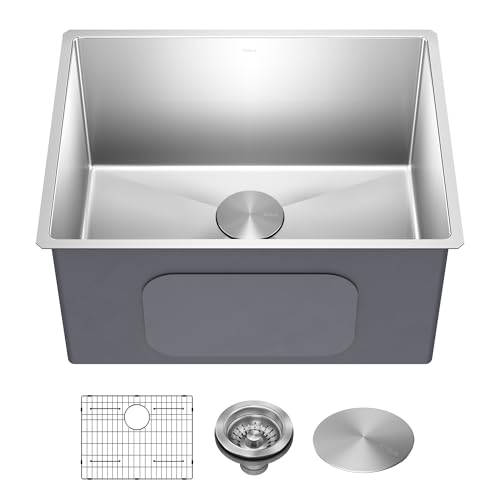
The best deep well sink for most kitchens is a 10-inch deep, 16-gauge stainless steel single-bowl sink in a 33 x 22 inch footprint, because it contains splashing and hides tall pots without forcing most people to hunch over, while fitting a standard 36-inch base cabinet. Choose 9-inch depth if you are under 5’4″ or want less bending, and 10 to 12-inch depth only for heavy utility, canning, or laundry use where splash containment matters more than ergonomics.
Our top picks



As an Amazon Associate we earn from qualifying purchases at no extra cost to you. Ratings are shown as listed on Amazon.
How Deep Is “Deep” and When Depth Helps or Hurts
Manufacturers label anything from 9 inches to 12 inches as a deep well or extra-deep sink, measured from the top rim to the bottom of the basin. Standard kitchen sinks are 7 to 8 inches deep. That 2 to 4 inch difference changes daily use more than you expect.
A deeper basin does three things well: it keeps water inside when you spray vegetables or run a high-arc faucet, it hides dirty dishes below the counter line, and it accommodates stockpots, sheet pans, and 5-gallon buckets that do not fit in shallow bowls. The trade-off is reach. Every extra inch of depth means you bend further to scrub the bottom, lift a heavy pot of water higher to empty it, and lean over a cabinet door or apron front.
For ergonomics, match sink depth to your height and counter height. Standard counters are 36 inches high. With a 10-inch deep sink, the bottom of the basin sits at about 26 inches from the floor. For someone 5’8″ to 6’0″, that is a comfortable reach with a slight forward bend. If you are 5’2″, that same sink forces a deeper stoop and shoulder strain during long prep. In that case a 9-inch depth with a high-arc faucet gives you splash control without the strain. For utility rooms, garages, and laundry spaces where you soak mops or bathe pets, a 12 to 15-inch deep laundry or utility sink is worth the bend because you rarely stand there for long prep.
Stainless Steel vs. Composite vs. Fireclay: Material Trade-offs
Most deep well sinks sold in 2026 are one of three materials, and the choice matters more than the brand name for noise, heat tolerance, and maintenance.
Stainless steel (304 grade, 16-18 gauge) is the lightest, most forgiving, and easiest to retrofit. Thicker steel is lower gauge. A 16-gauge basin flexes less, dent resists better, and sounds quieter than 18-gauge. Look for 304 stainless, not 201, for better corrosion resistance, plus a full undercoating and pads on the bottom and sides for noise damping. It will scratch and show water spots, but those are cosmetic and can be brushed out.
Composite granite (quartz/acrylic blends like Blanco Silgranit, Elkay Quartz Luxe, Kraus Forteza) is molded from 80% stone dust and 20% acrylic resin. It is much heavier, resists scratches and stains better than steel, and is naturally quiet. It handles heat up to about 535F but can crack from thermal shock if you place a screaming hot pan directly from the burner, and light colors can stain from coffee, wine, or turmeric if not rinsed quickly.
Fireclay (Kohler, Rohl, Franke) is glazed ceramic fired at high temperature. Glossy, very hard, and highly stain and heat resistant, but also the heaviest and most chip-prone if you drop a cast-iron pan on the rim. It also requires a reinforced cabinet and often a farmhouse-style cabinet modification.
| Spec | Stainless Steel 16-Gauge Example (Kraus Standart Pro 33″, Ruvati RVM4250) | Composite Granite Example (Blanco Precis 33″, Elkay Quartz Luxe 33″) | Fireclay Example (Kohler Whitehaven 36″, Franke Fireclay 33″) |
|---|---|---|---|
| Typical Depth Options | 9 – 10 – 12 in | 9.5 – 10 in | 9 – 10.5 in |
| Overall Size (L x W) | 33 x 22 x 10 in | 33 x 19.5 x 10 in | 35.5 x 21.25 x 9.625 in |
| Material Gauge / Thickness | 16 gauge (0.064 in / 1.6mm) 304 steel | 0.38 – 0.5 in molded composite | 0.75 – 1 in fireclay + glaze |
| Weight (empty) | 28 – 35 lbs | 45 – 65 lbs | 85 – 135 lbs |
| Heat Tolerance | High, will discolor but not crack | Up to 535F, avoid direct extreme thermal shock | High, resists scorching |
| Noise Without Accessories | Requires pads + coating; otherwise tinny | Naturally quiet | Naturally quiet |
| General Market Price Range (2026) | $300 – $650 | $400 – $850 | $800 – $1,600 |
Cabinet Fit: How to Know It Will Actually Fit
A deep well sink does not just need to fit the countertop cutout. It needs to clear the cabinet walls, plumbing, and disposal. Use this quick sizing check before you buy.
Worked Sizing Calculation
Example: You have a standard 36-inch base cabinet with face frame. You want a 33 x 22 x 10-inch single bowl stainless steel sink.
- Measure inside cabinet width: A 36-inch cabinet typically has 34.5 inches of usable interior width (subtract 0.75 inch per side for the stiles). Your 33-inch sink needs about 33 inches plus 0.25 inch clearance per side = 33.5 inches. It fits with about 1 inch to spare.
- Check front-to-back: Standard cabinets are 24 inches deep outside, about 22.75 inches inside. A 22-inch front-to-back sink leaves about 0.75 inch behind for the faucet deck and clips. Confirm your counter is 25 to 25.5 inches deep.
- Check depth clearance: With a 10-inch deep bowl, the drain outlet sits roughly 11.5 inches below the counter (bowl depth + drain assembly). You need at least 3.5 inches from the drain outlet to the P-trap to maintain fall. If your existing drain stub-out is 18 inches from the floor, subtract counter height (36 inches) to get about 18 inches of vertical space. 11.5 inches for the sink plus 3.5 inches for the trap = 15 inches, so you have clearance. If your stub-out is higher, say 20 inches from the floor, you only have 16 inches of space and a 12-inch deep sink would leave almost no fall and risk slow draining.
- Check for garbage disposal: Add 6 to 7 inches for the disposal body below the drain. A 10-inch deep sink plus a disposal needs at least 18 to 19 inches from the counter underside to the cabinet floor. Most 36-inch base cabinets provide about 22 to 24 inches, so it clears, but shallow plumbing can force you to lower the stub-out.
For farmhouse or apron-front sinks, the rule changes. You need an apron-front cabinet or you must cut the face frame and add a support cradle rated for 150+ lbs for fireclay and 100+ lbs for composite. Undermount single bowls need a solid plywood underlayment and clips rated for the sink weight when full of water. Water weighs 8.34 lbs per gallon, and a 33 x 19 x 10 inch bowl holds about 22 gallons to the rim, or roughly 180 lbs of water alone.
Decision Matrix: Pick by Your Situation
Use your primary use case, not just looks, to narrow the field.
| Your Situation | Best Depth and Configuration | Best Material | Why |
|---|---|---|---|
| Daily family kitchen, lots of dishes and pots | 33″ single bowl, 9.5 – 10″ deep, undermount | 16-gauge 304 stainless | Maximum usable bowl, easiest to clean pans, lighter weight for existing cabinets |
| Small kitchen with 30″ cabinet | 28 – 30″ single bowl, 9 – 10″ deep | 16- or 18-gauge stainless, or compact composite | Fits without cabinet modification, keeps counter space |
| Baker or canner, heavy large items | 33 – 36″ single bowl, 10 – 12″ deep | Composite granite or stainless with grid | Deep containment for canning pots, sheet pans lie flat |
| Design-first kitchen, light prep | 33 – 36″ apron-front, 9 – 9.5″ deep | Fireclay | Wide, shallow basin is more ergonomic and showcases the front, less bending |
| Utility, laundry, garage | 25″ x 22″ x 12 – 15″ deep laundry sink | Stainless or molded composite utility sink | Deep for buckets and mops, smaller footprint fits narrow rooms |
| Rental or budget retrofit | 33″ x 22″ x 8 – 9″ deep top-mount / drop-in | 18-gauge stainless | Drop-in avoids new counter cuts, lower cost, accepts existing faucet holes |
Ergonomics, Splash, and Noise: The Details Listings Skip
Depth alone does not prevent splashing. Two features matter more. First is bowl radius. A zero-radius sink with tight 0 to 10mm corners looks modern but traps food in corners and reflects spray upward. A 15 to 30mm radius (often called low radius) is easier to wipe and directs water toward the drain. Second is the faucet. A deep well paired with a low-arc or short-reach faucet forces you to angle dishes under the stream, which creates splash. For a 10-inch deep bowl, choose a high-arc faucet with at least 15 inches of spout height and a pull-down sprayer that can reach the corners at low pressure.
For noise, check the spec sheet for sound pads and undercoating coverage. The best stainless sinks cover 80% or more of the bottom and sides with thick pads. Thin, small pads leave a ringing sound when water hits the basin. Composite and fireclay do not need this but benefit from an included bottom grid. The grid raises dishes off the bottom, prevents scratches, and absorbs impact noise. If your sink does not include one, plan to add a fitted stainless or silicone grid sized to the exact bowl dimensions.
Do not ignore overflow and drain position. Rear-center or rear-offset drains give you more usable flat space in front and better clearance for the disposal and plumbing. An overflow is handy for safety but adds a cleaning point where biofilm collects.
Durability and Ownership: What Wears First and How to Avoid It
Stainless steel fails cosmetically before it fails structurally. Expect fine scratches in the first months, especially with a brushed finish. Scrub only along the grain with a non-scratch pad and Bar Keeper’s Friend-type cleanser, rinse after salty or acidic foods, and dry to prevent water spots. Avoid leaving cast iron, steel wool, or rubber mats that trap moisture for days, which can cause surface rust spots on even 304 steel.
Composite sinks wear differently. The resin can dull with abrasive cleaners and bleach. Clean with soapy water and a soft sponge, and do a periodic mineral oil wipe on darker colors to restore luster. Never use a razor blade or harsh scouring powder. If you get a white haze from hard water, a 50/50 vinegar-water rinse followed by thorough fresh water rinsing removes it without damaging the surface.
Fireclay’s glaze is the hardest but chips on impact. The most common chip points are the precise rim edge and the drain opening where heavy pans slip. Insist on a grid, lift rather than slide cast iron, and protect the rim during installation when the sink is most vulnerable before the counter is set.
Common mistakes with any deep well sink: overtightening undermount clips and bowing the rim, skipping plumber’s putty or silicone where the drain flange meets the basin, and failing to seal the countertop cutout for composite and wood cores. For undermount installations, silicone the rim to the counter underside and let it cure 24 hours before loading the sink with water or the weight can pull the seal.
Consumables to budget for: replacement bottom grid every 3 to 5 years if feet wear, new drain strainer and gasket, and faucet cartridge and supply lines. Keep the cabinet dry by checking the disposal and P-trap for leaks monthly, since a deep bowl puts more leverage and vibration on those joints than a shallow one.
FAQ
Is a 10-inch deep sink too deep for washing dishes by hand?
For most adults over 5’6″, a 10-inch depth with a bottom grid is comfortable because the grid raises dishes about 1 inch and reduces bending. If you hand-wash for long periods and are shorter, choose 9 to 9.5 inches and add a high-arc faucet for splash control instead of extra depth.
Can I put a deep well sink in a 30-inch cabinet?
Yes, but limit the sink width to 28 to 29 inches overall. A 30-inch cabinet has about 28.5 inches of usable interior width, so a 33-inch sink will not fit without replacing the cabinet. Look for models specified for a 30-inch minimum cabinet, such as Ruvati 30-inch or Blanco 28-inch compact bowls.
Do I need a special faucet for a deep sink?
You do not need a special valve, but you do need adequate reach and height. The spout should swivel to reach all corners and provide at least 8 inches of clearance above the rim for filling tall pots. A pull-down with two spray modes helps control splash at lower pressure.