Key takeaways
- Best everyday choice: a universal flip-up clip-on with adjustable silicone-covered jaws, a 10–12 mm opening, and lenses at least 50 mm wide.
- Best for thick acetate frames: a magnetic clip-on or wide-jaw model with an opening of 12–15 mm and a flexible bridge.
- Best for occasional small print: a flip-up computer lens with a low +1.00 to +1.50 magnification segment, not a full-strength reading lens.
- Best for long screen sessions: a lightweight clear or pale-amber lens weighing roughly 8–15 g, with anti-reflective treatment and replaceable nose pads.
- Best budget option: a basic spring clip with 5–8 mm of opening, provided it fits the frame without pressing against the prescription lenses.
The best clip-on computer lenses for prescription glasses are lightweight flip-up or magnetic lenses with an opening of at least 8–12 mm, a bridge that matches your frame, and moderate blue-light filtering rather than an extremely dark tint.
For most screen users, a clear or lightly amber, non-prescription clip-on is the most practical choice: it preserves your prescription, can move out of the way for conversation, and costs less than ordering a second pair of prescription computer glasses. The right design depends mainly on your frame thickness, how often you use it, and whether you need only glare reduction or occasional magnification.
Our top picks
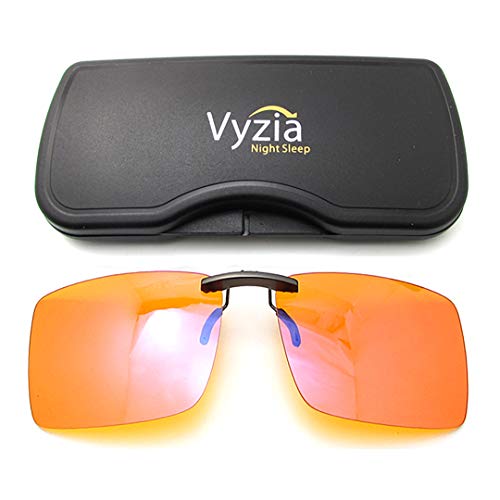
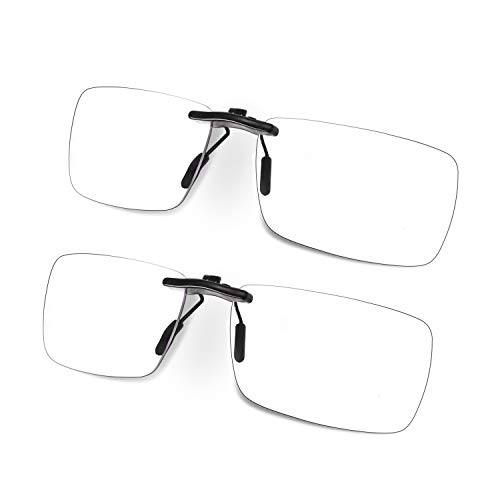


As an Amazon Associate we earn from qualifying purchases at no extra cost to you. Ratings are shown as listed on Amazon.
Quick picks by situation
- Best everyday choice: a universal flip-up clip-on with adjustable silicone-covered jaws, a 10–12 mm opening, and lenses at least 50 mm wide.
- Best for thick acetate frames: a magnetic clip-on or wide-jaw model with an opening of 12–15 mm and a flexible bridge.
- Best for occasional small print: a flip-up computer lens with a low +1.00 to +1.50 magnification segment, not a full-strength reading lens.
- Best for long screen sessions: a lightweight clear or pale-amber lens weighing roughly 8–15 g, with anti-reflective treatment and replaceable nose pads.
- Best budget option: a basic spring clip with 5–8 mm of opening, provided it fits the frame without pressing against the prescription lenses.
What the clip-opening measurement really means
Manufacturers often list a “clip opening,” but this is not always the same as usable frame clearance. Measure the distance from the inside of the clip jaw to the opposite jaw at its widest practical position. Then compare it with the thickness of your frame front, including any raised rim or decorative edge.
| Prescription frame type | Typical front thickness | Recommended clip opening | Most suitable design |
|---|---|---|---|
| Thin metal or rimless | 1–3 mm | 5–8 mm | Small spring clip or magnetic bridge |
| Standard plastic frame | 3–6 mm | 8–12 mm | Adjustable universal clip |
| Thick acetate or oversized frame | 6–10 mm | 12–15 mm | Wide-jaw clip or magnetic attachment |
| Strongly curved sport-style frame | Variable | 12 mm or more, plus curvature compatibility | Flexible bridge or frame-specific attachment |
A clip that technically opens wide enough can still be unsuitable if its rubber pads land on a bevel, hinge, or narrow edge. Check three points: the clip must grip the frame front, the nose bridge must not lift your prescription glasses, and the lens must sit centered over both eyes.
Blue-light filtering versus flip-up magnification
These features solve different problems. Blue-light filtering changes the transmission of selected wavelengths; magnification changes the apparent size of text and objects. A lens can have either feature, or both.
| Feature | Useful specification | Advantages | Limitations |
|---|---|---|---|
| Clear lens | Visible light transmission usually above 90% | Natural color and best general-purpose visibility | Less noticeable tint-based glare reduction |
| Pale-amber filter | Usually 10–30% blue-violet reduction, depending on wavelength | Can feel more comfortable to some users in bright displays | Changes color balance and may be unsuitable for color-critical work |
| Flip-up magnification | Common strengths: +1.00, +1.50, +2.00 | Helpful for brief close-up reading without changing glasses | Not ideal for continuous monitor viewing; can cause blur if too strong |
| Combined filter and magnifier | Typically 10–20 g, depending on mechanism | One attachment handles two occasional tasks | Heavier and more likely to sag on lightweight frames |
For a monitor positioned about 50–75 cm away, magnification is often unnecessary if your prescription is correctly updated. A +2.00 flip-up lens may be useful for a phone or fine print but can make a normal-distance monitor appear uncomfortable. If you want magnification, +1.00 is the safer starting point for mixed screen and document work; ask an optometrist if you need stronger or sustained near correction.
Head-to-head: spring clip, magnetic, or flip-up?
Spring-clip computer lenses
These are usually the least expensive and easiest to transfer between glasses. They work well on thin-to-medium frames, but the spring places pressure on the bridge and lens rims. Look for silicone contact pads, rounded jaws, and a total weight below 12 g. Avoid models whose metal edges touch your prescription lenses directly.
Magnetic clip-ons
Magnetic designs are neater and reduce pressure on the frame, but they normally require a small metal attachment or a compatible frame. They are a strong choice for thick acetate frames because the lens can sit in front of the frame rather than clamping over its thickest section. The trade-off is a higher initial cost and a permanent attachment that may be visible.
Flip-up clip-ons
A flip-up mechanism is valuable when you alternate between the monitor and the room. It should stay raised without wobbling and lower evenly over both lenses. Hinges are the part most likely to loosen, so choose a model with a metal hinge or a replaceable screw rather than a thin molded plastic pivot.
Decision matrix
| Your situation | Choose | Target specifications | Why |
|---|---|---|---|
| Under $25 and occasional use | Basic spring clip | 5–10 mm opening; under 15 g | Low cost and adequate for trying the format |
| Daily use for 4–8 hours | Adjustable flip-up | 8–12 mm opening; 8–15 g; silicone pads | Better comfort and convenient switching |
| Thick or designer acetate frames | Magnetic or wide-jaw clip | 12–15 mm clearance; flexible bridge | Less slipping and less pressure on the frame |
| Frequent phone and document reading | Low-power flip-up magnifier | +1.00 or +1.50; clear or lightly tinted lens | Provides occasional enlargement without replacing glasses |
| Color-sensitive design work | Clear anti-reflective lens | High transmission; no strong amber tint | Preserves more natural color appearance |
How to size one before buying
- Measure the frame front. Use a ruler or calipers to measure its thickest point where the clip will sit.
- Measure lens coverage. The clip-on lens should cover the prescription lens with at least 2–3 mm of margin on each side. A small clip may leave uncovered areas that catch reflections.
- Check the bridge width. A bridge that is too narrow pushes the prescription glasses downward; one that is too wide may wobble.
- Check the hinge path. If the model flips upward, make sure it will not hit your eyebrows or the underside of a brow bar.
- Test the weight. A 20 g attachment on 25 g glasses increases the front load by about 80 percent, making slipping much more likely. For daily wear, staying near 10–15 g is usually more comfortable.
For example, if your frame front is 7 mm thick, selecting a clip with a stated 8 mm opening leaves only 1 mm of clearance. That may work on a flat frame but fail on a curved or beveled one. A 12 mm opening leaves a more practical 5 mm margin.
Ownership: what wears out first
The first parts to deteriorate are usually nose pads, silicone jaw covers, and small hinge screws—not the optical lens. Oils from skin can make pads slippery, while repeated flipping loosens the pivot. Replacement pads and a tiny screwdriver can extend the useful life more than buying a heavier “premium” attachment.
Clean the clip-on with lukewarm water and a drop of mild dish soap, then dry it with a clean microfiber cloth. Do not use household glass cleaner, alcohol wipes, paper towels, or hot water unless the manufacturer specifically permits them. Store it in a rigid case so the lens is not pressed against keys, coins, or the prescription lenses.
Common mistakes include choosing a dark amber lens for color-critical work, selecting magnification that is too strong for monitor distance, and clamping directly onto a lens edge. If the attachment causes persistent eye strain, headaches, double vision, or a noticeable change in alignment, stop using it and have the fit and prescription checked by an optometrist.
Bottom line
For most buyers, the best clip-on computer lenses for prescription glasses are a clear or lightly tinted flip-up model with an 8–12 mm opening, low weight, soft contact points, and a stable hinge. Choose magnetic or wide-jaw construction for thick frames, and treat magnification as an occasional close-reading feature rather than a substitute for a properly fitted prescription. General screen comfort advice cannot replace an eye examination, particularly if your current glasses are old or symptoms continue after adjusting the clip-on.