Key takeaways
- 3–5 hp: suitable for intermittent commercial grinding and smaller batches.
- 5–10 hp: a practical range for frequent restaurant or butcher-shop use.
- 10–20 hp: better suited to larger batches and sustained production.
- 20 hp and above: generally an industrial decision requiring professional installation and process planning.
Best Commercial Capacity Meat Mixer Grinders
The best commercial capacity meat mixer grinders are chosen by matching hopper size and real pounds-per-minute throughput to your production schedule, then confirming that the machine can be disassembled, washed, sanitized, and reassembled without slowing the kitchen down.
For most restaurants, butcher shops, and commissaries, a 50- to 75-pound hopper with roughly 20–50 pounds per minute of practical grinding capacity is the most useful middle ground. Smaller 25- to 35-pound machines suit limited prep volume, while 100-pound-plus systems make sense only when the labor, floor space, electrical service, and sanitation process can support them.
Our top picks
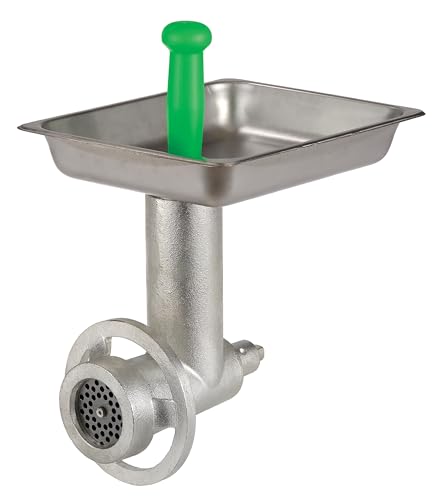
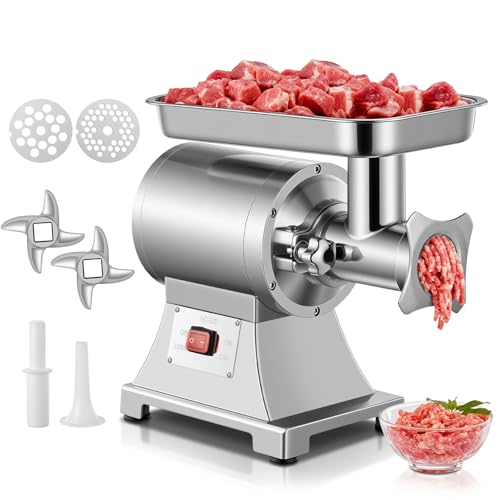
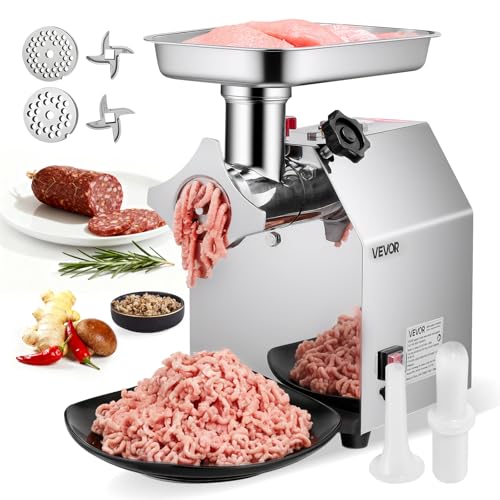
As an Amazon Associate we earn from qualifying purchases at no extra cost to you. Ratings are shown as listed on Amazon.
Commercial mixer grinder comparison
| Machine class | Typical hopper capacity | Typical practical throughput | Common motor range | Best fit | Main trade-off |
|---|---|---|---|---|---|
| Compact commercial | 25–35 lb | 10–25 lb/min | 3–5 hp | Small restaurants and low-volume retail counters | Requires more batches during a production run |
| Mid-size commercial | 50–75 lb | 20–50 lb/min | 5–10 hp | Butcher shops, caterers, and busy restaurant prep kitchens | Needs substantial cleaning access and electrical capacity |
| Large commercial | 100–150 lb | 40–90 lb/min | 10–20 hp | Commissaries and high-volume retail production | High purchase, installation, and sanitation demands |
| Industrial production | 200 lb or more | 100 lb/min or more | 20 hp or higher | Continuous or multi-shift processing | Usually excessive for a conventional restaurant |
These are useful purchasing ranges rather than guaranteed output figures. Actual throughput changes with meat temperature, grind plate diameter, fat content, auger design, knife sharpness, feed rate, and whether the product is mixed before or during grinding. A manufacturer’s maximum rating may describe ideal product and conditions, not the speed a kitchen should expect throughout a shift.
Best picks by operating situation
Best for a small restaurant or occasional sausage production
Choose a compact commercial grinder with a 25- to 35-pound hopper, a 3- to 5-horsepower motor, and removable grinding components. This class is easier to position near a prep sink and generally produces enough capacity for burger batches, meatballs, and intermittent sausage work.
Do not choose by motor horsepower alone. A compact unit with a well-designed feed throat and sharp knife may outperform a larger-looking machine that bridges meat around the auger. A reverse function is valuable when sinew or connective tissue begins to obstruct the head, but it does not replace trimming and correct product temperature.
Best all-around choice for a butcher shop
A 50- to 75-pound mixer grinder is the strongest general-purpose choice for a shop making several production runs per day. Look for approximately 5–10 horsepower, a stainless-steel hopper, a mixing paddle or ribbon that reaches the corners, and a grinding head compatible with the plate sizes your customers request.
This is the category where established commercial lines from Hobart, Biro, and Butcher Boy are commonly considered. Exact capacities, voltage options, head sizes, and motor configurations vary by model and build date, so the nameplate and current specification sheet should decide the final purchase—not the brand name alone.
Best for a commissary or high-volume production room
Large machines with 100- to 150-pound hoppers and 10 horsepower or more reduce the number of loading cycles and can maintain a higher production rate. They are appropriate when the business has scheduled batches, trained operators, adequate lifting or conveying equipment, and a dedicated wash-down area.
At this scale, consider manufacturers such as Hobart, Biro, and Provisur’s commercial processing equipment lines. Ask whether the quoted throughput is based on first grind, second grind, frozen material, or pre-mixed product. A system that is fast for coarse grinding may not maintain the same rate through a fine plate.
How hopper capacity affects real production
Hopper capacity is not the same as hourly output. A 75-pound hopper loaded to its practical working level might process a 60-pound batch in three minutes at 20 pounds per minute, but loading, staging, plate changes, weighing, and cleanup add time.
For example, suppose a shop needs 420 pounds of ground beef and its mixer grinder produces a dependable 35 pounds per minute. Grinding time is:
420 ÷ 35 = 12 minutes.
If the 60-pound working load requires seven loading cycles, and each cycle takes four minutes to weigh and stage, production time becomes approximately 40 minutes before sanitation. A larger hopper may not dramatically improve the motor’s grinding speed, but it can remove several loading interruptions. That matters when one employee is also preparing orders or operating another machine.
For a two-person kitchen, a smaller machine may be more efficient if a 100-pound hopper requires awkward lifting, repeated scraping, or a long walk to the wash area. Capacity should reduce labor, not merely increase the size of each task.
Motor horsepower: what it does and does not tell you
Horsepower indicates the motor’s potential to maintain torque under load, but it does not independently predict throughput. A grinder’s gearbox, auger pitch, throat diameter, plate size, electrical phase, and thermal protection all influence performance.
- 3–5 hp: suitable for intermittent commercial grinding and smaller batches.
- 5–10 hp: a practical range for frequent restaurant or butcher-shop use.
- 10–20 hp: better suited to larger batches and sustained production.
- 20 hp and above: generally an industrial decision requiring professional installation and process planning.
Check the electrical requirements before comparing machines. A unit may be offered in single-phase or three-phase versions, with different voltage and amperage requirements. The larger motor is not a bargain if the building needs a costly electrical upgrade or if the machine cannot be placed close to the approved outlet.
Sanitation and daily disassembly should decide the purchase
The most important ownership question is often, “How long does a complete clean take?” A commercial mixer grinder should be designed for routine removal of the hopper, feed tray, auger, knife, plate, retaining ring, and guards as specified by the manufacturer.
- Disconnect power and confirm the controls cannot be activated. Never begin disassembly with the machine connected.
- Remove remaining product promptly. Do not leave meat warming inside the hopper, auger tube, or grinding head.
- Take out the plate, knife, auger, and retaining components. Lay parts in an organized sequence so reassembly is correct.
- Wash with the approved detergent and water temperature. Follow the equipment manual and the kitchen’s food-safety program rather than assuming that a stronger chemical is better.
- Rinse, sanitize, and air-dry. Towel-drying can recontaminate cleaned surfaces if the towel is not controlled.
- Inspect seals, threads, corners, and welds. These areas can retain fat and protein even when broad stainless surfaces look clean.
- Lubricate only where specified. Use food-grade lubricant on approved points; never improvise around the product path.
Machines with enclosed drives may reduce external grime, but they do not eliminate cleaning around seals and access panels. A smooth stainless interior, tool-free component removal, drainable surfaces, and readily available replacement seals can be more valuable than an extra few horsepower.
What wears first and what to budget for
The knife and plate are normal wear items. They gradually lose cutting efficiency, causing smearing, increased product temperature, and a larger motor load. Replace or professionally sharpen them as a matched set when permitted by the manufacturer. A worn knife paired with a new plate can still produce poor results.
Other common service items include hopper or auger seals, retaining rings, bearings, switches, belts on applicable designs, and mixing paddles. Sinew, bone fragments, frozen chunks, and metal contact can damage the cutting set quickly. Keep spare knives and plates on site if production cannot stop for a service call.
Do not force partially frozen blocks into a head that is not rated for them. Do not use a knife or plate with visible cracks, deep scoring, or excessive wear. Avoid overfilling the hopper because it can stall the auger, increase heat, and make cleaning more difficult.
Final buying checklist
- Calculate pounds required per shift, not just the largest single batch.
- Use practical throughput, then allow time for loading, weighing, and plate changes.
- Confirm hopper working capacity rather than relying on a rounded marketing number.
- Match horsepower and electrical phase to the building.
- Measure doorways, aisle width, counter height, and clearance for disassembly.
- Ask for the weight of removable parts and whether one employee can handle them safely.
- Confirm replacement knife, plate, seal, and paddle availability.
- Request the cleaning procedure and the estimated time for a full daily sanitation cycle.
For most commercial kitchens, the best commercial capacity meat mixer grinders are not the largest available. A mid-size 50- to 75-pound machine is usually the best balance of capacity, throughput, motor strength, footprint, and cleanability. Move to a larger 100-pound-plus system only when the production schedule proves that fewer loading cycles and sustained output will repay its higher installation and maintenance demands.