Key takeaways
- Best for a typical large living room: A 60-inch fan rated around 6,000–8,000 CFM. It suits many rooms in the 225–400-square-foot range without overwhelming the ceiling.
- Best for a wide, open room: A 72-inch fan with airflow around 8,000–10,000 CFM or higher, provided the ceiling and mounting location can accommodate its blade sweep.
- Best for a very large room: Two appropriately sized fans can distribute air more evenly than one oversized fixture, especially in a long room or one divided by furniture.
- Best for low ceilings: A flush-mount or low-profile fan. Check the installed height, not just the fan’s blade span.
- Best for a vaulted ceiling: A fan compatible with a sloped-ceiling adapter and a downrod long enough to bring the blades into the useful airflow zone.
Best Ceiling Fans for Large Rooms: High-CFM Picks
The best ceiling fans for large rooms are sized by both blade span and airflow: choose a 60-inch fan for roughly 225–400 square feet, a 72-inch model for a broad open room, and a high-CFM design when you need stronger circulation across a long or busy space. For tall ceilings, add the right downrod so the blades sit about 8–9 feet above the floor; vaulted ceilings usually need an angled-ceiling mount as well.
Quick picks by room and priority
- Best for a typical large living room: A 60-inch fan rated around 6,000–8,000 CFM. It suits many rooms in the 225–400-square-foot range without overwhelming the ceiling.
- Best for a wide, open room: A 72-inch fan with airflow around 8,000–10,000 CFM or higher, provided the ceiling and mounting location can accommodate its blade sweep.
- Best for a very large room: Two appropriately sized fans can distribute air more evenly than one oversized fixture, especially in a long room or one divided by furniture.
- Best for low ceilings: A flush-mount or low-profile fan. Check the installed height, not just the fan’s blade span.
- Best for a vaulted ceiling: A fan compatible with a sloped-ceiling adapter and a downrod long enough to bring the blades into the useful airflow zone.
Match fan size to square footage
Room-area guidelines are a starting point, not a guarantee of comfort. Airflow depends on ceiling height, layout, furniture, and whether the fan is centered over the area where people spend time. CFM means cubic feet per minute: it describes the volume of air a fan moves, while blade span helps indicate how broadly that air may be distributed.
Our top picks
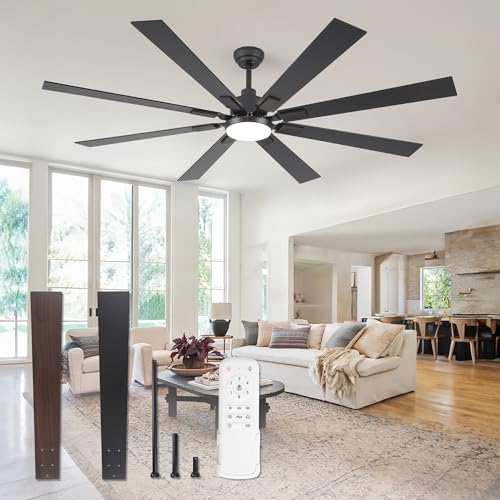


As an Amazon Associate we earn from qualifying purchases at no extra cost to you. Ratings are shown as listed on Amazon.
| Room area | Useful blade-span range | Practical airflow target | Typical situation |
|---|---|---|---|
| Up to 225 sq. ft. | 44–50 inches | About 3,000–5,000 CFM | Bedroom, office, or compact den |
| 225–400 sq. ft. | 52–60 inches | About 5,000–8,000 CFM | Large bedroom or standard living room |
| 400–600 sq. ft. | 60–72 inches | About 7,000–10,000 CFM | Open-plan living or dining area |
| Over 600 sq. ft. | 72 inches or larger, or multiple fans | About 9,000 CFM and up, or combined airflow | Great room, long studio, or shared space |
These ranges are screening targets, not standardized performance promises. Compare CFM figures only when they are reported under comparable conditions, and check whether a listed number refers to the fan’s highest speed. A very high top-speed CFM may come with more noticeable sound or a stronger draft than you want for everyday use.
Choose by the shape of the room
For a square room around 300–400 square feet
Start with a 60-inch fan and look for a model with multiple speeds. This size often balances coverage and clearance. If the room has a high ceiling or an obstructed layout, prioritize a suitable downrod and a strong mid-speed setting rather than choosing solely by the maximum CFM number.
For an open-plan room around 400–600 square feet
A 60- to 72-inch fan may work if the room is relatively open and the mounting point is central. For a long room, one central fan can leave the ends feeling still. Consider two fans positioned over separate activity zones; keep them far enough apart that their blade paths and airflow do not interfere.
For a room larger than 600 square feet
Look at a 72-inch or larger model, or plan a multi-fan layout. Two fans are often the more useful option when the room is rectangular, has a kitchen-dining-living arrangement, or includes partitions. Choose placement by occupied areas, not just the room’s geometric center.
Downrod length for tall and vaulted ceilings
For effective circulation and comfortable clearance, aim to place the blades roughly 8–9 feet above the floor. Many standard installations use a short downrod on a 9-foot ceiling, while ceilings of 10 feet or more often need a longer one. The correct length depends on the fan’s body height and the ceiling height, so use the manufacturer’s installation chart rather than selecting a rod by ceiling height alone.
For example, with a 12-foot ceiling and a fan body that extends about 1 foot below its mounting point, a downrod around 2–3 feet may place the blades near the 8–9-foot target. This is a planning estimate, not a universal specification: measure the actual installed dimensions and follow local electrical and building requirements.
On a vaulted ceiling, confirm the fan is approved for the ceiling angle. You may need a compatible angled mount, a longer downrod, or both. Check that the blades remain clear of the ceiling at every point in their rotation. Do not improvise an adapter or assume a standard canopy will fit a steep slope.
What to prioritize beyond size
- Motor and speed control: A DC motor can offer efficient operation and fine speed adjustment, but compatibility with wall controls, remotes, and smart-home systems varies. Check the included control method before buying.
- Blade material: Wood and wood-look blades suit many interiors but may have specific indoor-use limits. Composite or plastic blades can be easier to maintain in spaces where moisture is a concern; confirm the product’s damp- or wet-location rating.
- Lighting: If the fan includes a light, check brightness, color-temperature options, and whether the light source is replaceable. A fan’s lighting may not be enough as the room’s only illumination.
- Noise and airflow balance: Look for useful lower and middle speeds, not just a dramatic maximum CFM. Those settings are more likely to be comfortable for long periods.
- Installation compatibility: Verify ceiling-box support, mounting requirements, blade clearance, and any sloped-ceiling limits before purchase. A ceiling fan needs a box and support rated for fan installation.
Ownership details that affect long-term value
Dust collects on blade edges and can gradually make a fan look untidy or contribute to imbalance. Clean the blades periodically with a stable step ladder and a soft cloth; avoid leaning on the blades or bending them. If the fan wobbles, first check that the mounting hardware is secure and the blades are clean. A balancing kit may help with minor blade imbalance, but persistent movement can indicate an installation or support problem that needs attention.
Remote batteries, light modules, and control components are more likely to need attention than the motor under normal use. Before choosing a fan with an integrated light or proprietary remote, check whether replacement parts and controls are available. Keep the manual and model information for future maintenance. In a damp or coastal space, use only a fan rated for the location; an indoor-only finish or blade material may deteriorate faster.
A simple selection checklist
- Measure the room’s floor area and note whether it is square, rectangular, or open to another space.
- Select a blade-span range from the table, then compare airflow figures at the speeds you expect to use.
- Measure ceiling height and calculate the downrod needed to put the blades around 8–9 feet above the floor.
- For a vaulted ceiling, confirm angle compatibility and blade clearance before ordering.
- Check fan-rated ceiling support, control compatibility, location rating, and replacement-part availability.
For most large rooms, a 60-inch fan is the sensible starting point; choose 72 inches or multiple fans when the room is especially wide, long, or open. The best fit is the one that pairs adequate airflow with safe blade clearance and a mounting height suited to the actual ceiling.