
Our Top Picks
 Insta360 Ace Pro 2-8K Waterproof Action Camera Co-EngineeredCompact13 x 2 x 11 inches2 poundsCheck on Amazon
Slow motion turns ordinary movement into cinema. A splash becomes a sculpture, a bird’s wingbeat becomes a study in mechanics, and a skateboard trick becomes a moment you can examine frame by frame. The trick is frame rate: a camera that records at 120 frames per second lets you play footage back at a quarter of real speed, and a camera that reaches 240 or 960 frames per second stretches a single second into an eternity. The five cameras below all clear the bar for real slow motion, and each one serves a different kind of shooter.

As an Amazon Associate, we earn from qualifying purchases.
This guide is about cameras that record high frame rates natively, not cameras that fake slow motion by duplicating frames. Every pick here records at 120 frames per second or faster in at least one mode, and the pool is fully separate from our product videography guide in the same batch, so no camera appears twice.
What Makes Slow Motion Work
Frame rate is the headline number, but resolution and quality matter just as much. A camera that records 240 frames per second at low resolution will look soft when played back, while a camera that records 120 frames per second in 4K will look crisp and detailed. The best slow-motion cameras balance the two, giving you enough frames to slow time and enough resolution to keep the image clean.
Light is the hidden cost of slow motion. At 120 frames per second the shutter must be fast, which means each frame gets less light, so slow motion needs bright conditions or strong lighting. Autofocus matters too, because a subject moving fast enough to deserve slow motion is also moving fast enough to escape focus, and the cameras below all have autofocus systems that track moving subjects well.
1. Sony RX100 VII
The RX100 VII is a pocket camera that shoots like a much larger one, and its slow-motion abilities are the proof. It records 4K30 with full pixel readout, Full HD at up to 120 frames per second with autofocus, and a high frame rate mode that reaches 960 frames per second for short bursts. That 960 fps mode turns a water drop, a golf swing, or a dog shaking off water into a sequence you can study frame by frame.
The 1-inch sensor is larger than a phone sensor and delivers clean files in good light, the 24-200mm equivalent zoom covers wide to telephoto without a lens change, and the autofocus uses the same Real-time Tracking and Eye AF as Sony’s larger cameras. The camera fits in a pocket, so it is the slow-motion tool you actually have with you when the moment happens. Its limits are the small sensor in low light and the short duration of the highest frame rate modes, but for daylight action it is remarkable.
Specs
- Sensor: 20.1MP 1-inch CMOS; Lens: 24-200mm equivalent f/2.8-4.5; Video: 4K30, Full HD 120p, HFR up to 960 fps; Autofocus: Real-time Tracking and Eye AF; Stabilization: Optical SteadyShot; Screen: 3.0-inch tilting touchscreen; Battery: NP-BX1.
2. Nikon Z5 II Body
The Z5 II is the full-frame slow-motion pick for photographers who want shallow depth of field with their slow motion. Its 24.5MP sensor records 4K60 oversampled from 6K, and Full HD at 120 frames per second with full autofocus, which gives you clean, detailed slow motion with the look of a full-frame camera. The EXPEED 7 processor brings flagship autofocus features, including subject detection, to a body that costs far less than Nikon’s professional models.
In-body stabilization rated up to 7.5 stops steadies handheld slow-motion shots, and 10-bit N-Log recording gives you room to grade. The Z5 II’s dual card slots and deep grip suit longer sessions, and the Z-mount gives access to fast primes that make slow motion in lower light practical. For a creator who wants cinematic slow motion with a full-frame look, the Z5 II is the most affordable way in.
Specs
- Sensor: 24.5MP full-frame CMOS; Mount: Nikon Z; Video: 4K60 oversampled, Full HD 120p; Autofocus: Subject detection with EXPEED 7; Stabilization: 5-axis in-body, up to 7.5 stops; Screen: 3.2-inch vari-angle touchscreen; Battery: EN-EL15c; Card slots: Dual SD UHS-II.
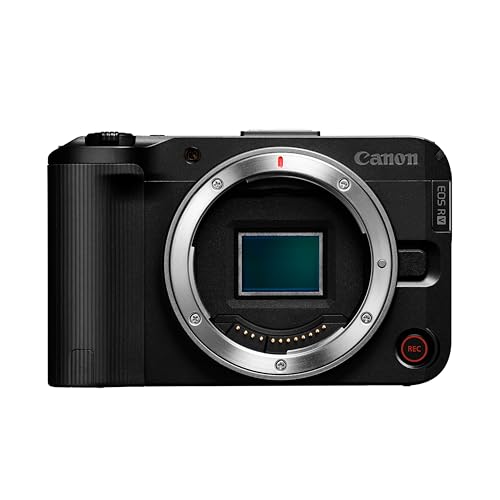
3. Canon EOS R50 V Body
The R50 V is Canon’s creator-first camera, and slow motion is part of its brief. It records 4K60 with a crop and Full HD at 120 frames per second, which is the sweet spot for social video: smooth enough to feel cinematic, sharp enough to hold up on a phone screen, and light enough to edit quickly. Dual Pixel CMOS AF II tracks subjects reliably, and the vari-angle screen flips forward for self-recording.
The body is small and light, which matters when you are chasing action with a camera in hand, and the RF mount gives access to Canon’s compact primes and zooms. The R50 V also records vertical video natively, which suits short-form platforms where slow-motion clips perform well. Its limits are the cropped 4K60 and the lack of in-body stabilization, so pair it with a stabilized lens for the steadiest results.
Specs
- Sensor: 24.2MP APS-C CMOS; Mount: Canon RF; Video: 4K60 cropped, Full HD 120p; Autofocus: Dual Pixel CMOS AF II; Stabilization: Lens-based and digital; Screen: 3.0-inch vari-angle touchscreen; Battery: LP-E17; Card slots: Single SD UHS-II.
4. DJI Osmo Pocket 3
The Osmo Pocket 3 is the most fun slow-motion camera in this guide, because it is a 4K120 camera on a three-axis gimbal that fits in a pocket. It records 4K at up to 120 frames per second, which means smooth, stabilized slow motion without any extra rig, and its 1-inch sensor delivers clean footage in good light. The gimbal keeps the horizon level while you run, skate, or ride, so the footage looks professional straight out of the camera.
ActiveTrack follows a subject and keeps it centered while you move, and the 2-inch rotating touchscreen flips between horizontal and vertical shooting. The Pocket 3 is the camera for creators who film themselves in motion: runners, cyclists, skaters, and travelers who want cinematic slow motion without carrying a bag of gear. Its limits are the fixed wide lens and the small sensor in dim light, but for daylight action it is hard to beat.
Specs
- Sensor: 1-inch CMOS; Lens: 20mm equivalent f/2.0; Video: 4K120, 4K60, Full HD 240p; Stabilization: 3-axis mechanical gimbal; Screen: 2-inch rotating touchscreen; Battery: Up to 166 minutes of 1080p recording; Weight: 179 g.
5. Insta360 Ace Pro 2
The Ace Pro 2 is the action camera for slow motion, and its numbers are the strongest in this guide for its size. It records 4K at 120 frames per second and Full HD at 240 frames per second, with a 1/1.3-inch sensor co-engineered with Leica that delivers clean, detailed footage in bright light and usable footage in dimmer conditions. FlowState stabilization keeps the image steady through rough movement, and the flip-up screen makes framing easy.
The Ace Pro 2 is waterproof, rugged, and mountable anywhere, so it goes where larger cameras cannot: on a helmet, a handlebar, a surfboard, or a dog’s harness. Its slow motion is the tool for sports and adventure, where the camera takes impacts and keeps recording. The companion app makes it easy to trim and share slow-motion clips, and the dual AI chip keeps processing fast.
Specs
- Sensor: 1/1.3-inch CMOS; Lens: 13mm equivalent f/2.6; Video: 4K120, Full HD 240p; Stabilization: FlowState, 360-degree horizon lock; Screen: 2.5-inch flip touchscreen; Waterproof: 12 m without a case; Battery: 1,800 mAh.
How to Shoot Slow Motion Well
Light is the first rule. At 120 frames per second your shutter needs to be around 1/250 of a second, which is four times less light per frame than standard video, so shoot in bright daylight or add strong lighting. Overcast days work well because the light is soft and even, while harsh midday sun creates hard shadows that slow motion makes more obvious.
Shutter speed is the second rule. The 180-degree shutter rule says your shutter speed should be roughly double your frame rate, so 1/250 for 120 fps and 1/500 for 240 fps. That keeps motion blur natural. If your footage looks too crisp and stuttery, your shutter is too fast; if it looks smeared, it is too slow.
Plan your shots around moments that reward slowing down: water, hair, fabric, sports, animals, and anything with fast, graceful movement. Slow motion makes ordinary motion boring and extraordinary motion magical, so choose subjects that change quickly and look beautiful doing it.
Frequently Asked Questions
What frame rate do I need for slow motion?
120 frames per second is the practical minimum for smooth, cinematic slow motion, because it plays back at a quarter of real speed in a 30 fps timeline. 240 frames per second gives you an eighth of real speed and suits very fast action, while 960 frames per second is a specialty mode for brief moments like a splash or an impact. Higher frame rates need more light and usually come with lower resolution, so 120 fps in 4K is the best balance for most creators.
Why does slow-motion footage look dark?
Because each frame gets less light. At 120 frames per second the shutter must be fast, so the sensor collects light for a shorter time per frame. The fix is more light: shoot outdoors in bright conditions, add lamps indoors, or open the aperture and raise the ISO. Cameras with larger sensors and fast lenses handle this better, which is why the full-frame Z5 II and the f/2.0 lens on the Osmo Pocket 3 perform well.
Can I slow down normal 30 fps footage instead?
You can, but the result is poor. Slowing 30 fps footage to half speed gives you 15 unique frames per second, which looks choppy and stuttery, and software interpolation invents frames that often look wrong on fast movement. Native high frame rate recording captures real frames, so the motion stays smooth and natural. That is why the cameras in this guide, which record 120 fps or faster natively, matter.
Which camera here is best for slow-motion sports?
The Insta360 Ace Pro 2 for action sports, because it is rugged, waterproof, mountable, and records 4K120 and Full HD 240p. The DJI Osmo Pocket 3 for running and travel, because the gimbal keeps footage steady while you move. The Nikon Z5 II for cinematic slow motion with a full-frame look, and the Sony RX100 VII for the extreme 960 fps bursts that capture moments no other camera here can.
Conclusion
Slow motion is one of the most satisfying things a camera can do, and the five cameras here cover it from a pocket compact to a full-frame body. The RX100 VII reaches 960 fps for extreme moments, the Z5 II brings full-frame quality to 120 fps, the R50 V is the creator-friendly APS-C option, the Osmo Pocket 3 puts 4K120 on a gimbal in your pocket, and the Ace Pro 2 takes slow motion into the roughest action. Pick the camera that matches where you shoot and how fast your subject moves, give it plenty of light, and time will slow down on command.
More from Amazon
Programs that pair well with the guide above. Offers and eligibility are set by Amazon and may change.
Free shipping on eligible items, Prime Video and more. Eligible new members can start with a free trial.
Start a Prime free trialAudiobooks and podcasts to listen to on the go. Eligible new members can start with a free trial.
Try Audible freeAd-free music streaming. Eligible new subscribers can start with a free trial.
Try Music Unlimited freeA free business account with business pricing and bulk-buying tools for work, shop or home office.
Create a business accountAs an Amazon Associate we earn from qualifying purchases.









