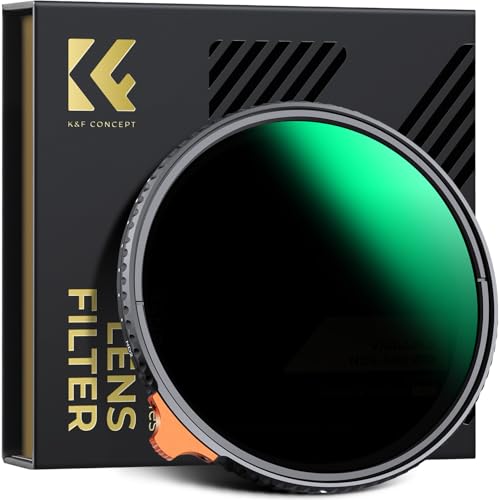
For 82mm lenses, a fixed-strength ND from a maker such as B+W, Hoya, NiSi or Breakthrough is the best choice when colour accuracy and landscape long exposures matter, while a good variable ND from NiSi, PolarPro, Freewell or K&F Concept suits video shooters who need to change strength quickly. If you are unsure, start with one variable ND for flexibility and add a fixed 6- or 10-stop filter later for serious daytime long exposures.
Our top picks



As an Amazon Associate we earn from qualifying purchases at no extra cost to you.
At a Glance: 82mm ND Filter Options
| Filter type / line | Best for | Key stated features | Limits |
|---|---|---|---|
| B+W ND MRC (fixed, various densities) | Landscape long exposures | Multi-coated glass, brass frame options, fixed strengths such as 3-stop, 6-stop and 10-stop | Premium tier; one strength per filter |
| Hoya ProND and ProND EX | Colour-neutral long exposures at moderate cost | Fixed densities, multi-coating, neutral-colour design per the maker | Mid to premium tier; some strengths harder to find |
| NiSi True Color ND-Vario | Video and general use | Variable range, maker states colour-neutral design and cross-polarisation controls | Premium tier; still a variable, so extremes need care |
| PolarPro variable ND (including the Peter McKinnon edition) | Video creators | Variable ND with hard stops stated by the maker, multi-coatings | Premium tier; check the stated range for your use |
| Freewell Variable ND (threaded or magnetic system) | Quick swaps for video | Magnetic systems let you change filters quickly | Needs the system’s adapter ring; mid to premium tier |
| K&F Concept variable and fixed ND | Budget to mid-range | Wide range of strengths, nano-coating claims | Colour accuracy and consistency vary by line |
| Breakthrough Photography X4 and X2 ND | Durable fixed ND with colour discipline | Maker lists tough frame and neutral colour | Premium tier |
Lines and densities change. Confirm the exact 82mm size and density you need before buying.
Which Lenses Use 82mm Filters?
Several popular professional wide-angle and standard zooms use an 82mm thread, including some 16-35mm f/2.8 and 24-70mm f/2.8 lenses from Sony, Canon and Nikon. Some lenses in the class have no front thread at all, so check the maker’s specification. If you own both 77mm and 82mm lenses, buying the larger filter and using a step-down ring on the smaller lens is cost-effective, though step-down rings can cause vignetting on wide angles.
Fixed ND or Variable ND?
Fixed ND
A fixed ND has one density. It is generally considered the cleaner option for still photography, since it avoids the polarisation effects built into variable designs. A 3-stop filter suits waterfalls in softer light, a 6-stop filter handles bright landscape long exposures, and a 10-stop filter stretches clouds and water into smooth bands.
Variable ND
A variable ND combines two polarising layers. Rotating the outer ring adjusts the density. This is practical for video, where you want to hold a 180-degree shutter in changing light. The trade-offs are possible colour casts, reduced sharpness at extremes, and an “X” pattern of dark bands when rotated too far on wide lenses. Quality makers add hard stops to prevent that, but the effect is stronger on lenses wider than about 24mm.
What to Look For
- Colour neutrality: Cheap ND filters can leave magenta, green or warm casts. Raw editing can correct this, but it adds time. Premium lines state neutral colour as a goal.
- Coatings: Multi-coating reduces flare. Water- and scratch-resistant coatings simplify cleaning at the shoreline.
- Frame thickness: Slim frames reduce vignetting on wide lenses. Check whether the filter has front threads if you need to stack other filters.
- Infrared leakage: Very strong ND filters (6 stops and above) can pass infrared light, which may cause a colour cast. Makers sometimes add IR-cut layers; read the product page.
- Hard stops on variable filters: These prevent over-rotation into the cross-polarised dark band.
- Case and cap: Hard cases and front caps protect the glass when you are working outdoors.
How Many Stops Do You Need?
| Goal | Typical choice |
|---|---|
| Wide aperture portraits in bright sun | Variable or fixed 3 to 6 stops |
| Video at a 180-degree shutter in daylight | Variable, covering roughly 2 to 5 stops |
| Silky waterfall detail | 3 to 6 stops fixed |
| Smooth seascapes and moving clouds | 6 to 10 stops fixed |
| Deep long exposures in strong light | 10 stops, possibly with a second filter |
Exposure times depend on aperture, ISO and light, so treat the table as starting points and consult a calculator app or your meter.
Budget Tiers
Budget
K&F Concept and similar brands offer a low entry point with a range of fixed and variable choices. Expect more colour variation and less consistent quality control between samples.
Mid-Range
Hoya ProND and Freewell fall in this tier. They offer better coatings and colour behaviour than generic options without the premium price tag.
Premium
B+W, NiSi, PolarPro and Breakthrough target buyers who need accuracy, tougher frames or strong video performance. For a working landscape photographer, the extra cost can prevent time spent correcting colour casts.
Fit and Handling Notes
- Check the thread size printed on the lens before buying; some similar-looking lenses take 77mm or 86mm.
- Use the lens hood where possible; remove it if it causes vignetting with a thick filter.
- For strong ND filters, focus and compose first, then attach the filter, because the viewfinder will be very dark. Some mirrorless cameras still display a bright image because the EVF compensates.
- Cover the viewfinder on DSLRs during long exposures to stop light leaking in.
- Use a tripod, remote release or two-second timer.
- Clean with a blower and a lens cloth; ND coatings can mark easily.
- Wear sun-protection when shooting in strong light, and never look at the sun through a camera or an ND filter. ND filters are not safe solar filters.
Pick X If… Decision Table
| Pick this | If you… |
|---|---|
| B+W fixed ND | want classic, durable fixed density for landscapes |
| Hoya ProND | want strong value and neutral colour |
| NiSi True Color ND-Vario | need a variable with a colour-focused design |
| PolarPro variable ND | create video and want hard stops and a premium build |
| Freewell magnetic system | swap filters often and want speed |
| K&F Concept | are starting out and want a low-cost way to try long exposures |
| Breakthrough X4 | want a rugged fixed ND with a neutral look |
Alternatives
- Square or rectangular filter systems: Systems from NiSi, Kase and others use a holder and slot-in filters, suitable for multiple lenses and graduated NDs. Bulkier but more flexible.
- Circular polariser: Gives about 1 to 2 stops of light reduction along with reflection control.
- Built-in ND on some cameras: Several cinema and mirrorless video bodies include electronic ND, removing the need for external filters.
- Stacking two lower-strength NDs: Adds flexibility but also reflections and possible vignetting.
Frequently Asked Questions
What does the stop rating on an ND filter mean?
Each stop halves the amount of light reaching the sensor. A 3-stop filter cuts light to one eighth, a 6-stop to about one sixty-fourth and a 10-stop to about one thousandth. Makers also label strength as ND8, ND64 and ND1000, or by optical density such as 0.9, 1.8 and 3.0.
Why do some variable ND filters show a dark X pattern?
The two polarising layers can cross each other at the highest settings, especially on wide-angle lenses. Hard stops, a smaller density range and using the filter at longer focal lengths all reduce the effect.
Do I need a step-up ring for 82mm filters?
Only if you want to use the filter on a lens with a smaller thread. Step-up rings go from a small lens to a larger filter and generally avoid vignetting, while step-down rings can clip wide-angle corners.
Are ND filters safe for looking at the sun?
No. Standard ND filters do not provide the protection needed to view the sun. Use only filters certified for solar observation, and follow the manufacturer’s guidance and eye-safety advice.
Will a cheap ND ruin image quality?
It can add a colour cast, reduce sharpness or cause flare. Many are acceptable for casual use, but demanding landscape and video work tends to benefit from a better filter.
Can I use an ND filter and a polariser together?
Yes, but stacking increases the risk of vignetting and flare. Many variable NDs already include polarising layers, so adding another polariser can interfere with the density effect.
More from Amazon
Programs that pair well with the guide above. Offers and eligibility are set by Amazon and may change.
Free shipping on eligible items, Prime Video and more. Eligible new members can start with a free trial.
Start a Prime free trialAudiobooks and podcasts to listen to on the go. Eligible new members can start with a free trial.
Try Audible freeAd-free music streaming. Eligible new subscribers can start with a free trial.
Try Music Unlimited freeA free business account with business pricing and bulk-buying tools for work, shop or home office.
Create a business accountAs an Amazon Associate we earn from qualifying purchases.