Our Short List of 3

- Best for: Beginners who want a viewfinder, fast autofocus, and a modern lens mount in one camera.
- 24.2 megapixel APS-C CMOS sensor
- DIGIC X image processor
- Dual Pixel CMOS AF II with subject detection and tracking
- 6K oversampled 4K 30p video

- Best for: Travelers and creators who want the most compact Z-mount body for stills and video.
- 20.9 megapixel DX-format CMOS sensor
- EXPEED 6 image processor
- 209-point hybrid autofocus with eye detection
- 4K UHD video at 30p

- Best for: Creators who film themselves often and want the smallest interchangeable-lens body with a wide lens system behind it.
- 24.2 megapixel APS-C Exmor CMOS sensor
- BIONZ X image processor
- Real-Time Eye AF and Real-Time Tracking
- 4K video oversampled from 6K
All 3 Picks at a Glance
| Product | Specs | Action |
|---|---|---|
| Canon EOS R50 |
| Check price on Amazon |
| Nikon Z30 |
| Check price on Amazon |
| Sony Alpha ZV-E10 |
| Check price on Amazon |
Our Top Picks
- Sony ZV-E10 APS-C Mirrorless Camera Body Black1.811.76 x 4.54 x 2.53 Inches0.76 poundsCheck on Amazon
A camera that only takes good stills leaves half your ideas on the table, and a camera that only shoots video forces you to carry a second device for everything else. The real decision inside a modest budget cap is which hybrid camera handles both jobs without making you fight its menus. Sensor size, autofocus behavior, and the screen you compose on matter far more than any single headline feature, because those are the traits you live with on every outing.
This guide is for beginners moving past a phone, travelers who want one camera for a trip album and a short film, and new creators filming tutorials between photo sessions. Every camera below shoots stills and video from the same body, and each one was chosen from its Amazon listing, with the traits that decide everyday hybrid results: a sensor large enough for clean indoor shots, autofocus that finds faces in motion, and a screen that turns toward you when you film yourself.
Quick Picks
As an Amazon Associate we earn from qualifying purchases.
| Product | Best for | Key spec from title |
|---|---|---|
| Canon EOS R50 | First interchangeable-lens camera for stills and video | 24.2 megapixel APS-C CMOS sensor |
| Nikon Z30 | Compact creator body with a flip-out screen | 20.9 megapixel DX-format CMOS sensor |
| Sony Alpha ZV-E10 | Smallest interchangeable-lens kit for filming | 24.2 megapixel APS-C Exmor CMOS sensor |
| Canon EOS M50 Mark II | Ready-to-shoot kit with lens included | 24.1 megapixel APS-C CMOS sensor |
| Sony ZV-1F | Pocket camera for self-filming on the move | 20.1 megapixel 1-inch Exmor RS CMOS sensor |
How to Choose
Sensor Size Sets the Look of Both Stills and Video
A larger sensor gathers more light, which shows up in every dim room, evening street scene, and indoor interview you shoot. APS-C sensors in this guide produce cleaner files at higher ISO values than the smaller 1-inch sensor in the pocket pick, and they give stills a softer background behind your subject. The 1-inch sensor still beats a phone sensor by a wide margin, and it keeps the camera small enough to carry in a jacket pocket. Decide how much low-light shooting you actually do before chasing the biggest sensor, because a smaller sensor in a camera you always carry will outshoot a larger one left at home.
Autofocus Has to Track Faces While You Move
Hybrid shooting means your subject rarely stands still. A person walks toward the camera during a vlog, a child runs across a yard during a photo session, and a pet turns away mid-clip. Eye-detection autofocus that locks on and follows a face through movement keeps both stills and video sharp while you think about framing instead of focus. Check that the autofocus works in video as well as in stills, because some older bodies focus fast for photos and hunt when you press record. A camera that holds focus on a moving face is worth more than extra resolution you will never see on a screen.
The Screen Decides How You Actually Shoot
Every camera here has a screen that flips out to face forward, and that single feature changes how you film yourself, shoot from low angles, and frame overhead shots. A vari-angle screen also folds away to protect itself in a bag. Bodies with a viewfinder give you a steadier way to compose stills in bright sunlight, while screen-only bodies stay lighter and simpler. If you film yourself often, a fully articulating touchscreen is not optional. If you shoot mostly stills outdoors, a viewfinder earns its place quickly.
Lenses and Mounts Shape What Comes Next
Three of the cameras here take interchangeable lenses, and the mount you choose decides which lenses you can buy later. A wide lens system with affordable primes gives you room to grow, while a fixed-lens camera keeps things simple at the cost of ever changing focal lengths. Kit lenses cover everyday wide-to-short-telephoto shooting, and a fast prime is the single most useful later purchase for indoor light. Before buying, confirm which lenses fit the mount, because an older mount with a shrinking lens range limits your options even when the body itself still performs well.
The 5 Best Options
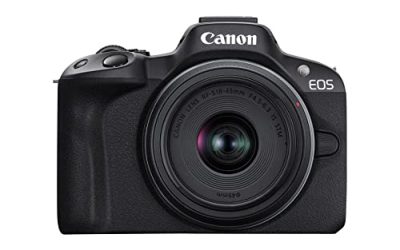
Canon EOS R50
- Best for: Beginners who want a viewfinder, fast autofocus, and a modern lens mount in one camera.
- 24.2 megapixel APS-C CMOS sensor
- DIGIC X image processor
- Dual Pixel CMOS AF II with subject detection and tracking
- 6K oversampled 4K 30p video
Beginners who want a viewfinder, fast autofocus, and a modern lens mount in one camera.
There is no in-body stabilization, so handheld video needs a stabilized lens, and the small battery calls for a spare on long days out.
The R50 is the most complete first camera in this guide, because it pairs a capable APS-C sensor with Canon’s quickest entry-level autofocus and a viewfinder. Dual Pixel CMOS AF II finds eyes in stills and video, and the 6K oversampled 4K footage looks detailed without demanding a large memory card. The vari-angle touchscreen makes self-filming straightforward, and the RF mount opens the door to Canon’s modern lenses. For a buyer who wants one camera to learn photography and video on together, this body covers the most ground.
Watch out for: There is no in-body stabilization, so handheld video needs a stabilized lens, and the small battery calls for a spare on long days out.
Nikon Z30
- Best for: Travelers and creators who want the most compact Z-mount body for stills and video.
- 20.9 megapixel DX-format CMOS sensor
- EXPEED 6 image processor
- 209-point hybrid autofocus with eye detection
- 4K UHD video at 30p
Travelers and creators who want the most compact Z-mount body for stills and video.
There is no viewfinder and no built-in flash, so bright outdoor shooting relies on the rear screen and dark scenes need a separate light or flash.
The Z30 is Nikon’s smallest Z-mount body, and its size is the reason to choose it. It slips into a small bag with a compact lens, weighs little on a long walk, and still carries a 20.9 megapixel DX sensor with eye-detection autofocus for stills and 4K video. The vari-angle screen faces forward for self-filming, and the Z mount gives access to Nikon’s growing range of small DX lenses. It suits travelers and creators who want a capable hybrid camera that never feels like luggage.
Watch out for: There is no viewfinder and no built-in flash, so bright outdoor shooting relies on the rear screen and dark scenes need a separate light or flash.
Sony Alpha ZV-E10
- Best for: Creators who film themselves often and want the smallest interchangeable-lens body with a wide lens system behind it.
- 24.2 megapixel APS-C Exmor CMOS sensor
- BIONZ X image processor
- Real-Time Eye AF and Real-Time Tracking
- 4K video oversampled from 6K
Creators who film themselves often and want the smallest interchangeable-lens body with a wide lens system behind it.
There is no viewfinder and no in-body stabilization, so bright sunlight and handheld walking shots need a stabilized lens or a different approach.
The ZV-E10 is the lightest interchangeable-lens camera here, built around a flip-out screen and a directional microphone instead of a viewfinder. Its 24.2 megapixel APS-C sensor records 4K video oversampled from 6K, and Real-Time Eye AF keeps faces sharp while you move through a scene. The E-mount system offers the widest choice of lenses in this guide, from compact primes to affordable zooms. It fits creators who film themselves daily and want a tiny kit that still takes proper stills between clips.
Watch out for: There is no viewfinder and no in-body stabilization, so bright sunlight and handheld walking shots need a stabilized lens or a different approach.
Canon EOS M50 Mark II
The M50 Mark II is the only camera here sold as a complete kit with a lens in the box, which makes it the simplest way to start shooting the day it arrives. Its 24.1 megapixel APS-C sensor and DIGIC 8 processor handle stills well, while 4K video at 24p and Full HD slow motion cover short films and family clips. The vari-angle touchscreen and built-in viewfinder give you two ways to compose, and the included 15-45mm zoom covers wide scenes to short portraits. It suits buyers who want a ready-to-shoot package without choosing a lens first.
Specs
- 24.1 megapixel APS-C CMOS sensor
- DIGIC 8 image processor
- Dual Pixel CMOS AF with Eye Detection AF
- 4K UHD video at 24p, Full HD 120p slow motion
- Up to 10 frames per second continuous shooting
- 3.0-inch vari-angle touchscreen LCD
- Built-in electronic viewfinder
- EF-M 15-45mm f/3.5-6.3 IS STM kit lens
- Wi-Fi and Bluetooth
Best for: Buyers who want a complete camera and lens kit in one box, ready to shoot immediately.
Watch out for: The EF-M mount is an older system with a narrow lens range, so confirm the lenses you might want later are still available before committing to it.
Sony ZV-1F
The ZV-1F is the pocket pick: a fixed-lens camera with a large 1-inch sensor that fits in a coat pocket and starts filming in seconds. Its wide 20mm f/2 lens captures more of the scene at arm’s length than any kit zoom here, which suits self-filming and small rooms. The 20.1 megapixel sensor records 4K video and sharp stills, eye autofocus tracks faces, and the flip-out touchscreen makes framing yourself simple. It is the camera for creators who want to carry nothing extra and shoot whenever an idea appears.
Specs
- 20.1 megapixel 1-inch Exmor RS CMOS sensor
- Fixed 20mm f/2 wide-angle lens
- 4K video at 30p
- Real-Time Eye AF and autofocus tracking
- 3.0-inch vari-angle touchscreen LCD
- Active mode image stabilization
- 3-capsule directional microphone with windscreen
- Background Defocus function and Product Showcase setting
- NP-BX1 battery
Best for: Self-filming creators who want a pocket-sized camera with a wide lens and no lens decisions to make.
Watch out for: The fixed lens has no optical zoom, so distant subjects stay distant, and stabilization is electronic only, so very shaky walking footage still shows movement.
Which One Fits Your Situation
You Are Buying Your First Real Camera
Choose the Canon EOS R50. Its viewfinder, fast autofocus, and modern RF mount give you a camera to grow with, while the flip-out screen keeps self-filming easy. Start with a kit zoom or a compact prime, learn how aperture and shutter speed shape both stills and video, and add lenses as your shooting develops. The R50 rewards a beginner who plans to keep shooting for years.
You Travel Light and Shoot Every Day
Choose the Nikon Z30 or the Sony ZV-1F. The Z30 pairs a larger sensor with interchangeable lenses for trips where image quality matters most, while the ZV-1F disappears into a pocket for days when you want to shoot without carrying a bag. Both flip their screens forward for self-filming, and both keep the kit small enough to carry from morning to night.
You Film Yourself More Than You Photograph
Choose the Sony Alpha ZV-E10. Its flip-out screen, directional microphone, and eye autofocus are built for solo filming, and the E-mount system lets you add a wide prime for arm’s-length shots or a longer lens for sit-down videos. The stills quality is strong enough that your thumbnails and photos come from the same camera as your footage.
You Want to Start Shooting Today With No Extra Decisions
Choose the Canon EOS M50 Mark II kit. The lens arrives in the box, the camera is ready to shoot out of it, and the viewfinder plus flip-out screen cover both stills and video from the first outing. Check the EF-M lens range before buying, and if the lenses you want are available, this kit is the fastest route from unboxing to a finished photo and clip.
Common Mistakes
- Choosing a camera for its video features and then discovering its stills autofocus is slow, or the reverse.
- Buying a body with no lens and forgetting that a usable lens is part of the real cost of starting.
- Ignoring battery life and arriving at a day trip with one charge and no spare.
- Picking a fixed-lens camera and then wanting a zoom for distant subjects it cannot reach.
- Never checking which lenses fit the mount, then finding the lens you want does not exist for your camera.
Frequently Asked Questions
Can one camera really do both photos and video well?
Yes, when the sensor and autofocus serve both jobs. The cameras in this guide record 4K video and take sharp stills from the same sensor, with eye autofocus that works while filming as well as while photographing. A hybrid body will not match a dedicated cinema camera for long-form video work, but for travel, family, and creator content it covers both jobs in one bag.
Do I need an interchangeable-lens camera?
Not necessarily. Interchangeable lenses give you room to grow, with wide primes for dim rooms and longer zooms for distant subjects. A fixed-lens camera like the ZV-1F is simpler, lighter, and ready instantly, which suits creators who film themselves and never change lenses. Choose interchangeable lenses when you want options later, and a fixed lens when you want simplicity now.
What matters more for video, the sensor or the stabilization?
Both matter, and they solve different problems. A larger sensor gives cleaner footage in dim light and a softer background, while stabilization keeps handheld walking shots steady. Bodies in this guide without in-body stabilization rely on stabilized lenses or electronic stabilization, so pair them with a stabilized lens if you film while walking.
Should I buy a kit with a lens or a body on its own?
A kit with a lens is the fastest way to start, and the included zoom covers everyday shooting from wide scenes to short portraits. A body on its own makes sense when you already own lenses for that mount or you know exactly which prime you want first. Either way, confirm the lens matches the mount before ordering, because mounts are not interchangeable between brands.
More from Amazon
Programs that pair well with the guide above. Offers and eligibility are set by Amazon and may change.
Free shipping on eligible items, Prime Video and more. Eligible new members can start with a free trial.
Start a Prime free trialAudiobooks and podcasts to listen to on the go. Eligible new members can start with a free trial.
Try Audible freeAd-free music streaming. Eligible new subscribers can start with a free trial.
Try Music Unlimited freeA free business account with business pricing and bulk-buying tools for work, shop or home office.
Create a business accountAs an Amazon Associate we earn from qualifying purchases.