Our Short List of 3

- Best for: Beginners who want a complete wildlife kit with camera and telephoto lens together.
- Sensor: 24.1MP APS-C CMOS
- Processor: DIGIC 4+
- Lenses: EF-S 18-55mm and EF 75-300mm
- Autofocus: 9-point AF
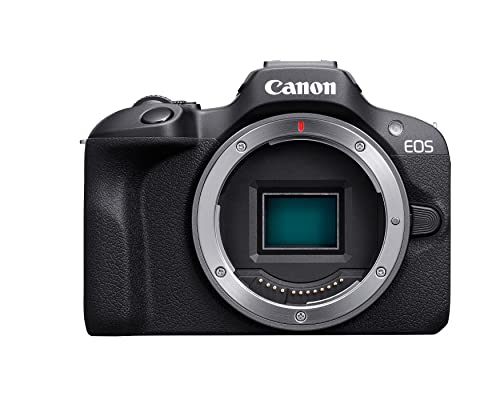
- Best for: Photographers who want modern eye-detection autofocus in a small, light body.
- Sensor: 24.1MP APS-C CMOS
- Processor: DIGIC 8
- Autofocus: Dual Pixel CMOS AF with eye detection
- Video: 4K and Full HD up to 60 frames per second
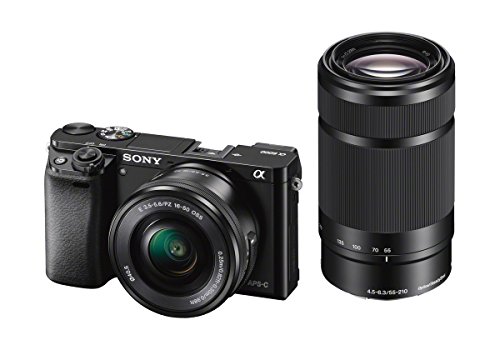
- Best for: Photographers who want fast burst shooting and a compact body for field work.
- Sensor: 24.3MP APS-C Exmor CMOS
- Processor: BIONZ X
- Lenses: 16-50mm and 55-210mm power zoom
- Shooting speed: 11 frames per second
All 5 Picks at a Glance
| Product | Specs | Action |
|---|---|---|
| Canon EOS Rebel T7 Double Zoom Kit |
| Check price on Amazon |
| Canon EOS R100 |
| Check price on Amazon |
| Sony a6000 Two-Lens Kit |
| Check price on Amazon |
 Canon EF 75-300mm f/4-5.6 III |
| Check price on Amazon |
 Nikon AF-P DX 70-300mm f/4.5-6.3G ED VR |
| Check price on Amazon |
Our Top Picks
Wildlife photography rewards reach, patience, and a camera that focuses quickly on a moving animal. The challenge is that long lenses and fast bodies usually cost far more than beginners expect, which leaves many wondering whether wildlife work is out of reach. It is not, because a capable crop-sensor camera paired with a telephoto zoom can capture birds, deer, and field animals with real quality, as long as you choose the right combination of sensor, autofocus, and focal length.
This guide is for photographers who want to start shooting wildlife without a professional budget, covering both camera bodies and lenses in one place. We chose each camera and lens from the names and specifications shown on its Amazon page, comparing sensor resolution, autofocus, focal length, and weight. The aim is to help you build a wildlife kit that reaches distant subjects, focuses reliably on movement, and stays light enough to carry on a long walk.
Quick Picks
As an Amazon Associate we earn from qualifying purchases
| Product | Best for | Key spec from title |
|---|---|---|
| Canon EOS Rebel T7 Double Zoom Kit | Complete starter wildlife kit | 24.1MP APS-C, 18-55mm and 75-300mm lenses |
| Canon EOS R100 | Modern mirrorless autofocus | 24.1MP APS-C, Dual Pixel CMOS AF |
| Sony a6000 Two-Lens Kit | Fast shooting and compact body | 24.3MP APS-C, 16-50mm and 55-210mm lenses |
| Canon EF 75-300mm f/4-5.6 III | Affordable telephoto reach | 75-300mm zoom, 58mm filter thread |
| Nikon AF-P DX 70-300mm f/4.5-6.3G ED VR | Stabilized telephoto for Nikon DSLR | 70-300mm zoom with vibration reduction |
How to Choose
Reach and Focal Length First
Wildlife rarely lets you walk closer, so focal length is the first specification to weigh. A telephoto zoom that reaches three hundred millimeters gives you a useful working distance for deer, herons, and other approachable animals, while shorter lenses force you to crop heavily and lose detail. On a crop-sensor camera the effective reach is longer than the number printed on the lens, which works in your favor for wildlife. Choose a kit whose longest focal length covers the animals you hope to photograph, and remember that a longer lens is only useful if you can hold it steady.
Autofocus Speed and Tracking
Animals move without warning, so autofocus speed decides whether you capture the moment or miss it. Modern mirrorless cameras use eye detection and subject tracking to hold focus on a moving animal, while older DSLRs rely on a smaller set of focus points that you must place over the subject yourself. Continuous shooting speed matters too, since a burst of frames gives you more chances to catch the right expression or pose. Check how many frames per second the camera shoots and whether the autofocus covers a wide area of the frame.
Sensor Size and Image Quality
A larger sensor gathers more light and produces cleaner images in dim conditions, which matters at dawn and dusk when wildlife is most active. APS-C sensors strike a good balance for beginners, offering strong image quality in a compact body while extending the effective reach of telephoto lenses. Full-frame sensors perform better in low light but cost more and need larger lenses, so they suit photographers who have already committed to the hobby. For a first wildlife kit, an APS-C body with a good telephoto zoom delivers strong results.
Weight, Handling, and Field Comfort
Wildlife photography means walking, waiting, and holding the camera ready for long stretches, so weight and handling shape your experience as much as specifications do. A compact mirrorless body with a modest telephoto zoom is easier to carry all day than a heavy DSLR with a long lens, and a lighter kit means steadier hands when the moment arrives. Check the grip, the viewfinder, and the control layout, since a camera that feels natural in your hands will get used more often than one that fights you.
The 5 Best Options
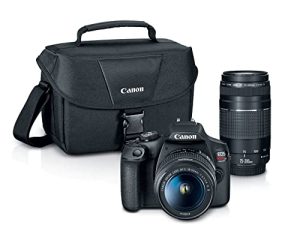
Canon EOS Rebel T7 Double Zoom Kit
- Best for: Beginners who want a complete wildlife kit with camera and telephoto lens together.
- Sensor: 24.1MP APS-C CMOS
- Processor: DIGIC 4+
- Lenses: EF-S 18-55mm and EF 75-300mm
- Autofocus: 9-point AF
Beginners who want a complete wildlife kit with camera and telephoto lens together.
The nine-point autofocus system needs manual placement on moving subjects.
The Canon EOS Rebel T7 Double Zoom Kit is the most complete starting point in this group, because it pairs a 24.1-megapixel APS-C DSLR with two lenses that cover wide scenes and distant wildlife in one box. The included 75-300mm telephoto zoom reaches far enough for deer, water birds, and field animals, while the 18-55mm kit lens handles landscapes and closer subjects. Built-in Wi-Fi and NFC make sharing images simple, and the nine-point autofocus system is straightforward for beginners learning to track movement. Full HD video adds a way to record animal behavior alongside still photos.
Canon EOS R100
- Best for: Photographers who want modern eye-detection autofocus in a small, light body.
- Sensor: 24.1MP APS-C CMOS
- Processor: DIGIC 8
- Autofocus: Dual Pixel CMOS AF with eye detection
- Video: 4K and Full HD up to 60 frames per second
Photographers who want modern eye-detection autofocus in a small, light body.
The body-only listing needs a lens, so budget for a telephoto zoom to complete the kit.
The Canon EOS R100 brings modern mirrorless autofocus to a compact, lightweight body, making it a strong choice for wildlife photographers who value tracking. Dual Pixel CMOS AF covers a wide area of the frame with subject detection and eye detection, which helps the camera hold focus on an animal as it moves. The 24.1-megapixel APS-C sensor and DIGIC 8 processor deliver clean images and detailed 4K video from the central area of the sensor. As the smallest and lightest camera in the EOS R series, the R100 pairs well with a telephoto lens for long walks, and its RF mount opens the door to modern mirrorless glass.
Sony a6000 Two-Lens Kit
- Best for: Photographers who want fast burst shooting and a compact body for field work.
- Sensor: 24.3MP APS-C Exmor CMOS
- Processor: BIONZ X
- Lenses: 16-50mm and 55-210mm power zoom
- Shooting speed: 11 frames per second
Photographers who want fast burst shooting and a compact body for field work.
This is an older model, so confirm the listing details and included lenses before buying.
The Sony a6000 Two-Lens Kit combines a compact mirrorless body with two lenses, including a 55-210mm telephoto zoom that suits wildlife work. The 24.3-megapixel APS-C sensor captures detailed images, and the camera shoots eleven frames per second, which gives you many chances to catch a bird taking off or a deer turning its head. Fast hybrid autofocus with phase and contrast detection locks onto subjects quickly, and the built-in OLED viewfinder shows exactly what the sensor sees. Wi-Fi and NFC make it easy to share images from the field, and the small body fits comfortably in a day pack.
Canon EF 75-300mm f/4-5.6 III
- Best for: Canon DSLR owners who want an affordable telephoto zoom for wildlife.
- Focal length: 75-300mm
- Maximum aperture: f/4-5.6
- Minimum focus distance: 4.9 feet
- Filter thread: 58mm
Canon DSLR owners who want an affordable telephoto zoom for wildlife.
The lens has no image stabilization, so use a fast shutter speed or a support in low light.
The Canon EF 75-300mm f/4-5.6 III is the classic first telephoto lens for Canon DSLR owners, offering four times zoom range in the smallest and lightest design in its class. The 75-300mm range covers portraits at the short end and distant wildlife at the long end, with a DC motor driving autofocus and a minimum focusing distance of 4.9 feet for closer subjects. Super Spectra coating reduces flare and ghosting when you shoot toward the light, and the 58mm filter thread accepts common filters for protection and creative effects. At 16.8 ounces it balances well on a crop-sensor DSLR without tiring your arms.
Nikon AF-P DX 70-300mm f/4.5-6.3G ED VR
- Best for: Nikon DX owners who want stabilized reach for handheld wildlife shooting.
- Focal length: 70-300mm
- Maximum aperture: f/4.5-6.3
- Stabilization: vibration reduction
- Autofocus: stepping motor, near-silent
Nikon DX owners who want stabilized reach for handheld wildlife shooting.
Autofocus works only on compatible Nikon DX bodies, so check your camera model first.
The Nikon AF-P DX 70-300mm f/4.5-6.3G ED VR gives Nikon DX photographers a stabilized telephoto zoom that reaches the equivalent of four hundred fifty millimeters on a crop-sensor body. Vibration reduction steadies the view at long focal lengths, which helps when you shoot handheld in the field, and the stepping motor autofocus runs quietly for video and for skittish animals. An extra-low dispersion element keeps colors clean and reduces fringing on bright edges, while the light 415-gram body keeps the kit comfortable on long walks. The 58mm filter thread matches many other Nikon lenses for shared accessories.
Which One Fits Your Situation
Starting From Nothing
If you own no camera yet, the Canon EOS Rebel T7 Double Zoom Kit is the simplest way to begin. One box gives you a body, a standard zoom, and a telephoto zoom, so you can start photographing wildlife on the first day. The DSLR controls are straightforward to learn, and the kit leaves room to add lenses later as your interests sharpen.
Tracking Fast-Moving Animals
Photographers who chase birds in flight or animals on the move should choose the Canon EOS R100 or the Sony a6000, since both offer faster autofocus and higher burst rates than an entry-level DSLR. The R100 adds eye detection that holds focus on an animal as it moves through the frame, while the a6000 fires eleven frames per second for more chances at the decisive moment. Pair either body with a telephoto zoom and practice panning.
Adding Reach to a Camera You Own
If you already own a Canon or Nikon DSLR, a telephoto lens is the smartest next step. The Canon EF 75-300mm fits Canon DSLR bodies directly and adds real reach for a modest outlay, while the Nikon AF-P DX 70-300mm VR adds stabilization for Nikon DX owners. Check your camera mount and compatibility list first, then let the lens extend the kit you already know.
Long Walks and Light Kits
Wildlife photography often means miles on foot, so a light kit gets used more than a heavy one. The Sony a6000 two-lens kit and the Canon EOS R100 both keep weight down while delivering strong image quality, and the Nikon 70-300mm VR weighs only 415 grams. Choose the lightest combination that still reaches your subjects, and your shoulders will thank you at the end of the day.
Common Mistakes
- Buying the longest lens first without checking whether your camera body can focus it well.
- Shooting at the longest focal length in low light without support, which blurs otherwise good frames.
- Ignoring autofocus compatibility and discovering a lens does not focus on your camera model.
- Cropping heavily instead of getting closer, which throws away detail your sensor captured.
- Forgetting a spare battery and memory card, then missing the best light of the day.
Frequently Asked Questions
What focal length do I need for wildlife photography?
A telephoto zoom reaching three hundred millimeters suits deer, herons, and other approachable animals, while small birds benefit from longer reach. On a crop-sensor camera the effective reach is longer than the number on the lens, which helps beginners. Start with a seventy to three hundred millimeter zoom and add longer glass when you know which animals you photograph most.
Is a mirrorless camera better than a DSLR for wildlife?
Mirrorless cameras usually offer faster autofocus with eye detection and subject tracking, which helps with moving animals, along with lighter bodies for long walks. DSLRs offer longer battery life and a large range of affordable lenses, which suits beginners building a first kit. Either system can produce excellent wildlife images, so choose the one that feels right to you.
Do I need image stabilization for wildlife lenses?
Image stabilization helps greatly at long focal lengths, where small hand movements are magnified along with the subject. It lets you shoot at slower shutter speeds in dim light and keeps the viewfinder steady while you track. Lenses without stabilization still work well in bright light, or when you support the lens on a monopod or a bean bag.
How can I get closer to wildlife without disturbing it?
Move slowly, stay downwind, and use cover such as trees, reeds, or a hide to break up your outline. Early morning and late afternoon bring the best light and the most active animals, so plan around those hours. A longer lens lets you keep a respectful distance, and patience usually beats chasing an animal that has already noticed you.
More from Amazon
Programs that pair well with the guide above. Offers and eligibility are set by Amazon and may change.
Free shipping on eligible items, Prime Video and more. Eligible new members can start with a free trial.
Start a Prime free trialAudiobooks and podcasts to listen to on the go. Eligible new members can start with a free trial.
Try Audible freeAd-free music streaming. Eligible new subscribers can start with a free trial.
Try Music Unlimited freeA free business account with business pricing and bulk-buying tools for work, shop or home office.
Create a business accountAs an Amazon Associate we earn from qualifying purchases.