Key takeaways
- Beavers work at dawn and dusk beside quiet water. These five cameras bring the reach, low-light skill and sealing you need for river wildlife.
Beavers are some of the most rewarding animals to photograph, and some of the hardest to catch on camera. They work at dawn and dusk, they spend much of their time half under water, and they vanish at the first loud noise. A good beaver camera needs strong low-light autofocus, enough reach to keep your distance, and sealing that can handle damp air beside a river.


As an Amazon Associate, we earn from qualifying purchases.
Why Beaver Photography Is Hard
A beaver is a large rodent, but it is a shy one. Most of your sightings will happen in the soft light of early morning or late evening, when the animal leaves its lodge to feed or repair its dam. In that light, a camera that hunts for focus or smears detail at high ISO will cost you the shot. You also need to stay well back. A beaver that feels watched will slap its tail on the water and dive, and it may not return for an hour. That means a long lens matters more than a fast walk to the bank.
The bank is muddy, the air is damp, and a sudden shower can arrive while you wait. A camera with real weather sealing will keep working through mist and drizzle, while an unsealed body needs a cover or a quick retreat to the car.
What to Look for in a Beaver Camera
Autofocus comes first. Animal eye detection that can lock onto a small dark head against dark water is a huge help, because a beaver often shows only its head and back above the surface. Burst speed comes second. A tail slap, a dive, or a kit riding on its mother’s back lasts a second or two, so a camera that shoots ten frames or more per second gives you a much better chance of catching the moment.
Low-light skill comes third. Dawn and dusk light beside a river is dim, and a beaver’s brown fur soaks up light rather than bouncing it back. A sensor that stays clean at high ISO, plus in-body stabilization for slow shutter speeds, will save shots that a lesser camera would blur. Reach comes fourth. A crop-sensor body turns a 400mm lens into a 600mm equivalent, which lets you fill the frame from the far bank.
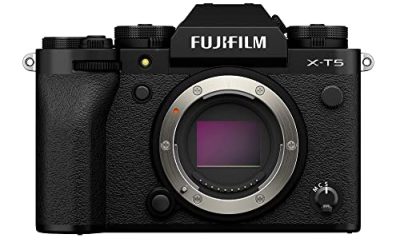
1. Fujifilm X-T5
The X-T5 is the most complete beaver camera in this guide. Its 40.2 megapixel APS-C sensor gives you enormous cropping room, so a beaver photographed from the far bank can still fill the frame after a crop. The crop sensor also adds reach to every lens you mount, which is exactly what river wildlife demands. Seven-stop in-body stabilization steadies slow shutter speeds in dawn light, and the body is sealed against dust and moisture, so mist off the water is not a worry.
Animal detection autofocus locks onto eyes and holds them as the beaver swims, and the mechanical shutter runs at 15 frames per second, with 20 frames per second on the electronic shutter. The classic dials on the top plate let you change shutter speed and ISO without taking your eye from the finder, which matters when a beaver surfaces without warning.
For a photographer who plans to sit by one pond all season, the X-T5 is the strongest single pick here.
Specs
- 40.2MP APS-C X-Trans CMOS 5 HR sensor; X-Processor 5; 7-stop in-body stabilization; 15 fps mechanical shutter, 20 fps electronic shutter; weather sealed; dual card slots; 557 g with battery and card.
2. Fujifilm X-H2
The X-H2 shares the X-T5 sensor and processor, and it adds the features that matter most for action at the water. Its electronic viewfinder is a sharp 5.76 million dot panel, which makes it easy to judge focus on a dark animal against dark water. The body is deeper and grippier, which helps when you hold a long telephoto lens for an hour.
Autofocus is the same animal-aware system as the X-T5, with eye detection that holds a swimming beaver through ripples and reeds. Burst speed matches the X-T5 at 15 frames per second mechanical and 20 frames per second electronic.
One honest note: the Amazon listing for model 16757045 is currently offered by a third-party seller, so check stock and seller details before you order. The X-H2 is also the heaviest body in this guide, and its video-first extras add bulk that a pure stills shooter may not need. If you want the best finder and the deepest grip for long lens work, it earns its place.
Specs
- 40.2MP APS-C X-Trans CMOS 5 HR sensor; X-Processor 5; 7-stop in-body stabilization; 5.76m-dot electronic viewfinder; 15 fps mechanical shutter, 20 fps electronic shutter; 8K video; dual card slots.
3. Sony ZV-E10 II Kit
The ZV-E10 II kit is the lightest interchangeable-lens option in this guide, and the easiest to carry to a remote pond. Its 26 megapixel back-illuminated APS-C sensor handles low light well, and the included 16-50mm power zoom lens is a handy walk-around optic for lodge and dam landscapes. The NP-FZ100 battery is rated for about 610 shots per charge, the best stamina in this group for a small body.
For beaver work, the honest limits matter. There is no viewfinder, so you compose on the rear screen, which can wash out in bright sun and drains the battery faster. There is no in-body stabilization, so you lean on the kit lens optical stabilization or a support. The 16-50mm kit lens is far too short for a beaver across a pond, so plan to add a telephoto zoom before your first serious session.
Where this camera shines is as a light second body, or as a first camera for a photographer who wants to learn river wildlife without carrying a heavy kit.
Specs
- 26MP APS-C back-illuminated Exmor R CMOS sensor; BIONZ XR processor; E PZ 16-50mm f/3.5-5.6 OSS II kit lens; flip screen; no viewfinder; NP-FZ100 battery rated about 610 shots; 292 g body before battery.
4. Nikon Z30

The Z30 is Nikon’s smallest and lightest Z series camera, and it is a friendly way into beaver photography. Its 20.9 megapixel DX sensor is the same size class as the APS-C sensors in this guide, and it delivers clean files in dim light. The vari-angle touch screen flips out for low-angle shots from the bank, and the body weighs only 350 g, so it disappears into a small bag beside your lunch and your waterproof boots.
Autofocus includes animal eye detection, and the camera shoots at 11 frames per second, enough to catch a tail slap or a dive if your timing is good. The Z mount opens the door to Nikon’s long telephoto lenses, which is where this camera grows into a serious wildlife tool.
The limits are real and worth stating plainly. There is no viewfinder, so bright daylight framing happens on the rear screen. There is no in-body stabilization, and there is only one card slot. The 20.9 megapixel sensor also gives you less cropping room than the 40 megapixel Fujifilm bodies. For a photographer on a tight budget who will pair it with a long zoom, the Z30 is still a sound way to begin.
Specs
- 20.9MP DX-format sensor; 11 fps continuous shooting; uncropped 4K/30p video; animal eye detection autofocus; vari-angle touch screen; no viewfinder; 350 g body.
5. Sony ZV-1

The ZV-1 is the companion camera in this guide, not the main wildlife body, and it is honest about that role. Its 20.1 megapixel 1-inch stacked sensor and bright 24-70mm f/1.8-2.8 ZEISS lens fit in a pocket, and at 294 g it is the lightest camera here. The fast lens gathers a lot of light for its size, and the flip screen and strong autofocus make it easy to grab a quick shot of a lodge, a dam, or a beaver that swims close to the bank.
For distant beavers, the fixed 24-70mm lens is simply too short, and the small sensor cannot match the low-light files of the APS-C bodies in this guide. There is no viewfinder and no weather sealing, so it stays in a dry bag when the rain arrives. Treat it as the camera you carry for the scene around the beaver: the dam, the gnawed trees, the still water at dawn, and the close encounter when a curious animal swims past your hiding spot.
Specs
- 20.1MP 1-inch stacked Exmor RS CMOS sensor; 24-70mm f/1.8-2.8 ZEISS Vario-Sonnar T lens; flip screen; 4K HDR video; fast hybrid autofocus with 315 phase-detection points; 294 g.
How the Five Compare
The X-T5 and X-H2 lead on resolution, stabilization, sealing, and burst speed, and either one is a fine main body for a serious beaver season. The X-T5 is lighter and more stills-focused, while the X-H2 offers the better finder, the deeper grip, and stronger video. The ZV-E10 II kit and the Z30 trade resolution and sealing for light weight and a lower barrier to entry, and both grow well when you add a long telephoto lens. The ZV-1 is the pocket companion for close work and scene-setting shots, not a replacement for a long lens.
For reach, every crop-sensor body here beats a full-frame camera with the same lens, because the smaller sensor effectively lengthens your telephoto.
Beaver Photography Tips
Arrive before first light and settle in quietly. Beavers follow a routine, and they will use the same feeding paths and the same dam crossings night after night. Pick a spot downwind with cover at your back, and stay still once you are set. A beaver that hears a zipper or a footstep on dry leaves will be gone before you lift the camera.
Keep your shutter speed at 1/1000s or faster when a beaver is swimming, because the head bobs and the water moves. For a beaver gnawing at the bank, 1/250s is enough if your stabilization is on and your support is steady. Expose for the fur, not the bright water, or the animal will turn into a silhouette.
Never block a dam or a lodge, and never approach a beaver on land. A beaver on the bank can move fast when it feels cornered, and a dam is the animal’s home and food store. Keep your distance, use a long lens, and leave the site as you found it. If a beaver slaps its tail, take it as a clear message: you are too close, or too loud. Back off, wait, and let the animal decide when to return.
Which One to Choose
Pick the Fujifilm X-T5 if you want the most complete beaver camera in this guide, with the resolution to crop, the sealing to survive a damp riverbank, and the stabilization for dawn light. Pick the Fujifilm X-H2 if you want the best viewfinder and grip for long telephoto sessions, and you also want strong video. Pick the Sony ZV-E10 II kit if you want the lightest interchangeable-lens kit and the longest battery life, and you plan to add a telephoto zoom. Pick the Nikon Z30 if you want the simplest and most affordable way into the Z system for river wildlife. Pick the Sony ZV-1 as a pocket companion for close encounters, dams, and lodge scenes, alongside a longer-lens body.
What time of day is best for beaver photography?
Dawn and dusk are the best times, because beavers are most active in the soft light around sunrise and sunset. Arrive at least half an hour before first light, settle into cover, and wait. Midday sightings do happen in spring, when kits are young, but the light is harsh and the animals are less active.
How far away should I stay from a beaver?
Stay as far back as your lens allows, and never approach a beaver on land or block its dam or lodge. A long telephoto lens on a crop-sensor body lets you fill the frame from the far bank. If a beaver slaps its tail or dives, you are too close or too loud, so back off and wait for it to return on its own terms.
Do I need a long telephoto lens for beaver photography?
Yes, for most beaver work a long telephoto lens is essential, because beavers keep their distance and much of the animal stays under water. A 400mm lens on a crop-sensor body gives about 600mm of equivalent reach, which is a good place to begin. The cameras in this guide all accept long lenses, except the ZV-1, which has a fixed 24-70mm lens and works only for close encounters.
Is weather sealing important for photographing beavers?
Yes, weather sealing matters a lot beside a river, where mist, drizzle, and muddy banks are part of every session. The X-T5 and X-H2 in this guide are sealed, while the ZV-E10 II, Z30, and ZV-1 are not. If your camera is unsealed, carry a rain cover or a dry bag, keep a lens cloth handy, and head for shelter when heavy rain arrives.
More from Amazon
Programs that pair well with the guide above. Offers and eligibility are set by Amazon and may change.
Free shipping on eligible items, Prime Video and more. Eligible new members can start with a free trial.
Start a Prime free trialAudiobooks and podcasts to listen to on the go. Eligible new members can start with a free trial.
Try Audible freeAd-free music streaming. Eligible new subscribers can start with a free trial.
Try Music Unlimited freeA free business account with business pricing and bulk-buying tools for work, shop or home office.
Create a business accountAs an Amazon Associate we earn from qualifying purchases.