Key takeaways
- Vloggers and creators who film themselves while walking and want stable footage without carrying a separate gimbal.
- Travelers who want better video than a phone in a device that is always in a pocket.
- Parents who film kids and want subject tracking that keeps them in frame.
- Short-form social creators who switch between horizontal and vertical video often.
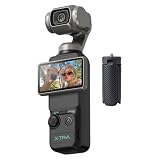
The DJI Osmo Pocket 4 is worth buying if you want the smoothest possible handheld video from a camera that fits in a shirt pocket, and you are willing to pay a premium over a smartphone for it. It is the successor to the Osmo Pocket 3, the gimbal vlog camera that popularized a large 1-inch sensor, a rotating screen and true three-axis mechanical stabilization in a tiny body. The Pocket 4 Essential Combo usually sells around $550 to $650, which puts it in the same bracket as mid-range action cameras and entry mirrorless kits.
Choose it for vlogging, travel diaries, family video, walk-and-talk content and low-light city footage where phone stabilization starts to look jittery or noisy. Skip it if you mainly shoot rough action such as mountain biking or surfing, where a waterproof action camera is tougher, or if you need interchangeable lenses and a shallow cinematic look, where a mirrorless camera is the better tool.
As an Amazon Associate we earn from qualifying purchases at no extra cost to you.

Who it is for
- Vloggers and creators who film themselves while walking and want stable footage without carrying a separate gimbal.
- Travelers who want better video than a phone in a device that is always in a pocket.
- Parents who film kids and want subject tracking that keeps them in frame.
- Short-form social creators who switch between horizontal and vertical video often.
Who should skip it
Skip it if you need waterproofing without a housing, crash-proof durability, or a camera for still photography first. A gimbal mechanism is precise but not designed for impacts.
What the Pocket line delivers
DJI builds the Pocket 4 on the formula established by the Pocket 3. For reference, the table below lists the Pocket 3’s published specs, which define the baseline the Pocket 4 builds on. The Pocket 4 keeps the 1-inch sensor and 2-inch rotating screen, raises slow motion to 4K at up to 240 fps, adds about 107GB of built-in storage alongside the microSD slot, and weighs about 190 g.
| Spec | Osmo Pocket 3 (baseline) | Why it matters |
|---|---|---|
| Sensor size | 1-inch CMOS | Better low-light quality and dynamic range than small phone sensors |
| Max video | 4K at up to 120 fps | Smooth slow motion at high resolution |
| Stabilization | 3-axis mechanical gimbal | Smoother walking footage than electronic stabilization alone |
| Screen | 2-inch rotating touchscreen | Instant switch between horizontal and vertical framing |
| Weight | About 179 g | Pocketable for all-day carry |
| Typical Pocket 4 Essential Combo price range | About $550–$650 | |
What stands out
Mechanical stabilization
A three-axis gimbal physically counters hand movement rather than cropping and warping the image in software. The result is a floating, steady look when walking, panning and turning, with no loss of field of view from heavy digital stabilization.
Large-sensor image quality in a tiny body
The Pocket line’s move to a 1-inch sensor class was a big step for compact vlog cameras. A bigger sensor gathers more light, which helps with evening street scenes, restaurants and indoor events where phone video often turns muddy.
Subject tracking
DJI’s ActiveTrack-style tracking keeps a face or subject centered as you move, which is the core vlogging feature. It allows one-person filming without a camera operator.
Fast framing changes
The rotating screen design lets you swap between landscape and portrait framing quickly, which is useful when producing both long-form and short-form video from one shoot.
Trade-offs
- Fragile compared with action cameras. The gimbal needs protection in a case and should not be dropped.
- Not waterproof. Rain and beach sand are risks.
- Fixed lens. You get one focal length class, so wide architecture shots or telephoto details need workarounds.
- Audio needs help. Built-in microphones are fine for quiet settings, but wireless mics improve voice quality outdoors. Check whether the Essential Combo includes one or whether that requires a larger combo.
- Price creep with accessories. Extra batteries, mics and mounts can push the total well beyond the base combo price.
Pocket 4 vs common alternatives
| Option | Stabilization | Sensor class | Rugged | Best for |
|---|---|---|---|---|
| DJI Osmo Pocket 4 | 3-axis mechanical gimbal | Large for its size | No | Vlogging, travel, low light |
| Action camera | Electronic | Small | Yes, often waterproof | Sports and adventure |
| Smartphone | Optical plus electronic | Small to medium | Moderate | Casual clips and instant sharing |
| APS-C mirrorless kit | Body or lens based | Much larger | No | Cinematic look and lens choice |
Before you buy: a short checklist
- Compare combo contents. The Essential Combo is the lower-cost bundle; larger combos usually add accessories such as microphones, extra power and handles. Price the extras separately before deciding.
- Check phone app compatibility with your phone model and operating system version for remote control and quick transfers.
- Confirm storage format. Plan for a high-capacity, fast card if you shoot high frame rate 4K regularly.
- Compare against the Pocket 3 price. If the older model is heavily discounted and meets your needs, it may be the better value.
Usage tips
- Use a fast microSD card rated for high-bitrate 4K recording to avoid dropped frames.
- Lock the gimbal mode to follow, tilt-locked or FPV depending on the shot; follow mode suits most walking vlogs.
- Add a wireless mic for outdoor talking-head content.
- Carry a power bank. High frame rate 4K recording drains battery quickly.
- Store it in its protective cover so the gimbal is locked and shielded during travel.
Quick answers
Should Pocket 3 owners upgrade?
Only if the Pocket 4’s specific improvements, listed on its product page, solve a problem you have today. The Pocket 3 remains capable for most vlogging.
Is it better than a phone for video?
For walking shots and low light, generally yes, thanks to the gimbal and larger sensor class. Phones remain more convenient for instant sharing.
Is the Essential Combo enough?
It covers basic use. Heavy creators usually add a wireless mic, spare battery power and a mini tripod.