Key takeaways
- Induction motor resists heat buildup during longer sessions.
- Five-nozzle set plus soap tank eliminates accessory purchases.
- Slightly heavier than the ePX-series units, making repositioning across a yard a two-step process.
Anyone shopping for an electric pressure washer is solving a specific problem: cleaning cars, fences, driveways, and patios without the noise, fumes, or oil changes that come with a gas-powered unit. Westinghouse fills that niche with a lineup of eight models spanning $109 to $375, all sharing the same brand name but delivering noticeably different real-world results. Owner feedback consistently reveals that motor type, nozzle durability, and base stability separate a machine you reach for every weekend from one that gathers dust in the garage.
The best westinghouse electric pressure washer in 2026 pairs a long-lived motor with at least 1.76 GPM of flow and a design that resists tipping during use. The weakest entries cut corners on fittings, omit the onboard soap tank, or rely on universal motors that overheat under sustained load. This roundup compares each model on published specs and aggregated owner reviews — no hands-on lab work, no borrowed marketing copy.
Our top picks





As an Amazon Associate we earn from qualifying purchases at no extra cost to you.
Quick Picks
| Product | Best for | Price |
|---|---|---|
| Westinghouse WPX3000e | Overall best balance of power and longevity | $242.49 |
| Westinghouse ePX3500 | Value mid-range with anti-tipping safety | $169 |
| Westinghouse WPX3400e | Heavy-duty jobs needing maximum PSI and GPM | $375 |
| Westinghouse ePX3100v | Portability and car detailing with foam cannon | $129 |
| Westinghouse ePX3100 | Budget buyers who want stability and a soap tank | $139 |
| Westinghouse WPX2300e | General home use with a durable induction motor | $179 |
| Westinghouse ePX3050 | Lowest entry price with foam cannon included | $109 |
| Westinghouse WPX3200e | High PSI without paying for brushless | $349 |
How We Picked
Four criteria drove every comparison here. First, motor type: induction and brushless motors run cooler and last longer than universal motors under repeated short-cycle use. Second, the PSI-to-GPM ratio — a unit that pairs high pressure with low flow cleans slowly, so balance matters more than any single number. Third, safety and handling features such as anti-tipping technology or a built-in carry handle, which owners cite as deal-breakers. Fourth, included accessories like the number of nozzle tips and whether a foam cannon or onboard soap tank ships in the box, since buying those separately erodes the value of a low sticker price.
The 8 Best Westinghouse Electric Pressure Washer in 2026
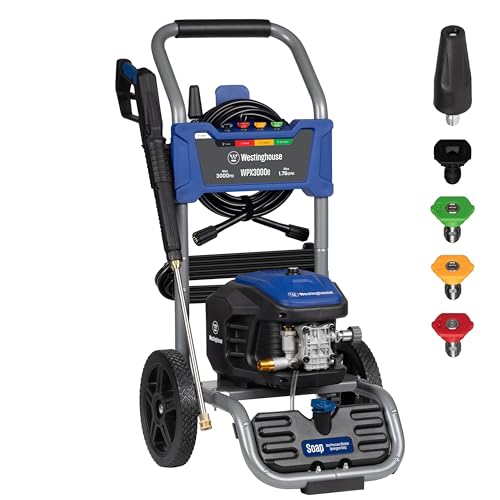
Westinghouse WPX3000e
The WPX3000e is the best all-around pick for owners who want induction-motor durability without stepping into the $350 tier. Its 3000 Max PSI and 1.76 Max GPM handle driveways, siding, and patio furniture without stalling. The onboard soap tank and five-nozzle set cover most residential tasks out of the box.
- Induction motor resists heat buildup during longer sessions.
- Five-nozzle set plus soap tank eliminates accessory purchases.
- Slightly heavier than the ePX-series units, making repositioning across a yard a two-step process.
Skip it if your budget sits under $200; the ePX3500 delivers usable pressure for a lower price.
Westinghouse ePX3500
At $169, the ePX3500 targets buyers who need more than 2000 PSI but cannot justify the WPX series. Its 2500 Max PSI at 1.76 GPM clears caked-on dirt from fences and patios. The anti-tipping technology is a genuine safety feature for uneven ground, and the pro-style steel wand feels more durable than plastic alternatives in cheaper models.
- Anti-tipping base keeps the unit stable on gravel or sloped surfaces.
- Steel wand resists flex and kinking better than vinyl options.
- The “2500” rating on the product name can confuse buyers comparing it to the higher-PSI WPX units.
Skip it if you routinely clean large driveways; the lower GPM extends job time noticeably.
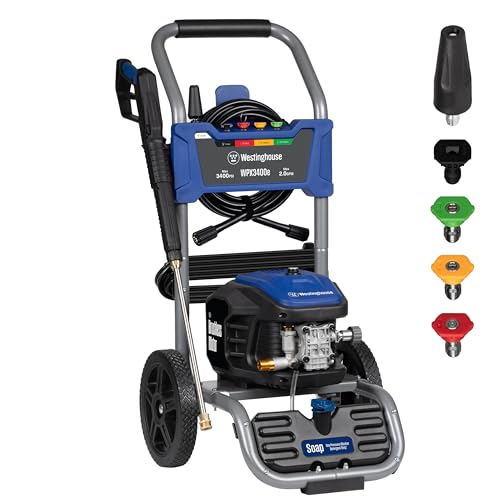
Westinghouse WPX3400e
The WPX3400e is the most powerful electric option in this lineup at 3400 Max PSI and 2.0 Max GPM. The brushless motor runs cooler and lighter than induction equivalents, making it the right choice for owners with long driveways or multi-surface projects. It handles what a mid-range gas unit would, minus the exhaust.
- Brushless motor offers the longest expected service life in the range.
- 2.0 GPM is the highest flow available, cutting cleaning time versus 1.76 GPM siblings.
- At $375 it costs more than twice the entry-level ePX3050, a steep jump for purely residential use.
Skip it if your tasks are limited to a single sedan and a small patio; you are paying for capacity you will not use.
Westinghouse ePX3100v
The ePX3100v fills a car-detailing niche most others ignore. At $129 it ships with a detachable foam cannon and a built-in carry handle, letting you lift the unit into a trunk and wash vehicles without a fixed water spigot setup. The 2100 Max PSI and 1.76 GPM suit light-to-medium jobs.
- Detachable foam cannon adds value without a separate purchase.
- Carry handle makes transport between garage and driveway straightforward.
- Only three nozzles ship included, so switching spray patterns requires more frequent tip swaps.
Skip it if you need to blast paint off a fence or clean a large concrete pad; the lower PSI will feel inadequate.
Westinghouse ePX3100
The ePX3100 sits between the budget ePX3050 and the mid-range ePX3500, offering 2300 Max PSI at 1.76 GPM with anti-tipping technology and a full five-nozzle set. For $139 it is the most feature-complete option under $150, with the same pro-style steel wand as costlier siblings.
- Five nozzles plus onboard soap tank at this price is unusual in the lineup.
- Anti-tipping base adds stability that the ePX3050 lacks at its price point.
- The universal motor runs louder and warmer than the induction or brushless alternatives above.
Skip it if noise matters — an induction-motor WPX unit will be quieter over multi-hour sessions.
Westinghouse WPX2300e
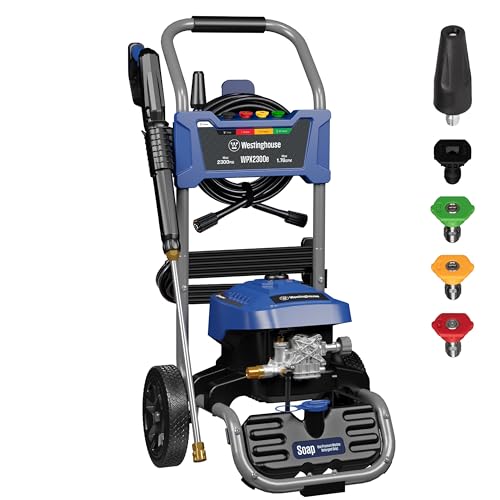
The WPX2300e is built for buyers who prioritize longevity over peak numbers. Its induction motor matches the WPX3000e in durability while delivering 2300 Max PSI at 1.76 GPM. The five-nozzle set and onboard soap tank cover residential tasks without accessory spending.
- Induction motor means fewer moving parts to wear out over years of use.
- Matches WPX-series build quality at a mid-range price of $179.
- At 2300 PSI it struggles with deeply embedded grime that 3000-plus units handle in fewer passes.
Skip it if you need to remove old paint or deep concrete staining; step up to the WPX3000e or WPX3400e instead.
Westinghouse ePX3050
At $109 the ePX3050 is the least expensive westinghouse electric pressure washer available and still includes a foam cannon and turbo nozzle. Its 2100 Max PSI at 1.76 GPM handles cars, patio furniture, and lightly soiled fences. For first-time buyers or those with limited storage, it proves that a low price does not mean a toy.
- Includes both a foam cannon and turbo nozzle at the lowest price point.
- Compact footprint suits apartment dwellers or small garages.
- Only 2100 PSI means multiple passes on concrete or heavily stained wood.
Skip it if you have a long driveway or expect to clean weekly; the ePX3100v or ePX3100 offer meaningful upgrades for a few more dollars.
Westinghouse WPX3200e
The WPX3200e delivers 3200 Max PSI — among the highest in the lineup — while keeping the price under $350. The trade-off is a universal motor rather than induction or brushless, which means more heat during sustained use. The five-nozzle set, onboard soap tank, and spray gun configuration mirror the WPX3000e.
- 3200 Max PSI tackles stubborn stains in fewer passes than lower-rated units.
- Same accessory package as the WPX3000e without the induction-motor premium.
- Universal motor is the weakest link; expect shorter lifespan versus WPX3000e or WPX3400e.
Skip it if you plan to use the unit commercially or for multi-hour sessions; the WPX3400e brushless motor handles that workload better.
Buying Guide
Motor Type Determines Lifespan and Noise
Universal motors are the cheapest to produce and the loudest at idle. They spin at high RPM, generate more heat, and have brushes that wear over time. Induction motors have no brushes, run cooler, and typically last several times longer under the same duty cycle. Brushless motors add electronic commutation for even better efficiency. If you expect to use your pressure washer more than once a month, the price difference between a universal-motor ePX unit and an induction-motor WPX unit pays for itself in avoided replacements.
PSI and GPM Must Be Read Together
Cleaning speed is proportional to the product of PSI and GPM. A 3000 PSI unit at 1.76 GPM cleans faster than a 2100 PSI unit at the same flow, but a 2500 PSI unit at 2.0 GPM can outperform a 3000 PSI unit at 1.6 GPM. Every model in this roundup sits at 1.76 GPM except the WPX3400e at 2.0 GPM, so pressure differences become the primary variable. Compare units at equal flow to judge real-time savings.
Accessories and Stability Features Reduce Hidden Costs
A five-nozzle set, onboard soap tank, and steel wand add roughly $40 to $60 in value versus a unit that ships with two tips and a vinyl hose. Anti-tipping technology or a built-in carry handle may seem like marketing language, but owners who work on gravel, sloped lawns, or uneven patio blocks consistently report that these features prevent mid-job knockovers. A detachable foam cannon matters only if you detail vehicles regularly; otherwise it sits unused and costs you nothing but box space.
Our Verdict
Best overall: the Westinghouse WPX3000e. It pairs an induction motor with 3000 Max PSI and 1.76 GPM, includes every accessory most owners need, and sits at a price where the durability premium is justified within the first year of regular use.
Best budget pick: the Westinghouse ePX3050 at $109. It delivers usable 2100 PSI with a foam cannon and turbo nozzle included, making it the lowest-risk entry into the westinghouse electric pressure washer family for someone who cleans occasionally.
One scenario where another model wins outright: if you live in an apartment or have no storage beyond a trunk, the ePX3100v carries its own handle, ships with a foam cannon, and weighs less than the WPX series — portability beats every other spec in that situation.
FAQ
Can a Westinghouse electric pressure washer replace a gas unit?
For residential tasks like cars, patios, and fences, yes. The WPX3400e at 3400 PSI and 2.0 GPM matches many mid-range gas models. Gas still wins for commercial surfaces, extended runtime beyond an hour, or areas without electrical access.
What does Anti-Tipping Technology actually do?
It is a weighted, flared base design that keeps the unit upright when the wand is fully extended or when pressure kicks back during trigger release. Owners on gravel or sloped concrete report it prevents most knockover incidents, though it does not make the unit immune to being pushed by a person or pet.
Is 1.76 GPM enough for driveway cleaning?
It is sufficient but not fast. Expect roughly twice the passes compared to a 2.0 GPM unit like the WPX3400e. For a standard two-car driveway, the difference is a few minutes per session; for a long or heavily stained driveway, it becomes noticeable over repeated cleanings.
Do I need a dedicated 20-amp circuit?
Most models in this lineup draw enough amperage that a shared 15-amp circuit will trip under load. A dedicated 20-amp circuit with a grounded outlet is the safest setup, particularly for the WPX3200e and WPX3400e which push higher wattage during startup.