
Our Top Picks
 Shure MV7+ USB-C & XLR Podcast Dynamic MicrophoneMedium12.9 x 4.95 x 4.4 inches1.92 poundsCheck on Amazon


Good audio makes a video feel professional even before a viewer notices the picture. Viewers forgive a slightly soft image, but they abandon a video fast when voices sound distant, hollow, or buried under room echo. The built-in microphone on a camera sits too far from the speaker and picks up lens and handling noise. A dedicated microphone for video solves that, and choosing the right one comes down to matching the mic to the job.

As an Amazon Associate, we earn from qualifying purchases.
Match the Microphone to the Job
Every microphone for video falls into one of a few families, and each family suits a different kind of shoot. An on-camera shotgun mic mounts on the hot shoe and points at whatever the lens sees, which suits run-and-gun filming, vlogs, and B-roll. A lavalier mic clips to clothing and sits close to the mouth, so it captures clear dialogue for interviews and talking-head videos even in a noisy room. A wireless lavalier system adds freedom of movement, letting the speaker walk and turn away from the camera without the audio dropping out. A USB mic stays on a desk for voiceover and commentary. A handheld dynamic mic suits on-location interviews and any scene where the speaker holds the mic and passes it between people.
Think about where your subject will be and how much they will move. If the speaker stays in one place, a lavalier or a desk mic gives the cleanest voice. If the speaker moves through a scene, a shotgun mic or a wireless lavalier keeps the audio consistent. If several people share one mic, a handheld dynamic mic is the simplest answer.
Understand Polar Patterns
A polar pattern describes the directions a microphone hears best, and it decides how much background sound reaches the recording. A cardioid pattern hears mostly what is in front of the mic and rejects sound from behind, which suits voiceover, interviews, and indoor scenes where the room adds echo. A supercardioid pattern, common on shotgun mics, narrows the pickup further and reaches toward a distant subject, which suits filming outdoors or across a room. An omnidirectional pattern hears sound equally from all directions, which is why lavalier mics use it: the tiny capsule sits on a chest and still captures the voice clearly even when the speaker turns their head.
Narrower is not always better. A very directional mic outdoors can sound thin if the speaker moves off axis, and indoors a shotgun mic can pick up more reflected sound than a lavalier placed close to the mouth. The closer the mic sits to the speaker, the less the polar pattern matters. For a camera-mounted mic, choose supercardioid; for a clip-on mic, omnidirectional; for a desk mic, cardioid.
Wired or Wireless
Wired microphones are simple, dependable, and never run out of battery mid-take. A wired lavalier plugs into a camera, a recorder, or a wireless transmitter, and a wired shotgun plugs straight into the camera mic input. The only limit is the cable: it tethers the speaker to the camera and can snag, tug, or appear in frame. For seated interviews and any shoot where the speaker stays put, wired is the sensible default.
Wireless systems trade a cable for a radio link between a small transmitter and a receiver on the camera. Modern 2.4 GHz systems pair in seconds and hold a clean link across a room or a garden. Look for a dual-channel receiver if you film two people at once, and look for internal recording in the transmitter: it saves a backup copy of the audio, so a dropped radio link does not lose the take.
Connections, Power, and Monitoring
Before buying, check how the mic connects to your camera or recorder. Most cameras accept a 3.5 mm mic input, and most on-camera and lavalier mics use a 3.5 mm plug. Some mics need plug-in power from the camera or the transmitter, while others run on their own battery or a USB connection. A USB mic connects to a computer rather than a camera, which makes it ideal for voiceover but useless on a camera rig unless you record audio separately and sync it in the edit. A handheld dynamic mic usually needs an XLR input, so it pairs with a recorder, an interface, or a camera with an XLR adapter.
Monitoring is the habit that saves the most takes. A headphone jack on the mic or on the camera lets you hear exactly what is being recorded, including wind noise, clothing rustle, and hum from nearby lights. Set levels so normal speech sits below the top of the meter, and leave headroom for laughter and loud moments. If your camera lacks a headphone jack, record a short test clip and play it back before the real take begins.
Wind, Handling Noise, and Room Sound
Outdoor audio fails more often from wind than from any other cause. A foam windscreen handles a light breeze, while a furry wind cover, often called a dead cat, handles stronger gusts. Keep one fitted whenever you film outside. Handling noise comes from touching the mic, the cable, or the camera body, and a shock mount with elastic suspension absorbs most of it. Indoors, bare walls and hard floors bounce the voice back into the mic as echo, and a lavalier close to the mouth beats echo better than any other trick.
1. Rode VideoMic Pro+ On-Camera Shotgun Microphone
The Rode VideoMic Pro+ is the classic on-camera shotgun, and it remains the most capable mic in its class for mirrorless and DSLR video. Its supercardioid capsule focuses on the subject in front of the lens while rejecting sound from the sides, and the Rycote Lyre suspension mount isolates it from footsteps, lens movement, and handling noise. A three-stage gain control, a high-pass filter, and a safety channel that records a second copy at a lower level cover loud moments and noisy rooms.
Power is flexible: the included LB-1 rechargeable battery, two AA batteries, or a micro USB connection all keep it running, and the mic switches itself on and off with the camera. For vlogs, documentaries, event coverage, and B-roll, the VideoMic Pro+ is the one-mic answer that mounts on the camera and simply works.
Specs:
– Type: supercardioid condenser shotgun microphone
– Frequency response: 20 Hz to 20 kHz
– Maximum SPL: 133 dB
– Sensitivity: -34 dB re 1 V/Pa
– Output: 3.5 mm TRS
– Power: LB-1 rechargeable battery, 2 x AA batteries, or micro USB
– Weight: 122 g
– ASIN: B07XM57G19
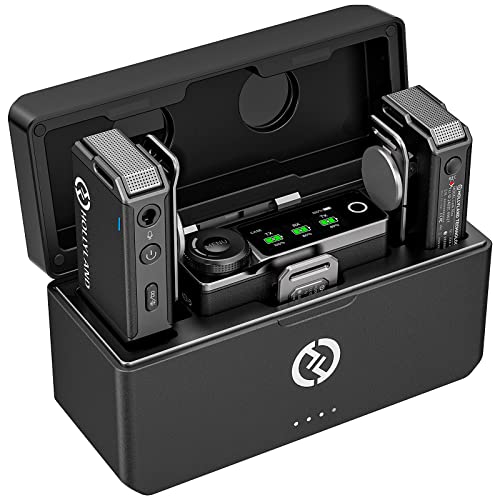
2. Hollyland Lark Max Duo Wireless Lavalier Microphone System
The Hollyland Lark Max Duo is a complete two-person wireless kit: two transmitters, one camera receiver, and a charging case, with two lavalier mics included for discreet placement. Each transmitter records internally to 8 GB of built-in memory, holding up to 14 hours of backup audio, so a dropped radio link never loses an interview. Noise cancelling cuts background hum at the touch of a button, and 48 kHz, 24-bit audio keeps dialogue clean and full.
The receiver mounts on the hot shoe and connects to the camera with a 3.5 mm cable. Total run time reaches 22 hours with the charging case. For two-person interviews, wedding films, and walk-and-talk videos, the Lark Max Duo lets speakers move naturally while the audio stays close and clear.
Specs:
– Channels: dual-channel, two transmitters and one receiver
– Transmission: 2.4 GHz digital, up to 250 m range
– Internal recording: 8 GB per transmitter, up to 14 hours
– Audio: 48 kHz, 24-bit, 70 dB signal-to-noise ratio
– Noise cancelling: environmental, switchable
– Battery life: up to 22 hours total with the charging case
– Outputs: 3.5 mm TRS, USB-C
– ASIN: B0C5R9H796
3. Rode Lavalier GO Omnidirectional Lavalier Microphone
The Rode Lavalier GO is a wired lavalier that does one job extremely well: it puts a broadcast-quality capsule a few inches from the speaker’s mouth. The tiny 4.5 mm omnidirectional capsule captures speech clearly even when the speaker turns their head, and the Kevlar-reinforced cable survives daily packing and tugging far better than a thin plain cable.
The Lavalier GO plugs into any device with a 3.5 mm mic input that supplies plug-in power, including cameras, recorders, and wireless transmitters, and an adapter lets it work with phones too. It needs no battery and no charging, so there is nothing to forget on a shoot day.
Specs:
– Type: omnidirectional condenser lavalier microphone
– Capsule: 4.5 mm miniature
– Frequency response: 20 Hz to 20 kHz
– Maximum SPL: 110 dB
– Sensitivity: -35 dB
– Signal-to-noise ratio: 67 dB
– Cable: 1.2 m Kevlar-reinforced, 3.5 mm TRS plug
– Weight: 16 g
– ASIN: B07WM65GTF
4. Shure MV7+ USB and XLR Dynamic Microphone
The Shure MV7+ is the desk mic for voiceover, narration, and YouTube commentary. Its dynamic cardioid capsule rejects room echo and keyboard noise far better than a condenser desk mic, so it sounds clean even in an untreated room. It connects by USB-C to a computer and by XLR to an interface or recorder, which means it can grow with your setup: begin with a simple USB connection, then move to XLR when you add an interface. Auto level mode, a digital pop filter, and tap-to-mute make recording effortless.
A built-in headphone output lets you monitor your voice live with zero delay. For creators who record voiceover at a desk, the MV7+ is the most forgiving single-mic solution, and the XLR output keeps it useful as your kit grows.
Specs:
– Type: dynamic cardioid microphone
– Outputs: USB-C and XLR
– Audio: up to 24-bit, 48 kHz
– Features: auto level mode, digital pop filter, tap-to-mute LED touch panel
– Monitoring: 3.5 mm headphone output
– Finish: black, standalone unit
– ASIN: B0CTJ7PVN1
5. Shure SM58-LC Cardioid Dynamic Vocal Microphone
The Shure SM58-LC is the handheld dynamic mic that has served stages, studios, and film sets for decades, and it suits video work where the speaker holds the mic. Its cardioid pattern focuses on the voice in front of it and rejects sound from behind, while the built-in spherical windscreen and pop filter tame plosives and breath noise.
The SM58-LC needs no battery and no phantom power. It connects by XLR to a recorder, an interface, or a camera with an XLR adapter, and the LC version ships without a cable so you can choose the length you need. For on-location interviews, event hosting, and vox-pop segments, the SM58-LC is the dependable choice that simply keeps working.
Specs:
– Type: dynamic cardioid vocal microphone
– Frequency response: 50 Hz to 15 kHz
– Polar pattern: cardioid
– Connector: 3-pin XLR
– Features: pneumatic shock mount, built-in spherical pop filter
– Included: A25D mic clip, storage bag
– Cable: not included (LC version)
– ASIN: B000CZ0R42
Which Microphone Should You Pick?
If you film mostly on the move, begin with the Rode VideoMic Pro+ on the camera and add the Rode Lavalier GO when interviews become a regular part of your work. If you film two people talking, the Hollyland Lark Max Duo covers both voices with a backup recording for each. If your videos lean on voiceover and commentary, the Shure MV7+ on your desk gives the cleanest narration with the least setup. If you host events or interview people on the street, the Shure SM58-LC is the mic to hand to your subject.
Frequently Asked Questions
Do I need a separate microphone for video, or is the camera mic enough?
A separate microphone is worth it for almost any video where someone speaks. A camera mic sits far from the speaker and picks up lens noise, handling noise, and room echo, while a dedicated mic sits close to the voice and lifts dialogue out of the background.
What is the best microphone type for interviews?
A lavalier mic is the best choice for most interviews because it clips close to the mouth and stays consistent as the speaker moves. A wireless lavalier suits interviews where the speaker walks or stands, while a wired lavalier suits seated interviews. A handheld dynamic mic works well when the interviewer holds the mic and passes it between people.
Can I use a USB microphone with a camera?
A USB microphone connects to a computer, not directly to most cameras, so it suits voiceover and commentary recorded at a desk. If you want USB audio in a camera video, record the voice separately on the computer and sync it with the picture in the edit, or choose a mic with both USB and XLR outputs, like the Shure MV7+.
How do I stop wind noise when filming outdoors?
Fit a foam windscreen for a light breeze and a furry wind cover for stronger gusts, and keep one on the mic whenever you film outside. Point the mic slightly away from the wind direction when you can, and always monitor with headphones so you hear wind noise before it ruins a take.
More from Amazon
Programs that pair well with the guide above. Offers and eligibility are set by Amazon and may change.
Free shipping on eligible items, Prime Video and more. Eligible new members can start with a free trial.
Start a Prime free trialAudiobooks and podcasts to listen to on the go. Eligible new members can start with a free trial.
Try Audible freeAd-free music streaming. Eligible new subscribers can start with a free trial.
Try Music Unlimited freeA free business account with business pricing and bulk-buying tools for work, shop or home office.
Create a business accountAs an Amazon Associate we earn from qualifying purchases.









