Key takeaways
- Fully Printed Fractions: Every mark is labeled (1/16, 1/8, 3/16 etc.). Fastest to learn and read, especially for beginners. Can look cluttered on narrow 3/4-inch blades. Found on tapes like the FastCap ProCarpenter FlatBack and Milwaukee Stud Fractional.
- Center-Point Fractions Only: Only the 1/2, 1/4, 3/4 and sometimes 1/8 marks are labeled. Cleaner blade, less visual noise for experienced users, but you still count the smaller 1/16 ticks. Common on Crescent Lufkin Shockforce Fractional.
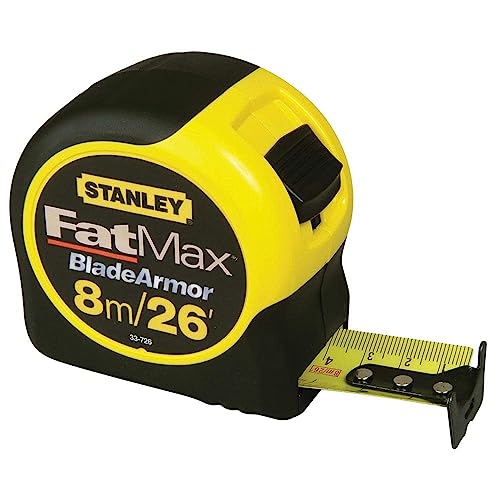
- Traditional Ticks Without Fractions: No fractions printed, just line lengths. Most compact and durable print, but slowest for fraction reading. Requires you to memorize tick hierarchy. Standard on most Stanley FatMax and DEWALT ToughSeries non-fractional models.
A 1-1/4-inch wide, 25-foot fractional measuring tape with 1/16-inch graduations and printed fractional labels is the fastest reading choice for most woodworking and DIY, while a 1-inch wide, 16-foot tape with 1/8-inch and 1/16-inch marks is lighter and easier to handle for basic home projects.
The right fractional measuring tape saves time by letting you read 1/2, 1/4, 1/8, and 1/16 marks without counting tick marks. Blade width, standout, graduation style, and how fractions are labeled matter more than tape length for speed and accuracy.
Our top picks



As an Amazon Associate we earn from qualifying purchases at no extra cost to you. Ratings are shown as listed on Amazon.
How Fractional Markings Actually Work
Standard fractional tapes divide each inch into 16 equal parts. The longest tick after the inch mark is 1/2″, the next longest are 1/4″ and 3/4″, then 1/8″ increments, and the shortest are 1/16″. Quick-read tapes print the fraction right on the blade so you don’t have to count.
The 3 Labeling Styles and Their Trade-offs
- Fully Printed Fractions: Every mark is labeled (1/16, 1/8, 3/16 etc.). Fastest to learn and read, especially for beginners. Can look cluttered on narrow 3/4-inch blades. Found on tapes like the FastCap ProCarpenter FlatBack and Milwaukee Stud Fractional.
- Center-Point Fractions Only: Only the 1/2, 1/4, 3/4 and sometimes 1/8 marks are labeled. Cleaner blade, less visual noise for experienced users, but you still count the smaller 1/16 ticks. Common on Crescent Lufkin Shockforce Fractional.
- Traditional Ticks Without Fractions: No fractions printed, just line lengths. Most compact and durable print, but slowest for fraction reading. Requires you to memorize tick hierarchy. Standard on most Stanley FatMax and DEWALT ToughSeries non-fractional models.
For speed, fully printed fractions win by a large margin if you work in fractions daily. If you also work in decimals or do framing layout where you are counting 16ths quickly, a cleaner center-point style may be less distracting once you are fluent.
Graduation Increments: 1/16 vs 1/32 vs 1/8
Most fractional measuring tapes offer one of these setups:
- 1/16-inch graduations for the entire length: The standard for woodworking and finish carpentry. Precise enough for joinery without overwhelming detail.
- 1/32-inch on the first 12 inches, 1/16-inch after: Useful for detailed layout, hardware placement, and small box work. The extra marks in the first foot make that critical area harder to read at speed.
- 1/8-inch graduations: Found on some framing and construction tapes. Very fast to read, but not precise enough for furniture, cabinets, or trim where 1/16″ matters.
For woodworking and general DIY, choose 1/16-inch throughout. Only choose 1/32-inch if you regularly measure hardware bore distances or need to hit 1/64-inch tolerances with a tape, and even then a steel rule is usually more accurate for that work.
Blade Width, Length, and Readability
Blade width affects more than comfort. Wider blades allow larger fraction text and longer standout, but add weight and bulk on a belt.
| Tape Type (Example) | Blade Width | Length | Standout (Approx.) | Weight (Approx.) | Fraction Style | Best For |
|---|---|---|---|---|---|---|
| Compact Fractional (FastCap ProCarpenter 16′) | 3/4 inch (19mm) | 16 ft | 7 ft | 7.5 oz | Fully printed to 1/16″ | Shop use, apron carry, light DIY |
| All-Purpose Fractional (Stanley FATMAX Fractional 25′) | 1-1/4 inch (32mm) | 25 ft | 11 ft | 15.8 oz | Fully printed to 1/16″ | Woodworking, remodeling, general DIY |
| Framing Fractional (Milwaukee STUD Fractional 25′) | 1-1/4 inch (32mm) | 25 ft | 12 ft | 16.5 oz | Fully printed to 1/16″ + architectural scale | Framing, deck building, large projects |
| Wide-Blade Heavy Duty (DEWALT ToughSeries 25′) | 1-1/4 inch (32mm) | 25 ft | 13 ft | 17.2 oz | Center-point fractions | Jobsite durability, overhead measuring |
| Narrow Budget (Crescent Lufkin Hi-Viz Fractional 25′) | 1 inch (25mm) | 25 ft | 8 ft | 11.5 oz | Center-point fractions | Homeowners, infrequent use |
Standout is how far the blade extends unsupported before it collapses. For solo work on sheet goods or ceiling layout, 11+ feet of standout reduces the need for a second person. For bench work, standout is irrelevant and a lighter 16-foot tape is faster to handle.
Decision Matrix: Which Fractional Tape to Buy
Match your primary use to the feature set that saves the most time:
| Your Situation | Recommended Spec | Why It Saves Time |
|---|---|---|
| Beginner DIY / Home Repairs, occasional use, budget $15-$25 | 16 ft, 1-inch wide, fully printed 1/16″ fractions | Largest text for the width, lightest weight, you read the fraction instead of counting. No need to manage 25 ft of blade. |
| Furniture, Cabinets, Trim Carpentry, frequent shop use | 25 ft, 1-1/4-inch wide, fully printed 1/16″ entire length, matte blade coating | Matte coating reduces glare under shop lights. Wide blade lets you see fractions at arm’s length on a saw bench. |
| Framing, Decks, Fencing, outdoor builds | 25 ft, 1-1/4-inch wide, 11+ ft standout, center-point or fully printed | Standout lets you span stud bays and joists alone. High-contrast blade survives dust and sunlight. |
| Small Shop / Tight Space / Apron Carry | 12-16 ft, 3/4-inch wide flat-back design | FlatBack sits stable on wood without rocking, ideal for marking directly off the blade. |
| Teaching Kids or Quick Learning | 16 ft, fully printed fractions with color-coded 1/8, 1/4, 1/2 marks | Color helps anchor the hierarchy while you learn tick lengths. Faster than monochrome blades. |
How to Read Fractions Fast: A 30-Second Method
Use the anchor technique instead of counting every tick from zero:
- Step 1: Find the nearest inch. Read the whole number (e.g., 5″).
- Step 2: Find the nearest 1/2″ mark. It’s the longest tick between inches. If your mark is past it, you know you’re at 1/2″ plus something.
- Step 3: Anchor to 1/4″ or 1/8″. The next longest ticks are quarters. Inside each quarter, the medium tick is the eighth.
- Step 4: Add 1/16s only if needed. Shortest ticks are sixteenths. On a fully printed fractional tape, just read the label at the tick instead of adding.
Example: A mark three short ticks past 7 and 1/4. On a non-labeled tape, that’s 7″ + 1/4″ (0.25″) + 3/16″ (0.1875″) = 7-7/16″. On a fractional-labeled tape, that same tick will simply read 7 7/16, eliminating the math. With practice, you stop calculating and start recognizing the pattern by position and color.
Durability and Ownership Realities
Fractional tapes fail in the same places as standard tapes, but the printed fractions add a wear point:
- Blade coating wears first. The first 12 inches and the hook area lose their clear coat fastest from repeated sliding and contact with lumber. Matte nylon-coated blades like those on Milwaukee STUD and DEWALT ToughSeries resist abrasion and glare longer than lacquered blades.
- Hook slop is normal. The riveted end hook is designed to slide about 1/16 inch to compensate for inside vs. outside measurements. If the hook is bent from a drop, accuracy is lost. Check it against a steel rule monthly if you do finish work.
- Fractional ink can fade. On budget tapes with small 3/4-inch blades, densely printed fractions rub off faster in the first foot. A wider 1-1/4-inch blade with larger type lasts longer.
- Cleaning matters. Sawdust and pitch build up under the blade return. Extend the tape fully, wipe with a dry cloth, and avoid oil which attracts grit that grinds the markings.
- Common mistake: using the tape as a marking straightedge. Dragging a utility knife along the blade edge nicks the coating and fractions. Use the tape to measure, then mark with a square or straightedge.
In general market ranges in 2026, expect $12-$20 for compact 16-foot fractional tapes, $22-$35 for 25-foot fully printed models from major brands, and $30-$45 for wide-blade jobsite models with extra standout and reinforced housing. Replacement is typically needed every 2-4 years for daily shop use, longer for occasional home use.
Features That Actually Help You Read Faster
- Double-sided printing: Useful when measuring overhead or from either side of the blade, common on FastCap models.
- Fractional + decimal + metric: Some blades show both. Helpful if you switch between systems, but it shrinks fraction size and slows reading. Choose single-system if speed is the priority.
- High-contrast colors: Black fractions on a yellow or white blade with red highlights for 16-foot stud marks or half-inch increments are easier under dim garage lighting.
- Belt clip and brake lock: A strong brake that holds without creep prevents you from remeasuring after the blade slips.
FAQ
Are fractional tapes less accurate than standard tapes?
No. Accuracy depends on the blade’s manufacturing standard (typically Class II), not whether fractions are printed. Both types are usually accurate to within about 1/32 inch over 12 feet. The fractions just make the reading faster.
Should I get a fractional tape with 1/32-inch marks for woodworking?
Usually not. Wood moves more than 1/32 inch with humidity, and most joinery is laid out to 1/16 or 1/32 inch maximum. A 1/16-inch tape with printed fractions is faster and less error-prone. For finer work, use a steel rule or calipers.
What length is best for DIY furniture?
16 feet covers most furniture parts and is lighter to handle on a bench. Choose 25 feet only if you also break down sheet goods or measure rooms.