
Key takeaways
- Five Micro Four Thirds lenses for the Panasonic G95, from a pocket power zoom to a 600mm-equivalent super telephoto for sharp stills and video.
The Panasonic G95 is a camera that rewards a good lens collection. Its 20.3 megapixel Micro Four Thirds sensor, 4K video recording, and Dual I.S. 2 stabilization make it a capable hybrid body for stills and motion, and the fully articulating screen plus V-Log L support suit it to interviews, vlogs, and travel photography alike. The body is only half the story, though. The lens in front of that sensor decides how sharp your images look, how smoothly your footage zooms, and how far you can reach when a subject will not come closer.

Micro Four Thirds is one of the most generous mounts in photography. Panasonic and OM System share the same mount, so every lens in this guide fits the G95 natively, with full autofocus, aperture control, and stabilization communication. That shared mount also means a deep back catalog of compact, well made optics that pair beautifully with the G95’s modest size. The five lenses below cover the focal lengths most G95 owners actually use, from a pocketable everyday zoom to a super telephoto that reaches the equivalent of 600mm.
As an Amazon Associate, we earn from qualifying purchases.
The 2x Crop Factor, in Plain English
Every Micro Four Thirds camera, including the G95, has a sensor about half the diagonal of a full frame sensor. That gives the system a 2x crop factor, which means you double a lens focal length to get its full frame equivalent field of view. A 25mm lens frames like a 50mm on a full frame camera, a 100mm lens frames like a 200mm, and a 300mm lens frames like a 600mm.
This is genuinely good news for telephoto shooting, because long lenses stay small and light. It also means a lens that looks short on paper can be a serious portrait or wildlife tool on the G95. Throughout this guide, both numbers are given: the number printed on the lens barrel, and the full frame equivalent that tells you how the framing will actually feel. Depth of field is a little deeper at a given aperture than on a larger sensor, which helps video work where holding focus matters.
1. Panasonic Lumix G X Vario PZ 14-42mm f/3.5-5.6 ASPH POWER O.I.S. — Best Everyday Video Zoom
The power zoom is the feature that sets this lens apart for video. Instead of twisting a zoom ring by hand, you drive the zoom with a small lever, and the movement is smooth and even, the way a camcorder zoom feels. That makes slow push-ins and pull-backs during a take look deliberate instead of jerky, and it is a real advantage for vlogs, interviews, and event footage on the G95. It covers 14-42mm, which is 28-84mm in full frame terms, the classic walkaround range that handles landscapes, street scenes, interiors, and casual portraits without a lens change.
The lens is also remarkably small. It collapses to about 27mm long when powered down and weighs roughly 95 grams, so it keeps the G95 pocketable in a jacket or a small bag. POWER O.I.S. stabilization works together with the G95’s Dual I.S. 2 system, which steadies handheld footage and helps stills at slower shutter speeds. The optical design uses four aspherical elements and two extra-low dispersion elements to keep aberrations in check, and the 37mm filter thread takes small, inexpensive filters. Autofocus is quiet and smooth, tuned for video, so the focus motor does not intrude on recorded audio. The variable aperture is the honest trade-off here: you will not get the shallow depth of field of a fast prime, but for daylight shooting, travel, and run-and-gun video, this lens earns its place on the camera.
Specs
- 14-42mm (28-84mm equivalent), f/3.5-5.6, 9 elements in 8 groups (4 aspherical, 2 ED), POWER O.I.S., 0.2 m minimum focus, 37mm filter thread, approx. 27mm long, approx. 95 g, Micro Four Thirds mount.
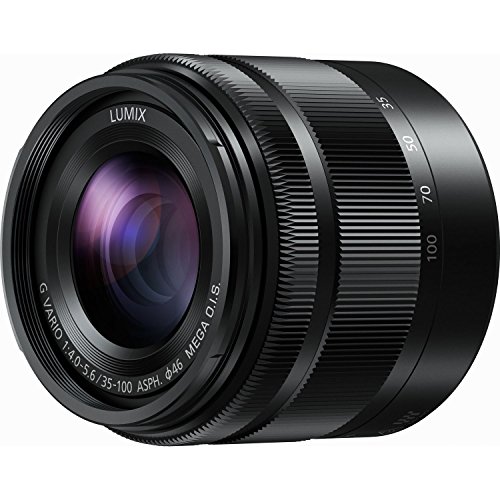
2. Panasonic Lumix G Vario 35-100mm f/4.0-5.6 ASPH MEGA O.I.S. — Best Compact Portrait Telephoto
The 35-100mm is the telephoto zoom that disappears into your bag. At 50mm long and 135 grams, it is barely larger than a lens cap, yet it covers 70-200mm in full frame terms, the focal range portrait photographers reach for most often. On the G95, 35mm gives a flattering head-and-shoulders framing, while 100mm compresses features and softens backgrounds for tighter portraits, and the whole range suits events, stage performances, and detail shots where you cannot walk closer.
MEGA O.I.S. stabilization helps hold the longer end steady, and it pairs with the G95’s in-body stabilization for handheld work. Focus is internal, so the front element and the 46mm filter thread do not rotate as you focus. The optical construction packs 12 elements in 9 groups, including one aspherical element and two extra-low dispersion elements, into that tiny barrel, and the seven-blade circular diaphragm keeps out-of-focus areas smooth. Minimum focus is 0.9 m, though this is not a macro lens. The modest aperture is the trade-off, so this lens shines brightest in good light, and it is the 70-200mm equivalent you will actually carry everywhere.
Specs
- 35-100mm (70-200mm equivalent), f/4.0-5.6, 12 elements in 9 groups (1 aspherical, 2 ED), MEGA O.I.S., 0.9 m minimum focus, 0.11x maximum magnification, 46mm filter thread, 55.5 x 50mm, 135 g, Micro Four Thirds mount.
3. Olympus M.Zuiko Digital ED 40-150mm f/4.0-5.6 R — Best Lightweight Telephoto Value

The Olympus 40-150mm R is one of the best value telephoto lenses ever made for Micro Four Thirds, and it is a natural match for the G95. It covers 80-300mm in full frame terms, which takes you from short telephoto portraits through sports, school events, and distant landscapes, all in a lens that weighs just 190 grams and measures 63.5 x 83mm. It is shorter than a soft drink can and light enough to carry all day, which is exactly what a travel or walkaround telephoto should be.
Image quality is strong for a lens of this size and class, with an extra-low dispersion element and a high refractive index element in the 13-element design keeping colors clean and contrast high. The MSC autofocus motor, which stands for Movie and Still Compatible, focuses quickly and quietly, so it suits the G95’s video modes as well as stills. Minimum focus distance is 0.9 m throughout the zoom range, giving 0.16x maximum magnification for flowers and details. The 58mm filter thread is a common size, so filters are easy to find. One thing to note: this lens has no built-in stabilization of its own, so it leans on the G95’s in-body stabilization, which handles the job well and keeps the lens small.
Specs
- 40-150mm (80-300mm equivalent), f/4.0-5.6, 13 elements in 10 groups (1 ED, 1 HR), MSC autofocus, 0.9 m minimum focus, 0.16x maximum magnification, 7 rounded diaphragm blades, 58mm filter thread, 63.5 x 83mm, 190 g, Micro Four Thirds mount.
4. Panasonic Lumix G Vario 45-200mm f/4.0-5.6 MEGA O.I.S. — Best Stabilized Long Telephoto

The 45-200mm takes the telephoto idea further, reaching 90-400mm in full frame terms, and it does so with built-in MEGA O.I.S. stabilization that works alongside the G95’s Dual I.S. 2 system. That combination matters at 200mm, where every small hand movement is magnified, and it lets you shoot handheld at focal lengths that would normally demand a tripod. For wildlife at the edge of a field, youth sports from the sideline, or aircraft and boats at a distance, the extra 50mm over the 40-150mm is a meaningful gain.
The optical design uses 16 elements in 13 groups with three extra-low dispersion elements, which keeps chromatic aberration under control at the long end where it usually shows up first. Focus is internal, so the lens does not extend as you focus and the 52mm filter thread stays put, which is convenient for filter users. Minimum focus distance is 1.0 m at all focal lengths, with 0.19x maximum magnification, and the seven-blade circular diaphragm gives pleasing background blur for a lens in this class. At 380 grams and 100mm long, it is still modest by telephoto standards and balances well on the G95’s grip. It is an older design, and its autofocus is not the fastest of the group, but for deliberate telephoto work where reach and stabilization matter more than speed, it remains dependable.
Specs
- 45-200mm (90-400mm equivalent), f/4.0-5.6, 16 elements in 13 groups (3 ED), MEGA O.I.S., 1.0 m minimum focus, 0.19x maximum magnification, 7 diaphragm blades, 52mm filter thread, 70 x 100mm, 380 g, Micro Four Thirds mount.
5. Olympus M.Zuiko Digital ED 75-300mm f/4.8-6.7 II — Best Super Telephoto for Wildlife

When 200mm is not enough, the 75-300mm II changes what you can photograph. It reaches 150-600mm in full frame terms, which brings distant birds, shy wildlife, and far-off details into frame-filling range. A 600mm equivalent on a full frame camera would be a huge, heavy, expensive lens, but this Micro Four Thirds optic is 69 x 116.5mm and weighs 423 grams, so it fits in a day pack and mounts comfortably on the G95 without unbalancing it.
The optical formula is serious for a consumer super telephoto: 18 elements in 13 groups, including one Super ED element, two ED elements, and three high refractive index elements, with Olympus ZERO coating to suppress flare and ghosting when you shoot toward the light. The MSC autofocus motor is fast and quiet, which matters for video and for tracking moving subjects, and the seven-blade rounded diaphragm keeps backgrounds smooth. Minimum focus distance is 0.9 m, giving 0.18x maximum magnification. Like the 40-150mm R, it has no built-in stabilization and relies on the G95’s in-body stabilization, so a steady grip still matters. The f/4.8-6.7 aperture calls for good light, and the G95’s stabilization plus its clean higher sensitivities make the combination workable.
Specs
- 75-300mm (150-600mm equivalent), f/4.8-6.7, 18 elements in 13 groups (1 Super ED, 2 ED, 3 HR), ZERO coating, MSC autofocus, 0.9 m minimum focus, 0.18x maximum magnification, 7 rounded diaphragm blades, 58mm filter thread, 69 x 116.5mm, 423 g, Micro Four Thirds mount.
Which Lens Should You Buy First
If you can only buy one lens for the G95, get the 14-42mm power zoom. It covers the focal lengths you will use most often, its smooth power zoom is genuinely useful for video, and it keeps the camera small enough to carry every day. Add the 40-150mm R second, because together those two lenses cover 28mm to 300mm equivalent in a kit that fits in a small bag and weighs almost nothing.
From there, choose by subject. Portrait and event shooters should add the 35-100mm for its compact 70-200mm equivalent range and flattering compression. Wildlife and sports shooters should add the 45-200mm for its stabilized 400mm equivalent reach, or jump straight to the 75-300mm II for the full 600mm equivalent when subjects are truly distant. There is overlap between the telephoto zooms in this guide, and that is deliberate: each one trades a little reach for a little size, weight, or stabilization, so pick the balance that matches how you shoot.
Frequently Asked Questions
Do all Micro Four Thirds lenses fit the Panasonic G95?
Yes. The G95 uses the Micro Four Thirds mount, so lenses from Panasonic and OM System mount directly, with full autofocus, aperture control, and electronic communication. That includes every lens in this guide, plus older Four Thirds lenses with an adapter, though adapted lenses may focus more slowly.
Is the G95 good for video with these lenses?
Yes, the G95 is a strong video camera for its class, with 4K recording, V-Log L, and Dual I.S. 2 stabilization. Lenses with built-in stabilization, such as the 14-42mm power zoom and the 45-200mm, work together with the body stabilization, while the Olympus lenses in this guide rely on the body’s stabilization alone, which still works well.
What is the best lens for wildlife on the G95?
The Olympus 75-300mm II is the best wildlife pick in this guide, because its 600mm full frame equivalent reach brings distant animals into frame. The 45-200mm is a good alternative when you want built-in stabilization and a smaller lens, and its 400mm equivalent reach still handles larger animals and birds at moderate distances.
Can I use these lenses on an OM System camera?
Yes. Micro Four Thirds is a shared mount, so every lens here works on OM System bodies such as the OM-1 and OM-5, with autofocus and aperture control. Stabilization behavior may differ slightly between brands, since each maker tunes its own in-body stabilization, but the lenses mount and function normally.
Final Thoughts
The G95 is a camera that punches above its size, and these five lenses let it do so across almost every kind of shooting. The power zoom handles daily life and video, the compact telephotos cover portraits and events, and the long zooms reach wildlife and sports that a small camera has no business capturing. Buy the 14-42mm first, add a telephoto second, and let your favorite subjects decide the rest.
More from Amazon
Programs that pair well with the guide above. Offers and eligibility are set by Amazon and may change.
Free shipping on eligible items, Prime Video and more. Eligible new members can start with a free trial.
Start a Prime free trialAudiobooks and podcasts to listen to on the go. Eligible new members can start with a free trial.
Try Audible freeAd-free music streaming. Eligible new subscribers can start with a free trial.
Try Music Unlimited freeA free business account with business pricing and bulk-buying tools for work, shop or home office.
Create a business accountAs an Amazon Associate we earn from qualifying purchases.









