
Key takeaways
- The best lenses for Nikon D500 cover wildlife, travel, portraits and low light. Five F-mount picks with crop-factor notes, specs and verified ASINs.
The Nikon D500 remains one of the most capable APS-C DSLRs ever built, and the right glass is what unlocks it. With a 20.9MP sensor, a 153-point autofocus system borrowed from the flagship D5, and 10 frames per second of continuous shooting, this camera rewards lenses that can keep up. The F-mount gives you access to decades of Nikon glass, plus strong third-party options, so the challenge is not finding a lens but choosing the right one for the way you shoot.


As an Amazon Associate, we earn from qualifying purchases.
One detail shapes every choice below: the D500 has a 1.5x crop factor. A 50mm lens behaves like a 75mm lens on a full-frame body, and a 300mm telephoto reaches like a 450mm. That crop is a gift for wildlife and sports shooters, because it adds free reach, but it also means wide-angle lenses need shorter focal lengths than you might expect. Every pick in this guide notes its effective focal length on the D500 so you can judge it honestly.
Why the D500 Rewards Good Glass
The D500 pairs a fast, dense autofocus system with a deep buffer, which means the camera can track a bird in flight or a player cutting across a field and hold focus while you fire long bursts. A slow or soft lens wastes that ability. The lenses below were chosen because they focus quickly, hold up at the edges of the frame, and match the camera’s rugged, weather-sealed character.
Both DX and FX F-mount lenses fit the D500, and both appear here. DX lenses are smaller and lighter because they only need to cover the APS-C sensor, while FX lenses cover a larger image circle and can move with you if you ever add a full-frame body. Neither type is better in general; the right one depends on the focal length and the job. All five picks below are real, verified listings, and none repeats a lens from our recent D750, D780, or D7500 guides.
1. Sigma 150-600mm f/5-6.3 DG OS HSM Contemporary
Wildlife is where the D500 earns its keep, and this Sigma is the most reach you can put on the camera without a second mortgage. On the D500 it behaves like a 225-900mm lens, which puts distant birds, deer, and athletes well inside the frame. The Contemporary version is noticeably lighter than the Sigma Sport model, so it stays manageable on a long walk, and the optical stabilizer keeps the viewfinder steady at the long end.
Focus is fast enough to track moving subjects, and the zoom lock stops the barrel from creeping when the lens points down. Image quality holds up well through the middle of the range, and stopping down a little at 600mm tightens the edges. The lens takes a 95mm front filter, and the tripod foot is removable, which helps when you want to handhold for a while and then switch to a monopod.
This is the lens to buy first if wildlife or field sports are your main subject. It turns the D500’s crop factor into a genuine advantage, and the effective 900mm reach at the long end covers subjects that shorter zooms simply cannot touch.
Specs: Focal length: 150-600mm; Maximum aperture: f/5-6.3; Mount: Nikon F; Stabilization: Optical Stabilizer; Weight: 1,930 g; Filter thread: 95mm; Minimum focus distance: 2.8 m; Effective focal length on D500: 225-900mm.
2. Nikon AF-S DX 18-300mm f/3.5-5.6G ED VR
If you want one lens that stays on the camera all day, this is it. The 18-300mm covers wide angle through super-telephoto in a single barrel, which on the D500 means an effective range of 27-450mm. That span handles a landscape at dawn, a portrait at midday, and a distant subject in the afternoon without a single lens change, which matters when dust, rain, or a moving crowd makes swapping glass risky.
Vibration Reduction gives you several stops of help in dim light, and the autofocus motor is quick and quiet. The lens is not as fast as a fixed-aperture zoom, so low-light work needs higher ISO settings or a tripod, but for travel and walk-around shooting the convenience is hard to beat. It focuses close enough for near-macro detail work, and the zoom range means you rarely miss a shot while fumbling in a bag.
This is the best single-lens answer for a D500 owner who travels light. It will not match a prime for shallow depth of field, but it will be on the camera and ready when the moment happens, which is worth more than a faster lens left at home.
Specs: Focal length: 18-300mm; Maximum aperture: f/3.5-5.6; Mount: Nikon F (DX); Stabilization: Vibration Reduction II; Weight: 550 g; Filter thread: 72mm; Minimum focus distance: 0.45 m; Effective focal length on D500: 27-450mm.
3. Nikon AF-S 85mm f/1.8G
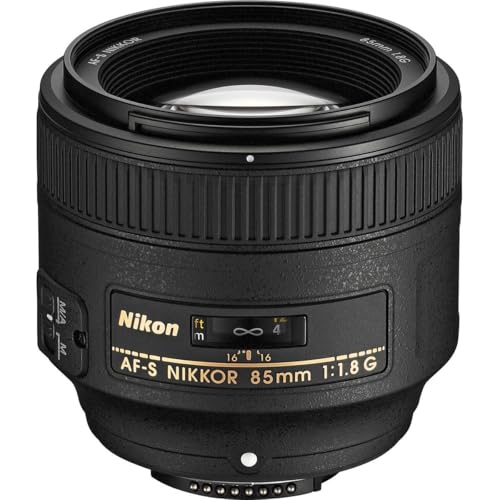
Portraits are where a fast prime earns its place, and the 85mm f/1.8G is one of Nikon’s best-value lenses. On the D500 it behaves like a 127.5mm lens, which is a classic portrait focal length: long enough to flatter faces and compress backgrounds, short enough to use indoors without backing through a wall. The f/1.8 aperture gives you soft, smooth background blur and lets you shoot in dim rooms without pushing the ISO hard.
Sharpness is excellent even wide open, and the lens is light enough to carry all day at 350 g. It focuses quickly and silently, and the 67mm filter thread takes standard filters. There is no stabilization here, but at this focal length the D500’s high ISO performance and the wide aperture cover most situations, and the lens rewards good technique with crisp, detailed files.
If portraits, events, or indoor candids are a regular part of your work, this is the prime to own. It is the smallest, lightest lens in this guide, and the one most likely to change how your portraits look.
Specs: Focal length: 85mm; Maximum aperture: f/1.8; Mount: Nikon F (FX); Stabilization: None; Weight: 350 g; Filter thread: 67mm; Minimum focus distance: 0.8 m; Effective focal length on D500: 127.5mm.
4. Nikon AF-S 50mm f/1.4G

The 50mm f/1.4G is the classic fast normal lens, and on the D500 it becomes a 75mm short telephoto, which is a sweet spot for portraits, street shooting, and low-light work. The f/1.4 aperture gathers far more light than any zoom in this guide, so it is the lens to reach for in a dim restaurant, a concert hall, or a living room at dusk. Backgrounds melt away at f/1.4, and subjects stand out with a three-dimensional quality that slower lenses cannot match.
It is a simple, honest lens: no stabilization, no zoom, just a bright aperture and good optics. The autofocus motor is quiet, the build is solid, and the 58mm filter thread keeps filters affordable. Wide open, the corners are a little soft and the depth of field is thin, so you need to place focus carefully, but that is the nature of fast glass, and the results repay the effort.
Every D500 owner should have one fast prime, and this is the most versatile choice. It teaches you to move your feet instead of twisting a zoom ring, and it keeps shooting long after slower lenses have given up on the light.
Specs: Focal length: 50mm; Maximum aperture: f/1.4; Mount: Nikon F (FX); Stabilization: None; Weight: 280 g; Filter thread: 58mm; Minimum focus distance: 0.45 m; Effective focal length on D500: 75mm.
5. Nikon AF-S 70-300mm f/4.5-5.6G IF-ED VR

The 70-300mm is the telephoto zoom for D500 owners who want real reach without the weight of the 150-600mm. On this camera it behaves like a 105-450mm lens, which covers sports from the sideline, wildlife at moderate distance, and compressed landscapes with ease. Vibration Reduction II steadies the view at the long end, and the autofocus is fast enough for the D500’s tracking system to do its best work.
At 745 g it balances nicely on the D500’s deep grip, and it is small enough to fit in a day bag beside a standard zoom. Image quality is strong through most of the range, with the best results coming from stopping down slightly at 300mm. The 67mm filter thread matches the 85mm prime above, so one set of filters serves both lenses, which is a small but real convenience.
This is the telephoto to choose when the 150-600mm is more lens than you want to carry. It pairs well with the 18-300mm as a two-lens travel kit, and it gives the D500 the reach its autofocus system was built to exploit.
Specs: Focal length: 70-300mm; Maximum aperture: f/4.5-5.6; Mount: Nikon F (FX); Stabilization: Vibration Reduction II; Weight: 745 g; Filter thread: 67mm; Minimum focus distance: 1.5 m; Effective focal length on D500: 105-450mm.
How to Match a Lens to Your Shooting
Think about focal length first and aperture second. If your subjects are far away, the crop factor is your friend, and the two telephoto zooms here give you 450mm and 900mm of effective reach. If you shoot people, the 85mm and 50mm primes give you the aperture and the focal lengths that flatter faces. If you travel, the 18-300mm covers nearly everything in one barrel.
Aperture matters most in low light and for background blur. The f/1.4 and f/1.8 primes in this guide gather several times more light than the zooms, which is the difference between a sharp shot and a blurred one indoors. Zooms trade aperture for range, which is the right trade when you cannot change lenses or cannot predict your distance to the subject.
Weight is the third factor, and it is easy to underestimate. The 150-600mm is a serious piece of glass that rewards a monopod and a strong shoulder, while the primes disappear into a jacket pocket. Buy the lens you will actually carry, not the one with the longest spec sheet, and your D500 will repay you with sharper files and more keepers.
Frequently Asked Questions
Do full-frame FX lenses work on the Nikon D500?
Yes. The D500 uses the Nikon F-mount, so both DX and FX F-mount lenses fit and work fully, including autofocus and metering. FX lenses project a larger image circle than the APS-C sensor needs, so the camera simply uses the central portion. That central portion is usually the sharpest part of the lens, which is a small bonus, and an FX lens can move with you if you later add a full-frame body.
What is the effective focal length of a lens on the D500?
Multiply the marked focal length by 1.5. A 50mm lens behaves like a 75mm lens, an 85mm behaves like a 127.5mm lens, and a 300mm behaves like a 450mm lens. This crop factor helps wildlife and sports shooters by adding free reach, but it also means true wide-angle work needs lenses in the 10-20mm range, which is why the 18mm end of the 18-300mm zoom equals 27mm on this camera.
Is the Sigma 150-600mm Contemporary too heavy to handhold on the D500?
It is heavy at 1,930 g, but many photographers handhold it for short bursts, especially with the optical stabilizer engaged and the lens supported by the left hand under the barrel. For longer sessions a monopod makes a real difference, and the removable tripod foot lets you switch between handheld and supported shooting quickly. If weight is a concern, the 70-300mm in this guide gives you 450mm of effective reach at less than half the weight.
Can I use older Nikon lenses on the D500?
The D500 accepts a wide range of F-mount lenses, including many older AF and AI-P lenses, but autofocus and metering depend on the lens type. Modern AF-S lenses with built-in motors work fully. Older screw-drive AF lenses also autofocus on the D500 because the camera has a built-in focus motor, unlike entry-level Nikon bodies. Fully manual lenses can be used with manual focus and, in many cases, metering, but check the specific lens before buying.
Conclusion
The D500 is a camera that rewards ambition, and these five lenses cover the ground most owners will ever need: a super-telephoto for wildlife, an all-in-one zoom for travel, two fast primes for portraits and low light, and a mid-weight telephoto for everything in between. The crop factor is the thread that ties them together, turning modest focal lengths into serious reach and turning fast primes into classic portrait lenses. Pick the lens that matches the subject you shoot most, add a second one when your work demands it, and the D500 will keep delivering the sharp, well-tracked files it was built for.
More from Amazon
Programs that pair well with the guide above. Offers and eligibility are set by Amazon and may change.
Free shipping on eligible items, Prime Video and more. Eligible new members can start with a free trial.
Start a Prime free trialAudiobooks and podcasts to listen to on the go. Eligible new members can start with a free trial.
Try Audible freeAd-free music streaming. Eligible new subscribers can start with a free trial.
Try Music Unlimited freeA free business account with business pricing and bulk-buying tools for work, shop or home office.
Create a business accountAs an Amazon Associate we earn from qualifying purchases.









