Key takeaways
- Compare the best hard camera cases: six rolling and compact picks, with size, foam type, wheels and water protection explained for your kit.
The K&F CONCEPT IP67 Waterproof Hard Case is the best overall pick for photographers who want true hard-shell protection for one camera kit: it combines a sealed shell with pick-and-pluck foam you can shape around your own gear. A hard camera case is a rigid, usually lockable shell with a foam interior that guards against impacts, crushing, dust and, on sealed models, water. If your priority is rolling a large kit through airports, look instead at the VEVOR, Relaxweex and Eylar rolling cases, and if you only need to protect a mirrorless body and a lens or two, the small Basics case is the simplest choice.
Quick List
- K&F CONCEPT IP67 Hard Case – best for sealed protection of a single camera kit
- Basics Large Rolling Hard Camera Case – best for a budget-friendly rolling case for a big kit
- VEVOR Weatherproof Hard Case – best for rugged travel and field use with wheels and pre-cut foam
- Basics Small Hard Camera Case – best for a body, a lens or two and a short trip
- Relaxweex Rolling Camera Hard Case – best for organizing many lenses with padded dividers
- Eylar 22-Inch Rolling Carry-On Camera Case – best for air travel with a divider and a lid organizer
Which One Is Right for You?
| If you… | Choose |
|---|---|
| Fly often and want a rolling case sized near carry-on limits | Eylar 22-Inch Rolling Carry-On Case |
| Need an IP67-rated shell and custom foam for a precise fit | K&F CONCEPT IP67 Hard Case |
| Carry many lenses and want dividers you can rearrange | Relaxweex Rolling Camera Hard Case |
| Work outdoors in rough conditions and want wheels plus pre-cut foam | VEVOR Weatherproof Hard Case |
| Need a basic large hard case with wheels for studio-to-location moves | Basics Large Rolling Hard Camera Case |
| Carry just a body, a lens or two and a flash | Basics Small Hard Camera Case |
The deciding questions are how much gear you carry, how often it moves by air and whether you need water resistance or just impact protection. A studio photographer driving to a client rarely needs the same case as a wildlife shooter crossing rivers. Pick the smallest case that holds the kit with some padding to spare, because a half-empty case lets equipment slide.
All 6 Picks in Detail
1. K&F CONCEPT IP67 Hard Case – Best for sealed protection of a single kit
As an Amazon Associate we earn from qualifying purchases at no extra cost to you.

This K&F CONCEPT case is a compact hard-shell box marketed with an IP67 waterproof, dustproof and shockproof rating and pre-scored pick-and-pluck foam. K&F’s listings for this size describe an exterior of roughly 13.5 x 11.4 x 5.3 inches, and related K&F pages for the same case family give an interior of about 12.4 x 9.2 x 4.8 inches and a weight near 4.5 pounds. Confirm those figures on the product page, since K&F sells several sizes with similar names.
The appeal is customization. You peel foam cubes out of a grid so your camera, lens and accessories each sit in a cut-out that matches their shape. That precision is hard to get with fixed dividers. It is a good fit for a mirrorless body with a couple of lenses, or for a drone kit, and its small size makes it easy to slide into a larger bag or onto a vehicle seat.
The practical tip with any pluck-foam case is to plan before you pull. Lay the camera and lenses on the foam, trace their outlines with a pencil, and remove cubes a layer at a time, starting smaller than you think you need. A snug fit is the goal, because a loose cut-out lets gear rattle. Keep the removed cubes: they are handy for padding gaps, cushioning a lens hood or filling a spot when you sell a lens.
- IP67 protection rating stated in the listing
- Pre-scored pick-and-pluck foam that you shape yourself
- Hard-shell exterior with latches
- Exterior about 13.5 x 11.4 x 5.3 inches (confirm on listing)
- Wheels: none listed; carried by handle
Pros
- Custom-fit foam keeps gear from shifting
- Sealed design suits wet and dusty environments
Cons
- Not a rolling case, so it gets heavy with a large kit
- Cutting foam takes time and cannot be undone
Compared with the VEVOR, it is smaller and more precise but lacks wheels.
2. Basics Large Rolling Hard Camera Case – Best for a large kit on a budget

This large rolling case is a house-brand hard protective camera case with wheels, listed at 22 inches long, 14 inches wide and 9.8 inches high. The listing describes it as black and positions it for photography and video equipment. It does not advertise a waterproof rating in the listing name, so treat it as a protective travel case rather than a sealed one. With a width and length matching many airline guidelines, it is tempting as a carry-on, but the 9.8-inch height is above the commonly cited 9-inch depth limit, so check your airline.
The Large model is mainly a transport tool for studio and location work. Use it to move lights, a body and several lenses between a car and a set, and think of the wheels as a way to prevent back strain on long walks through a venue. If you need the shell sealed against rain or dust, look at the K&F CONCEPT or the VEVOR instead, since the listing for this case does not make that claim.
Inside, expect a customizable foam or divider interior of the kind used in this class of case, but verify the layout on the product page. For studio photographers who move lights, bodies and lenses between locations, a case like this removes the strain of carrying everything by hand.
- External size 22 x 14 x 9.8 inches
- Wheels and a pull handle format for rolling
- Hard protective shell
- Black finish
- Waterproof rating and interior layout: confirm on listing
Pros
- Large capacity for a full kit
- Rolling design saves your back
Cons
- No sealed rating stated
- Height may exceed some carry-on limits
Next to the Eylar, it offers a similar footprint, while the Eylar markets itself specifically for carry-on travel with a lid organizer.
3. VEVOR Weatherproof Hard Case – Best for rugged field use with wheels

The VEVOR case is a heavy-duty protective dry box with pre-cut foam, wheels and a retractable pull handle. The listing mentions travel, hunting, military and tactical use, and VEVOR’s pages for this model list an IP67 waterproof rating with an exterior around 21.7 x 13.4 x 9.5 inches. VEVOR sells many sizes under similar names, so check the exact dimensions and whether the foam is pre-cut or pluck style on the page you buy from.
It targets users who care more about toughness than about a polished look: wildlife and sports photographers, drone operators and field crews. The wheels and extendable handle suit airport floors and rough loading docks, and the pre-cut foam saves setup time, although it is less customizable than pluck foam.
Rugged cases add weight, and the VEVOR is no exception: the thick shell, gasket and latches make it heavier than a soft bag or a thin roller. For photographers who shoot in weather, that weight buys security. The lock holes let you add a padlock for vehicle storage, the retractable handle makes it easy to pull across gravel or a parking lot, and the sealed lid is a reasonable safeguard for dust. Always check the foam fit with your own gear before you travel.
- Weatherproof, IP67-rated shell per the manufacturer
- Pre-cut foam interior
- Wheels and a retractable pull handle
- Exterior about 21.7 x 13.4 x 9.5 inches (confirm on listing)
- Latches and lock holes for padlocks
Pros
- Built for harsh conditions
- Rolling design with a sealed shell
Cons
- Pre-cut foam may not match camera gear well
- Bulky and heavy when loaded
Compared with the K&F CONCEPT, it handles a larger kit but gives up the pluck-foam precision.
4. Basics Small Hard Camera Case – Best for a body, a lens or two and a short trip

The small case is a compact hard camera case listed at 12 inches long, 11 inches wide and 6 inches high. It is designed for a modest kit, such as a mirrorless body, a couple of lenses and a few accessories. Like its larger sibling, it is a protective case without a stated waterproof rating, so think of it as a way to keep a kit safe from drops and pressure, not from immersion.
It works well as a case within a case: tuck it into a suitcase or a larger roller and your camera gear arrives in better shape than in a soft pouch. It also suits a car trunk or a studio shelf where you want a hard-sided home for a single camera.
Because it is small, it also makes a good second case for the items you cannot afford to lose, such as memory cards, spare batteries and a backup body. Keeping those in a separate hard case means a lost or damaged main bag does not take everything with it. For longer trips with several lenses, step up to one of the larger cases in this list.
- External size 12 x 11 x 6 inches
- Hard-sided black case
- No wheels; handheld carry
- Interior foam or divider layout: confirm on listing
- Waterproof rating: not stated
Pros
- Compact enough to fit inside luggage
- Simple, low-fuss design
Cons
- Limited space for telephoto lenses
- Not marketed as a sealed case
Against the K&F CONCEPT, it is similar in size but lacks the IP67 claim and customizable foam.
5. Relaxweex Rolling Camera Hard Case – Best for organizing many lenses

The Relaxweex is a rolling hard-shell travel case with 15 padded dividers and wheels. The listing describes it as impact-resistant and waterproof, so it targets photographers who want to configure their own layout with hook-and-loop dividers rather than cut foam. Confirm the exact interior and exterior dimensions on the page, because the listing name does not state them.
The divider approach is flexible. You can create compartments for a body with a grip, a stack of lenses, flashes and cables, and reconfigure the layout when your kit changes. It is a good choice for people who rent or swap equipment often, because foam cutouts are permanent while dividers are not.
To make a divider layout work, build the compartments tight and leave no empty space, since loose items can shift and bang against the shell. Place the heaviest lens at the bottom near the wheels so the case stays stable when it rolls, and wrap loose cables in a pouch. Photographers who also carry lights or audio gear can create extra compartments for microphones and batteries, then reshuffle them for the next job.
- 15 padded dividers for custom compartments
- Wheels for rolling travel
- Impact-resistant hard shell
- Described as waterproof (confirm rating on listing)
- Interior and exterior size: confirm on listing
Pros
- Reconfigurable layout adapts to changing kits
- Rolling design for heavy loads
Cons
- Dividers shift more than cut foam if not tightened
- Size and waterproof rating details are limited in the listing name
Compared with the VEVOR, it favors reconfigurable organization over a pre-cut layout.
6. Eylar 22-Inch Rolling Carry-On Camera Case – Best for air travel
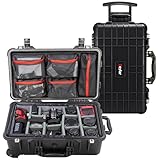
The Eylar is a 22-inch rolling hard camera case marketed for carry-on travel. The listing mentions an adjustable padded divider, a lid organizer, a waterproof shell and shockproof protection for equipment such as drones. A lid organizer is a practical extra: it keeps cables, memory cards and small accessories out of the main compartment so the lens area stays clean.
For travel, this case is the most natural fit for a flight with a mirrorless kit, a drone and a few accessories. Pack the camera body and lenses in the main area with the divider between them, use the lid for cables and cards, and weigh the case at home before you leave. If you plan to check the case instead of carrying it on, add padding on all sides and consider a lock that meets your airline’s rules.
Airline carry-on limits vary, and cases that are 22 inches long are often close to the limit once wheels and handles are included. Check the exact dimensions on the product page against your airline’s published limits, and plan for the fact that a full case may be too heavy to lift into an overhead bin comfortably.
- 22-inch rolling carry-on style
- Adjustable padded divider system
- Lid organizer for accessories
- Waterproof, shockproof claims in the listing
- Full exterior dimensions and weight: confirm on listing
Pros
- Designed with air travel in mind
- Lid pocket keeps small items organized
Cons
- Carry-on acceptance depends on the airline and the exact size
- Loaded weight can exceed bin lifting comfort
Next to the Relaxweex, it trades a larger number of dividers for a simpler layout and a dedicated lid organizer.
Specs Compared
| Case | Stated size | Wheels | Interior | Water protection | Notable feature |
|---|---|---|---|---|---|
| K&F CONCEPT IP67 | About 13.5 x 11.4 x 5.3 in (confirm) | No | Pick-and-pluck foam | IP67 stated | Pre-scored foam grid |
| Basics Large Rolling | 22 x 14 x 9.8 in | Yes | Confirm on listing | Not stated | Large rolling case |
| VEVOR Weatherproof | About 21.7 x 13.4 x 9.5 in (confirm) | Yes, retractable handle | Pre-cut foam | IP67 per manufacturer | Heavy-duty dry box |
| Basics Small | 12 x 11 x 6 in | No | Confirm on listing | Not stated | Compact hard case |
| Relaxweex Rolling | Confirm on listing | Yes | 15 padded dividers | Described as waterproof | Reconfigurable layout |
| Eylar 22-Inch Rolling | 22 in class (confirm full size) | Yes | Adjustable divider, lid organizer | Described as waterproof | Carry-on oriented |
How We Chose These
This is a research-based guide built from the six hard camera cases in the current catalog set. We compared each listing name with manufacturer pages and published specification summaries, looking at stated size, wheels, interior type, waterproof or impact claims and extras such as lid organizers. We favored clear statements over marketing language and flagged every spec that the listing does not state. Because many case families come in several sizes, we repeatedly advise confirming exact dimensions. Nothing here claims personal testing or ownership.
What to Look For
Size: interior, not exterior
The interior dimensions decide whether your gear fits. Measure your longest lens with the hood reversed and your camera with any grip attached, then add at least one inch on every side for foam. A 70-200mm f/2.8 lens is roughly 7 to 8 inches long, so an interior shorter than about 10 inches will struggle. Exterior size matters for carry-on rules, interior size for fit, and manufacturers do not always list both.
Foam type: pick-and-pluck, pre-cut or dividers
Pick-and-pluck foam comes as a grid of small cubes you remove to form cavities, making it the most flexible way to fit odd shapes. Pre-cut foam saves time but only suits the kit it was designed for. Padded hook-and-loop dividers let you change layouts but give less shock absorption on the sides. Use pluck foam for a stable kit, dividers for a changing one.
Water and dust protection
The IP67 rating means the case is dust-tight and can withstand temporary immersion to about one meter for up to 30 minutes, under standard test conditions. Look for a gasket around the lid, strong latches and a pressure-release valve if you fly, because air pressure changes can make a sealed case hard to open. Cases described only as waterproof, without a rating, should be treated as water-resistant until proven otherwise.
Wheels, handles and carry-on rules
Rolling cases save your back, but wheels and handles add to the case’s external size, and many airlines cap carry-on bags at about 22 x 14 x 9 inches including wheels. A fully loaded hard case can easily weigh 20 to 30 pounds, so check your airline’s weight limit as well. Spare lithium batteries should travel in your carry-on, not checked luggage, and loose batteries should have their terminals protected.
Worked example
Suppose you carry a mirrorless body, three lenses (the longest 8 inches), two flashes and a few accessories. Arrange them on a table, measure the footprint and add 1 inch of padding on each side. If the total is about 16 x 11 x 5 inches, a case with an interior near 17 x 12 x 6 inches fits, while the small 12 x 11 x 6 inch exterior case would not. Choose one size up if you plan to add a lens.
Questions
Is IP67 enough for kayaking or boating?
IP67 covers short immersion, but not extended submersion or impacts that break the seal. For boats, keep the case clipped down, check the gasket for debris before closing and use desiccant packs to manage moisture inside.
Why does my sealed case not open after flying?
Air pressure changes can create a vacuum inside a sealed case. A pressure-equalizing valve solves this, so open the valve before you try the latches.
Can I use a hard case as a carry-on?
Often yes, if its external size and weight match the airline’s limits. Measure with wheels and handle extended, and check the airline’s policy, because rules vary between carriers.
Should I choose foam or dividers?
Foam gives tighter protection for a fixed kit, while dividers suit a kit that changes. If you can afford it, a pluck-foam case is best for expensive, stable gear.
Will a hard case stop all damage?
No. It reduces risk from drops, crushing and moisture, but a case that is overpacked or poorly padded can still let gear shift. Keep lenses capped and use padding around loose items.
How should I clean and maintain a hard case?
Wipe the shell and gasket with a damp cloth, let it dry fully and keep latches free of grit. Replace any foam that has degraded or absorbed moisture.
Update History
- October 20, 2026 – Initial publication; product set drawn from current catalog listings.
- Check the product page for current specifications and availability before buying.
Sources
- Manufacturer product and specification pages for K&F CONCEPT and VEVOR
- Retailer listing titles and specification fields for all six cases
- Published product roundups and retailer spec sheets for case size and feature cross-checks