Our Top Picks
 Slinger 35L Electronic Dry Cabinet with Combination Lock15.2520.5 x 15.25 x 15.25 inches20.25 PoundsCheck on Amazon
The best camera dry cabinet for most photographers is an electronic model in the 50 to 80 liter range, and on paper the RUGGARD Electronic Dry Cabinet (80L) is the best all-rounder because it holds two bodies and a handful of lenses with growth room. The reason is simple: a cabinet that is too small gets crammed, and gear packed tight blocks the airflow the cabinet depends on.
Here is how the rest of this guide is organized. First, a liters worksheet so you can size the cabinet before looking at a single product. Then eight electronic cabinets from 30L to 125L, compared from published specifications, manufacturer documentation and buyer reviews by the Editorial team. After that, the humidity band to aim for, a three-day setup routine and a monthly power estimate. Nobody on the team used or measured these cabinets, so every performance number below is a labeled estimate and everything else is whatever the product title says.
Start with liters: a worksheet for your own kit

RUGGARD Electronic Dry Cabinet (50L)


As an Amazon Associate we earn from qualifying purchases. Product prices and availability are accurate as of the date/time indicated.

Ruggard Electronic Dry Cabinet (80L)


As an Amazon Associate we earn from qualifying purchases. Product prices and availability are accurate as of the date/time indicated.

SLINGER 125L Dehumidifying Dry Cabinet Box, Digital Control Noiseless and Energy Saving, 5 Layers for DSLR/Mirrorless Camera Lens and Electronic Equipment Storage,Temperature Humidity LED Dual Screen


As an Amazon Associate we earn from qualifying purchases. Product prices and availability are accurate as of the date/time indicated.
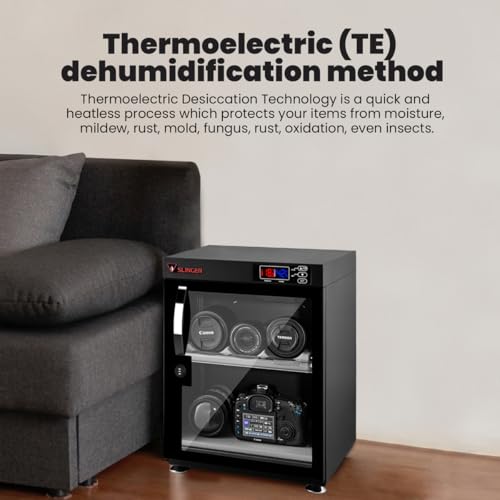
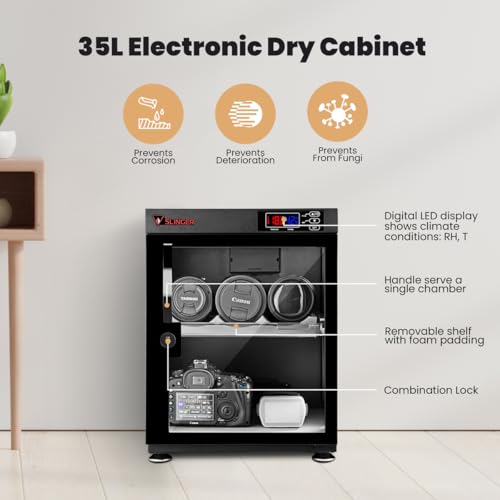
Slinger 35L Electronic Dry Cabinet with Combination Lock | 35L capacity with thermoelectric cooling and combination lock for cameras, lenses and electronics




As an Amazon Associate we earn from qualifying purchases. Product prices and availability are accurate as of the date/time indicated.

30L Camera Dry Cabinet, Electronic Dehumidifier Storage Cabinet | 25%-70% RH Adjustable, Temperature & Humidity LED Display, Quiet, Energy-Efficient Storage for Cameras, Lenses & Electronics


As an Amazon Associate we earn from qualifying purchases. Product prices and availability are accurate as of the date/time indicated.

AUTENS 80L Dehumidifying Dry Cabinet Box, Digital Control Noiseless and Energy Saving, 4 Layers for DSLR SLR Camera Lens and Electronic Equipment Storage,Temperature Humidity LED Dual Screen


As an Amazon Associate we earn from qualifying purchases. Product prices and availability are accurate as of the date/time indicated.
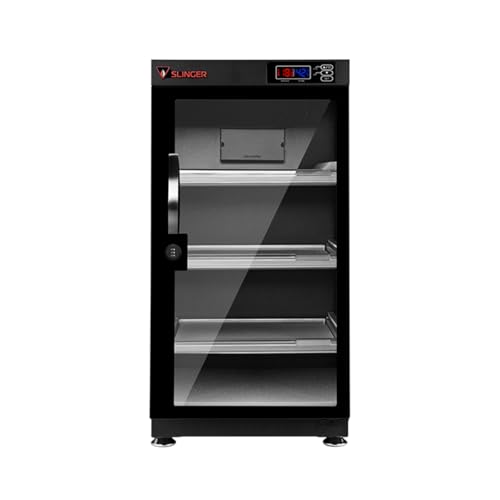
Slinger 55L Electronic Dry Cabinet with Combination Lock | 55L capacity with combination lock and thermoelectric cooling for cameras, lenses and precision instruments


As an Amazon Associate we earn from qualifying purchases. Product prices and availability are accurate as of the date/time indicated.

SLINGER 125L Electronic Dry Cabinet with Combination Lock (Oak) – Humidity Controlled Camera Storage, LED Display, Adjustable Shelves for Cameras, Lenses & Electronics


As an Amazon Associate we earn from qualifying purchases. Product prices and availability are accurate as of the date/time indicated.
Cabinet capacity is quoted in liters of internal volume, not usable shelf space. Racks, gaps between lenses and the curve of a lens barrel waste room, so a practical rule is to divide your raw gear volume by about 0.5. The item volumes below are rough estimates for common gear, not measurements; weigh them against your own kit.
| Item | Rough volume (estimate) |
|---|---|
| Camera body without lens | 1.5 to 2.5 L |
| Standard zoom or kit lens | about 1 L |
| 70-200mm f/2.8-class telephoto zoom | about 2.5 L |
| Compact prime lens | 0.3 to 0.8 L |
| On-camera flash | about 0.8 L |
| Pouch of batteries, charger and cards | about 0.7 L |
Run three example kits through that table. A starter setup with one mirrorless body, three lenses and a pouch totals about 4.7 L raw, so roughly 9 to 10 L in practice, which a 30L or 35L cabinet handles easily. An enthusiast setup with two bodies, five lenses (one a big telephoto), a flash and a pouch totals about 10.8 L raw, or about 22 L in practice: a 35L cabinet is tight, and a 50L or 55L model leaves breathing room. A working kit of three bodies, seven lenses, two flashes and pouches lands around 20 L raw, or 40 L packed, which points to 80L. Add a gimbal, mics and a monitor and you are looking at 125L.
If the Editorial team had to give one rule, it would be to buy the size above the one the math suggests. Gear grows, and a cabinet at 90 percent full is also a cabinet whose humidity readings lag behind the shelf in the back corner.
Top picks at a glance
Capacity numbers come from the product titles. Price tiers are relative within this group; check each listing for the current price.
| Model | Key spec (from title) | Price tier | Best for |
|---|---|---|---|
| RUGGARD Electronic Dry Cabinet (80L) | 80L electronic | Mid-range | Best overall for two bodies and several lenses |
| SLINGER 125L Electronic Dry Cabinet with Combination Lock (Oak) | 125L, combo lock, adjustable shelves, LED display | Mid-range | Large kits with a lock and a furniture look |
| SLINGER 125L Dehumidifying Dry Cabinet Box | 125L, 5 layers, digital control, dual LED screen | Mid-range | Video and hybrid kits |
| AUTENS 80L Dehumidifying Dry Cabinet Box | 80L, 4 layers, digital control, dual LED screen | Premium | Buyers who want a dual display |
| Slinger 55L Electronic Dry Cabinet with Combination Lock | 55L, thermoelectric cooling, combo lock | Budget | Enthusiast kit with a lock |
| RUGGARD Electronic Dry Cabinet (50L) | 50L electronic | Mid-range | Compact two-body kits |
| Slinger 35L Electronic Dry Cabinet with Combination Lock | 35L, thermoelectric cooling, combo lock | Budget | Starter kit and shared spaces |
| 30L Camera Dry Cabinet (Zuomeng) | 30L, 25%-70% RH adjustable, LED display | Budget | Smallest footprint |
RUGGARD Electronic Dry Cabinet (80L)
RUGGARD is a photography-accessory brand name, and this 80-liter electronic cabinet is the sweet spot on paper for a person whose kit is no longer a hobby. The title gives only three facts: it is electronic, it is a dry cabinet, and it holds 80 liters. Everything else (shelf count, humidity range, wattage, lock) sits behind the listing, so open it and read before buying.
Capacity is the main selling point. By the worksheet above, 80 liters accommodates about 40 liters of raw gear volume at 50 percent packing, which is the working kit of three bodies and seven lenses, or an enthusiast kit with real growth room. That headroom keeps lenses spaced apart so air moves between them, which matters because an electronic cabinet conditions the whole volume rather than each item.
Check the listing for outside dimensions against your space, including door swing and the clearance the maker wants around the vents. Ask yourself where the power cable will route and whether the outlet is behind furniture you will want to move. Because the cabinet will run for years, a unit with a user-replaceable seal or filter, if the listing mentions one, is worth more than an extra shelf. Also decide in advance how you will load it: bodies with caps on, lenses with both caps on, and batteries removed from bodies if the camera maker advises it.
Pros
- 80L capacity suits two to three bodies and a full lens lineup, by our estimate
- Photography-accessory brand (confirm warranty details on the listing)
- Electronic control, so no silica to recharge
Cons
- Title does not state humidity range, wattage, shelf count or lock type; check the listing
- Large footprint compared with 30 to 55L models
- Mid-range price tier, higher than the small budget cabinets
Who it’s for: a working or serious enthusiast shooter with two or three bodies who wants one cabinet that will not be outgrown in a year.
SLINGER 125L Electronic Dry Cabinet with Combination Lock (Oak)
This is the biggest cabinet in the round and the only title that names a finish, oak. The title also lists a combination lock, humidity control, an LED display and adjustable shelves, which together make it the closest to a piece of furniture. A 125-liter volume holds roughly 60 liters of raw gear by our packing estimate, enough for a studio kit with several bodies, a dozen lenses and lighting accessories.
The lock changes the use case. A combination lock is useful in a shared studio, a rented space or a house with children, though it is a deterrent rather than a safe, and most cabinet locks can be defeated by force. Treat it as a way to keep casual hands off an expensive lens, not as theft protection. Write the combination somewhere sensible and not on the cabinet, and test the lock a few times with the door open before you close it with gear inside.
Adjustable shelves matter more than they sound. Telephoto lenses stand tall, while primes and flashes can share half-height layers. Set the shelves once, put the heaviest lens low, and leave a finger of space around each item. A 125L cabinet can take 15 or more hours (our estimate) to settle to its target after you fill it, so judge it by the second day, not the first hour.
Think about the footprint, too. Large cabinets are heavy once loaded, so place it on a solid surface and keep the cable and vent clear.
Pros
- 125L volume with adjustable shelves
- Combination lock and LED display listed
- Oak finish blends into a living space or office
Cons
- Large and heavy; check dimensions and desk or shelf strength
- Combination lock is a deterrent, not a security product
- Power draw and exact humidity range are not in the title
Who it’s for: a studio owner or hybrid photographer-videographer with a big kit and a shared workspace.
SLINGER 125L Dehumidifying Dry Cabinet Box
This second 125L Slinger takes a different form: a “dehumidifying dry cabinet box” with digital control, noiseless and energy-saving claims, five layers, and a temperature and humidity LED dual screen. It is marketed for DSLR and mirrorless cameras, lenses and electronic equipment. The “5 layers” in the title tells you the shelf count, which is the detail missing from many competitors.
The dual screen is the practical feature. One readout for temperature and one for humidity lets you check the cabinet at a glance without opening it, and it makes the 72-hour settling routine later in this guide much easier. Still, an onboard sensor measures one spot; place a small separate hygrometer on a middle shelf to confirm the display tells the truth.
“Noiseless” and “energy saving” are marketing words. Real thermoelectric and small compressor-free systems tend to be quiet, but fans and relays can click or hum, and a cabinet in a bedroom or recording space is worth reading buyer reviews about on that point. Likewise, check the listing for rated power, because 125 liters of air is a bigger job than 35.
The five-layer setup suits mixed kits: lenses on one level, bodies on another, flashes and batteries on a third, and a video layer for monitors, mics or cables. Keep batteries, which dislike heat, off the shelf nearest the dehumidifying element if the listing mentions where that sits.
Pros
- 125L with five layers stated in the title
- Temperature and humidity dual screen
- Digital control, built for DSLR and mirrorless gear
Cons
- No lock mentioned in the title
- “Noiseless” and “energy saving” are claims, not measurements
- Large, so it is a cabinet for a dedicated spot
Who it’s for: a hybrid shooter who stores bodies, lenses and video accessories together and wants shelf separation.
AUTENS 80L Dehumidifying Dry Cabinet Box
AUTENS offers 80 liters in four layers, with digital control, “noiseless and energy saving” language, and a temperature and humidity LED dual screen. It is the only Premium-tier unit in the group, which means it costs more than the equally sized RUGGARD 80L and needs a feature argument to justify the gap. The title offers the dual display and four-layer shelving; whether the build, the seal or the control accuracy is better is something only the listing and buyer reviews can tell you.
Four layers of 80 liters averages about 20 liters per level. That is enough for a telephoto lens standing up on one level, bodies on another, and primes or flashes on the others. If you shoot with a long zoom, check the internal height listed for each shelf, because a 70-200mm lens with a hood on is tall.
When two cabinets look equal on paper, durability and seal quality decide the winner over several years. Check the door seal, the hinge design and the cable exit in photos and reviews. A door gasket that stops compressing evenly leaks humid air, and the cabinet runs constantly to compensate, which wears the dehumidifying element faster and raises the power bill. Read the lowest-rated recent reviews and look for patterns such as a drifting sensor or a door that will not close flush.
Price is the other question. Because RUGGARD’s 80L sits in a lower tier, the AUTENS has to win on something concrete, and the likeliest candidates are the dual display and the four-shelf layout. If neither matters to you, the cheaper 80L is the more rational purchase.
Pros
- 80L with four layers
- Dual LED screen for temperature and humidity
- Digital control and a design aimed at DSLR/SLR gear
Cons
- Premium price tier for the same capacity as cheaper rivals
- No lock mentioned in the title
- Wattage, humidity range and warranty terms are not stated; check the listing
Who it’s for: a buyer who prefers the shelf layout and display of this model and has read good build-quality reports.
Slinger 55L Electronic Dry Cabinet with Combination Lock
The 55-liter Slinger is the budget-tier choice that most enthusiasts should look at first. The title lists thermoelectric cooling, a combination lock, and a target of “cameras, lenses and precision instruments.” At 55 liters, the worksheet puts it at about 27 liters of raw gear, which means the enthusiast kit (two bodies, five lenses, a flash and a pouch, about 11 liters raw) fits with a good margin.
Thermoelectric cooling is worth understanding. A thermoelectric unit pulls moisture by chilling a surface so water condenses, and it has no compressor, so it tends to be quiet. The limit is output: in a very humid room or a space with big temperature swings, the moisture load can exceed what a small thermoelectric element removes, and the cabinet may run continuously without reaching your target. Check the listing for how condensate is handled and for the recommended ambient range.
For a typical bedroom or office in a moderately humid home, it should keep up with a lived-in kit, assuming the door is kept closed. Opening the door for a full minute lets in a cabinet-load of room air; limit visits and take things out in one trip. Pair it with an inexpensive separate hygrometer to confirm the reading.
The lock is useful for a shared house, but treat it as a deterrent only.
Pros
- 55L is a flexible mid-size capacity at a Budget tier
- Thermoelectric cooling and combination lock listed
- Fits an enthusiast kit with room to grow
Cons
- Thermoelectric elements can struggle in very humid rooms
- Too small for a three-body working kit
- Shelf count, wattage and humidity range are not in the title
Who it’s for: an enthusiast with two bodies and a handful of lenses who wants a lock and a moderate price.
RUGGARD Electronic Dry Cabinet (50L)
The 50-liter RUGGARD is the smaller sibling of the 80L pick, and the title again keeps to three facts: RUGGARD, electronic, 50 liters. It sits in the Mid-range tier, a notch above the Slinger 55L despite having slightly less volume, so the purchase is about brand preference, warranty and build, not capacity. Look at the listing for shelf count, humidity range and any lock.
At 50 liters, the worksheet supports about 25 liters of raw gear. That is a two-body kit with three or four lenses and a flash, or a single body with a telephoto and a collection of primes. If you shoot wildlife with a long lens in the 2.5-liter class, one such lens takes a tenth of the cabinet by itself, so count the big items first and then fill around them.
A smaller cabinet has one advantage: it recovers faster after the door is opened, since there is less air to dry. For a desk-side cabinet that you open every day, that matters. If you carry gear in a sling bag and return it each evening, a 50L unit paired with sensible habits is quite enough. Read the listing for physical dimensions and the door hinge side so it fits next to a wall.
Keep a separate list of anything you cannot store: tripod feet and straps, for instance, do not need a cabinet. Our guide to camera tripods explains why a damp tripod head matters less than a damp lens.
Pros
- 50L suits a two-body kit
- Photography-accessory brand with electronic control
- Fast recovery after door opening because of the smaller volume
Cons
- Costs more than the larger Slinger 55L
- Title omits lock, humidity range, wattage and shelf count
- Limited headroom if the kit grows
Who it’s for: a buyer who wants a compact photography-brand cabinet for a two-body kit and values faster recovery.
Slinger 35L Electronic Dry Cabinet with Combination Lock
The 35-liter Slinger packs thermoelectric cooling and a combination lock into a small footprint for the Budget tier. By the worksheet it handles about 17 liters of raw gear, so the starter kit (one body, three lenses and a pouch, about 4.7 liters raw) fits with more than 3 times the space needed, while the enthusiast kit is a squeeze.
That headroom is the point. A small cabinet that is 30 to 40 percent full has air space around everything, so the humidity reading is meaningful and the dehumidifying element works less hard. It also means a modest mirrorless setup can include a flash, a spare battery and a couple of extra lenses without a reshuffle.
Small thermoelectric cabinets are well suited to apartments and shared rooms because they tend to be quiet and have a small power draw, though you should check the listing for the actual figure. If you travel, keep the cabinet for home use and a sealed hard case with a small desiccant pack for the road. Do not assume a travel bag is protected: a cabinet only protects gear while it is inside with the door shut.
One more practical angle: a 35L cabinet makes an excellent dedicated home for the one lens you reach for least. The lens that lives in a drawer for months is the one most likely to grow fungus, so put the rarely used telephoto or the vintage prime inside, and leave your daily zoom in the bag where it gets airflow and use.
Many photographers also keep straps and bags outside. See our camera strap guide for materials that tolerate humid travel better than leather.
Pros
- 35L at a Budget tier with a lock
- Thermoelectric cooling listed
- Small footprint for apartments and desks
Cons
- Too small for two bodies plus a telephoto
- Thermoelectric elements can be overwhelmed in very humid rooms
- Wattage and humidity range are not in the title
Who it’s for: a starter or casual photographer with one body and a few lenses who wants a lock.
30L Camera Dry Cabinet (Zuomeng)
The Zuomeng 30-liter cabinet is the only one whose title states a humidity range: “25%-70% RH Adjustable.” It also lists a temperature and humidity LED display, quiet operation and energy efficiency. It is a Budget-tier unit built for cameras, lenses and electronics, and its small size makes it the lightest and easiest to move among the eight.
The stated range is useful because it shows you the settings you can pick. A target of 40 to 50 percent sits comfortably inside it. The wide range also lets you run the cabinet drier for a damp season or looser for electronics that do not need aggressive drying. Remember, though, that a range printed in a title is a setting range, not a promise that the cabinet can hit 25 percent in a room at 85 percent humidity. Check the listing for the ambient conditions it expects.
At 30 liters, the worksheet suggests about 15 liters of raw gear: one body, three or four lenses, and a pouch. That is a good fit for beginners, a second kit, or a dedicated cabinet for one camera system. The compact size also makes it practical to put in a closet, though keep the air around the cabinet free so the unit can vent its heat.
The brand is lesser known, so read buyer reviews for sensor accuracy and warranty support before purchase.
Because the humidity range is adjustable, this is also a good unit for experimenting. Start at 45 percent, log the display and a separate hygrometer for a week, then move the setpoint two or three points at a time. If the cabinet runs constantly without reaching the target, the room is too damp for a small element, and the fix is moving the cabinet, not turning the dial lower.
Pros
- 25%-70% RH adjustable range stated in the title
- LED display for temperature and humidity
- Lowest price tier and a small footprint
Cons
- 30L gets tight beyond one body and a few lenses
- No lock mentioned in the title
- Lesser-known brand; verify warranty and support terms
Who it’s for: a beginner or second-camera owner who wants a small, simple, adjustable cabinet.
Electronic cabinet or desiccant: which humidity band to aim for
Fungus on lens elements and coatings tends to appear when the air stays warm and damp for extended periods. A common rule of thumb is that growth risk rises above roughly 60 to 65 percent relative humidity, and many photographers aim for about 40 to 50 percent. Those numbers are rules of thumb, not guarantees; read your camera and lens manuals and choose a target within a reasonable band.
Electronic cabinets control humidity with a sensor and a dehumidifying element that switches on when readings climb above the setpoint. Desiccant (silica gel) cabinets and boxes absorb moisture passively and need recharging when saturated. Electronic units cost more up front and add a small electricity bill, but they remove the recharging routine and suit humid regions. Silica is cheaper, and fine in a sealed case if you keep checking the indicator and a hygrometer.
The cabinets in this guide are all electronic. The titles that mention thermoelectric cooling (Slinger 35L and 55L) describe a quiet approach without a compressor. The others state “dehumidifying” or “humidity controlled” without naming the mechanism, so check the listing. If you live in a swamp-humid climate, ask whether the cabinet’s stated ambient range covers your room.
A word on going too dry: pushing humidity far below the 30 percent area is rarely necessary, and some people avoid extremes because rubber, leather and lubricants can respond badly. If your cabinet allows a setpoint, pick one in the middle of the band and see how it behaves for a week. Use our camera flash guide if you plan to store speedlights in the same cabinet, since battery compartments dislike moisture too.
A 72-hour setup routine for a new cabinet
- Hour 0: place the cabinet on a firm surface with space around the vents, away from direct sun, radiators and bathrooms.
- Hour 0 to 4: run it empty with the door closed; set the target near 45 percent and place a separate hygrometer on the middle shelf.
- Hour 4 to 24: compare the display and the hygrometer; if they differ by more than five points, note the offset on a label.
- Day 2: load gear, heaviest on the lowest shelf, with a finger of space around each lens; close the door and leave it alone for 24 hours.
- Day 3: read both sensors. If humidity is still above 55 percent, check the door seal, move the cabinet away from damp walls and recheck.
- Week 2: open the cabinet no more than a few times per day and take out everything you need in one visit.
Fungus risk rarely strikes in a week, so patience is part of the routine. If you have a lens that already smells musty, do not store it with the rest. Inspect it with a flashlight, and if you see web-like growth inside, take it to a repair shop; a cabinet prevents new growth but does not fix existing contamination.
This is also the right time to write down serial numbers, so that insurers and resale buyers can see which lens is which. If your kit includes motion gear, such as a gimbal with sensitive bearings, see our gimbal stabilizer guide for what to keep in the cabinet.
Power, noise and monthly cost
Wattage is rarely in the title, so use these labeled assumptions for a rough estimate: a small thermoelectric cabinet cycles and averages about 15 watts across the day, while a larger or less efficient unit averages about 40 watts. Running 24 hours for 30 days means 720 hours.
At 15 watts, that is 0.015 kW x 720 hours = 10.8 kWh, and at 16 cents per kilowatt-hour roughly $1.70 per month. At 40 watts, it is 28.8 kWh, or about $4.60 per month. Either number is small next to the price of one lens. The comparison that matters is not the electric bill but the cost of a repair: a fungus-damaged lens can cost more than a cabinet to clean or replace.
Noise matters more than power for bedrooms and studios. Thermoelectric models tend to be quiet apart from a small fan, which is a reason the Slinger 35L and 55L are good picks for a living space. Larger cabinets move more air and may be more audible. Check the listing for any decibel figure and read buyer reviews for words like hum, click or buzz.
How we picked these
This is a desk comparison from the Editorial team. We read each product title, the manufacturer documentation that was available, and patterns in buyer reviews. The testbench is published specifications, manufacturer documentation and buyer reviews. Nobody on the team used or measured any of these cabinets, and every performance figure here is either a title statement or a labeled estimate.
We weighed six factors. First, capacity in liters, converted into kit sizes using the worksheet above. Second, whether the title states a humidity range, a display and a lock. Third, the stated cooling method, because thermoelectric and other approaches behave differently in humid rooms. Fourth, shelf layout, such as four or five layers or adjustable shelves. Fifth, the brand’s focus on photography storage. Sixth, relative price tier.
When a title did not provide something, such as wattage, noise level or shelf height, we wrote “check the listing” instead of making up a figure. Buyer reviews help with durability, sensor accuracy and service, but they are anecdotes. Read the lowest-rated recent reviews, and look for a repeated complaint about a drifting sensor or a door that will not seal.
Mistakes buyers make
Buying to the exact liter. A cabinet that fits today’s gear with no room will block airflow, and gear grows. Buy one size up.
Trusting one sensor. Onboard displays can drift. A small separate hygrometer on the middle shelf is cheap insurance.
Opening the door constantly. Every long door-open lets in room air, forcing the cabinet to dry it again. Take what you need in one trip.
Putting wet gear in. Gear that came in from rain or a humid beach should dry in open air first. A cabinet is not a drying machine for soaked equipment.
Assuming the lock equals security. A combination lock keeps casual hands out. It does not replace insurance or a safe.
Storing nothing but lenses. Bodies, batteries, flashes and filters also suffer in humid air. Include them, subject to each maker’s advice on batteries.
Verdict
For most people, the RUGGARD Electronic Dry Cabinet (80L) is the best overall pick on paper: enough room for a full working kit, a photography-focused brand and an electronic control. The best value is the Slinger 55L with a combination lock, which covers an enthusiast kit at the Budget tier. For large studio or hybrid kits, choose between the two Slinger 125L models, picking the oak version for the lock and the other for the five-layer layout and dual screen.
The AUTENS 80L is worth a look if its shelf layout suits you, though it carries a Premium tier. For a single body and a few lenses, the Slinger 35L or the Zuomeng 30L are enough. Whichever you pick, add a separate hygrometer and follow the 72-hour routine.
Frequently asked questions
What humidity should a camera dry cabinet hold?
Many photographers aim for roughly 40 to 50 percent relative humidity and treat sustained readings above about 60 percent as the risk zone for fungus on lens coatings and in focusing helicals. Going much drier is rarely necessary, and some people avoid extremes because leather, rubber and lubricants can suffer. Check your lens and camera manuals for guidance, and confirm the cabinet’s adjustable range on its listing.
How many liters do I need for a camera and lenses?
Estimate the raw volume of your gear, then divide by roughly 0.5 to allow for shelf gaps and packing. A mirrorless body with three lenses needs about 8 to 10 liters in practice, two bodies with five lenses and a flash about 20 to 25, and a working kit with three bodies and seven lenses about 40. These are planning estimates. Buy the next size up to leave room for growth.
Is an electronic dry cabinet better than silica gel?
Electronic cabinets regulate humidity automatically and need only a power outlet, while silica gel is cheap but needs regular recharging and has no feedback loop unless you add a hygrometer. Electronic units suit humid climates and larger collections. Silica works in a small case if you check it often. Either way, a separate hygrometer helps you confirm the cabinet is doing its job.
Can a dry cabinet run all the time without damaging gear?
These cabinets are designed for continuous operation, and the humidistat cycles the dehumidifying element on and off to hold the setpoint. The usual caution is to avoid driving humidity far below a sensible target, and to keep batteries and lens caps in ordinary conditions as advised by their makers. Read the listing for the power draw and any recommended operating environment.
Do I still need to open the cabinet and use my lenses?
Yes. Lenses and bodies benefit from being used, because moving parts stay lubricated and you will notice early problems such as haze or a stiff zoom ring. A cabinet lowers fungus risk but does not remove existing contamination or replace routine cleaning. Rotate gear, and have a suspicious lens inspected by a repair shop rather than trying to fix it yourself.