Key takeaways
- Coarse stage: removes metal quickly and establishes a new bevel. Use it for serious dullness or minor damage, not routine touch-ups.
- Fine stage: refines the bevel and removes much of the coarse stage’s scratch pattern.
- Stropping or polishing stage: smooths and aligns the apex, usually improving slicing feel and reducing the roughness left by diamond abrasives.
The best electric knife sharpeners depend on your knives and sharpening habits: choose the Chef’sChoice 1520 for a polished, repeatable edge on both Western and Asian blades, the Work Sharp Ken Onion Edition for maximum control and heavy repair work, or the Presto EverSharp for inexpensive everyday maintenance.
Our top picks

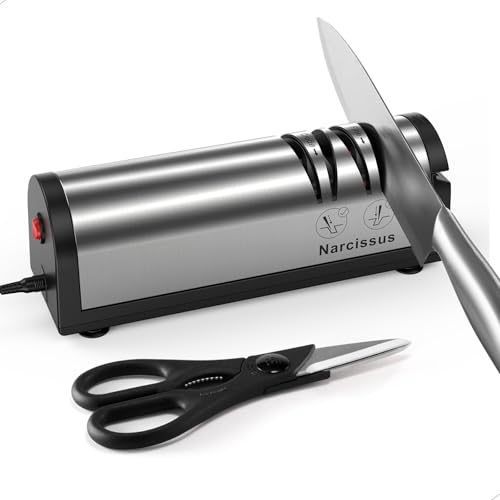

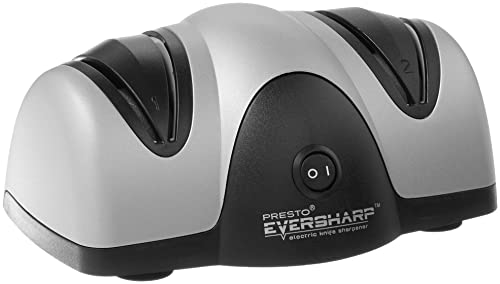
As an Amazon Associate we earn from qualifying purchases at no extra cost to you. Ratings are shown as listed on Amazon.
Best electric knife sharpeners at a glance
| Best for | Product or type | Stages | Angle control | Typical price range | Main limitation |
|---|---|---|---|---|---|
| Most mixed home kitchens | Chef’sChoice 1520 | 3 | 15° and 20° guides | $150–$220 | Less suitable for thick outdoor or heavily damaged blades |
| Best low-cost maintenance | Presto EverSharp 08800 | 2 | Fixed guides, approximately 20° | $35–$60 | Limited control and fewer blade types |
| Best for repairs and customization | Work Sharp Ken Onion Edition | Variable belt system | Adjustable, approximately 15°–30° | $150–$220 | Requires more technique and careful handling |
| Best compact upgrade | Chef’sChoice 250 | 3 | Fixed guides, approximately 15°–20° | $80–$130 | Not a full substitute for a variable-angle system |
| Frequent professional-style maintenance | Commercial three-stage diamond sharpener | 3 | Usually fixed 15° or 20° guides | $200–$500+ | More counter space, noise, and consumable cost |
Prices are broad 2026 market ranges rather than fixed quotes. Product packages, regional pricing, and included accessories can change the total.
Our top picks by kitchen situation
Chef’sChoice 1520: the easiest all-round choice
The Chef’sChoice 1520 is a strong choice when a household owns both standard Western knives and thinner Japanese-style knives. Its three stages typically combine a coarse diamond abrasive for reshaping, a finer diamond stage for sharpening, and a stropping or polishing stage for refining the edge. Separate guides accommodate approximately 15-degree and 20-degree edges.
That combination matters more than the number of stages alone. A coarse stage removes metal quickly, while the polishing stage reduces the roughness left by the abrasive. For ordinary dullness, you usually need only the fine and polishing stages; using the coarse stage every time accelerates blade wear.
Choose it if you want push-through consistency without learning freehand technique. Avoid it for single-bevel Japanese knives, serrated bread knives, or unusually thick blades unless the manual specifically lists them as compatible.
Presto EverSharp 08800: the budget maintenance pick
The two-stage Presto EverSharp is suited to inexpensive or everyday kitchen knives that have become blunt but are not badly damaged. Its fixed-angle guides make it simple to use, and its compact footprint suits a small kitchen.
Its compromise is control. A fixed guide cannot accommodate every factory edge, and a basic two-stage system gives you less opportunity to repair a chipped or severely rounded edge gradually. It is best viewed as a convenient maintenance appliance rather than a precision sharpening platform.
For a household sharpening ten knives twice a year, a $45 sharpener used for five years costs about $0.45 per sharpening session before electricity: $45 divided by 100 sessions. That is inexpensive, but replacing blades damaged by excessive sharpening can erase the saving.
Work Sharp Ken Onion Edition: the choice for control and repairs
The Work Sharp Ken Onion Edition uses abrasive belts rather than narrow pull-through slots. Its variable speed and adjustable guide make it better suited to repairing dull edges, changing bevel angles, and working on larger knives. The system can typically cover approximately 15° to 30°, depending on setup and guide position.
The belt format also makes it more versatile: different grits can remove damage, establish an edge, and polish it. However, it demands a lighter touch. Holding the blade too long in one place can create a hollow or uneven bevel, while excessive pressure can round the edge. It is the best electric option here for an owner willing to follow a technique-based process, not necessarily the best first sharpener for a completely inexperienced user.
Chef’sChoice 250: a compact middle ground
The Chef’sChoice 250 offers a smaller three-stage format for users who want more refinement than a basic two-stage sharpener but do not need the belt flexibility of the Work Sharp. It is particularly appealing when storage space is limited and the knife collection is mostly conventional double-bevel kitchen knives.
Check the guide specifications before buying if you own very thin Japanese knives, thick cleavers, or serrated blades. Fixed slots are convenient, but they cannot reproduce every edge geometry.
What the stages actually do
- Coarse stage: removes metal quickly and establishes a new bevel. Use it for serious dullness or minor damage, not routine touch-ups.
- Fine stage: refines the bevel and removes much of the coarse stage’s scratch pattern.
- Stropping or polishing stage: smooths and aligns the apex, usually improving slicing feel and reducing the roughness left by diamond abrasives.
More stages do not automatically mean a sharper knife. Angle accuracy, abrasive quality, blade support, and stopping at the right time matter just as much. A sharpener that removes too much metal can produce a temporarily keen edge while shortening the knife’s useful life.
Angle, blade type, speed, and noise
Most Western chef’s knives use a bevel near 20 degrees per side, while many Japanese-style double-bevel knives use approximately 15 degrees per side. These are useful categories, not universal laws. Always check the knife maker’s guidance where available.
Electric pull-through sharpeners generally run for only seconds at a time, but their motors can be noticeably loud in a quiet kitchen. Belt systems vary their sound with speed and abrasive grit; coarse belts are often louder and produce more visible dust. If noise matters, a three-stage slot sharpener is usually less disruptive than a high-speed belt tool, although the exact sound depends on the motor and countertop.
Compatibility is equally important. Serrated knives need a specialized tapered abrasive or a manual rod; flat pull-through slots cannot properly sharpen the recessed portions of most serrations. Single-bevel sushi knives, scissors, hatchets, and very thick cleavers also require equipment designed for their geometry.
A practical decision matrix
| Your situation | Best fit | Why |
|---|---|---|
| Under $60, occasional sharpening, standard knives | Two-stage fixed-angle sharpener | Low entry cost and simple operation |
| Mixed 15° and 20° knives | Three-stage dual-angle sharpener | Handles common Western and Japanese-style profiles |
| Frequent cooking and precise edge preferences | Variable-speed belt system | More control over angle, grit, and metal removal |
| Small counter and low noise priority | Compact three-stage slot model | Fewer accessories and usually less operating time |
| Serrated, single-bevel, or specialist knives | Electric sharpener plus dedicated manual tool | No single common kitchen sharpener covers every geometry well |
How to use an electric sharpener without shortening your knives
- Clean and dry the blade. Grease and food residue can contaminate abrasives and make the knife drag unevenly.
- Identify the correct guide. Use the 15-degree slot for a compatible thin Japanese-style edge and the 20-degree slot for a compatible Western edge.
- Support the knife vertically. Keep the heel centered in the guide and use only light, steady pressure.
- Use the minimum effective passes. Start with one or two passes per side, then inspect the edge. Move to the coarse stage only when the fine stage cannot restore sharpness.
- Finish and clean. Run the polishing stage as directed, wipe away metal residue, and unplug the machine before brushing debris from the slots.
Do not force a blade through a slot, rock it side to side, or stop halfway through a pass. Those mistakes can create uneven bevels. Keep fingers away from the cutting edge and follow the manufacturer’s instructions for pass count and compatible materials.
Long-term ownership: what wears first
Abrasive wheels and belts wear gradually, so sharpening may take more passes or leave a less consistent edge before the machine appears to fail. Belts are consumables and are normally replaced sooner than a diamond wheel. Guide surfaces can also collect filings, especially when knives are sharpened wet or dirty.
Store the unit dry, keep the cord away from the cutting area, and remove metal dust according to the manual. Do not use oil unless the manufacturer specifies it. Repeated coarse-stage sharpening is the most common avoidable source of unnecessary blade loss. For routine care, a fine or polishing stage—or a ceramic honing tool between electric sharpening sessions—usually preserves more steel.
Bottom line
For most households, the Chef’sChoice 1520 offers the best balance of blade compatibility, angle consistency, and polishing stages. Choose the Presto EverSharp when price and simplicity outweigh precision. Choose the Work Sharp Ken Onion Edition when you need adjustable angles, variable speed, or serious repair capability. Whichever you buy, match the sharpener to the blade geometry and use the coarse abrasive only when the edge actually needs reshaping.