
Our Top Picks
 Nikon Z 50 with Wide-Angle Zoom Lens2.36 x 4.98 x 3.68 inches2.36 x 4.98 x 3.68 inches0.9 poundsCheck on Amazon

Product videography is a different job from product photography. A still image needs one sharp frame; a video needs minutes of sharp frames, accurate color, smooth focus pulls, and a screen you can trust while the product moves. The camera has to focus close, hold exposure steady as hands and objects shift, and record clean footage that grades well. The five cameras below were chosen for exactly that work, and each one is a body or kit with a verified listing.
As an Amazon Associate, we earn from qualifying purchases.
This guide is about video, not stills. Every camera here records strong video, focuses reliably on small objects at close range, and works with lenses that render products honestly. The pool is fully separate from our slow-motion guide in the same batch, so each camera here appears in one place only.
What Product Video Demands from a Camera
Close focus comes first. A product video lives in the details: the texture of leather, the glint of glass, the mechanism of a watch. A camera that cannot focus close forces you to shoot wide and crop, which throws away resolution and makes the product look distant. The cameras below all work with kit lenses or standard zooms that focus close, and several have macro-capable lens options in their mount.
Color accuracy comes second. A product video that shifts the color of a fabric or a cosmetic will cost a sale, so cameras with reliable white balance, flat log profiles, and good skin-tone rendering matter more than cameras with the highest resolution. Autofocus comes third: the camera must hold focus on a small object while hands move it, and it must do so without hunting, which is why the autofocus systems below are all modern, subject-aware designs.
1. Nikon Z50 with 16-50mm Kit Lens
The Z50 kit is the smallest, most affordable way into serious product video, and the 16-50mm kit lens is part of the reason. It focuses close, collapses small for travel, and covers wide establishing shots through short telephoto detail work. The Z50 records 4K30 without a crop, and its autofocus tracks faces and eyes reliably, which matters when a presenter holds a product up to the camera.
The flip-down screen is useful on a tabletop rig, and the camera’s clean high-ISO files handle the soft, diffused lighting that product work favors. The Z-mount gives access to Nikon’s growing DX lens range, including macro-capable options, and the body is light enough to mount on a small tripod or a slider without a heavy rig. For a creator filming products on a table, this kit is a strong, low-cost entry point.
Specs: Sensor: 20.9MP APS-C CMOS; Mount: Nikon Z; Video: 4K30 uncropped, Full HD 120p; Autofocus: Eye detection AF; Screen: 3.2-inch tilting touchscreen; Kit lens: NIKKOR Z DX 16-50mm f/3.5-6.3 VR; Battery: EN-EL25.
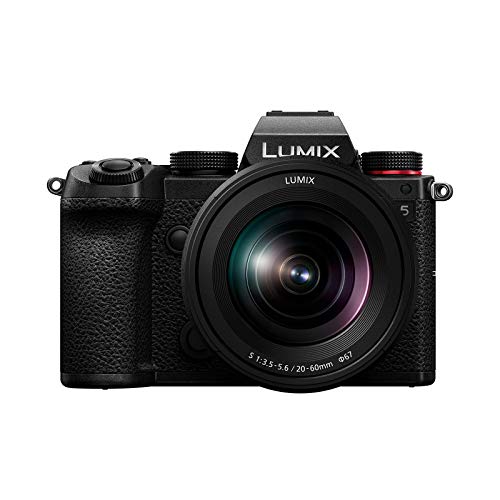
2. Panasonic LUMIX S5 with 20-60mm Kit Lens
The S5 is the video-first camera in this guide, and it shows in every feature that matters for product work. Its 24.2MP full-frame sensor delivers excellent dynamic range and clean shadows, which helps when a product sits against a bright background. The camera records 4K60 in 10-bit 4:2:0 internally, offers V-Log for grading, and has dual native ISO, which keeps footage clean across a wide range of lighting.
The 20-60mm kit lens is unusually wide at the short end, which is useful for overhead tabletop shots, and it focuses close enough for detail work. Dual image stabilization, combining in-body and lens stabilization, keeps handheld shots steady, and the fully articulating screen makes low-angle product work comfortable. For a creator who grades footage and wants full-frame depth of field, the S5 is the most capable camera here.
Specs: Sensor: 24.2MP full-frame CMOS; Mount: Leica L; Video: 4K60 10-bit, V-Log; Autofocus: Contrast-detect with DFD; Stabilization: Dual I.S. 2, 5-axis in-body; Screen: 3.0-inch free-angle touchscreen; Kit lens: LUMIX S 20-60mm f/3.5-5.6; Battery: DMW-BLK22.
3. Canon EOS M50 Mark II with 15-45mm Kit Lens

The M50 Mark II is the camera for creators who film products while talking to the camera. Its Dual Pixel autofocus tracks faces and eyes with confidence, the vari-angle screen flips forward for self-recording, and the body is small enough to mount on a compact tripod on a desk. The 15-45mm kit lens covers wide establishing shots through short telephoto, and it focuses close enough for detail inserts.
Video covers 4K30 with a crop and Full HD 60p without one, and the camera’s color science renders skin tones and product colors pleasantly straight out of camera, which reduces grading time. The EF-M mount has compact lenses that suit tabletop work, and the camera’s clean HDMI output allows external recording for longer sessions. For a solo creator filming unboxings, demos, and tutorials, the M50 Mark II is a friendly, capable tool.
Specs: Sensor: 24.1MP APS-C CMOS; Mount: Canon EF-M; Video: 4K30 cropped, Full HD 60p; Autofocus: Dual Pixel CMOS AF with Eye Detection; Screen: 3.0-inch vari-angle touchscreen; Kit lens: EF-M 15-45mm f/3.5-6.3 IS STM; Battery: LP-E12.
4. OM System OM-1 Kit with 12-40mm f/2.8 PRO II Lens

The OM-1 kit is the most rugged and most versatile camera in this guide, and the 12-40mm f/2.8 PRO II lens is a large part of that. The constant f/2.8 aperture stays bright across the zoom range, the lens focuses down to 20 cm for near-macro detail, and it is weather-sealed to match the body. The 24-80mm equivalent range covers wide tabletop shots through tight product close-ups without a lens change.
The OM-1 records 4K60 in 10-bit, offers HLG for high dynamic range delivery, and has industry-leading in-body stabilization that keeps handheld product shots steady. The Micro Four Thirds sensor gives deeper depth of field at a given aperture, which is an advantage when you want an entire product sharp rather than a thin slice of it. For creators who film products in varied locations, including outdoors, the OM-1’s sealing and stabilization are genuine working benefits.
Specs: Sensor: 20.4MP Micro Four Thirds Live MOS; Mount: Micro Four Thirds; Video: 4K60 10-bit, HLG; Autofocus: Cross Quad Pixel AF with subject detection; Stabilization: 5-axis in-body, up to 8 stops; Screen: 3.0-inch vari-angle touchscreen; Kit lens: M.Zuiko 12-40mm f/2.8 PRO II; Battery: BLX-1.
5. Nikon Z6 II Body
The Z6 II is the full-frame upgrade pick in this guide, and it earns its place with a combination of image quality, autofocus, and video features that suit serious product work. Its 24.5MP full-frame sensor delivers clean files and strong dynamic range, dual EXPEED 6 processors drive fast, reliable eye-detection autofocus, and the camera records 4K60 with 10-bit N-Log output. The full-frame sensor gives shallower depth of field than the APS-C bodies here, which helps a product stand out from its background.
A note on this pick: the original Z6 body is no longer listed new on Amazon.com, so this guide uses its direct successor, the Z6 II, which improves on the original with dual processors, dual card slots, and better autofocus. The Z6 II body pairs with the same Z-mount lenses as the Z50 in this guide, so a creator can build one lens collection that serves both bodies, from the 16-50mm kit zoom to macro lenses for extreme close-ups.
Specs: Sensor: 24.5MP full-frame CMOS; Mount: Nikon Z; Video: 4K60, 10-bit N-Log; Autofocus: Eye-detection AF for people and animals; Stabilization: 5-axis in-body; Screen: 3.2-inch tilting touchscreen; Battery: EN-EL15c; Card slots: Dual, CFexpress Type B and SD.
How to Light and Shoot Products for Video
Lighting matters more than the camera. Soft, diffused light from a large source flatters products and hides harsh reflections, while a second light from the side adds shape and texture. A simple setup with two soft lights and a clean background will make any camera in this guide look good, and no camera can rescue a product lit by a single harsh overhead bulb.
Focus technique matters too. Use autofocus to track the product as hands move it, but lock focus manually for static detail shots so the camera does not hunt. Shoot in a flat or log profile when you plan to grade, and shoot in the camera’s standard profile when you need finished footage quickly. Record at 4K even when you deliver in Full HD, because the extra resolution lets you reframe and punch in without losing quality.
Finally, keep the camera still. A tripod, a slider, or a small gimbal makes product footage look professional, while handheld shots need stabilization and a steady hand. The in-body stabilization in the S5, OM-1, and Z6 II helps, but a solid support is the single biggest upgrade to product video quality after lighting.
Frequently Asked Questions
What makes a camera good for product videography rather than product photography?
Video needs sustained autofocus, clean footage over minutes rather than one frame, accurate color across changing light, and a screen you can trust while a product moves. A stills camera can take a sharp product photo and still struggle with focus hunting, exposure shifts, or overheating in video. The cameras in this guide were chosen for video-specific strengths: reliable continuous autofocus, log profiles, close-focusing kit lenses, and articulating screens.
Do I need a macro lens for product video?
Not always, but it helps for small products. The kit lenses in this guide focus close enough for most products, from shoes to electronics, and the OM-1’s 12-40mm lens focuses to 20 cm for near-macro detail. A dedicated macro lens becomes worth it when you film jewelry, watches, or other small items where the finest detail is the selling point, and every mount in this guide has macro options.
Is 4K necessary for product video?
It is strongly recommended. Most platforms still deliver in Full HD, but shooting in 4K lets you reframe, punch in on details, and stabilize footage in post without losing quality. All five cameras here record 4K, and the S5, OM-1, and Z6 II add 10-bit recording, which gives you more room to grade color accurately, something that matters when a product’s color must match reality.
Can I use the same camera for product video and vlogging?
Yes, and the M50 Mark II and Z50 in this guide are especially good at it, because their screens flip forward and their autofocus tracks faces well. The S5 and Z6 II also vlog capably with a wide lens, though they are larger. If you film both products and yourself, prioritize a flip screen, good face autofocus, and a microphone input, which all five cameras here provide.
Conclusion
Product videography rewards cameras that focus close, render color honestly, and hold focus while objects move, and the five cameras here cover that job from a compact kit to a full-frame upgrade. The Z50 and M50 Mark II are friendly entry points, the S5 is the video-first choice, the OM-1 is the rugged all-rounder with a superb kit lens, and the Z6 II is the full-frame step up for creators who grade footage and want shallow depth of field. Pick the camera that matches your lighting, your space, and your editing workflow, and your products will look as good in motion as they do in a still frame.
More from Amazon
Programs that pair well with the guide above. Offers and eligibility are set by Amazon and may change.
Free shipping on eligible items, Prime Video and more. Eligible new members can start with a free trial.
Start a Prime free trialAudiobooks and podcasts to listen to on the go. Eligible new members can start with a free trial.
Try Audible freeAd-free music streaming. Eligible new subscribers can start with a free trial.
Try Music Unlimited freeA free business account with business pricing and bulk-buying tools for work, shop or home office.
Create a business accountAs an Amazon Associate we earn from qualifying purchases.









