Key takeaways
- Best compact travel balance: Manfrotto Befree Advanced, especially for mirrorless cameras and standard zooms.
- Best space-saving design: Peak Design Travel Tripod, whose legs fold around the center column to create a particularly slim package.
- Best for landscapes and heavier kits: a carbon-fiber tripod with a 25–32 mm leg-tube diameter, such as the Gitzo Mountaineer or a comparable professional model.
- Best value for occasional use: an aluminum travel tripod with a ball head and a stated capacity of at least 1.5 times your complete camera setup.
- Best for video: a tripod with a fluid video head, bowl or leveling base, and independent pan and tilt controls—not a stills-oriented ball head.
The best camera tripods match your camera’s weight, the height you actually need, and the way quickly you want to move—not simply the tripod with the largest load rating.
Quick picks by shooting situation
- Best compact travel balance: Manfrotto Befree Advanced, especially for mirrorless cameras and standard zooms.
- Best space-saving design: Peak Design Travel Tripod, whose legs fold around the center column to create a particularly slim package.
- Best for landscapes and heavier kits: a carbon-fiber tripod with a 25–32 mm leg-tube diameter, such as the Gitzo Mountaineer or a comparable professional model.
- Best value for occasional use: an aluminum travel tripod with a ball head and a stated capacity of at least 1.5 times your complete camera setup.
- Best for video: a tripod with a fluid video head, bowl or leveling base, and independent pan and tilt controls—not a stills-oriented ball head.
Best camera tripods compared
The figures below are representative manufacturer specifications for common configurations. Weight, maximum height, and folded length can change between aluminum and carbon versions, head options, and regional model revisions, so check the exact kit before buying.
Our top picks

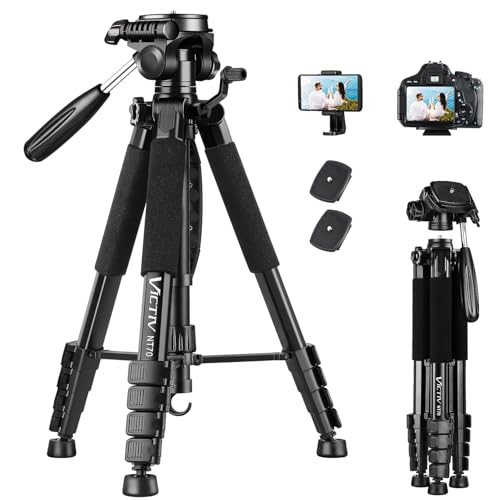


As an Amazon Associate we earn from qualifying purchases at no extra cost to you. Ratings are shown as listed on Amazon.
| Tripod | Material | Maximum height | Minimum height | Folded length | Weight | Load capacity | Head type |
|---|---|---|---|---|---|---|---|
| Manfrotto Befree Advanced | Aluminum | 150 cm | 40 cm | 40 cm | About 1.5 kg | Up to 8 kg | Ball head |
| Peak Design Travel Tripod | Aluminum or carbon fiber | About 152 cm | About 14 cm | 39 cm | About 1.56 kg aluminum; 1.27 kg carbon | 9.1 kg | Low-profile ball head |
| Gitzo Mountaineer Series 2 | Carbon fiber | About 160–170 cm, depending on model | About 16–20 cm | About 62–66 cm | About 1.5–1.7 kg without some head configurations | About 12–13 kg | Head sold separately or as a kit |
| Manfrotto 055 carbon or aluminum series | Carbon fiber or aluminum | About 170 cm without column fully extended | About 9 cm | About 61 cm | About 2.3–2.5 kg before head, depending on version | About 19 kg | Head sold separately |
How to choose the right load capacity
Tripod capacity is not the same as a recommended camera weight. A camera body listed at 1 kg may become a 2.5 kg system after adding a telephoto lens, battery grip, plate, microphone, and an external monitor. The tripod also needs to resist movement from wind, uneven ground, and the leverage of a long lens.
Add the weight of every item that will remain attached during the exposure. Then multiply that total by at least 1.5 for general photography. For example, a 1.8 kg camera-and-lens combination suggests a tripod rated for roughly 2.7 kg or more. For a 400 mm or 600 mm lens, wildlife work, or windy coastlines, choosing a substantially stronger tripod is sensible because long lenses stress the head even when their scale weight seems modest.
Do not compare capacity numbers in isolation. A light tripod may publish an impressive maximum load but still be less resistant to vibration than a heavier model with wider leg tubes, fewer extended sections, and a more rigid center column.
Height, folded size, and portability
Maximum height
A tripod that reaches eye level without a fully extended center column is usually more stable and more comfortable than a shorter tripod raised to its limit. Measure your own eye height, then subtract the camera body, the tripod head, and the distance from the camera base to the viewfinder. Many photographers find that a maximum height around 150–165 cm is sufficient.
For low-angle landscapes, macro photography, and product photography, minimum height matters more than maximum height. Look for legs that spread independently and a center column that can be reversed or removed. A 10–20 cm minimum height gives much more flexibility than a travel tripod that stops at 40 cm.
Folded size
Folded length determines whether the tripod fits inside a suitcase, attaches comfortably to a backpack, or becomes something you leave at home. Travel tripods usually fold to roughly 35–45 cm. Full-size landscape tripods often fold to 55–70 cm but provide wider leg tubes and better stability. A compact tripod that stays in your bag can produce more sharp photos than a stronger one that is too inconvenient to carry.
Ball heads versus three-way and fluid heads
A ball head is the fastest choice for still photography. One main lock releases movement in every direction, while a separate friction control can help prevent a heavy camera from dropping when you loosen the ball. Ball heads are well suited to travel, landscapes, portraits, and general-purpose mirrorless or DSLR kits.
A three-way head uses separate controls for horizontal rotation, front-to-back tilt, and side-to-side tilt. It takes longer to adjust but makes precise architectural, studio, and copy-work framing easier. It is also useful when keeping a horizon level is more important than rapid repositioning.
A fluid video head provides controlled pan and tilt, usually with a long handle and adjustable drag. It is the right choice for video movement, but it is slower and bulkier for stills. A video camera or cinema rig should also use a tripod with enough counterbalance and a plate that can slide to balance the rig over the tilt axis.
Check the plate system before purchase. Arca-Swiss-compatible plates are common and easy to move between compatible supports, while proprietary plates may be convenient within one brand but less flexible. A safety catch or secondary locking mechanism is valuable insurance against an incompletely tightened plate.
Decision matrix: which tripod suits your routine?
| Your situation | Prioritize | Suitable tripod type | Trade-off |
|---|---|---|---|
| Small bag, frequent travel, mirrorless camera | Folded length under 45 cm, weight under 1.6 kg, quick ball head | Travel tripod with four or five leg sections | Thinner lower sections are less stable in wind |
| Landscape photographer carrying gear several hours | Low weight, 150 cm or more, strong carbon legs | Carbon travel or Series 2 tripod | Higher purchase cost and smaller feet than studio models |
| Large DSLR or telephoto lens | Wide leg tubes, high capacity, rigid head, replaceable feet | Full-size tripod with a separate ball or gimbal head | Longer folded size and greater carrying weight |
| Architecture, interiors, or studio work | Precise height and independent controls | Three-way head on a full-size tripod | Slower setup and more space in the bag |
| Short video clips and panning | Fluid movement, counterbalance, leveling base | Video tripod with fluid head | Less convenient for rapidly changing still compositions |
Setup speed and stability in practice
Leg locks determine how quickly a tripod becomes usable. Flip locks are easy to inspect visually and often fast when wearing gloves. Twist locks can create a cleaner profile and are less likely to catch on branches, but every section must be tightened consistently. Five-section legs pack shorter but take more turns or locks to deploy than three- or four-section legs.
- Place one leg toward the subject or downhill side, then spread the other two legs for a balanced base.
- Extend the thickest leg sections first; leave the narrowest sections retracted whenever height allows.
- Press each foot firmly into the ground and check that all leg locks are fully closed or tightened.
- Keep the center column down for long exposures, wind, and heavy lenses. Raise it only when the extra height is necessary.
- Attach the camera, tighten the plate, and gently test the head before removing your hand.
- Use a remote release or a two-second timer to prevent pressing the shutter from moving the camera.
A tripod does not guarantee sharpness if image stabilization is left in the wrong mode. Many cameras detect a tripod automatically, but consult the camera manual for long exposures and lenses with optical stabilization. Focus manually or lock focus after confirming the subject, and avoid hanging a heavy bag from the center hook in strong wind because it can swing and transmit vibration.
Durability and ownership costs
The parts that usually wear first are leg-lock bushings, twist-lock threads, rubber feet, head knobs, and quick-release plates. Sand and salt accelerate wear. After beach or dusty use, extend the legs, wipe them with a clean damp cloth, and let them dry before collapsing them. Do not apply oil to leg locks unless the manufacturer specifies a compatible lubricant; oil can attract grit and reduce friction.
Aluminum tripods generally cost less and tolerate ordinary knocks well, although they transmit temperature and vibration more readily. Carbon fiber reduces weight and can feel less harsh in cold conditions, but a severe impact can damage a tube in a way that is not obvious at first. Inspect for cracks, crushed sections, loose rivets, and locks that no longer hold firmly.
Include replacement feet and a compatible plate in the ownership budget. A tripod used twice a month for five years gets about 120 outings. Paying an additional $150 for a model that you carry every time works out to about $1.25 per use, before considering repairs; the more important question is whether the lighter or faster design means you actually bring it with you.
Final buying checklist
- Choose a stated capacity at least 1.5 times your complete camera-and-lens setup.
- Compare minimum height as carefully as maximum height if you shoot landscapes or close-ups.
- Confirm folded length against your bag, suitcase, or carry-on space.
- Pick a ball head for fast stills, a three-way head for precise framing, or a fluid head for video movement.
- Prefer a tripod that reaches your working height without relying on a fully extended center column.
- Check plate compatibility, replacement-foot availability, leg-lock design, and warranty support.
For most photographers, the best camera tripods are not the tallest or strongest models available. A travel tripod is the better choice when portability controls whether it gets used, while a heavier full-size tripod earns its place when long lenses, wind, low-light exposures, or precise framing matter more than folded size.