Choosing an edison light bulb means balancing a specific aesthetic — the exposed filament, the amber or warm glow, the vintage silhouette — against the practical realities of modern lighting. Most buyers want that decorative look without the heat, energy draw, and short lifespan of the original incandescent designs. That tradeoff drives the entire market, and the differences between top options are meaningful.
What separates a good pick from a mediocre one comes down to a few concrete factors. Actual lumen output versus what the label claims. Whether the bulb dims smoothly on household switches or flickers and buzzes. How the filament pattern reads at a glance when the light is on. And whether the glass is truly clear or has an unintended yellowish tint that dulls the warm-white effect. Price per bulb matters too, especially when outfitting multiple fixtures.
Our top picks
 DAYBETTER 4 Pack Vintage LED Edison Bulbs
- 【Energy & Money Saving】DAYBETTER edison bulbs provide lighting…
- 【Smooth Dimming】 E26 led bulbs 60 watts are…
- 【Excellent Performance】Edison led light bulbs are made of…
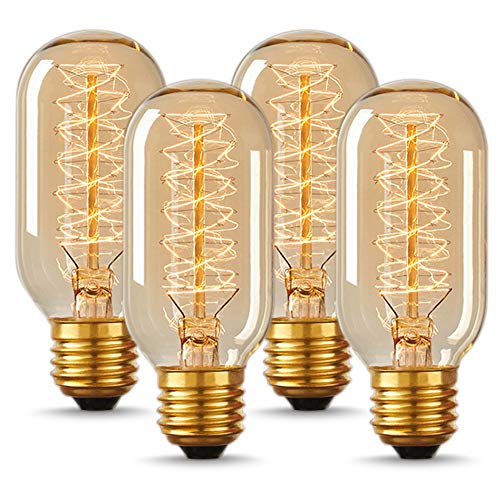 DORESshop Edison Bulbs
- Features: These Edison bulbs are available in 4…
- Vintage Inspired Appearance: Our incandescent (Non-LED) bulbs are…
- No Flickering: These edison light bulbs have a…
 TJOY LED Edison Light Bulbs
- 【Classic Vintage Design & Wide Application】Designed based on…
- 【Dimmable Compatibility & Flicker Free】ST58 dimmable led light…
- 【Long-Lasting Lifetime & Energy Saving Effiency】 With a…
| Product | Key specs | |
|---|---|---|
| DAYBETTER 4 Pack Vintage LED Edison Bulbs | 【Energy & Money Saving】DAYBETTER edison bulbs provide lighting… 【Smooth Dimming】 E26 led bulbs 60 watts are… 【Excellent Performance】Edison led light bulbs are made of… | Check price |
| DORESshop Edison Bulbs | Features: These Edison bulbs are available in 4… Vintage Inspired Appearance: Our incandescent (Non-LED) bulbs are… No Flickering: These edison light bulbs have a… | Check price |
| TJOY LED Edison Light Bulbs | 【Classic Vintage Design & Wide Application】Designed based on… 【Dimmable Compatibility & Flicker Free】ST58 dimmable led light… 【Long-Lasting Lifetime & Energy Saving Effiency】 With a… | Check price |
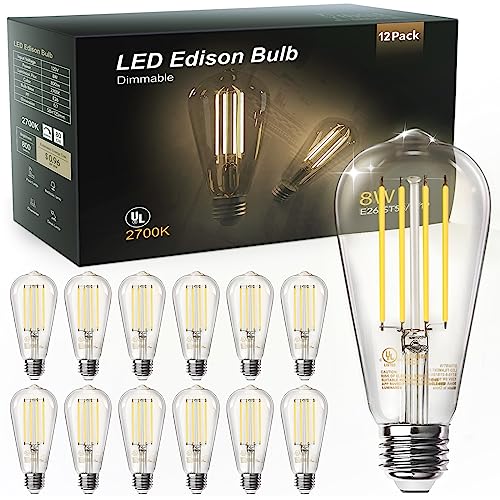 TJOY 12 Pack Edison LED Light Bulbs TJOY 12 Pack Edison LED Light Bulbs | 【Classic Edison Style 【60W Equivalent 【Smooth Dimmable | Check price |
 Ascher Vintage LED Edison Bulbs Ascher Vintage LED Edison Bulbs | Efficient LED Bulbs: Ascher pack of 4 units… Excellent Performance: The LED filament bulb turns on… Eye Comfort: No mercury, no UV & IR,… | Check price |
 PHILIPS LED 60 W A19 Vintage Edison PHILIPS LED 60 W A19 Vintage Edison | Designed to be Seen: Philips Vintage Filament LED… Complete the Look: Philips Vintage Filament LED bulbs… EyeComfort: Our LED lights are designed for the… | Check price |
 DiCUNO E26 Edison Bulbs 60W DiCUNO E26 Edison Bulbs 60W | 【2200K Amber Warm 】: DiCUNO Amber Edison Bulb… 【Energy Efficient & Money Saving】: This ST64 Edison… 【Vintage Look & Great Performance】: DiCUNO vintage LED… | Check price |
 TJOY A19 LED Edison Light Bulb TJOY A19 LED Edison Light Bulb | 【Classic Vintage Design & Wide Application】Designed based on… 【Dimmable Compatibility & Flicker Free】A19 dimmable led light… 【Long-Lasting Lifetime & Energy Saving Effiency】 With a… | Check price |
As an Amazon Associate we earn from qualifying purchases at no extra cost to you.
Quick Picks
| Product | Best for | Price |
|---|---|---|
| DAYBETTER 4 Pack ST58 | Highest output per dollar | $9.99 |
| DORESshop Incandescent | Authentic warm glow | $13.98 |
| TJOY Single Dimmable | Premium standalone replacement | $19.99 |
| TJOY 12 Pack | Bulk whole-home coverage | $22.48 |
| Ascher 4 Pack | Color-critical settings | $9.99 |
| PHILIPS Spiral A19 | Trusted brand, single fixture | $6.98 |
| DiCUNO Amber Glass 2-Pack | Deep vintage amber tone | $11.99 |
| TJOY A19 12 Pack | Classic shape in bulk | $24.69 |
How We Picked
We evaluated published specifications, per-bulb pricing, and owner-reported experiences across four criteria. First, dimmer compatibility: bulbs that flicker or buzz on trailing-edge dimmers lose points regardless of how they look. Second, verified lumen and color temperature output versus advertised specs, since some LED bulbs run dimmer than claimed. Third, build and glass quality — thin glass or inconsistent tint undermines the whole decorative purpose. Fourth, cost per bulb when calculated from the pack price, because a $22.48 twelve-pack is a different value proposition than a $6.98 single unit.
The 8 Best Edison Light Bulb in 2026
DAYBETTER 4 Pack Vintage LED Edison Bulbs (ST58)
Owners who want maximum brightness in a vintage form factor will appreciate that this bulb pushes 800 lumens at a 2700K warm-white color temperature, which is noticeably brighter than most competitors in the same price range. The ST58 teardrop shape suits open pendants and exposed fixtures well.
- Pro: 800 lumens is among the highest outputs in this comparison, making it viable as a primary light source rather than purely decorative.
- Pro: Four bulbs for under ten dollars is a competitive entry cost for anyone outfitting several fixtures.
- Con: The filament pattern is less complex than some rivals, so the vintage effect reads slightly thinner up close.
Skip this if you need the most dramatic filament visibility in a short fixture where the bulb is viewed at arm’s length.
DORESshop Edison Bulbs (Incandescent, 40W)
This is the only true incandescent on the list, and for some buyers that is the entire point. Incandescent edison light bulbs produce a spectral quality and gradual warm-up that no LED fully replicates. At 40 watts, it throws a soft, inviting glow ideal for ambient lighting where energy efficiency is a secondary concern.
- Pro: The color rendering and warm-up curve of real tungsten filament remain unmatched for atmosphere in bars, patios, and restaurant settings.
- Pro: Works on virtually any dimmer without compatibility concerns.
- Con: Significantly shorter lifespan and higher energy cost over time compared to every LED option here.
Skip this if you are lighting fixtures that stay on for long hours or in enclosed spaces where heat buildup is a concern.
TJOY LED Edison Light Bulb (Single, E26 Dimmable)
As a single-bulb purchase at $19.99, this is a premium replacement rather than a value play. The eight-watt draw equivalent to sixty watts means it dims smoothly across a wide range, and the build quality is described by owners as noticeably more substantial than budget packs. A good choice when replacing a failed bulb in a statement fixture where one unit matters more than four.
- Pro: Owners report a dense, layered filament that fills the bulb visually, giving a convincing vintage character even at full brightness.
- Pro: E26 base with strong dimmer compatibility across common household switch types.
- Con: At nearly twenty dollars for one bulb, it is the most expensive unit here, making it impractical for multi-fixture installations.
Skip this if you need more than one or two bulbs; the TJOY multi-packs below offer better per-unit value.
TJOY 12 Pack Edison LED Light Bulbs (E26, 8W, 2700K)
Twelve dimmable bulbs for $22.48 brings the per-unit cost to under two dollars, which is hard to beat in this category. The 2700K warm-white output is consistent across the pack, and the eight-watt equivalent-to-sixty-watt rating matches the single TJOY above. This is the practical choice for someone replacing every bulb in a kitchen or dining room set.
- Pro: Lowest per-bulb cost in this roundup, making it feasible to light an entire home in the edison style.
- Pro: Consistent 2700K output across all twelve units avoids the mismatched color that cheap mixed packs sometimes show.
- Con: The glass envelope is slightly thinner than the single TJOY, and a small number of owners note occasional dead-on-arrival units in a twelve-pack.
Skip this if you need color accuracy above all else or if your fixture is a short one where the teardrop shape does not suit the housing.
Ascher Vintage LED Edison Bulbs (4 Pack, Non-Dimmable)
The standout spec here is the 80-plus CRI rating, which means this edison light bulb renders colors more faithfully than virtually anything else on this list. At six watts and 2700K, it is efficient and warm, but it is non-dimmable, which limits placement. Best for gallery walls, kitchen task zones, or any setting where accurate color under the light matters.
- Pro: 80+ CRI ensures food, artwork, and interior paint tones look their best under the light.
- Pro: Four bulbs at $9.99 offers genuine value for a high-CRI option.
- Con: Cannot be used on a dimmer, eliminating it from fixture positions where variable brightness is expected.
Skip this if any of your fixtures are on a dimmer circuit; the non-dimmable limitation is absolute.
PHILIPS LED 60W A19 Vintage Edison Spiral Amber (1-Pack)
PHILIPS carries brand trust that lesser-packaged competitors cannot match, and the spiral filament design gives this bulb a distinctive visual character. At $6.98 for a single unit, it is priced for a one-off replacement or a small decorative accent. The amber glass tint leans warmer than the clear-glass options, producing a more candle-like glow.
- Pro: Widely recognized brand with accessible warranty support and reliable quality control.
- Pro: Spiral filament pattern is visually engaging and reads well in open fixtures.
- Con: Single-pack pricing means per-bulb cost is higher than multi-pack LED alternatives.
Skip this if you need multiple identical bulbs; the PHILIPS multi-packs, where available, would offer better value than buying singles.
DiCUNO E26 Edison Bulbs (Amber Glass, 2200K, 2-Pack)
At 2200K, this is the warmest bulb in the group, sitting closer to candlelight than the 2700K options. The amber glass envelope reinforces that deep vintage tone, making it the right pick for someone chasing an Old West saloon or speakeasy atmosphere rather than a clean warm white. Six hundred lumens is adequate for accent and ambient use.
- Pro: The 2200K output paired with amber glass delivers the most authentic incandescent-era warmth among the LED options.
- Pro: Compact two-pack keeps commitment low for buyers wanting to test the look before scaling up.
- Con: At 600 lumens, it is the dimmest bulb here and will not serve well as a primary light source.
Skip this if you want a neutral or bright warm white; the deep amber tone is a specific aesthetic choice.
TJOY A19 LED Edison Light Bulb (12 Pack, E26 Dimmable)
The A19 classic shape fits standard enclosed fixtures where the teardrop ST58 form does not, making this the most versatile option on the list. Twelve dimmable bulbs at $24.69 gives a per-unit cost near two dollars, matching the TJOY ST58 pack above. Owners praise the smooth low-end dimming on standard switches.
- Pro: Standard A19 shape works in enclosed or semi-enclosed fixtures that cannot accommodate longer decorative bulbs.
- Pro: Strong dimmer performance with minimal flicker reported by owners across multiple switch brands.
- Con: The A19 silhouette is less visually distinctive than teardrop or spiral shapes, so the vintage effect is subtler.
Skip this if your fixtures are fully exposed and you want the bulb itself to be the visual focal point; the ST58 packs deliver more decorative impact.
Buying Guide
Color Temperature and Glass Tint
Color temperature determines the mood. The 2700K standard reads as a clean warm white that still shows true colors reasonably well. Anything below 2500K, like the DiCUNO at 2200K, pushes toward candlelight and casts a distinctly amber wash over everything. Separately, the glass envelope can be clear, amber-tinted, or frosted. Amber glass adds warmth on top of the color temperature, compounding the effect. Decide whether you want the bulb to illuminate a space neutrally or to saturate it in vintage tone, because those are different lighting goals.
Dimmer Compatibility
Not every LED edison light bulb works reliably on a household dimmer. Low-quality drivers cause flickering, buzzing, or a dead zone at the bottom of the dimmer range. Check whether the bulb is rated dimmable and whether the manufacturer lists compatible switch types. Non-dimmable bulbs like the Ascher will malfunction or fail early on a dimmer circuit. If your fixture is wired to a three-way or smart switch, verify compatibility before buying a multi-pack, because return shipping on LED bulbs erodes the value fast.
Bulb Shape and Fixture Fit
ST58 teardrop bulbs are longer and narrower, designed for open pendants and sconces where the bulb is visible. A19 bulbs match the standard household shape and fit enclosed or semi-enclosed fixtures, table lamps, and recessed housings. Measure the available space before committing to a teardrop style, especially in shorter fixtures where a longer bulb will protrude awkwardly. The shape also affects how prominent the filament looks; a longer envelope gives the filament more room to read as a design element.
Our Verdict
For most buyers who want a reliable, dimmable LED that looks the part and costs under three dollars per bulb, the TJOY 12 Pack is the top pick. The DAYBETTER 4 Pack is the best budget entry for someone who needs only a few bulbs and wants the highest lumen output in a decorative shape. If your space demands accurate color rendering for food, art, or retail displays, the Ascher 4 Pack wins despite its non-dimmable limitation, because 80-plus CRI at that price point is uncommon.
FAQ
Do LED Edison bulbs look as warm as real incandescent?
They are close but not identical. LED options at 2200K with amber glass, like the DiCUNO, come nearest to the tungsten character. The DORESshop incandescent remains the benchmark if you want the unambiguous look and gradual warm-up that only real filament produces.
Can I use these in enclosed light fixtures?
Only the A19-shaped bulbs from the TJOY packs and PHILIPS should go in enclosed housings. The ST58 teardrop bulbs are designed for open fixtures and may trap heat in a fully enclosed space, which shortens LED lifespan.
What CRI means and why it matters here
CRI measures how accurately a light source renders colors compared to natural light. Most decorative edison light bulbs sit in the 70-80 range. The Ascher exceeds 80, making it suitable for task lighting where you need paint, fabric, or food to look their true color.
Are these bulbs worth replacing incandescent in existing fixtures?
For fixtures that stay on more than an hour or two daily, the energy savings and longer lifespan of LED easily offset the slightly higher upfront cost. For rarely used decorative accents, the difference is negligible, and the incandescent character of the DORESshop may justify its inefficiency.